The 2023 BMW i4 M50 at a Glance
The 2023 BMW i4 M50 was BMW's first all-electric M Performance model — a dual-motor, all-wheel-drive sport sedan that slots between the comfort-oriented i4 eDrive40 and the flagship i7. Built on BMW's CLAR platform (shared with the 4 Series Gran Coupe), the i4 M50 trades a dedicated EV skateboard for near-50/50 weight distribution and a driving character that feels unmistakably BMW. For 2026 buyers shopping the used market, it remains one of the most dynamically satisfying electric sedans available, though its 81.5 kWh battery and 227-mile EPA range demand realistic expectations for road trips.
| Spec | Value |
|---|---|
| EPA Range | 227 miles (with 19" wheels); 245 mi (20" aero) / 270 mi (eDrive40 RWD) |
| Battery (usable / gross) | 81.5 kWh usable / 83.9 kWh gross — NMC (nickel-manganese-cobalt) |
| Drivetrain | Dual-motor AWD (xDrive) |
| Horsepower | 536 hp (400 kW) with Launch Control; 469 hp (350 kW) standard |
| Torque | 586 lb-ft |
| 0–60 mph | 3.7 seconds (BMW est., with Launch Control) |
| Top Speed | 130 mph (electronically limited) |
| Max DC Fast Charge | 200 kW (CCS1) |
| 10–80% DC Charge Time | ~31 minutes (peak conditions) |
| Level 2 AC Charge Rate | 11 kW (48A) — ~25 miles of range per hour |
| EPA Efficiency | 87 MPGe combined (39 kWh/100 mi) |
| Cargo Volume | 16.6 cu ft (rear seats up); 45.6 cu ft (rear seats folded) |
| Rear Legroom | 34.4 inches |
| Curb Weight | ~5,018 lbs |
| Base MSRP (2023) | $67,795 (incl. destination) |
| Battery Warranty | 8 years / 100,000 miles (70% capacity retention) |
| Vehicle Warranty | 4 years / 50,000 miles bumper-to-bumper |
Real-World Range: What to Actually Expect
Real-World Highway (65–75 mph, mild weather): ~190–210 miles
Real-World City / Mixed Commute: ~215–235 miles (regen-friendly stop-and-go helps)
Cold Weather (below 32°F, highway): ~155–180 miles (30–35% loss typical for NMC without heat-pump option on early builds)
The i4 M50's 227-mile EPA figure — measured with the standard 19-inch M Sport wheel and tire package — is the lowest in the i4 lineup. The eDrive40 with its single rear motor and lighter weight achieves 301 miles on the same battery. The gap comes down to physics: the M50's front motor adds ~130 lbs, its stickier performance tires increase rolling resistance, and its sport-tuned suspension and aerodynamic profile prioritize grip and handling over slipstream efficiency.
In practice, owners report the i4 M50 delivers roughly 2.4–2.6 mi/kWh on highway trips at legal speeds, which translates to 195–212 miles from a full 81.5 kWh usable pack. City driving with aggressive regenerative braking (BMW's adaptive regen or max-regen B mode) can push that closer to 2.8 mi/kWh. The car's efficiency of 39 kWh/100 miles, per fueleconomy.gov, is competitive with the Audi e-tron GT but trails the Tesla Model 3 Performance (28 kWh/100 mi) and Porsche Taycan 4S (35 kWh/100 mi with the larger battery).
Cold weather is the M50's kryptonite on longer runs. BMW did not standardize a heat pump on the 2023 i4 — it was optional as part of a cold-weather package. Without it, cabin heating relies on resistive elements that draw heavily from the traction battery, compounding the chemistry-level capacity loss that NMC cells experience below freezing. Plan conservatively: in sub-30°F highway driving, budget for 160–175 miles of usable range before needing a charger.
Charging Speed: DC Fast Charging and Home Level 2
The i4 M50 uses a CCS1 (Combined Charging System) connector and supports up to 200 kW peak DC fast charging. BMW quotes a 10–80% charge time of approximately 31 minutes under ideal conditions. However, peak rate is not sustained rate — the charge curve tells the real story.
| Charging Level | Power / Rate | Range Added | Notes |
|---|---|---|---|
| Level 1 (120V household) | ~1.4 kW | ~3–4 mi/hr | Emergency/trickle only; full charge in ~55+ hours |
| Level 2 (240V, 48A) | 11 kW | ~25 mi/hr | Full 0–100% in ~8.25 hours; ideal for overnight |
| DC Fast (peak) | 200 kW | ~164 mi in 10 min (BMW claim, 10–80%) | Peak only at low SoC; tapers significantly above 60% |
| DC Fast (sustained avg 10–80%) | ~120–140 kW avg | ~177 mi added (10–80%) | 31 min total; taper starts ~55–60% SoC |
The 200 kW peak is available only when the battery is preconditioned (via navigation-routed preconditioning to a DC charger) and the state of charge is below roughly 30%. The curve holds above 150 kW until about 50% SoC, then progressively steps down: roughly 120 kW at 60%, 80 kW at 70%, and 50 kW by 80%. This taper is typical for NMC chemistry and explains why BMW's 31-minute 10–80% time is honest but not class-leading.
For comparison, the Hyundai Ioniq 5 and Kia EV6 on their 800V architecture sustain higher rates deeper into the charge, achieving 10–80% in roughly 18 minutes. The Tesla Model 3 Performance on V3 Superchargers (250 kW peak) hits 10–80% in about 25–27 minutes. The i4 M50 is adequate for road trips with 30-minute stops every ~180 miles, but it won't win charging drag races.
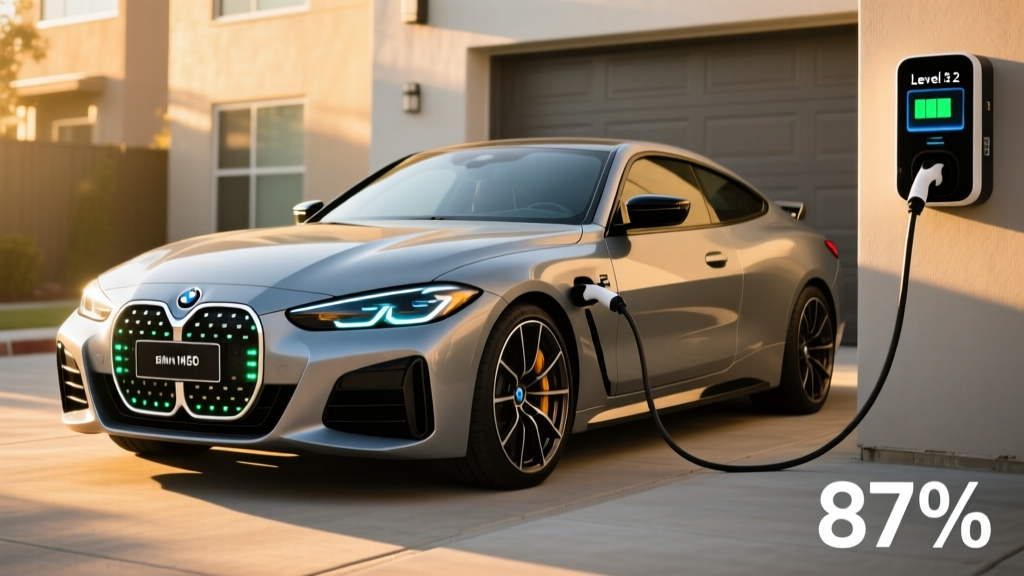
Home charging at 11 kW (the car's max AC acceptance rate) on a 48-amp Level 2 station adds about 25 miles of range per hour, meaning a full overnight charge from near-empty takes roughly 8 hours. BMW's own Wallbox or a third-party unit like the ChargePoint Home Flex or Emporia Vue will work well. Expect installation costs of $800–$2,000 depending on panel capacity and conduit runs — consult a licensed electrician for a site-specific quote.
Performance and Driving Dynamics
This is where the M50 justifies its M badge. The dual-motor xDrive system produces 536 hp and 586 lb-ft of torque when Launch Control is engaged (469 hp in standard driving). BMW's official 0–60 mph time of 3.7 seconds is conservative — independent tests by Car and Driver have clocked the M50 at 3.3–3.4 seconds. That puts it in Porsche Taycan 4S territory and well ahead of the Tesla Model 3 Long Range AWD (4.2 seconds), though the Model 3 Performance (3.1 seconds) still has a slight edge off the line.
What sets the M50 apart from its EV sport-sedan rivals is chassis tuning. The adaptive M suspension, variable sport steering, and near-50/50 weight distribution (helped by the CLAR platform's front-rear battery placement) deliver a ride-and-handling balance that feels more analog and communicative than most EVs. The steering has genuine feedback — rare in the electric era — and the car rotates eagerly through corners despite its 5,018-pound curb weight.
The tradeoff is ride firmness. Even in Comfort mode, the M50 is noticeably stiffer than the i4 eDrive40, and the 19- or 20-inch run-flat tires transmit more road imperfections than some buyers will appreciate on daily commutes. If your priority is a plush luxury cruiser, the eDrive40 or a Mercedes EQE is a better fit. If you want a sport sedan that happens to be electric, the M50 is arguably the best-driving EV in its price range.
Interior, Tech, and Practicality
The i4 M50's cabin is lifted from the G26 4 Series Gran Coupe, which means BMW's Curved Display running iDrive 8: a 12.3-inch digital instrument cluster and a 14.9-inch touchscreen fused behind a single glass panel. The system is responsive, supports wireless Apple CarPlay and Android Auto, and includes a capable voice assistant. The M-specific sport seats, aluminum rhombicle trim, and optional Harman Kardon surround sound give the interior a premium feel that rivals Audi's e-tron GT and surpasses Tesla's Model 3 in material quality.
Practicality is a mixed story. The Gran Coupe hatchback design gives the i4 a genuinely useful 16.6 cu ft of cargo space behind the rear seats (45.6 cu ft with seats folded), which beats the Tesla Model 3's trunk (23 cu ft total including the frunk) for loading bulky items. However, rear legroom at 34.4 inches is tight for taller passengers — the Model 3 offers 35.2 inches, and the Hyundai Ioniq 6 provides 38.4 inches. There is no front trunk (frunk); the space under the hood houses drive electronics and the HVAC system.
Driver-assistance tech includes BMW's Driving Assistant Professional package (optional on the M50): adaptive cruise control with stop-and-go, lane-keeping assist, automatic lane-change on highway, and Parking Assistant Plus with a 360-degree camera. This is an SAE Level 2 system — the driver must keep hands on the wheel (or demonstrate attention via the cabin camera) and remain fully engaged. It is not autonomous driving, and BMW does not market it as such. The system is competent but not class-leading; Tesla's Autopilot and GM's Super Cruise offer more polished highway experiences, though Super Cruise remains limited to mapped roads.
Pricing, Tax Credits, and Ownership Costs
The 2023 BMW i4 M50 launched with a base MSRP of $67,795 (including destination). Well-optioned examples with the Premium Package, Driving Assistant Professional, larger wheels, and metallic paint easily reached $75,000–$80,000 as-tested.
For 2026 buyers shopping the used market, the federal used-EV tax credit (§25E) is the relevant incentive — not the new-vehicle §30D credit. Key rules for §25E:
- Credit amount: 30% of the sale price, up to $4,000 maximum
- Vehicle must be at least 2 model years old (2023 qualifies in 2026)
- Sale price must be $25,000 or less to qualify
- Buyer income caps: $75,000 single / $112,500 head of household / $150,000 married filing jointly (modified AGI)
- Must purchase from a licensed dealer
- Credit is non-refundable (can reduce tax liability to zero but won't generate a refund)
Given that used 2023 i4 M50 listings in early 2026 typically range from $38,000 to $52,000 depending on mileage and condition, the $25,000 sale-price cap effectively disqualifies the i4 M50 from the used-EV credit in most cases. Unless you find an exceptionally high-mileage or damaged example priced at or below $25,000, plan to pay full price without federal incentive assistance. Always verify current rules at irs.gov before purchase.
On the ownership-cost side, the i4 M50 benefits from lower fueling costs (electricity at $0.13–$0.18/kWh nationally translates to roughly $5.00–$7.00 per 100 miles vs. $12–$15 for a comparable gas-powered M340i xDrive) and minimal drivetrain maintenance. However, BMW insurance premiums tend to run 15–25% higher than average for the segment, and tire replacement costs for the M-specific 19- or 20-inch rubber can reach $1,200–$1,800 per set.
Pros, Cons, and Who Should Buy
Pros
- Class-leading driving dynamics — genuine sport-sedan feel rare in EVs
- 536 hp and 3.3–3.7 sec 0–60 with Launch Control
- Premium interior with iDrive 8 Curved Display and hatchback versatility
- 11 kW AC charging is faster than many rivals (Tesla Model 3 is 11.5 kW, but many EVs cap at 7.2–9.6 kW)
- 8-year/100,000-mile battery warranty with 70% capacity retention guarantee
- CCS1 compatibility with the growing Electrify America and third-party DC networks
Cons
- 227-mile EPA range is the weakest in the i4 lineup and trails key rivals
- 200 kW peak DC charging is slower than 800V competitors (Ioniq 5, EV6, Taycan)
- No front trunk (frunk) — lost cargo opportunity
- Rear legroom (34.4") is tight for a luxury sedan in this price class
- Heat pump was optional, not standard — cold-weather range suffers without it
- Does not qualify for used-EV tax credit at typical market prices
- Firm ride may not suit daily commuters on rough roads
Best for: Driving enthusiasts who prioritize handling, acceleration, and BMW's sport-sedan heritage over maximum range. Ideal as a daily-driver commuter and weekend canyon carver for households with home Level 2 charging and a second vehicle (or tolerance for 30-minute DC stops) for longer road trips.
Not ideal for: High-mileage commuters exceeding 200 miles daily, families needing spacious rear seats, or buyers in cold climates without garage parking and the optional heat pump.
How It Stacks Up Against Competitors
| Spec | BMW i4 M50 | Tesla Model 3 Perf. | Porsche Taycan 4S (93.4 kWh) | Hyundai Ioniq 5 N |
|---|---|---|---|---|
| EPA Range | 227 mi | 315 mi | 227 mi | 221 mi |
| 0–60 mph | 3.3–3.7 sec | 3.1 sec | 3.8 sec | 3.25 sec |
| Horsepower | 536 hp | 510 hp | 562 hp (launch) | 640 hp (N Grin Boost) |
| Max DC Charge | 200 kW | 250 kW | 270 kW | 240 kW (800V) |
| 10–80% Time | ~31 min | ~27 min | ~22 min | ~18 min |
| Base MSRP (2023) | $67,795 | $53,990 | $106,100 | $66,100 |
| Cargo (rear up) | 16.6 cu ft | 23 cu ft (trunk+frunk) | 14.3 cu ft | 27.2 cu ft |
The i4 M50 occupies a specific niche: it's more refined and better-built than the Model 3 Performance, more affordable than the Taycan 4S, and more luxurious than the Ioniq 5 N (which trades comfort for track antics). If driving feel and interior quality matter more to you than range and charging speed, the M50 makes a compelling case. If you need 300+ miles of range and the fastest charging available, the Model 3 Performance or a refreshed Ioniq 5/6 is the pragmatic pick.
Frequently Asked Questions
What is the real-world range of the 2023 BMW i4 M50?
Expect 190–210 miles on highway trips in mild weather, 215–235 miles in mixed city driving with regenerative braking, and 155–180 miles in cold-weather highway driving below freezing. The 227-mile EPA figure is achievable in optimal conditions but should not be your planning number for road trips.
How fast does the i4 M50 charge at home and on DC fast chargers?
On a Level 2 home charger (240V, 48A), the i4 M50 accepts up to 11 kW, adding roughly 25 miles of range per hour for a full overnight charge in about 8 hours. On DC fast chargers, it peaks at 200 kW but averages ~120–140 kW during a 10–80% session that takes approximately 31 minutes. Preconditioning via navigation routing is essential for achieving peak rates.
Does the 2023 BMW i4 M50 qualify for any federal EV tax credit in 2026?
As a used vehicle in 2026, the i4 M50 could theoretically qualify for the §25E used-EV credit (up to $4,000), but the vehicle's sale price must be $25,000 or less. Since most used 2023 i4 M50 listings range from $38,000–$52,000, it effectively does not qualify. The new-vehicle §30D credit is no longer available for 2023 model-year purchases. Verify all rules at irs.gov.
Is the BMW i4 M50 worth buying over a Tesla Model 3 Performance?
It depends on priorities. The i4 M50 offers superior interior quality, more engaging steering and chassis dynamics, and a hatchback design. The Model 3 Performance delivers longer range (315 vs. 227 miles), faster Supercharger charging, a lower purchase price, and access to the Tesla Supercharger network (though CCS adapters and NACS adoption are broadening access for BMW owners). Choose the M50 for driving feel and luxury; choose the Model 3 for efficiency and charging infrastructure.
What is the battery warranty on the i4 M50?
BMW covers the high-voltage battery for 8 years or 100,000 miles, whichever comes first, guaranteeing at least 70% of original capacity retention. If the battery degrades below that threshold within the warranty period, BMW will repair or replace it at no cost. For a 2023 model, this coverage extends through the 2031 model year or 100,000 miles.
Does the i4 M50 have a heat pump for cold weather?
A heat pump was available as an option on the 2023 i4 M50 (part of the Cold Weather Package or standalone), but it was not standard. Check the specific vehicle's build sheet or window sticker before purchasing a used example — a heat pump-equipped M50 will retain noticeably more range in sub-freezing conditions.