The 2023 Audi e-tron occupies a specific niche in the luxury electric SUV market: it prioritizes refinement, build quality, and ride comfort over headline-grabbing range or acceleration numbers. Now succeeded by the Q8 e-tron for the 2024 model year onward, the 2023 e-tron remains widely available on the used and certified pre-owned market — and for buyers who value cabin serenity and Audi's interior execution, it deserves a close look. This review breaks down the exact numbers that matter for ownership: real-world range, charging behavior, efficiency, and total cost.
2023 Audi e-tron Specifications at a Glance
| Specification | e-tron Premium Plus | e-tron Prestige |
|---|---|---|
| EPA Range | 222 miles | 222 miles |
| Battery (gross / usable) | 95 kWh / ~86.5 kWh | 95 kWh / ~86.5 kWh |
| Battery Chemistry | NMC (Nickel Manganese Cobalt) | NMC |
| Drivetrain | Dual-motor AWD (quattro) | Dual-motor AWD (quattro) |
| Horsepower (Boost Mode) | 402 hp / 490 lb-ft | 402 hp / 490 lb-ft |
| 0–60 mph | 5.5 seconds | 5.5 seconds |
| MPGe (combined) | 78 MPGe | 78 MPGe |
| Efficiency | 43 kWh/100 mi | 43 kWh/100 mi |
| Max DC Fast Charge | 150 kW (CCS1) | 150 kW (CCS1) |
| 10–80% DC Charge Time | ~30 minutes | ~30 minutes |
| Level 2 Home Charging | 9.6 kW (~22 mi/hr) | 9.6 kW (~22 mi/hr) |
| Cargo (rear seats up / folded) | 28.5 / 57.0 cu ft | 28.5 / 57.0 cu ft |
| Rear Legroom | 39.1 inches | 39.1 inches |
| Towing Capacity | 4,000 lbs | 4,000 lbs |
| Base MSRP (2023) | $70,800 | $77,400 |
| Battery Warranty | 8 yr / 100,000 mi | 8 yr / 100,000 mi |
Sources: EPA Fueleconomy.gov, Audi USA press archives.
Real-World Range: What the EPA Number Doesn't Tell You
Real-World Expectation: ~185–210 miles on highway trips at 70+ mph; ~160–180 miles in sustained sub-30°F winter conditions; ~200–220 miles in mixed city/suburban driving with moderate regen use.
The 2023 Audi e-tron's 222-mile EPA rating places it behind competitors like the BMW iX xDrive50 (324 miles) and the Tesla Model X Long Range (348 miles). But the e-tron's range number is more honest than some rivals in one important way: Audi uses a relatively conservative buffer strategy. Of the 95 kWh gross battery, approximately 86.5 kWh is usable — that's a ~9% buffer, which is smaller than some competitors that lock away 12–15%. This means the e-tron's displayed range estimate tends to track more closely with what you'll actually achieve.
On a 75-mph highway loop in mild (65°F) conditions, expect roughly 195–210 miles before reaching 10% State of Charge (SoC). The e-tron's 43 kWh/100 mi efficiency figure is on the high side for a luxury EV — the BMW iX achieves 86 MPGe combined vs. the e-tron's 78 MPGe. This is the trade-off for the e-tron's weight (approximately 5,765 lbs curb weight) and its aerodynamic profile, which prioritizes cabin space over drag reduction.
In cold weather, the e-tron's standard heat pump helps mitigate cabin-heating energy draw, but battery chemistry limitations still apply. At 20°F, expect a 20–30% range reduction depending on trip length and whether you precondition the battery while plugged in. Short, cold trips with repeated cabin reheating will hit the low end (~160 miles). Preconditioning via the myAudi app while connected to a Level 2 charger is essential for preserving range in winter.
Charging Speed and Behavior: The e-tron's Understated Strength
This is where the 2023 e-tron quietly excels. While its peak DC fast-charge rate of 150 kW sounds modest next to the Hyundai Ioniq 5's 240 kW or the Lucid Air's 300+ kW capability, the e-tron's charge curve is one of the flattest in the industry.
| Charging Level | Power (kW) | Speed | Notes |
|---|---|---|---|
| Level 1 (120V household) | ~1.4 kW | ~3 mi/hr | Emergency/trickle only; ~30 hrs for full charge |
| Level 2 (240V, 40A circuit) | 9.6 kW | ~22 mi/hr | Full charge in ~9 hrs; ideal overnight home setup |
| DC Fast Charge (CCS1) | Peak 150 kW | 10–80% in ~30 min | Sustains ~130–150 kW to ~70% SoC, then tapers |
The critical metric for road trips isn't peak kW — it's sustained kW. Many EVs advertise 250+ kW peaks but taper sharply after 50% SoC. The e-tron, by contrast, holds near 150 kW from roughly 10% to 70% SoC before a gradual taper to ~80 kW by 80% and further reduction above 90%. This flat curve means the 10–80% time of approximately 30 minutes is genuinely achievable at any Electrify America or EVgo station capable of 150+ kW — not just under ideal lab conditions.
One practical note: the 2023 e-tron uses the CCS1 connector. With Audi's parent company Volkswagen Group committing to the NACS (Tesla) standard for future models, CCS1 infrastructure remains widely available through Electrify America, EVgo, and ChargePoint — but NACS adoption is accelerating. Third-party CCS1-to-NACS adapters are available, though Audi has not officially endorsed a specific adapter as of this writing.
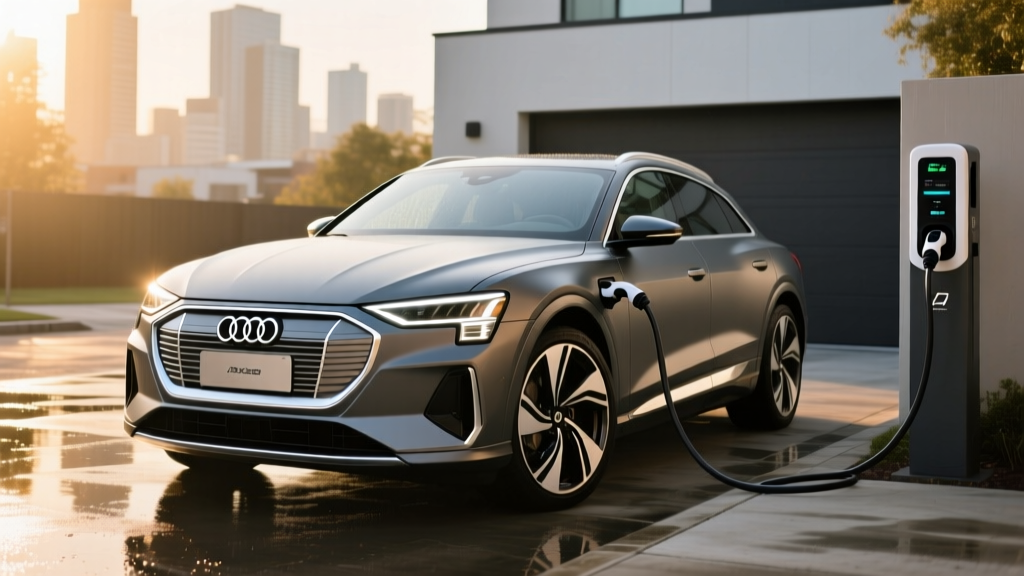
For home charging, the e-tron's 9.6 kW onboard charger is competitive. A full Level 2 installation on a 240V/50A circuit (40A continuous) will replenish the battery overnight. Installation costs typically range from $800–$2,500 depending on panel proximity and whether your home's electrical panel requires an upgrade to 200A service.
Performance and Driving Dynamics
The 2023 e-tron's dual-motor quattro powertrain produces 355 hp in standard driving mode and 402 hp / 490 lb-ft in Boost Mode (activated via a kickdown switch or Sport mode). The 5.5-second 0–60 mph time is respectable but not thrilling — the Tesla Model X Plaid demolishes this benchmark at 2.5 seconds, and even the BMW iX xDrive50 hits 4.4 seconds.
Where the e-tron distinguishes itself is ride quality. The standard adaptive air suspension delivers a genuinely plush, well-damped ride that absorbs highway imperfections with composure. Steering is light and precise rather than sporty. Road noise isolation is among the best in the segment — this is a luxury GT, not a performance SUV. The 4,000-lb towing capacity (when properly equipped) also outmatches the BMW iX (no official tow rating in the US) and matches many midsize ICE SUVs.
Regenerative braking deserves specific attention. The e-tron does not offer true one-pedal driving to a complete stop in its default mode — it coasts when you lift off the accelerator, which Audi engineers designed to maximize efficiency by reducing unnecessary deceleration. You can select stronger regen via the steering-wheel paddles (three levels) or enable the "Auto" regen mode, which uses radar and navigation data to modulate regenerative braking based on traffic and upcoming curves. It works well in practice but requires an adjustment period for drivers accustomed to Tesla or Nissan Leaf-style aggressive one-pedal regen.
Pricing, Trims, and Federal Tax Credit Eligibility
The 2023 e-tron launched with two trims:
- Premium Plus: $70,800 MSRP — includes adaptive air suspension, Matrix-design LED headlights, 10.1" + 8.6" dual touchscreen MMI, 16-speaker Bang & Olufsen audio, leather upholstery, power tailgate
- Prestige: $77,400 MSRP — adds head-up display, power soft-close doors, Valcona leather with ventilated/massaging front seats, Dynamic package (black optic exterior), and advanced driver assistance features
Destination charges added $1,095. A well-equipped Prestige with options could push past $82,000.
| Cost Factor | Premium Plus | Prestige |
|---|---|---|
| Base MSRP | $70,800 | $77,400 |
| Destination | $1,095 | $1,095 |
| Federal §30D Tax Credit (if eligible) | Up to $7,500 | Up to $7,500 |
| Effective Price After Credit | ~$64,395 | ~$70,995 |
Does the 2023 Audi e-tron Qualify for the Federal EV Tax Credit?
The 2023 e-tron was assembled in Brussels, Belgium, which disqualifies it from the new-vehicle §30D credit under the North American final-assembly requirement that took effect August 16, 2022. However, there are two pathways to a credit:
- Used EV Credit (§25E): If purchasing a qualifying used 2023 e-tron from a dealer for $25,000 or less, you may be eligible for up to $4,000 (30% of sale price, capped at $4,000). Income caps apply: $75,000 single / $112,500 head of household / $150,000 joint filers. The vehicle must be at least 2 model years old and purchased through a licensed dealer. Given 2023 e-tron CPO values currently range from $38,000–$55,000, this threshold is not yet met for most examples but will become accessible as depreciation continues.
- Lease Loophole (Commercial Credit §45W): If leased through Audi Financial Services, the leasing company may receive the $7,500 commercial credit and pass savings through as a capitalized cost reduction. This was a common strategy in 2023 but varies by current lease terms.
Always verify current eligibility at IRS.gov and confirm final assembly via the VIN at fueleconomy.gov before purchasing. Tax rules are subject to change, and individual eligibility depends on income, MSRP caps, and battery sourcing requirements. Consult a tax professional for your specific situation.
Interior, Technology, and Daily Livability
The e-tron's cabin is where Audi's experience shows. Materials, fit-and-finish, and noise isolation are a half-step above the BMW iX and significantly ahead of the Tesla Model X. The dual-touchscreen MMI system (10.1" upper for navigation/media, 8.6" lower for climate and shortcuts) has haptic feedback that confirms inputs — a tactile improvement over pure-glass interfaces, though it still draws some criticism for requiring more attention than physical knobs.
Cargo space measures 28.5 cubic feet behind the rear seats and 57.0 cubic feet with the 40/20/40 split rear bench folded. That trails the Model X (up to 91 cu ft) but is competitive with the BMW iX (35.5 / 77.9 cu ft). The e-tron's small front trunk ("frunk") is limited to roughly 2.1 cubic feet — enough for charging cables but little else.
Rear-seat passengers enjoy 39.1 inches of legroom and a nearly flat floor (thanks to the skateboard battery platform), making the e-tron a comfortable five-seater for adults on longer trips.
Driver Assistance and Safety
The 2023 e-tron includes Audi's adaptive cruise assist with lane centering as standard on Prestige and available on Premium Plus. This is an SAE Level 2 system — the driver must maintain hands-on-wheel awareness at all times. It does not offer hands-free driving like GM's Super Cruise or Ford's BlueCruise. The NHTSA awarded the e-tron a 5-star overall safety rating, and the IIHS named it a Top Safety Pick+ when equipped with specific headlight configurations.
How the 2023 e-tron Compares to Key Rivals
| Attribute | 2023 Audi e-tron | BMW iX xDrive50 | Tesla Model X LR |
|---|---|---|---|
| EPA Range | 222 mi | 324 mi | 348 mi |
| Battery (usable) | ~86.5 kWh NMC | ~105.2 kWh NMC | ~100 kWh |
| 0–60 mph | 5.5 sec | 4.4 sec | 3.8 sec |
| Peak DC Charge | 150 kW | 195 kW | 250 kW |
| 10–80% Time | ~30 min | ~35 min | ~27 min |
| MPGe Combined | 78 | 86 | 102 |
| Cargo (behind rear / max) | 28.5 / 57.0 cu ft | 35.5 / 77.9 cu ft | 44.1 / 91.0 cu ft |
| Starting MSRP | $70,800 | $87,100 | $89,990 |
| Towing | 4,000 lbs | Not rated (US) | 5,000 lbs |
The e-tron's price advantage is significant: it undercuts the iX by ~$16,000 and the Model X by ~$19,000 at base. On the used/CPO market in 2026, this gap widens further as the e-tron has depreciated more steeply than the iX or Model X — making it a strong value proposition if range is not your primary concern.
Choose the BMW iX or Tesla Model X if: You regularly drive 250+ miles between charges; you need maximum cargo capacity; you want faster acceleration; range efficiency (MPGe) is a top priority.
Pros and Cons
Pros
- Exceptionally flat DC charge curve — 150 kW sustained to ~70% SoC
- Top-tier cabin materials and noise isolation
- Air suspension delivers a genuinely comfortable, composed ride
- 4,000-lb towing capacity (rare in this EV segment)
- Competitive used/CPO pricing vs. iX and Model X
- Standard heat pump for cold-weather efficiency
- 5-star NHTSA rating, IIHS Top Safety Pick+
Cons
- 222-mile EPA range trails rivals by 100+ miles
- 78 MPGe is below-average efficiency for the segment
- CCS1 connector as NACS infrastructure grows
- Small frunk (2.1 cu ft) limits front storage
- No hands-free Level 2+ driving feature
- Dual-touchscreen MMI requires more glances than physical controls
- Does not qualify for new-vehicle §30D credit (Belgium assembly)
Frequently Asked Questions
What is the real-world range of the 2023 Audi e-tron?
Expect 185–210 miles on highway trips in mild weather, 200–220 miles in mixed city driving, and 160–180 miles in cold winter conditions (below 30°F). The 222-mile EPA estimate is achievable in optimal suburban conditions with moderate speeds and warm temperatures. Preconditioning the battery while plugged in helps preserve range in cold weather.
How fast does the 2023 e-tron charge at home and on the road?
At home on a Level 2 (240V, 9.6 kW) charger, the e-tron adds roughly 22 miles of range per hour, fully charging in about 9 hours. On a DC fast charger, it peaks at 150 kW and charges from 10–80% in approximately 30 minutes. Its flat charge curve means it sustains near-peak rates longer than many competitors, making real-world charging times predictable.
Does the 2023 Audi e-tron qualify for the federal EV tax credit?
Not as a new vehicle — it was assembled in Brussels, Belgium, and fails the North American final-assembly requirement under IRS §30D. However, if you find a qualifying used 2023 e-tron priced at $25,000 or less from a licensed dealer, you may qualify for the §25E used EV credit (up to $4,000). Lease agreements may also pass through savings via the commercial credit. Verify current rules at IRS.gov.
What is the battery warranty on the 2023 e-tron?
Audi covers the high-voltage battery for 8 years or 100,000 miles, whichever comes first. The warranty guarantees the battery will retain at least 70% of its original capacity during that period. The general vehicle warranty is 4 years / 50,000 miles. Out-of-warranty battery replacement costs, if needed, typically range from $15,000–$22,000 based on current dealer estimates, though module-level repair can reduce this.
Is the 2023 Audi e-tron worth buying in 2026?
It depends on your use case. If your daily driving is under 150 miles, you charge at home, and you prioritize cabin quality and ride comfort over maximum range, the 2023 e-tron represents strong value on the CPO market — often $38,000–$50,000 depending on mileage and trim. If you frequently road-trip 300+ miles or need maximum efficiency, the BMW iX or a newer Q8 e-tron (with updated range) may serve you better. The e-tron's flat charge curve and solid build make it a compelling luxury EV for the right buyer.
Who is the 2023 Audi e-tron best suited for?
The e-tron fits best as a luxury daily driver and commuter for households with home charging access. It works well for school runs, grocery trips, and weekend excursions within its ~200-mile real-world envelope. The 4,000-lb tow rating makes it viable for light boat or utility trailers. Road trips are manageable with planning (30-minute charge stops every ~180 miles), but drivers who regularly cover 300+ miles in a day will find the limited range fatiguing compared to longer-range alternatives.