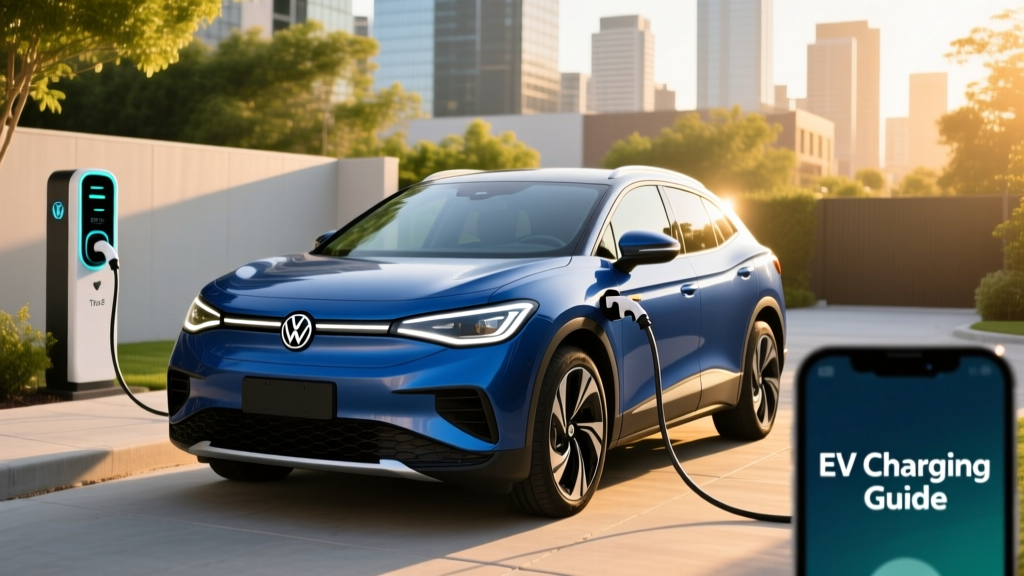
The 2022 Volkswagen ID.4 Pro S occupies a specific niche in the used-EV market: a practical, comfort-oriented compact crossover with solid range, decent cargo space, and one of the best battery warranties in the business. It isn't the fastest-charging or quickest EV in its class, but for buyers prioritizing ride quality, interior room, and long-term battery coverage, it remains a compelling option in 2026 — especially at depreciated used prices that may qualify for the federal used-EV tax credit.
This review focuses on the 2022 VW ID.4 Pro S with rear-wheel drive, the volume-selling configuration. We'll cover its EPA and real-world range, charging behavior (including the critical charge-curve taper), performance, interior space, pricing in today's used market, and how it stacks up against competitors like the Hyundai Ioniq 5, Ford Mustang Mach-E, and Tesla Model Y.
2022 VW ID.4 Pro S: Core Specifications at a Glance
| Specification | 2022 VW ID.4 Pro S (RWD) |
|---|---|
| EPA Range | 260 miles |
| Battery (Usable) | 77 kWh (82 kWh gross), NMC lithium-ion |
| Drivetrain | Rear-wheel drive, single motor |
| Horsepower / Torque | 201 hp / 229 lb-ft |
| 0–60 mph | 7.7 seconds |
| Max DC Fast Charge | 135 kW (peak) |
| 10–80% DC Fast Charge | ~34 minutes |
| Level 2 Home Charging | 11 kW (approx. 33 mi/hr) |
| EPA Efficiency | 104 MPGe combined (32 kWh/100 mi) |
| Cargo Volume (rear seats up/down) | 30.3 / 64.2 cu ft |
| Base MSRP (2022) | $45,540 (before incentives) |
| Battery Warranty | 8 years / 100,000 miles (70% capacity retention) |
Range: EPA Sticker vs. Real-World Expectations
Real-World Expectation: 220–245 miles in mixed driving; 190–210 miles at sustained 75+ mph highway speeds; 160–190 miles in sub-freezing winter conditions.
The 2022 ID.4 Pro S carries an EPA-estimated 260 miles of range from its 77 kWh usable battery pack. That figure holds up reasonably well in city and suburban driving, where regenerative braking recovers energy and speeds stay moderate. On the EPA's official fuel-economy page, the ID.4 Pro S posts 104 MPGe combined, translating to 32 kWh consumed per 100 miles — competitive with the Ford Mustang Mach-E Select RWD but trailing the more aerodynamic Hyundai Ioniq 5.
Where the ID.4 loses ground is sustained highway travel. At 75 mph on flat terrain in moderate temperatures (60–80°F), expect roughly 220–230 miles before the battery hits 10% State of Charge. Push speeds to 80+ mph or encounter headwinds and elevation changes, and 200–210 miles is a safer planning number.
Cold weather is the ID.4's most significant range vulnerability. The 2022 model uses a resistance heater rather than a heat pump (VW added a heat pump to later model years on certain trims). In temperatures below 32°F, expect 25–35% range reduction, yielding a practical winter range of 160–195 miles. Preconditioning the battery while plugged in mitigates some of this loss and is essential for preserving DC fast-charge speeds in cold weather.
Charging Speeds: DC Fast, Level 2, and the Curve Reality
Charging is where the ID.4 Pro S reveals its most significant competitive gap. The 2022 model peaks at 135 kW on DC fast chargers — adequate but not class-leading. Competitors like the Hyundai Ioniq 5 (240 kW peak with 800V architecture) and Tesla Model Y (250 kW on V3 Superchargers) add range substantially faster.
| Charging Level | Power / Rate | Speed | Notes |
|---|---|---|---|
| Level 1 (120V household) | ~1.2 kW | ~3–4 mi/hr | Emergency/trickle only |
| Level 2 (240V home) | 11 kW (48A) | ~33 mi/hr | Full charge in ~8 hours |
| DC Fast Charge | 135 kW peak | 10–80% in ~34 min | Tapers significantly above 80% |
The charge curve matters more than peak kW. The ID.4 holds near its 135 kW peak from roughly 5% to about 30% State of Charge, then progressively tapers. By 60% SoC, you're seeing approximately 90–100 kW. By 80%, charge speed drops to around 50–55 kW. This means the 10–80% session takes approximately 34 minutes on a 150+ kW-capable charger — roughly 16 minutes slower than an Ioniq 5 under similar conditions.
For home Level 2 charging, the ID.4's 11 kW onboard charger is a genuine strength. On a 48-amp Level 2 circuit (such as a ChargePoint Home Flex or Wallbox Pulsar Plus), you'll add about 33 miles of range per hour. A full 10–100% session takes roughly 8 hours — meaning you plug in at night and wake up with a full battery every morning. Most ID.4 owners report that home charging eliminates any day-to-day range concern entirely.
The ID.4 uses the CCS1 connector for DC fast charging. In 2026, VW has committed to NACS adoption for new models, and adapters for existing CCS-equipped VWs to access Tesla Superchargers are available through VW and third-party manufacturers. This significantly expands the ID.4's usable fast-charging network.
Performance, Drivetrain, and Driving Dynamics
The 2022 ID.4 Pro S sends 201 horsepower and 229 lb-ft of torque to the rear wheels through a single-speed reduction gear. The 0–60 mph sprint takes 7.7 seconds — perfectly adequate for merging and passing but not thrilling. The Mach-E Extended Range RWD hits 60 in about 6.1 seconds; the Model Y Long Range does it in roughly 5.0 seconds.
Where the ID.4 excels is ride quality and refinement. The suspension tuning is decidedly comfort-oriented, absorbing bumps and road imperfections with a maturity that outclasses the firmer Mach-E and Ioniq 5. Cabin noise levels are low, thanks to acoustic glass and careful insulation. The turning circle of 31.5 feet is exceptionally tight for a compact crossover — a genuine advantage in urban environments and parking garages.
Regenerative braking in the ID.4 is relatively mild. There's no true one-pedal driving mode (unlike Nissan Leaf or Chevrolet Bolt). The "B" gear mode increases regen but still requires brake-pedal use for complete stops. VW's philosophy here is to let the vehicle coast efficiently rather than aggressively recapturing energy — a choice that some EV veterans find frustrating but that new EV adopters often find more natural.
Interior Space, Cargo, and Practicality
The ID.4's interior dimensions are a key selling point for families and cargo-haulers:
- Rear legroom: 37.6 inches — more than the Mach-E (34.4 in) and competitive with the Model Y
- Front headroom: 41.1 inches (with panoramic glass roof on Pro S)
- Cargo behind rear seats: 30.3 cubic feet
- Cargo with rear seats folded: 64.2 cubic feet
- Frunk: None — the ID.4 has no front trunk, a missed opportunity for additional storage
The Pro S trim adds a panoramic fixed glass roof, which creates an airy cabin feel but eliminates a traditional retractable sunshade. VW includes a retractable fabric shade, though some owners report it allows more light and heat through than desired in summer months. The heated and ventilated front seats (standard on Pro S) and heated steering wheel are welcome features, especially given the resistance heater's impact on range.
The 12-inch infotainment touchscreen runs VW's ID. Software 3.x, which drew widespread criticism at launch for laggy response times, confusing menu structures, and non-illuminated touch-sensitive sliders for volume and temperature. VW has issued multiple over-the-air updates improving responsiveness, and by 2026, the software is materially better than the 2022 launch version — though still not as intuitive as Tesla's or Hyundai's interfaces. Wireless Apple CarPlay and Android Auto are standard.
Pricing, Tax Credits, and Used-EV Value in 2026
When new, the 2022 ID.4 Pro S carried an MSRP of $45,540 (plus destination). By 2026, used examples have depreciated meaningfully. Current market pricing for a 2022 ID.4 Pro S with 30,000–50,000 miles typically falls between $22,000 and $28,000, depending on condition, mileage, and region.
| Scenario | Estimated Cost |
|---|---|
| 2022 MSRP (new) | $45,540 |
| 2026 used market (avg. 40k mi) | $24,000–$27,000 |
| Federal used-EV credit (§25E, max) | Up to $4,000 (30% of sale price) |
| Estimated net cost after credit | $20,000–$23,000 |
Because the 2022 ID.4 is now a used vehicle, it does not qualify for the new-vehicle §30D credit (up to $7,500). Instead, buyers should evaluate eligibility for the §25E previously owned clean vehicle credit, which provides 30% of the sale price up to a maximum of $4,000. Key eligibility requirements per the IRS used-EV credit page:
- Sale price must be $25,000 or below
- Buyer income caps: $75,000 single / $112,500 head of household / $150,000 joint
- Vehicle must be at least two model years old (2022 qualifies in 2026)
- Buyer must not have claimed the used-EV credit in the prior three years
- Vehicle must be purchased from a licensed dealer (private-party sales excluded)
At a $24,000 sale price, the §25E credit would yield $4,000 (hitting the cap). At $27,000, the vehicle exceeds the $25,000 price cap and is ineligible. This makes deal negotiation critical — pushing the sale price to or below $25,000 unlocks thousands in additional savings. Always consult a tax professional to confirm your personal eligibility, as IRS rules are subject to change.
Warranty Coverage and Long-Term Battery Outlook
Volkswagen provides one of the most comprehensive EV warranties in the industry:
- Battery warranty: 8 years / 100,000 miles, guaranteeing at least 70% of original capacity
- Powertrain warranty: 8 years / 100,000 miles
- Bumper-to-bumper: 4 years / 50,000 miles
For a 2022 model, the battery and powertrain warranty remains active through the 2030 model year or 100,000 miles — whichever comes first. A buyer purchasing in 2026 still has approximately four years and 50,000–70,000 miles of battery coverage remaining, which is a meaningful safety net.
The ID.4's 82 kWh (gross) NMC battery pack has shown moderate degradation in early owner reports. Data from ID.4 owner forums and fleet tracking suggest typical capacity loss of 4–7% over the first three years / 40,000–60,000 miles. This is within the normal range for liquid-cooled NMC packs and well above the 70% warranty threshold. VW's battery management system maintains a relatively large buffer (approximately 5 kWh above and below the usable window), which helps protect long-term health by avoiding true 0% or 100% cell states.
Driver-Assistance Technology and Safety
The ID.4 Pro S comes equipped with VW's IQ.DRIVE suite, which includes:
- Adaptive cruise control with stop-and-go
- Lane-keeping assist with centering
- Front and rear automatic emergency braking
- Blind-spot monitoring with rear cross-traffic alert
- Travel Assist (combined adaptive cruise + lane centering up to 95 mph)
Travel Assist works well on divided highways but requires consistent hand contact on the capacitive steering wheel. It does not support hands-free operation like Ford's BlueCruise or GM's Super Cruise on mapped roads. The system is competent but unremarkable compared to Tesla's Autopilot or Hyundai's Highway Driving Assist 2.
The ID.4 earned the IIHS Top Safety Pick+ designation for the 2022 model year, with "Good" ratings across all crashworthiness categories and a "Superior" rating for front crash prevention. IIHS safety ratings confirm strong structural performance. The NHTSA awarded the ID.4 a 5-star overall safety rating.
Pros, Cons, and the Competitive Verdict
Pros
- Comfortable, quiet ride quality — best in class for refinement
- Spacious rear seat (37.6 in legroom) and generous cargo area (64.2 cu ft)
- Strong 11 kW Level 2 onboard charger for fast home charging
- 8-year/100,000-mi battery warranty with 70% capacity guarantee
- Tight 31.5-ft turning circle for excellent urban maneuverability
- Depreciated used pricing can unlock §25E used-EV credit (up to $4,000)
- CCS-to-NACS adapter access expands Supercharger network availability
Cons
- 135 kW peak DC charging is slow vs. Ioniq 5 (240 kW) and Model Y (250 kW)
- No front trunk (frunk) — lost cargo opportunity
- Infotainment software, while improved, still lags behind competitors
- No heat pump (resistance heater hurts cold-weather range and efficiency)
- Mild regenerative braking — no true one-pedal driving mode
- 201 hp feels underpowered for highway merging vs. competitors
- Touch-sensitive steering wheel controls frustrate some drivers
Who Should Buy the 2022 VW ID.4 Pro S?
Choose the ID.4 Pro S if: You prioritize ride comfort and cabin quietness over acceleration; you primarily charge at home and rarely take road trips exceeding 200 miles without a planned stop; you want strong battery warranty coverage on a used EV; you need generous rear-seat and cargo space for a family.
Look elsewhere if: You take frequent long road trips and want the fastest possible DC charging (consider Ioniq 5 or Model Y); you need all-wheel drive for snow (look at the ID.4 AWD Pro S or Mach-E); you want cutting-edge infotainment and driver-assist features; you live in a very cold climate where the lack of a heat pump will meaningfully reduce your winter range.
Frequently Asked Questions
What is the real-world range of the 2022 VW ID.4 Pro S?
The EPA rates the 2022 ID.4 Pro S at 260 miles. In real-world mixed driving at moderate temperatures, expect 220–245 miles. At sustained highway speeds above 75 mph, plan for 200–220 miles. In sub-freezing winter conditions, range drops to approximately 160–195 miles due to the resistance heater and cold battery chemistry effects.
How fast does the 2022 ID.4 Pro S charge?
On a DC fast charger, the ID.4 Pro S peaks at 135 kW and charges from 10–80% in approximately 34 minutes. On a Level 2 home charger (240V, 48A), it charges at 11 kW, adding about 33 miles of range per hour and reaching a full charge in roughly 8 hours.
Does the 2022 VW ID.4 qualify for a federal tax credit in 2026?
As a used vehicle, the 2022 ID.4 does not qualify for the new-vehicle §30D credit. However, it may qualify for the §25E used-EV credit (up to $4,000) if the sale price is $25,000 or less, the buyer meets income caps ($75K single / $150K joint), and the vehicle is purchased from a licensed dealer. Consult a tax professional for personal eligibility.
Is the 2022 ID.4 Pro S worth buying vs. the Ioniq 5 or Model Y?
The ID.4 Pro S wins on ride comfort, cabin quietness, and battery warranty coverage. The Ioniq 5 is superior for DC charging speed and design; the Model Y leads in range, performance, Supercharger access (native NACS), and software. At depreciated prices near $24,000, the ID.4 represents strong value for comfort-focused buyers who charge primarily at home.
What are the biggest problems with the 2022 VW ID.4?
The most commonly cited issues are the infotainment system's sluggish response (improved via OTA updates but not fully resolved), the lack of a heat pump reducing cold-weather efficiency, non-illuminated touch-sensitive controls on the steering wheel and dashboard, and DC fast-charging speeds that trail key competitors. No widespread battery or drivetrain defect has been reported.
Can the 2022 ID.4 charge at Tesla Superchargers?
Yes, with a CCS-to-NACS adapter. Volkswagen has approved specific adapters for use with ID.4 vehicles, and Tesla's Supercharger network has opened to non-Tesla EVs via adapters and the Tesla app. Charging speed will be limited to the ID.4's 135 kW peak, not the Supercharger's full capability.