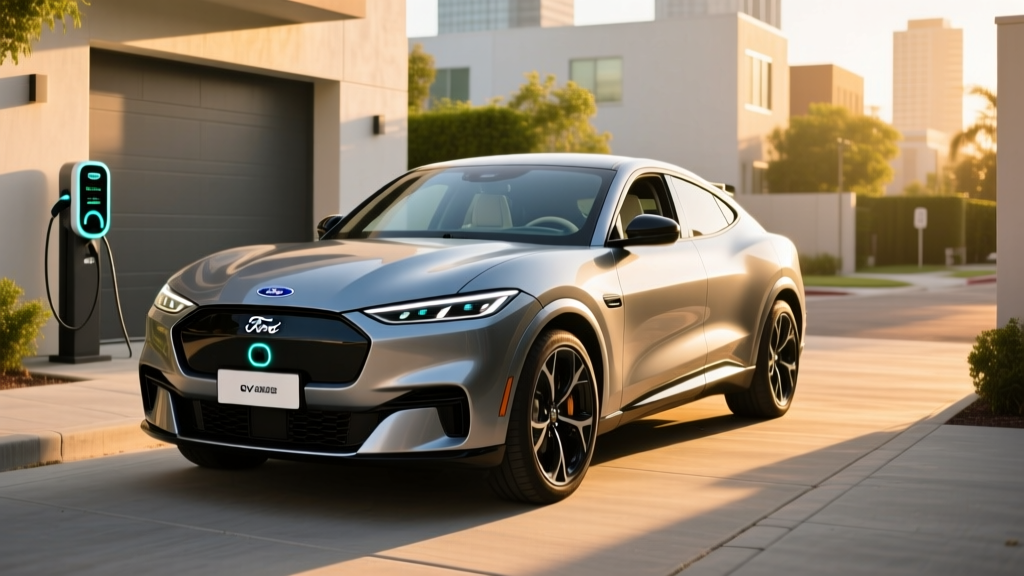
The 2022 Ford Mustang Mach-E arrived as Ford's most ambitious electric vehicle to date — a battery-electric crossover wearing the Mustang badge, built on Ford's dedicated Global Electrified Platform (GE1). Now several model years into production, the 2022 Mach-E has established a track record that lets us evaluate it beyond launch hype. This review breaks down the real-world ownership experience: actual range versus EPA stickers, charging behavior at DC fast chargers, federal tax credit eligibility under current IRS §30D rules, and how it stacks up against the Tesla Model Y, Hyundai Ioniq 5, and Kia EV6.
2022 Mach-E Trim Lineup and Core Specifications
Ford offered the 2022 Mach-E in four trims across two battery sizes and two drivetrain configurations. The Standard Range (SR) battery was available only on the Select and Premium trims with rear-wheel drive or all-wheel drive. The Extended Range (ER) battery powered the Select, Premium, GT, and GT Performance Edition. All trims use nickel-manganese-cobalt (NMC) lithium-ion pouch cells supplied primarily by LG Energy Solution.
| Spec | Select SR | Premium ER RWD | Premium ER AWD | GT ER AWD | GT Perf. Ed. |
|---|---|---|---|---|---|
| EPA Range | 230 mi | 314 mi | 290 mi | 270 mi | 260 mi |
| Battery (usable) | 70 kWh | 91 kWh | 91 kWh | 91 kWh | 91 kWh |
| Horsepower | 266 hp | 290 hp | 346 hp | 480 hp | 480 hp |
| Torque | 317 lb-ft | 317 lb-ft | 428 lb-ft | 600 lb-ft | 634 lb-ft |
| 0-60 mph | 5.8 s | 5.5 s | 4.8 s | 3.8 s | 3.5 s |
| Drivetrain | RWD / AWD | RWD / AWD | AWD | AWD (dual motor) | AWD (dual motor) |
| MPGe (combined) | 101 | 97 | 93 | 84 | 82 |
| Base MSRP (2022) | $43,995 | $50,875 | $53,875 | $61,995 | $67,995 |
Sources: fueleconomy.gov, Ford Motor Company 2022 specifications.
Real-World Range: What the EPA Sticker Doesn't Tell You
The 2022 Mach-E Premium ER RWD carries an EPA-estimated 314 miles of range. In real-world mixed driving, expect 260–280 miles in moderate temperatures. Sustained highway driving at 75+ mph drops this to approximately 240–260 miles. In freezing temperatures (below 32°F), plan for a 20–30% reduction, yielding roughly 200–230 miles on a full charge for the ER RWD variant. The GT trims, with their stickier summer tires and higher power draw, typically deliver 210–230 miles in temperate mixed driving.
Range in the Mach-E is heavily influenced by drive mode selection. Ford's Whisper, Engage, and Unbridled modes alter throttle response, climate system behavior, and regenerative braking intensity. In our experience, the one-pedal driving mode with maximum regen recovers meaningful energy in stop-and-go traffic but offers negligible benefit on open highway where coasting is more efficient.
The 91 kWh Extended Range battery uses NMC chemistry, which offers higher energy density than LFP alternatives but comes with slightly faster long-term degradation if regularly charged to 100% or deeply discharged. Ford recommends daily charging to 90% State of Charge (SoC) for battery longevity, reserving 100% charges for road trips. The vehicle's battery management system includes a buffer — the usable capacity of 91 kWh sits within a gross pack of approximately 98 kWh — protecting the cells from extreme states that accelerate degradation.
Charging Speed: DC Fast Charging and Home Level 2
Charging capability is where the 2022 Mach-E reveals both strengths and limitations compared to its 800-volt rivals.
| Charging Method | Power | Rate / Time | Notes |
|---|---|---|---|
| Level 1 (120V household) | 1.4 kW | ~3 mi/hr | Emergency/trickle only |
| Level 2 (240V, 32A) | 7.7 kW | ~21 mi/hr (ER: ~35 hr full) | Included Ford Mobile Charger |
| Level 2 (240V, 48A) | 11.5 kW | ~32 mi/hr (ER: ~23 hr full) | Requires hardwired Wallbox or similar |
| DC Fast Charge (peak) | 150 kW (ER) / 115 kW (SR) | 10–80% in ~45 min (ER) | CCS1 connector; tapers significantly above 80% |
The 2022 Mach-E uses a CCS1 (Combined Charging System) connector for DC fast charging. The Extended Range variants peak at approximately 150 kW, while Standard Range models top out around 115 kW. On a Electrify America or EVgo station capable of delivering that power, you'll see the charge rate ramp quickly from 10% to roughly 50% SoC, then progressively taper. The 10–80% charge takes approximately 45 minutes for the ER battery — competitive with the 2022 Model Y on V2 Superchargers but noticeably slower than the Hyundai Ioniq 5 and Kia EV6, which leverage 800V architecture to achieve 10–80% in roughly 18 minutes at 350 kW chargers.
Above 80% SoC, the Mach-E's charge rate drops sharply to protect the NMC cells — often to below 30 kW. This means topping from 80% to 100% at a DC fast charger can take nearly as long as the 10–80% portion. For road trips, the practical strategy is to charge in the 10–80% window and move on, which aligns well with typical rest-stop timing.
For home Level 2 charging, Ford included a Mobile Power Cord with the 2022 Mach-E capable of 32 amps (7.7 kW) on a 240V NEMA 14-50 outlet. For faster home charging, a dedicated 48-amp hardwired Level 2 station delivers 11.5 kW, fully replenishing the ER battery overnight in roughly 8–9 hours of sleep-time charging (accounting for the 90% daily SoC target). Expect to budget $500–$1,500 for professional Level 2 home installation depending on panel capacity and run length — consult a licensed electrician for your specific situation.
Performance, Efficiency, and Driving Dynamics
The 2022 Mach-E GT Performance Edition's 3.5-second 0–60 mph time places it firmly in sports-car territory, and the instant torque delivery from dual electric motors makes it feel even quicker in real-world passing situations. The standard GT (3.8 seconds) is barely slower and costs $6,000 less. Both GT variants feature Ford's MagneRide adaptive dampers, larger front brakes, and a sport-tuned AWD system that can send up to 100% of torque to the rear axle.
The non-GT trims are no slouches. The Premium ER AWD at 4.8 seconds to 60 mph outpaces most gasoline crossovers in this price bracket. The RWD variants trade acceleration for the best efficiency in the lineup — the Premium ER RWD achieves an EPA-estimated 97 MPGe combined (approximately 34 kWh per 100 miles), which translates to roughly $0.04–$0.06 per mile depending on local electricity rates, versus $0.12–$0.16 per mile for a comparable gasoline crossover at $3.50/gallon.
Ride quality is a mixed bag. The non-GT trims ride comfortably on their 18- or 19-inch wheels, but the GT's 20-inch wheels with low-profile summer tires transmit more road imperfections than you might expect from a premium crossover. Road noise is moderate — better than the early-build 2021 models thanks to added sound deadening, but not class-leading compared to the quieter Hyundai Ioniq 5.
Interior Space, Cargo, and Technology
The Mach-E's cabin trades traditional Mustang cues for a minimalist, screen-forward design. A 15.5-inch portrait touchscreen running Ford's SYNC 4A system dominates the dashboard, while a 10.2-inch digital instrument cluster sits behind the steering wheel. The large center screen handles navigation, climate, media, and vehicle settings. Wireless Apple CarPlay and Android Auto are standard across all trims. Physical buttons are minimal — climate controls are embedded in the touchscreen, which some drivers find distracting while driving.
Passenger space is competitive for the compact electric crossover segment:
- Front legroom: 43.3 inches
- Rear legroom: 38.9 inches
- Front headroom: 40.4 inches
- Rear headroom: 38.2 inches
- Cargo (behind rear seats): 29.7 cu ft
- Cargo (rear seats folded): 59.7 cu ft
- Front trunk (frunk): 4.7 cu ft (drainable, useful for wet gear)
The frunk is a practical differentiator — its drain plug lets you use it as a cooler for tailgating, a feature Ford marketed heavily. However, the frunk opening is relatively narrow compared to the Tesla Model Y's, limiting what you can fit inside.
On the driver-assistance front, the 2022 Mach-E offers Ford Co-Pilot360 2.0 as standard, including adaptive cruise control with stop-and-go, lane centering, automatic emergency braking, and blind-spot monitoring. The available BlueCruise system (a $1,900 option at launch, later included on certain trims) enables hands-free driving on pre-mapped divided highways — approximately 130,000 miles of qualified roads as of 2022.
BlueCruise is an SAE Level 2 driver-assistance system. Despite hands-free capability on mapped highways, the driver must remain attentive. A driver-facing camera monitors eye gaze, and the system will issue warnings and eventually disengage if it detects inattention. BlueCruise is not self-driving and does not handle construction zones, unmapped roads, or complex urban intersections without driver takeover.
Pricing, Tax Credit Eligibility, and Ownership Costs
The 2022 Mach-E launched with MSRPs ranging from $43,995 (Select SR RWD) to $67,995 (GT Performance Edition), before a $1,300 destination charge. As a used vehicle in 2026, market pricing varies significantly by mileage, condition, and trim, but expect to find 2022 models between $22,000 and $42,000 depending on configuration.
Federal tax credit eligibility for the 2022 Mach-E requires careful attention to current IRS §30D rules, which have evolved considerably since the vehicle's launch year.
- New vehicle credit (up to $7,500): The 2022 Mach-E is no longer available new; this credit applies only to new purchases of current-year models meeting battery sourcing, critical mineral, MSRP cap ($55,000 for SUVs), and buyer income limits ($150K single / $300K joint MAGI).
- Used EV credit (up to $4,000): A 2022 Mach-E purchased from a licensed dealer may qualify for the Used Clean Vehicle Credit — 30% of the sale price, capped at $4,000. The vehicle must be priced at or below $25,000, at least two model years old, and the buyer must meet income caps ($75K single / $150K joint). This credit can be transferred to the dealer as a point-of-sale discount.
- Battery sourcing: The used-EV credit does not have the same battery-sourcing restrictions as the new-vehicle credit, making it more broadly accessible for 2022 Mach-E buyers in 2026.
Always verify current eligibility at irs.gov and consult a tax professional before relying on credit amounts for purchase decisions.
On the cost-of-ownership side, the 2022 Mach-E benefits from lower maintenance costs versus gasoline crossovers — no oil changes, fewer brake replacements thanks to regenerative braking, and no transmission fluid. However, insurance premiums tend to run 15–25% higher than equivalent ICE vehicles due to repair costs and parts pricing. Ford's warranty coverage includes:
- Battery: 8 years / 100,000 miles (capacity retention warranty; Ford guarantees the battery will retain at least 70% of original capacity)
- Electric powertrain components: 8 years / 100,000 miles
- Bumper-to-bumper: 3 years / 36,000 miles
2022 Mach-E vs. Key Competitors
The 2022 Mach-E competes in a crowded segment. Here's how it compares to three rivals buyers cross-shop most frequently:
| Metric | Mach-E Premium ER AWD | Tesla Model Y LR AWD | Hyundai Ioniq 5 Limited AWD | Kia EV6 GT-Line AWD |
|---|---|---|---|---|
| EPA Range | 290 mi | 318 mi | 256 mi | 274 mi |
| Battery (usable) | 91 kWh (NMC) | 75 kWh (NMC/NCA) | 77.4 kWh (NMC) | 77.4 kWh (NMC) |
| Peak DC Charge | 150 kW | 250 kW | 235 kW (800V) | 235 kW (800V) |
| 10–80% DCFC Time | ~45 min | ~30 min | ~18 min | ~18 min |
| 0–60 mph | 4.8 s | 4.8 s | 5.1 s | 4.5 s |
| Cargo (rear seats up) | 29.7 cu ft | 30.2 cu ft | 27.2 cu ft | 24.4 cu ft |
| Starting MSRP (2022) | $53,875 | $65,990 | $52,600 | $55,900 |
Sources: fueleconomy.gov, manufacturer specifications.
The Mach-E's primary advantage is its balance of range, cargo space, and price in the ER AWD configuration. Its main weakness is charging speed — the 150 kW peak and ~45-minute 10–80% time trails the Ioniq 5 and EV6 significantly, which matters on road trips where charging stops add up. The Tesla Model Y offers slightly more range and access to the Supercharger network, though Ford has since gained NACS adapter access to Superchargers for Mach-E owners (using a Ford-provided adapter for the CCS1 port).
Pros, Cons, and Who Should Buy the 2022 Mach-E
Pros
- Strong real-world range on ER variants (260–280 mi mixed)
- GT Performance Edition delivers supercar-level acceleration (3.5s 0–60)
- Drainable frunk adds practical utility
- BlueCruise hands-free highway driving on mapped roads
- Comfortable ride on non-GT trims
- Competitive cargo volume (29.7 cu ft + frunk)
- Available as used EV with up to $4,000 federal credit
Cons
- DC fast charging at 150 kW is slow for the segment
- 10–80% charge takes ~45 minutes — rivals do it in 18–30
- Climate controls buried in touchscreen
- GT ride quality is firm on rough pavement
- No heat pump on 2022 model (reduces cold-weather efficiency)
- Rear visibility limited by thick C-pillars and small rear window
- Early OTA software updates were inconsistent
Who the 2022 Mach-E Suits Best
Daily commuters and suburban families who prioritize range and interior space over charging speed will find the Premium ER variants rewarding. The 290-mile EPA range (real-world ~260) covers most commutes with days between charges, and the cargo area handles strollers and groceries easily.
Performance enthusiasts who want EV acceleration without the Tesla aesthetic will appreciate the GT's 3.5–3.8 second 0–60 time and MagneRide suspension.
Not ideal for: Frequent long-distance road trippers who need fast charging (look at Ioniq 5/EV6), or buyers in extreme cold climates where the lack of a heat pump compounds range loss.
Frequently Asked Questions
What is the real-world range of the 2022 Mustang Mach-E?
The EPA rates the Mach-E Premium ER RWD at 314 miles, but real-world mixed driving typically yields 260–280 miles. Highway driving at 75+ mph drops this to 240–260 miles. In freezing weather, expect a 20–30% reduction across all trims. The GT variants realistically deliver 210–230 miles in temperate conditions.
How fast does the 2022 Mach-E charge?
On DC fast charging, the Extended Range battery peaks at 150 kW and charges from 10–80% in approximately 45 minutes. At home on a 48-amp Level 2 charger (11.5 kW), a full charge takes roughly 8–9 hours. The included Mobile Power Cord at 32 amps (7.7 kW) adds about 21 miles per hour of charging.
Does the 2022 Mach-E qualify for a federal tax credit in 2026?
As a used vehicle, the 2022 Mach-E may qualify for the Used Clean Vehicle Credit — up to $4,000 (30% of sale price) if purchased from a licensed dealer at or below $25,000. Buyer income must not exceed $75,000 (single) or $150,000 (joint). This credit can be applied as a point-of-sale discount. It is not eligible for the new-vehicle §30D credit since it is no longer sold new. Always confirm current rules at irs.gov.
Is the 2022 Mach-E worth buying versus the Tesla Model Y or Hyundai Ioniq 5?
It depends on your priorities. If charging speed on road trips matters most, the Ioniq 5 or EV6 (18-minute 10–80% at 800V chargers) is a better choice. If you want Supercharger network access and maximum range, the Model Y leads. The Mach-E wins on driving engagement (especially the GT), practical frunk design, and a more traditional dealership service experience. As a used purchase in 2026, the Mach-E often trades at a discount to equivalent Model Y listings, making it a strong value play if the charging speed tradeoff is acceptable.
What is the biggest drawback of the 2022 Mach-E?
The most significant limitation is DC fast-charging speed. At 150 kW peak and ~45 minutes for a 10–80% session, the Mach-E adds more time to road-trip charging stops than most rivals. For buyers who road-trip frequently, this is a meaningful inconvenience. The absence of a heat pump on the 2022 model year also hurts cold-weather efficiency compared to competitors that added one.
How long will the 2022 Mach-E battery last?
Ford warranties the high-voltage battery for 8 years or 100,000 miles, guaranteeing at least 70% capacity retention. NMC batteries in liquid-cooled packs like the Mach-E's typically degrade 1–2% per year under normal use patterns. A 2022 Mach-E in 2026 with average mileage (40,000–50,000 miles) should still retain approximately 92–96% of original capacity, assuming it was not routinely charged to 100% or exposed to extreme heat without preconditioning. Full battery replacement, if ever needed outside warranty, is estimated at $12,000–$18,000 based on current pack pricing.