Quick Verdict: The Sensible Electric Crossover That Started VW's EV Era
The 2021 Volkswagen ID.4 was VW's first mass-market electric vehicle built on the dedicated MEB platform, and it arrived with a clear mission: offer a practical, spacious, and approachable electric compact SUV for mainstream buyers. Now that we're evaluating it from a 2026 ownership perspective — with several years of real-world data, battery degradation tracking, and a mature used-EV market — the ID.4 holds up as a competent daily driver with notable strengths in ride comfort and interior space, but also clear weaknesses in software responsiveness and charging speed compared to newer rivals.
If you're shopping the used EV market or considering a remaining new-old-stock unit, this review covers everything you need: exact EPA range figures, real-world highway and cold-weather expectations, DC fast-charging curves, battery chemistry, and how the 2021 ID.4 stacks up against competitors like the Hyundai Ioniq 5, Ford Mustang Mach-E, and Tesla Model Y.
Range, Battery, and Efficiency: What the Numbers Actually Mean
| Specification | Value |
|---|---|
| EPA Range (Pro / Pro S, RWD) | 260 miles |
| EPA Range (1st Edition, RWD) | 250 miles |
| Battery (Gross / Usable) | 82 kWh / 77 kWh |
| Battery Chemistry | NMC (Nickel Manganese Cobalt) |
| EPA Efficiency (Combined) | 104 MPGe (2.0 kWh/mi) |
| Drivetrain | Rear-Wheel Drive (single motor) |
| Horsepower / Torque | 201 hp / 229 lb-ft |
| 0–60 mph | 7.7 seconds |
| Cargo Volume (rear seats up / down) | 30.3 / 64.2 cu ft |
| Rear Legroom | 37.6 inches |
| Battery Warranty | 8 years / 100,000 miles (70% capacity) |
| Original Base MSRP (Pro) | $39,995 |
The 2021 ID.4 Pro carries an EPA-estimated 260 miles of range. In real-world mixed driving, expect approximately 220–240 miles on a combination of city and highway routes. On sustained 75 mph highway driving, range drops to roughly 200–215 miles. In freezing temperatures (below 32°F), the ID.4 — which uses a resistive PTC heater rather than a heat pump in the 2021 model year — can lose 25–35% of range, bringing winter highway range down to approximately 160–180 miles. City driving in mild weather can occasionally exceed the EPA estimate thanks to regenerative braking, reaching 265–275 miles.
The 82 kWh gross (77 kWh usable) NMC lithium-ion battery pack sits low in the MEB skateboard platform. VW's battery management system maintains a buffer of approximately 5 kWh to protect long-term cell health. According to fueleconomy.gov, the combined efficiency rating of 104 MPGe translates to roughly 32 kWh per 100 miles in mixed driving — competitive with the Ford Mustang Mach-E but trailing the more efficient Hyundai Ioniq 5 and Tesla Model Y.
One important note on chemistry: the 2021 ID.4 uses NMC (nickel manganese cobalt) cells supplied primarily by SK Innovation and LG Energy Solution. NMC offers higher energy density than LFP (lithium iron phosphate), giving VW more range in a smaller package, but NMC cells are more sensitive to sustained high states of charge. For daily use, VW recommends setting the charge limit to 80% and only charging to 100% before long trips — this practice meaningfully extends pack longevity.
Charging Speed: DC Fast Charging and Home Level 2
| Charging Level | Power | Speed / Time |
|---|---|---|
| Level 1 (120V household) | ~1.2 kW | ~3–4 miles per hour |
| Level 2 (240V home/public) | 11 kW (max onboard) | ~32 miles per hour; 0–100% in ~7.5 hours |
| DC Fast Charge (CCS) | 125 kW peak | 10–80% in ~38 minutes |
The ID.4's DC fast-charging capability peaks at 125 kW via its CCS1 connector. In real-world testing at Electrify America and similar 150+ kW stations, the ID.4 sustains approximately 100–125 kW between 10% and 30% state of charge, then tapers progressively. By 50% SoC, the rate drops to roughly 80 kW, and above 80% it slows dramatically to under 30 kW. The 10–80% session takes approximately 38 minutes under ideal conditions — preconditioned battery, moderate ambient temperature, and a capable charger.
This charging speed was acceptable in 2021 but falls behind 2026 benchmarks. The Hyundai Ioniq 5 charges at up to 240 kW (10–80% in ~18 minutes), and the Tesla Model Y on V3 Superchargers peaks at 250 kW. If you frequently road-trip, the ID.4's slower charge curve means longer stops — plan for roughly 40-minute breaks every 200 miles on the highway.
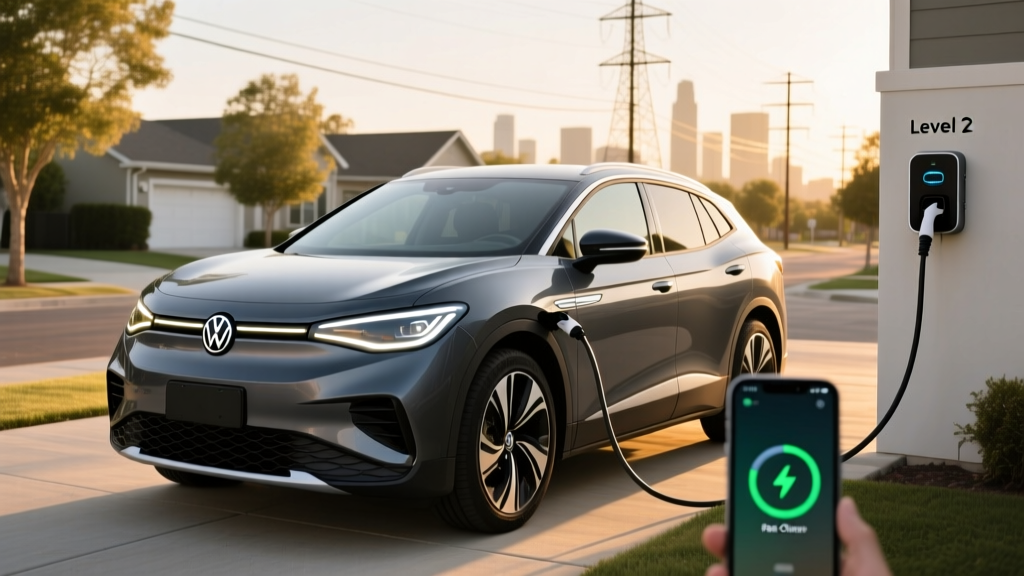
For home charging, the ID.4's 11 kW onboard AC charger is a genuine strength. On a 48-amp Level 2 home station (such as a ChargePoint Home Flex or Tesla Wall Connector with J1772 adapter), you'll add approximately 32 miles of range per hour, fully replenishing the battery overnight in about 7.5 hours. Most owners with home Level 2 rarely visit public chargers except on road trips.
A critical note for 2026 buyers: VW committed to transitioning to the NACS (Tesla) connector starting with the 2025 model year. The 2021 ID.4 retains CCS1 natively, but VW has confirmed NACS adapter compatibility for Tesla Supercharger access. Check VW's official adapter program for availability.
Performance and Driving Dynamics
The 2021 ID.4 sends 201 horsepower and 229 lb-ft of torque to the rear wheels via a single permanent-magnet synchronous motor mounted on the rear axle. The 0–60 mph sprint takes 7.7 seconds — adequate for highway merging and daily driving, but noticeably slower than the dual-motor AWD variant (295 hp, 5.7 seconds) introduced later, and behind the Mustang Mach-E Select RWD (5.8 seconds).
Where the ID.4 earns praise is in ride quality. The MEB platform's low center of gravity and well-tuned suspension deliver a composed, comfortable ride that absorbs bumps with a maturity that rivals some luxury crossovers. The steering is light and predictable, though it lacks the communicative feedback of a driver-focused EV like the Mach-E. The turning circle of 31.5 feet is impressively tight for a compact SUV, making the ID.4 genuinely easy to maneuver in urban environments.
Regenerative braking in the 2021 ID.4 is modest. The B-mode (accessed via the gear selector) increases regen but does not enable true one-pedal driving — the vehicle will creep at low speeds rather than coming to a complete stop. This is a deliberate VW design choice that frustrates some EV veterans but feels natural to drivers transitioning from gas cars.
Interior, Tech, and Cargo Space
The ID.4's cabin is spacious and minimalist, with a 12-inch infotainment touchscreen (10-inch on the base Pro trim), a 5.3-inch digital instrument cluster, and capacitive touch controls for climate and volume. Rear-seat passengers enjoy 37.6 inches of legroom — competitive with the Toyota RAV4 — and the flat floor (thanks to the skateboard battery) makes the middle seat genuinely usable.
Cargo capacity measures 30.3 cubic feet behind the rear seats and 64.2 cubic feet with them folded. There is no front trunk (frunk) — the space under the hood houses electronics and the cabin HVAC system. A power liftgate is standard on Pro S and 1st Edition trims.
The most-cited criticism of the 2021 ID.4 is its software. The infotainment system at launch suffered from slow response times, occasional lag, and a frustrating lack of physical buttons for climate controls. VW issued multiple over-the-air updates through 2022–2024 that improved stability, but the interface still feels a generation behind Tesla's or Hyundai's systems. Apple CarPlay and Android Auto are wired (not wireless) on the 2021 model — a notable omission at this price point.
Driver assistance comes via VW's IQ.DRIVE suite, which includes adaptive cruise control with stop-and-go, lane-keeping assist, automatic emergency braking, and blind-spot monitoring. This is an SAE Level 2 system — it assists with steering and speed but requires the driver to remain fully engaged and hands-on at all times. It is not autonomous driving.
Pricing, Trims, and Federal Tax Credit Eligibility
When new, the 2021 ID.4 launched in three trims:
- Pro: $39,995 MSRP (10-inch screen, cloth seats, 19-inch wheels)
- Pro S: $44,495 MSRP (12-inch screen, panoramic roof, heated seats, power liftgate)
- 1st Edition: $43,995 MSRP (limited-run, unique badging, gradient wheels, Pro S equipment)
In the 2026 used market, well-maintained 2021 ID.4 Pro models typically sell for $18,000–$23,000 depending on mileage and condition, while Pro S and 1st Edition trims command $21,000–$26,000. These prices reflect normal EV depreciation — the ID.4 has held value reasonably well thanks to its strong battery warranty and VW's brand recognition.
If purchasing a used 2021 ID.4 from a dealer in 2026, you may qualify for the Used Clean Vehicle Credit (§25E) — up to $4,000 or 30% of the sale price (whichever is less). Requirements per IRS §25E rules:
- Sale price must be $25,000 or below
- Buyer income caps: $75,000 single / $112,500 head of household / $150,000 joint (MAGI)
- Vehicle must be at least 2 model years old (2021 qualifies in 2026)
- Must purchase from a licensed dealer (private-party sales do not qualify)
- Credit is non-refundable and can only be claimed once per vehicle
If a remaining new 2021 ID.4 were somehow purchased new in 2026, the §30D new-vehicle credit would apply — but eligibility depends on current-year battery sourcing and critical mineral rules, which have tightened significantly since 2021. Consult a tax professional and review IRS §30D guidance before relying on credit amounts.
Competitive Comparison: ID.4 vs. the Field
| Spec | 2021 VW ID.4 Pro | 2021 Ford Mach-E Select RWD | 2021 Hyundai Ioniq 5 SE | 2021 Tesla Model Y LR |
|---|---|---|---|---|
| EPA Range | 260 mi | 230 mi (SR) / 300 mi (ER) | 303 mi | 326 mi |
| Battery (usable) | 77 kWh | 68 kWh (SR) / 88 kWh (ER) | 77.4 kWh | ~75 kWh |
| Peak DC Charge | 125 kW | 115 kW | 240 kW | 250 kW |
| 10–80% Time | ~38 min | ~45 min (SR) | ~18 min | ~20 min |
| 0–60 mph | 7.7 sec | 5.8 sec | 7.4 sec | 4.8 sec |
| Horsepower | 201 hp | 266 hp | 225 hp | 384 hp |
| Cargo (seats up) | 30.3 cu ft | 29.7 cu ft | 27.2 cu ft | 30.2 cu ft |
| Original Base MSRP | $39,995 | $42,895 | $43,650 | $53,990 |
The ID.4's closest competition reveals its positioning clearly. It's not the fastest, longest-range, or quickest-charging EV in its class — that honor goes to the Ioniq 5 and Model Y. But it is one of the most comfortable and accessible, with a ride quality and ease-of-use philosophy that appeals to buyers who prioritize daily comfort over performance specs.
The Mach-E offers more power and a sportier driving experience. The Ioniq 5 dramatically outperforms on charging speed and range. The Model Y leads in efficiency, Supercharger network access, and software capability. The ID.4 wins on ride comfort, interior practicality, and approachability for first-time EV buyers.
Pros and Cons
- Comfortable, composed ride quality
- Spacious rear seat and cargo area
- Tight turning circle (31.5 ft) — excellent urban maneuverability
- 11 kW Level 2 onboard charger — fast home replenishment
- Strong 8-year/100,000-mile battery warranty
- Approachable for gas-to-EV switchers
- Competitive used-market pricing ($18K–$26K)
- Sluggish infotainment software, capacitive touch frustration
- No wireless CarPlay/Android Auto
- 125 kW DC charging is slow vs. 2026 standards
- Resistive heater (no heat pump) — significant winter range loss
- Modest regen — no true one-pedal driving
- No front trunk (frunk)
- 201 hp feels underpowered for the segment
Who Should Buy the 2021 Volkswagen ID.4?
The 2021 ID.4 is best suited for daily commuters and small families who prioritize ride comfort, interior space, and straightforward usability over performance and cutting-edge tech. If your routine involves a 30–60 mile round-trip commute with access to home Level 2 charging, the ID.4 handles that workload effortlessly with range to spare.
It is not the best choice for frequent long-distance road trippers (the 125 kW charge curve and 200-mile highway range make stops longer and more frequent than in an Ioniq 5 or Model Y), nor for cold-climate buyers without a garage (the lack of a heat pump is a meaningful winter penalty). It also won't satisfy drivers seeking sporty acceleration or tech-forward interfaces.
At 2026 used-market prices of $18,000–$26,000, and with a potential $4,000 used-EV tax credit bringing effective cost as low as $14,000–$22,000, the ID.4 represents strong value for the right buyer. The battery warranty transfers to subsequent owners, providing peace of mind through at least 2029 or 100,000 miles from the original in-service date.
Frequently Asked Questions
What is the real-world range of the 2021 Volkswagen ID.4?
The EPA rates the ID.4 Pro at 260 miles. In real-world mixed driving, expect 220–240 miles. Highway-only driving at 75 mph drops to roughly 200–215 miles. In freezing temperatures, range can fall to 160–180 miles due to the resistive cabin heater and battery thermal demands.
How fast does the 2021 ID.4 charge?
On DC fast charging (CCS), the ID.4 peaks at 125 kW and charges from 10–80% in approximately 38 minutes. On a Level 2 home charger (240V, 48A), the 11 kW onboard charger delivers about 32 miles of range per hour, fully charging the battery in roughly 7.5 hours.
Does the 2021 ID.4 qualify for the federal EV tax credit in 2026?
As a used vehicle in 2026, the 2021 ID.4 may qualify for the §25E Used Clean Vehicle Credit of up to $4,000, provided the sale price is $25,000 or below, the buyer meets income caps ($75K single / $150K joint), and the purchase is through a licensed dealer. New-vehicle §30D credit eligibility for any remaining unsold units depends on current-year battery sourcing rules. Always verify with the IRS and a tax professional.
Is the 2021 ID.4 worth buying vs. competitors?
It depends on your priorities. If you value ride comfort, interior space, and easy daily usability at a competitive used price, the ID.4 is an excellent choice. If fast charging, long highway range, or sporty performance matter more, the Hyundai Ioniq 5, Tesla Model Y, or Ford Mustang Mach-E are stronger options. The ID.4 trades outright performance for everyday comfort and value.
How long will the 2021 ID.4 battery last?
VW warranties the ID.4's high-voltage battery for 8 years or 100,000 miles against degradation below 70% of original capacity. Early data from European and US ID.4 fleets suggests NMC degradation is modest — approximately 5–8% loss over the first 3 years / 60,000 miles under normal use. Following VW's recommendation to charge to 80% daily and avoid frequent DC fast charging will help maximize longevity.
Can the 2021 ID.4 use Tesla Superchargers?
The 2021 ID.4 has a native CCS1 port. VW has announced NACS adapter compatibility for Supercharger network access, but availability and terms vary. Check with VW directly or the Electrify America network (which the ID.4 was originally bundled with) for current adapter options and network access.