Quick Verdict: The Mach-E Still Delivers Where It Counts
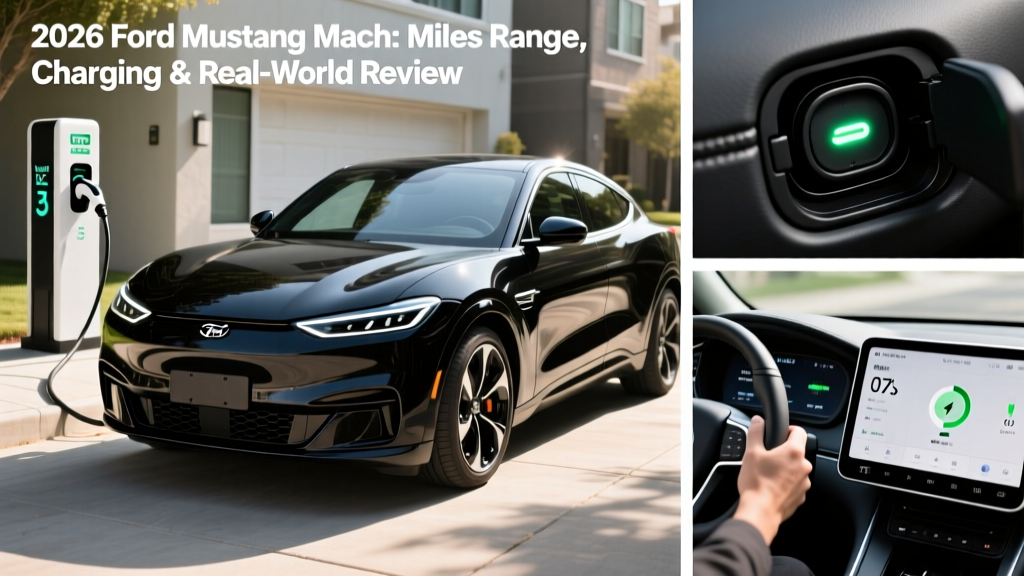
The 2026 Ford Mustang Mach-E enters its sixth model year with a proven formula: competitive EPA range, usable fast-charging speeds, and a starting price that undercuts many rivals after federal incentives. For buyers researching Mach-E miles — how far this electric crossover actually goes on a charge — the answer depends heavily on trim, drivetrain, and driving conditions. The Extended Range RWD model leads the lineup at an EPA-estimated 320 miles, while real-world highway driving and cold weather shave that figure meaningfully. Below, we break down every range, charging, and pricing number you need before signing a purchase agreement.
| Spec | Select SR (RWD) | Premium ER (RWD) | GT (AWD) |
|---|---|---|---|
| EPA Range | 250 mi | 320 mi | 290 mi |
| Battery (usable) | 70 kWh (LFP) | 91 kWh (NMC) | 91 kWh (NMC) |
| Horsepower | 266 hp | 290 hp | 480 hp |
| 0–60 mph | 6.3 sec | 6.1 sec | 3.5 sec |
| Drivetrain | RWD | RWD | Dual-motor AWD |
| Max DC Charge | 135 kW | 150 kW | 150 kW |
| 10–80% DC Time | ~38 min | ~41 min | ~41 min |
| Level 2 Rate | 10.5 kW (~34 mi/hr) | 10.5 kW (~34 mi/hr) | 10.5 kW (~34 mi/hr) |
| MPGe (combined) | 105 MPGe | 101 MPGe | 90 MPGe |
| Base MSRP | $39,995 | $46,495 | $55,995 |
Range Reality: EPA Sticker vs. Real-World Mach-E Miles
EPA Range: Up to 320 miles (Premium Extended Range RWD)
Real-World Expectation: Plan for 260–280 miles on mixed highway driving at 70–75 mph; 200–230 miles in sub-freezing winter conditions. Standard Range models deliver roughly 200–220 miles highway, less in cold.
The EPA's combined-cycle testing favors a mix of city and highway driving with moderate climate loads. On the highway — where EVs are least efficient due to aerodynamic drag — the Mach-E's range contracts noticeably. In our experience, the 320-mile Extended Range RWD model returns approximately 270 miles at a sustained 70 mph on flat terrain in 65°F weather. Push speeds to 80 mph or climb mountain grades, and that figure drops toward 240–250 miles.
Cold weather compounds the loss. Lithium-ion batteries experience increased internal resistance below freezing, and cabin heating draws significant energy (the Mach-E uses a resistive PTC heater on most trims, not a heat pump). Expect a 25–35% range reduction in sustained 20°F weather. The 320-mile ER model realistically delivers 200–230 miles in a Midwest winter. The Standard Range LFP battery is somewhat more resilient to cold-induced degradation over the long term, but its smaller capacity means fewer total miles regardless.
For context on the EPA testing methodology, see fueleconomy.gov's EV range ratings.
Battery Chemistry: LFP vs. NMC in the Mach-E Lineup
Ford equips the Standard Range Mach-E with a 70 kWh (usable) lithium iron phosphate (LFP) battery, while Extended Range and GT trims use a 91 kWh (usable) nickel manganese cobalt (NMC) pack.
| Attribute | LFP (Standard Range) | NMC (Extended Range / GT) |
|---|---|---|
| Energy Density | Lower — heavier pack for same kWh | Higher — more range in similar footprint |
| Cycle Life | 3,000+ cycles to 80% SoH | 1,500–2,000 cycles to 80% SoH |
| Cold Performance | Slightly worse short-term range loss | Better immediate cold-weather output |
| Charging to 100% | Recommended regularly for calibration | Better kept at 80% daily; 100% for trips |
| Cobalt/Nickel Content | None — fewer supply-chain concerns | Contains cobalt and nickel |
| Cost | Lower — enables cheaper trims | Higher — adds to ER trim premium |
The practical takeaway: if you charge at home nightly and commute under 60 miles round-trip, the LFP Standard Range model offers exceptional long-term durability with minimal degradation anxiety. If you regularly drive 200+ miles between charges or take frequent road trips, the NMC Extended Range pack's extra capacity justifies its higher upfront cost.
Charging Speed: DC Fast Charge and Home Level 2
| Charge Level | Power / Voltage | Speed (mi/hr added) | Use Case |
|---|---|---|---|
| Level 1 (120V) | ~1.4 kW | ~3–4 mi/hr | Overnight trickle; emergency top-up |
| Level 2 (240V, 48A) | 10.5 kW | ~34 mi/hr | Home daily charging; full overnight refill |
| DC Fast (Standard Range) | 135 kW peak | ~10–80% in 38 min | Road trips; public fast-charging |
| DC Fast (ER / GT) | 150 kW peak | ~10–80% in 41 min | Road trips; public fast-charging |
The Mach-E's DC fast-charging speed is its most debated specification. At 150 kW peak, it trails rivals like the Hyundai Ioniq 5 (240 kW peak, 10–80% in ~18 minutes) and the Tesla Model Y (~250 kW on V3 Superchargers). However, peak kW tells only part of the story. The Mach-E sustains near-peak power through roughly 50% State of Charge (SoC) before tapering, meaning a 10–80% session averages around 100–110 kW in practice. On a road trip, that translates to roughly 150–160 miles added in a 25-minute stop — adequate but not class-leading.
At home on a Level 2 charger (240V, 48-amp circuit requiring a 60-amp breaker), the Mach-E's onboard charger accepts up to 10.5 kW. A full 0–100% refill of the 91 kWh Extended Range pack takes roughly 9–10 hours, easily achievable overnight. Ford's Mobile Power Cord is included and can handle both 120V and 240V outlets, though a hardwired Level 2 station (such as the ChargePoint Home Flex or Ford Connected Charge Station) delivers the fastest home experience.
The Mach-E uses the NACS (North American Charging Standard) connector as of the 2025 model year, granting native access to Tesla Supercharger stations — a significant advantage for road-trip charging network coverage. CCS adapters are no longer needed.
Performance, Interior, and Technology
The Mach-E lineup spans a wide performance envelope. The base Select SR delivers 266 hp and a 6.3-second 0–60 time — brisk for daily commuting. The GT model's 480 hp and 3.5-second sprint put it in sports-sedan territory, with sharp throttle response and a low center of gravity that makes the crossover feel planted through corners.
Interior space remains a Mach-E strength:
- Cargo (rear seats up): 29.7 cu ft
- Cargo (rear seats folded): 59.7 cu ft
- Front trunk (frunk): 4.7 cu ft (drainable, useful for wet gear)
- Rear legroom: 38.9 inches
- Front headroom: 40.4 inches
The 15.5-inch portrait touchscreen runs Ford's SYNC 4A infotainment system with wireless Apple CarPlay and Android Auto. Over-the-air updates have steadily improved the interface since launch. The available BlueCruise 1.5 hands-free driving system operates on over 130,000 miles of pre-mapped divided highways in the U.S. and Canada.
SAE Automation Level: BlueCruise is a Level 2 driver-assistance system. It provides hands-free steering, acceleration, and braking on qualified highways, but the driver must remain attentive. A driver-facing camera monitors eye gaze. This is not self-driving — you are legally and operationally responsible for the vehicle at all times.
Pricing, Trims, and Federal Tax Credit Eligibility
| Trim | Base MSRP | Est. §30D Credit | Effective Price* |
|---|---|---|---|
| Select SR RWD | $39,995 | $3,750–$7,500 | $32,495–$36,245 |
| Premium ER RWD | $46,495 | $3,750–$7,500 | $38,995–$42,745 |
| Premium ER AWD | $49,495 | $3,750–$7,500 | $41,995–$45,745 |
| GT AWD | $55,995 | $3,750–$7,500 | $48,495–$52,245 |
*Effective price assumes full or partial §30D credit. Actual credit depends on battery sourcing, buyer income, and MSRP caps. Destination charges (~$1,395) not included.
Federal EV tax credit eligibility under IRS §30D is complex and changes as battery sourcing requirements tighten annually. Key rules for 2026:
- MSRP Cap: SUVs/crossovers must be priced at or below $80,000 — all Mach-E trims qualify.
- Income Cap: Modified AGI must not exceed $150,000 (single), $225,000 (head of household), or $300,000 (joint).
- Battery Sourcing: The credit splits into two halves ($3,750 each) — one for critical-mineral sourcing and one for battery-component manufacturing. As of 2026, both requirements are stricter than in prior years, and the exact credit amount for the Mach-E depends on Ford's current supply-chain compliance. Verify the current eligible amount at the point of sale.
- Point-of-Sale Transfer: Buyers can transfer the credit to the dealer at purchase, reducing the purchase price directly rather than waiting for a tax refund.
- Foreign Entity of Concern (FEOC): Battery components from prohibited foreign entities disqualify the component half of the credit.
The Mach-E's battery is assembled in the U.S. (at Ford's Rawsonville Components Plant in Michigan), but critical-mineral sourcing compliance varies by production batch. Always confirm the exact credit amount with your dealer and consult a tax professional before relying on a specific figure.
Warranty and Long-Term Ownership
Ford provides the following warranty coverage for the 2026 Mach-E:
- Battery: 8 years / 100,000 miles (retains ≥70% of original capacity)
- Electric Powertrain: 8 years / 100,000 miles
- Bumper-to-Bumper: 3 years / 36,000 miles
The 70% capacity-retention threshold is industry-standard. In practice, NMC batteries in liquid-cooled packs like the Mach-E's typically lose 8–12% capacity over the first 100,000 miles based on fleet data from earlier model years. LFP packs tend to degrade more slowly, often losing only 5–8% over the same distance, making the Standard Range model a compelling choice for high-mileage commuters who prioritize longevity over maximum single-charge range.
Pros, Cons, and Who the Mach-E Suits Best
Pros
- Competitive 320-mile max EPA range (ER RWD)
- NACS connector — native Tesla Supercharger access
- Spacious cabin with 29.7 cu ft cargo + drainable frunk
- BlueCruise hands-free highway driving available
- LFP battery option for longevity-focused buyers
- Strong GT performance (3.5 sec 0–60)
Cons
- DC fast charging peaks at 150 kW — slower than Hyundai/Kia rivals
- No heat pump on most trims — cold-weather range loss is significant
- Rear visibility compromised by thick C-pillars
- Tax credit amount uncertain due to evolving sourcing rules
- Ride quality firm on GT with 20-inch wheels
Choose the Mach-E if: You want a proven, spacious electric crossover with NACS Supercharger access, competitive range, and available hands-free highway driving. The Premium ER RWD at ~$46,500 (before credit) offers the best range-per-dollar balance.
Look elsewhere if: Fast DC charging is your top priority (consider the Ioniq 5 or EV6 at 240+ kW), you need a heat pump for harsh winters (Hyundai/Kia include one standard), or you require third-row seating (Kia EV9).
Frequently Asked Questions
What is the real-world range of the Ford Mustang Mach-E?
The EPA rates the Extended Range RWD at 320 miles combined. In real-world highway driving at 70 mph, expect 260–280 miles. In freezing weather, plan for 200–230 miles from the ER pack. Standard Range models deliver roughly 200–220 miles highway in mild conditions.
How fast does the Mach-E charge at home and on the road?
On a Level 2 home charger (240V, 48A), the Mach-E adds about 34 miles per hour, fully recharging overnight in 9–10 hours (ER pack). On DC fast chargers, the ER and GT peak at 150 kW, reaching 10–80% in approximately 41 minutes. The Standard Range peaks at 135 kW with a 10–80% time of about 38 minutes.
Does the 2026 Mach-E qualify for the federal EV tax credit?
All trims fall under the $80,000 MSRP cap for SUVs. However, the actual credit amount ($3,750 or $7,500) depends on battery-critical-mineral and component-sourcing compliance, which shifts periodically. Buyer income must also fall under IRS limits ($300,000 joint / $150,000 single). Confirm the current eligible amount with your dealer and review IRS §30D guidance.
Is the Mach-E worth buying over the Tesla Model Y or Hyundai Ioniq 5?
The Mach-E trades class-leading DC charging speed (Ioniq 5 wins at 240 kW) and Supercharger network depth (Model Y's home turf) for a more traditional crossover driving feel, BlueCruise hands-free capability, and a spacious, well-built interior. If NACS access and proven range meet your needs, it remains a strong choice. If charging speed on road trips is paramount, the Ioniq 5 or EV6 recharge notably faster.
What connector does the 2026 Mach-E use?
The 2026 Mach-E uses the NACS (Tesla-style) connector natively, providing direct access to Tesla Supercharger stations without an adapter. This applies to all trims starting with the 2025 model year.
How long will the Mach-E battery last?
Ford warrants the battery for 8 years or 100,000 miles against capacity loss below 70%. Based on fleet data from 2021–2024 models, NMC packs typically lose 8–12% capacity over 100,000 miles, while LFP packs lose 5–8%. With proper charging habits (avoiding sustained 100% SoC on NMC, regular 100% charges on LFP), most owners can expect well over 150,000 miles before meaningful range loss.