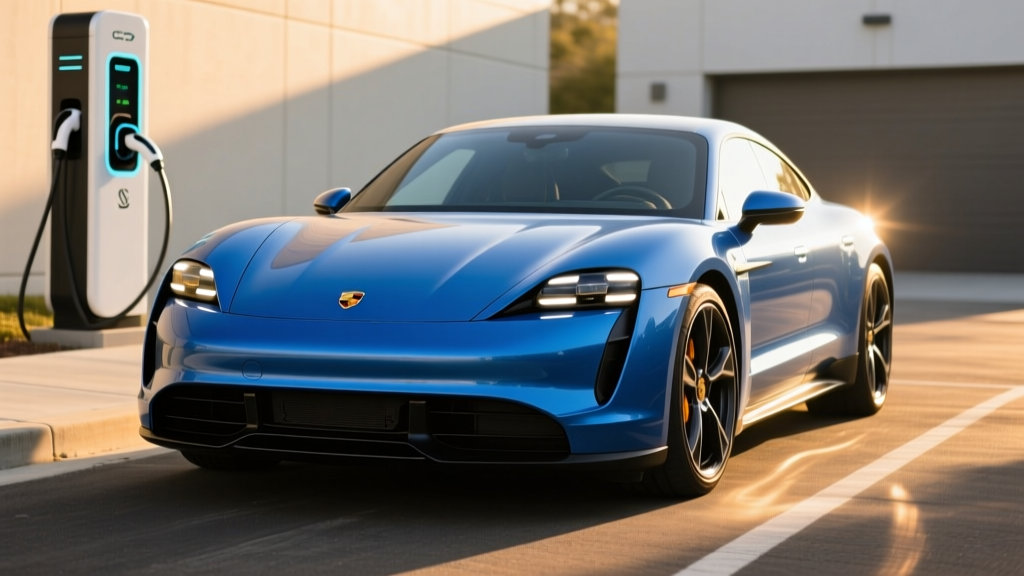
The 2021 Porsche Taycan 4S remains one of the most dynamically accomplished electric sedans ever built, blending sports-car reflexes with a dual-motor all-wheel-drive powertrain and an 800-volt architecture that was years ahead of its competitors. Now firmly in the used-EV market, it presents a compelling — if expensive — proposition for buyers who prioritize driving engagement over maximum range. This review covers the Taycan 4S with the optional Performance Battery Plus, the variant most buyers selected and the one that delivers the headline acceleration figures.
2021 Porsche Taycan 4S: Core Specifications at a Glance
| Spec | Value |
|---|---|
| EPA Range (Performance Battery Plus) | 227 miles |
| EPA Range (Standard Performance Battery) | 203 miles |
| Battery Capacity (Plus) | 93.4 kWh gross / 83.7 kWh usable |
| Battery Chemistry | NMC (Nickel Manganese Cobalt) |
| Drivetrain | Dual-motor AWD (permanent magnet synchronous) |
| Horsepower (Launch Control) | 562 hp (Overboost) |
| Torque | 479 lb-ft |
| 0-60 mph (Porsche claimed) | 3.8 seconds |
| 0-60 mph (independent testing avg.) | 3.4–3.6 seconds |
| Top Speed | 155 mph |
| MPGe (Combined) | 68 MPGe |
| Efficiency | 49 kWh/100 mi |
| Max DC Fast Charge | 270 kW (Plus) / 225 kW (Standard) |
| 10-80% DC Charge Time | ~22.5 minutes (optimal conditions) |
| Level 2 Home Charging | 9.6 kW (onboard charger) |
| Cargo (rear trunk) | 14.3 cu ft |
| Cargo (frunk) | 2.8 cu ft |
| Rear Legroom | 32.7 inches |
| Battery Warranty | 8 years / 100,000 miles |
| Original Base MSRP (4S w/ Plus) | ~$105,150 (before options) |
The 2021 Porsche Taycan 4S 0-60 Story: Why It Beats Its Own Sticker
Porsche officially rates the 2021 Taycan 4S with the Performance Battery Plus at 3.8 seconds to 60 mph using Launch Control. In practice, independent testing by outlets including Car and Driver and Motor Trend consistently recorded times between 3.4 and 3.6 seconds. Porsche has a well-documented history of publishing conservative acceleration figures, and the Taycan 4S is no exception.
The dual-motor AWD system uses a permanent magnet synchronous motor on each axle. The rear motor features a two-speed automatic transmission — a first for a production EV — with a short first gear for brutal launches and a tall second gear for efficient highway cruising. This engineering choice is why the Taycan 4S pulls harder from 30-70 mph than many single-speed EV competitors, even those with higher peak horsepower numbers.
With 562 hp available in Overboost mode (activated during Launch Control), the 4S sits between the base Taycan (402 hp) and the Turbo (670 hp). For real-world driving, the difference between 3.8 and 3.4 seconds is academic — what matters is the instant, linear torque delivery and the way the car squats and launches without wheelspin thanks to the AWD system's millisecond torque vectoring.
Real-World Range: What 227 EPA Miles Actually Means
Real-World Expectation:
• City/mixed driving (mild weather): 210–230 miles
• Highway cruising (70-80 mph, mild): 180–200 miles
• Cold weather (below 32°F, mixed): 155–180 miles
• Cold weather highway: 140–165 miles
The Taycan 4S's EPA-rated 227 miles with the larger 93.4 kWh Performance Battery Plus is modest by 2026 standards, where competitors like the Tesla Model S and Lucid Air offer 350+ miles. Porsche prioritized performance and charging speed over raw range, and the car's efficiency rating of 49 kWh/100 miles reflects that trade-off. According to fueleconomy.gov, the 2021 Taycan 4S earns a combined 68 MPGe.
The 800-volt architecture means the car can sustain higher charge rates longer, partially compensating for the smaller battery. On road trips, the Taycan 4S makes up ground at the charger even if it stops more frequently than a Model S. Still, if your typical drive includes 250+ mile stretches between reliable DC fast chargers, this car will require planning.
Cold weather hits the NMC battery harder than LFP chemistry found in some competitors. Expect 20-30% range reduction in sub-freezing conditions, particularly on highway drives where cabin heating and battery thermal management both draw significant power. The Taycan's heat pump (standard on 2021 models) helps mitigate this, but physics is physics — a 93.4 kWh battery in 20°F weather simply delivers fewer usable miles.
Charging Speed: The 800-Volt Advantage Explained
| Charging Level | Power | Speed / Notes |
|---|---|---|
| Level 1 (120V) | ~1.4 kW | ~3-4 miles per hour — emergency only |
| Level 2 (240V, 40A) | 9.6 kW | ~23 miles per hour; full charge in ~9 hours |
| DC Fast (peak) | 270 kW (Plus battery) | 10-80% in ~22.5 min (optimal conditions) |
| DC Fast (sustained avg.) | ~175-200 kW avg. | Real-world 10-80% typically 25-30 min |
| DC Fast (50 kW station) | 50 kW | 10-80% in ~65 minutes |
The Taycan's 800-volt architecture was groundbreaking in 2021 and remains competitive in 2026. The Performance Battery Plus can accept up to 270 kW at a compatible DC fast charger — meaning you need a 350 kW Electrify America or similar station to see peak speeds. At 270 kW, the charge curve holds strong from roughly 10-40% SoC before tapering progressively. The 10-80% time of 22.5 minutes is Porsche's claim under ideal thermal conditions; in real-world use, expect 25-30 minutes depending on battery preconditioning and ambient temperature.
A critical ownership note: the Taycan uses a CCS1 connector in North America. Porsche did not adopt NACS for the 2021 model year. You can charge at Tesla Superchargers only with a CCS-to-NACS adapter (readily available in 2026 for ~$150-200), but peak speeds may be limited depending on the adapter and Supercharger generation.
For home charging, the 9.6 kW onboard charger adds roughly 23 miles of range per hour on a Level 2 wallbox. A full overnight charge from 20% to 100% takes about 8-9 hours. Most owners will set a daily charge limit of 80-90% to preserve long-term battery health, which still provides 170-190 usable miles — plenty for daily commuting.
Interior, Cargo, and Daily Livability
The Taycan 4S interior is unmistakably Porsche: a curved 16.8-inch digital instrument cluster, a 10.9-inch central touchscreen, and an optional 8.4-inch haptic climate-control panel below it. Build quality is exceptional, with available leather, Race-Tex (Porsche's Alcantara alternative), and carbon-fiber trim. The infotainment system runs Porsche Communication Management (PCM), which supports wireless Apple CarPlay but only wired Android Auto on 2021 models.
Practicality is where the Taycan reveals its sports-sedan compromises. The rear trunk offers 14.3 cubic feet — adequate for a week's luggage for two but tight for a family road trip. The front trunk (frunk) adds just 2.8 cubic feet, enough for a charging cable bag and a small duffel. Rear legroom at 32.7 inches is snug for adults over six feet on longer journeys, and the transmission tunnel hump (a legacy of the platform's engineering) limits the middle rear seat to occasional use.
Driver-assistance tech includes Porsche InnoDrive (adaptive cruise with predictive speed adjustment based on navigation data), lane-keeping assist, and night vision assist. These are SAE Level 2 systems requiring full driver engagement — not autonomous driving. InnoDrive is genuinely impressive on highways, smoothly adjusting speed for upcoming curves and speed limits, but it lacks the lane-change automation of Tesla's Autopilot or GM's Super Cruise.
Pricing, Used Market Value, and Federal Tax Credit Eligibility
When new, the 2021 Taycan 4S with the Performance Battery Plus started around $105,150 before options. Well-equipped examples regularly exceeded $120,000-$130,000 with additions like the Premium Plus package, Adaptive Sport Seats Plus, rear-axle steering, and the Burmester audio system. The 4S was the volume seller in the Taycan lineup, sitting between the base RWD model (~$81,250) and the Turbo (~$152,350).
In the 2026 used-EV market, a 2021 Taycan 4S with 30,000-50,000 miles typically lists between $52,000 and $68,000, depending on condition, options, and battery health. Depreciation has been steep — good news for second-hand buyers, painful for original owners.
| Scenario | Estimated Cost |
|---|---|
| Used 2021 Taycan 4S (avg. market) | $58,000 |
| Federal Used EV Credit (§25E, if eligible) | -$4,000 (30% of sale price, max $4,000) |
| Effective price after credit | ~$54,000 |
| New §30D Credit | Not applicable (used vehicle) |
Tax credit reality check: The $7,500 new-EV federal tax credit under IRS §30D does not apply to used vehicles. However, the §25E Used Clean Vehicle Credit offers 30% of the sale price up to $4,000 for qualifying used EVs. Eligibility requirements include: the vehicle must be sold by a licensed dealer, the sale price must be $25,000 or less (which eliminates most Taycan 4S examples from this credit), buyer income must fall below $75,000 single / $150,000 joint, and the credit can only be claimed once per VIN. Given that most 2021 Taycan 4S examples sell well above $25,000, most buyers will not qualify for the used-EV credit. Consult a tax professional and review current rules at irs.gov.
Pros, Cons, and Who Should Buy the Taycan 4S
- Exceptional driving dynamics — best-in-class steering feel and chassis balance
- 800V architecture enables sustained high-speed DC charging
- Two-speed rear transmission delivers strong mid-range acceleration
- Consistent performance — minimal power loss at low SoC
- Superb build quality and interior materials
- Strong regenerative braking (up to 265 kW recuperation)
- EPA range of 227 miles trails competitors by 100+ miles
- Tight rear seat and limited cargo for a $100K+ sedan
- No NACS port — requires adapter for Tesla Superchargers
- Complex infotainment with haptic panels prone to fingerprints
- Expensive maintenance (Porsche dealer network, tire costs)
- Steep depreciation makes ownership costly if selling within 3 years
Who this EV suits best: The Taycan 4S is ideal for the driving enthusiast who wants an EV that feels like a Porsche first and an electric car second. It excels as a daily-driver sports sedan for commutes under 100 miles round-trip, weekend canyon carving, and occasional road trips where charging infrastructure is reliable. It is not the right choice for families needing rear-seat space, buyers who regularly drive 300+ miles between stops, or anyone prioritizing range-per-dollar above all else.
Key competitors: The Tesla Model S Plaid offers vastly more range (405 mi EPA), faster acceleration (1.99s 0-60), and a Supercharger network — but cannot match the Taycan's steering feel or build quality. The Audi e-tron GT shares the Taycan's J1 platform and 800V architecture with similar range and a slightly more spacious rear seat. The Lucid Air Pure offers 419 miles of range in a luxury sedan package but at a higher entry price.
Battery Warranty, Longevity, and Ownership Costs
Porsche covers the Taycan's high-voltage battery for 8 years or 100,000 miles, whichever comes first, with a capacity retention threshold of 70%. A 2021 model's battery warranty extends through 2029, providing meaningful coverage for second owners. If the battery degrades below 70% of its original 83.7 kWh usable capacity (roughly 58.6 kWh), Porsche will repair or replace it under warranty.
NMC chemistry in the Taycan has proven durable in early data. The 800V system's sophisticated thermal management — liquid cooling with dedicated chillers and heaters — keeps the battery in its optimal temperature window during both fast charging and hard driving. Real-world degradation reports from high-mileage Taycan owners suggest 5-8% capacity loss over the first 60,000 miles, which is in line with industry averages for well-managed NMC packs.
Out-of-warranty battery replacement remains expensive: Porsche has quoted $20,000-$30,000 for a full pack replacement, though individual module replacement may be possible at lower cost. Insurance premiums for the Taycan 4S run 20-35% higher than comparable gas-powered Porsche Panameras, reflecting repair costs and parts pricing. Expect annual insurance of $3,000-$4,500 depending on your profile and location.
Frequently Asked Questions
What is the real-world range of the 2021 Porsche Taycan 4S?
With the Performance Battery Plus, expect 210-230 miles in mild city/mixed driving, 180-200 miles on the highway at 70-80 mph, and 155-180 miles in cold weather. The EPA sticker says 227 miles, but highway speeds and low temperatures significantly reduce that figure.
How fast does the 2021 Taycan 4S charge at home and on the road?
At a 350 kW DC fast charger, the Taycan 4S (Plus battery) peaks at 270 kW and charges from 10-80% in roughly 22-30 minutes depending on conditions. At home on a Level 2 wallbox (9.6 kW), it adds about 23 miles of range per hour, with a full charge taking approximately 9 hours.
Does the 2021 Taycan 4S qualify for the federal EV tax credit?
As a used vehicle, it is not eligible for the $7,500 §30D new-EV credit. The §25E used-EV credit (up to $4,000) requires a sale price of $25,000 or less — and virtually no 2021 Taycan 4S examples sell at that price point. Most buyers will pay full market price with no federal credit. Always verify current rules at irs.gov and consult a tax professional.
Is the 2021 Taycan 4S worth buying vs. a Tesla Model S or Audi e-tron GT?
Choose the Taycan 4S if driving dynamics, build quality, and charging speed matter more than maximum range. Choose the Model S if you want 400+ miles, Supercharger access, and over-the-air updates. Choose the e-tron GT if you want similar performance to the Taycan with a slightly roomier back seat and a lower used-market entry price.
What connector does the 2021 Taycan 4S use?
The 2021 Taycan 4S uses a CCS1 connector for DC fast charging and a J1772 inlet for Level 2 AC charging. It does not have a native NACS (Tesla) port. A CCS-to-NACS adapter (~$150-200) enables Supercharger access, though peak charge speeds may vary.
How reliable is the Taycan's battery over time?
Early data from high-mileage Taycans shows 5-8% degradation over 60,000 miles, which is average for NMC chemistry with active thermal management. Porsche's 8-year/100,000-mile battery warranty (70% capacity threshold) remains in effect for 2021 models through 2029, providing strong protection for used buyers.