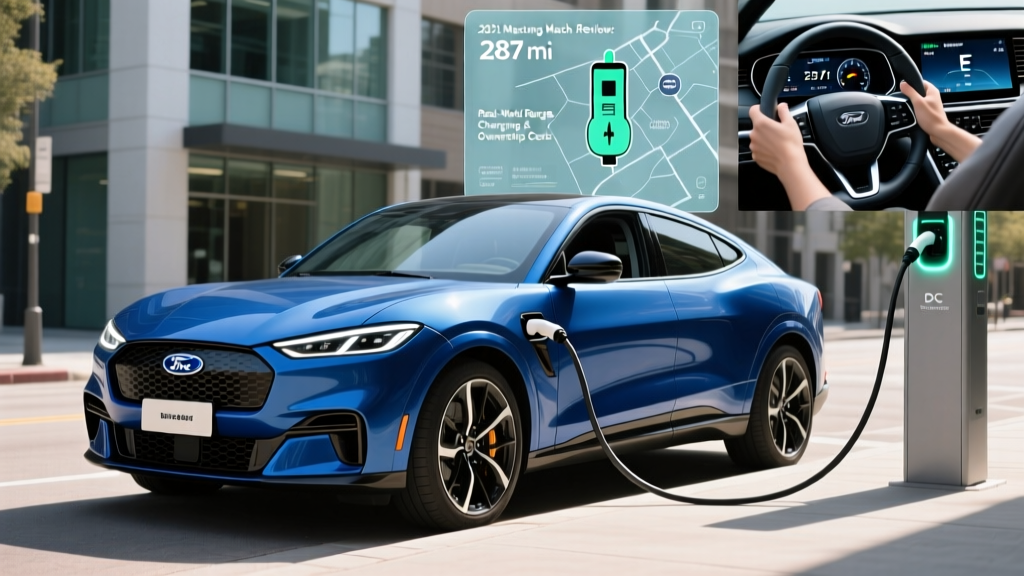
The 2021 Ford Mustang Mach-E was a gamble that paid off. Ford took the most sacred nameplate in its stable and applied it to a battery-electric crossover — and the result was one of the first legitimate Tesla Model Y alternatives to hit American roads. Now, several years into production, the Mach-E has matured through OTA updates, NACS charging adoption, and expanded battery options. But for buyers eyeing the used market or evaluating how the original model-year stacks up, the 2021 Mach-E remains a compelling — and increasingly affordable — entry into EV ownership.
This review breaks down every spec that matters: real-world range versus the EPA sticker, charging speeds across DC fast and home Level 2, the nuances of its NMC battery chemistry, and whether it still qualifies for federal incentives under current IRS §30D rules. Whether you're shopping the used market or benchmarking against newer competitors, here's the data you need.
Range, Battery, and Real-World Efficiency
The 2021 Mach-E shipped with two battery options, both using NMC (nickel manganese cobalt) lithium-ion chemistry supplied primarily by LG Energy Solution. NMC offers higher energy density than LFP, meaning more range per kilogram — but it also means Ford recommends daily charging to 90% rather than 100% to preserve long-term battery health, unless you're prepping for a road trip.
| Spec | Standard Range (SR) | Extended Range (ER) |
|---|---|---|
| Usable Battery Capacity | 68 kWh | 88 kWh |
| Gross Battery Capacity | 75.7 kWh | 98.8 kWh |
| Chemistry | NMC | NMC |
| EPA Range (RWD) | 230 miles | 305 miles |
| EPA Range (AWD) | 211 miles | 270 miles |
| EPA Efficiency (RWD ER) | 101 MPGe combined (34 kWh/100mi) | |
The EPA's 305-mile figure for the Extended Range RWD is achievable in mild city/suburban driving at moderate speeds. On the highway at 70-75 mph, expect 250-270 miles from the ER RWD. In freezing temperatures (below 32°F), range drops 20-30%, putting the ER AWD at roughly 190-215 miles in winter conditions. The Mach-E's heat pump (standard on all trims) helps mitigate cabin-heating energy draw, but cold battery chemistry still limits regen and overall efficiency. Plan conservatively for road trips in cold weather.
For context, fueleconomy.gov lists the ER RWD at 101 MPGe combined, which translates to about 34 kWh consumed per 100 miles of driving. That's competitive with the Model Y Long Range but slightly behind the Hyundai Ioniq 5's efficiency numbers.
Charging Speed: DC Fast Charge and Home Level 2
The 2021 Mach-E originally shipped with a CCS1 charge port. However, Ford began providing complimentary NACS adapters to Mach-E owners in early 2024, unlocking access to Tesla's Supercharger network — a significant upgrade in charging infrastructure access. If you're buying a used 2021 model, confirm whether the adapter was claimed or order one through Ford.
| Charging Level | Power (kW) | Speed / Time |
|---|---|---|
| Level 1 (120V household) | ~1.4 kW | ~3-4 miles per hour |
| Level 2 (240V, 48A mobile charger) | 10.5 kW | ~25-28 miles per hour; full charge in ~9-10 hrs (ER) |
| Level 2 (240V, Ford Connected Charge Station) | 11.5 kW (48A) | ~28-31 miles per hour; full charge in ~8-9 hrs (ER) |
| DC Fast Charge (CCS/NACS w/ adapter) | Peak 150 kW | 10-80% in ~45 minutes (SR); ~52 minutes (ER) |
The Mach-E's peak 150 kW DC fast-charging rate is its most notable limitation compared to newer competitors. The Hyundai Ioniq 5 and Kia EV6, built on 800V architectures, can peak above 230 kW and hit 10-80% in roughly 18 minutes. The Mach-E's 400V architecture and conservative charge curve mean it sustains peak rate only briefly before tapering — particularly above 60% state of charge. On a road trip, you'll spend noticeably more time at chargers than in an Ioniq 5 or a Tesla Model Y (which peaks around 250 kW on V3 Superchargers).
At home, the included Ford Mobile Charger delivers up to 10.5 kW on a 240V/48A NEMA 14-50 outlet, which is adequate for overnight replenishment. The optional Ford Connected Charge Station (a hardwired Wallbox unit) bumps this slightly to 11.5 kW. Either way, you'll wake up with a full battery every morning — the primary advantage of home charging.
Performance and Drivetrain
The Mach-E lineup offers a breadth of performance, from efficient commuter to genuine sports-car territory. All variants use permanent-magnet synchronous motors.
| Trim / Config | Horsepower | Torque (lb-ft) | 0-60 mph | Drivetrain |
|---|---|---|---|---|
| Select / Premium SR RWD | 266 hp | 317 | 5.8 sec | Rear-Wheel Drive |
| Premium ER RWD | 290 hp | 317 | 5.5 sec | Rear-Wheel Drive |
| Select / Premium SR AWD | 266 hp | 428 | 5.2 sec | Dual-Motor AWD |
| Premium ER AWD | 346 hp | 428 | 4.8 sec | Dual-Motor AWD |
| GT (ER AWD) | 459 hp | 612 | 3.5 sec | Dual-Motor AWD |
| GT Performance Edition | 480 hp | 634 | 3.5 sec | Dual-Motor AWD |
The GT Performance Edition's 3.5-second 0-60 time puts it in legitimate sports-car territory, rivaling a Porsche Macan GTS. But even the base RWD model feels quick off the line thanks to instant electric torque — the 5.8-second time is faster than most gas-powered compact SUVs. The dual-motor AWD models also provide genuine all-weather traction, with torque vectoring between front and rear axles.
Pricing, Trims, and Federal Tax Credit Eligibility
The 2021 Mach-E launched with an MSRP range from approximately $43,895 (Select SR RWD) to $65,995 (GT Performance Edition with options). On the used market in 2026, prices have settled considerably — expect to pay roughly $22,000-$38,000 depending on trim, mileage, and battery health.
| Trim | Original MSRP | Est. 2026 Used Range |
|---|---|---|
| Select SR RWD | $43,895 | $22,000 - $26,000 |
| Premium ER RWD | $50,800 | $27,000 - $32,000 |
| Premium ER AWD | $53,100 | $28,000 - $34,000 |
| GT ER AWD | $61,495 | $33,000 - $38,000 |
| GT Perf. Edition | $65,995 | $35,000 - $40,000 |
Federal Tax Credit (§30D): The 2021 Mach-E did qualify for the full $7,500 federal tax credit when new, as Ford had not yet hit the pre-2023 manufacturer cap. Under current 2026 IRS rules, however, the landscape has shifted significantly. If purchasing a used 2021 Mach-E from a dealer, you may qualify for the Used Clean Vehicle Credit (§25E) — up to $4,000 or 30% of the sale price (whichever is lower), provided:
- The vehicle sale price is $25,000 or below
- Your adjusted gross income is ≤ $75,000 (single) / $150,000 (married filing jointly)
- The vehicle is at least 2 model years old (a 2021 model qualifies in 2026)
- You purchase from a licensed dealer (private-party sales excluded)
- You have not claimed the used EV credit in the prior 3 years
For current rules, always verify at IRS.gov's used vehicle credit page. Point-of-sale transfers are available, meaning the dealer can apply the credit as a down-payment reduction at purchase. Consult a tax professional for your specific situation.
Interior Space, Cargo, and Practicality
The Mach-E is sized as a midsize crossover, competing directly with the Tesla Model Y, Hyundai Ioniq 5, and Volkswagen ID.4. It offers comfortable seating for five adults with generous rear legroom and a flat floor thanks to the dedicated EV platform (Ford's Global Electrified Platform, or GE1).
| Measurement | Value |
|---|---|
| Front Headroom | 40.4 in |
| Rear Headroom | 38.9 in |
| Front Legroom | 43.3 in |
| Rear Legroom | 38.9 in |
| Cargo Volume (rear seats up) | 29.7 cu ft |
| Cargo Volume (rear seats folded) | 59.7 cu ft |
| Front Trunk (Frunk) | 4.7 cu ft (drainable, with dividers) |
The 29.7 cu ft rear cargo area is competitive but trails the Model Y's ~30 cu ft (behind the second row) and significantly trails the Ioniq 5's 27.2 cu ft with a more usable shape. The frunk is a practical bonus — its drainable design means you can use it as a cooler for tailgating, a feature Ford marketed heavily.
Technology, Driver Assistance, and Software
The 2021 Mach-E debuted Ford's SYNC 4A infotainment system on a massive vertically oriented 15.5-inch touchscreen — one of the largest in any production vehicle at launch. The interface is responsive, supports wireless Apple CarPlay and Android Auto, and features a physical volume knob integrated into the bottom of the screen (a smart ergonomic choice).
Ford Co-Pilot360 Assist 2.0 comes standard and includes:
- Adaptive cruise control with stop-and-go
- Lane centering assist
- Automatic emergency braking with pedestrian detection
- Blind-spot monitoring with rear cross-traffic alert
- Evasive steering assist
Ford Co-Pilot360 and the available BlueCruise (added via OTA update in late 2021/2022 for qualified vehicles) are SAE Level 2 driver-assistance systems. BlueCruise enables hands-free driving on pre-mapped divided highways (over 130,000 miles of road in the US/Canada), but the driver must remain attentive and is monitored by a driver-facing camera. This is not autonomous driving — you are responsible for the vehicle at all times. Only Level 4 services like Waymo operate without a human driver.
The Mach-E has received continuous over-the-air (OTA) software updates since launch, adding features like BlueCruise hands-free driving, improved battery preconditioning for DC charging, new drive modes, and UI refinements. This is one of the Mach-E's underappreciated strengths — a 2021 model purchased in 2026 may have substantially more capability than when it left the factory.
Notable drawbacks: Early 2021 build vehicles experienced some software bugs (phantom braking, SYNC freezes) that were largely resolved through OTA patches. The panoramic glass roof lacks a shade, which can make the cabin warm in summer. And the absence of a rear wiper (shared with many EVs) is a persistent annoyance in rain.
Warranty and Long-Term Battery Outlook
Ford provides the following warranty coverage for the 2021 Mach-E:
- Battery: 8 years / 100,000 miles (retains ≥70% of original capacity)
- Electric Powertrain Components: 8 years / 100,000 miles
- Bumper-to-Bumper: 3 years / 36,000 miles
- Corrosion Perforation: 5 years / unlimited miles
The 70% capacity retention threshold is industry-standard but worth noting — it means Ford considers a battery "within spec" even if it has degraded 30%. Real-world data from early Mach-E owners suggests degradation has been modest, with most vehicles retaining 90-94% of original capacity after 3-4 years and 40,000-60,000 miles. NMC chemistry, when charged to 90% daily and only taken to 100% for road trips, tends to age gracefully.
If you're buying used, request a battery health report from Ford (accessible through the FordPass app or a dealership diagnostic scan) to check current State of Health (SoH) before purchasing.
How It Compares: Mach-E vs. Key Competitors
| Attribute | 2021 Mach-E ER AWD | 2021 Tesla Model Y LR AWD | 2022 Hyundai Ioniq 5 AWD |
|---|---|---|---|
| EPA Range | 270 mi | 326 mi | 256 mi |
| Battery (usable) | 88 kWh (NMC) | ~75 kWh (NMC/NCA) | 77.4 kWh (NMC) |
| DC Fast Charge Peak | 150 kW | 250 kW | 233 kW |
| 10-80% DC Time | ~52 min | ~30 min | ~18 min |
| 0-60 mph | 4.8 sec | 4.8 sec | 5.2 sec |
| Cargo (seats up) | 29.7 cu ft | 30.2 cu ft | 27.2 cu ft |
| NACS Native / Adapter | Adapter (free from Ford) | Native NACS | Adapter available |
The Mach-E's biggest competitive disadvantage is DC fast-charging speed. At 150 kW peak, it's significantly slower than both the Model Y and Ioniq 5 on road trips. If you regularly take trips exceeding 200 miles, this matters — you'll add 15-25 extra minutes per charging stop compared to the Ioniq 5.
Where the Mach-E wins: ride quality and interior refinement. Its suspension tuning is more compliant than the Model Y's firm setup, and the cabin materials feel more traditional-luxury than Tesla's minimalist approach. BlueCruise, on mapped highways, is also a competitive hands-free system that feels intuitive.
✅ Pros
- Engaging, car-like driving dynamics with quick acceleration
- Comfortable ride quality superior to Model Y
- Massive 15.5" SYNC 4A screen with wireless CarPlay/Android Auto
- BlueCruise hands-free driving (via OTA) on 130K+ miles of highway
- Drainable frunk for practical storage
- Continuous OTA updates adding features post-purchase
- NACS adapter access to Supercharger network
- Competitive used pricing in 2026
❌ Cons
- 150 kW peak DC charging is slow vs. newer competitors
- Real-world highway and cold-weather range falls short of EPA
- No rear wiper
- Panoramic roof lacks a sunshade
- Early build software bugs (mostly patched via OTA)
- NMC battery recommends 90% daily charge limit
- AWD Extended Range range (270 mi EPA) trails Model Y LR
- Used tax credit limited to vehicles priced ≤$25,000
Who Should Buy the 2021 Mach-E?
Choose the 2021 Mach-E if:
- You want a sporty, engaging EV crossover with a refined ride
- You primarily commute and take shorter road trips (<200 miles between stops)
- You value traditional automotive interior quality over minimalist design
- You want BlueCruise hands-free highway driving
- You're shopping the used market and want strong value at $25K-$35K
Look elsewhere if:
- Road-trip charging speed is a top priority (consider Ioniq 5, Model Y)
- You need maximum EPA range for long commutes in cold climates
- You prefer LFP chemistry for 100% daily charging convenience
- You need three rows of seating (look at the Kia EV9 or Rivian R1S)
Frequently Asked Questions
What is the real-world range of the 2021 Mustang Mach-E?
The EPA rates the Extended Range RWD at 305 miles and the Extended Range AWD at 270 miles. In real-world highway driving at 70-75 mph, expect roughly 250-270 miles (ER RWD) or 220-240 miles (ER AWD). In freezing weather, subtract another 20-30%. The Standard Range models will deliver 175-200 miles in mixed real-world use.
How fast does the 2021 Mach-E charge at home and on the road?
At home on a 240V Level 2 charger, it adds roughly 25-31 miles of range per hour, fully charging overnight in 8-10 hours. On DC fast chargers, it peaks at 150 kW and charges from 10-80% in approximately 45 minutes (Standard Range) or 52 minutes (Extended Range). This is slower than competitors like the Ioniq 5 (~18 min) or Model Y (~30 min).
Does the 2021 Mach-E qualify for a federal tax credit in 2026?
As a used vehicle, it may qualify for the §25E Used Clean Vehicle Credit of up to $4,000, but only if the dealer sale price is $25,000 or less, your income is below IRS thresholds ($75K single / $150K joint), and you haven't claimed the used credit in the past 3 years. Verify current rules at IRS.gov.
Is the 2021 Mach-E worth buying over a Tesla Model Y or Ioniq 5?
It depends on priorities. The Mach-E offers superior ride comfort and a more traditional interior versus the Model Y, plus BlueCruise hands-free capability. However, the Model Y has longer range and faster charging, and the Ioniq 5 charges dramatically faster. On the used market, the Mach-E often undercuts both on price, making it a strong value play for buyers who don't regularly road-trip.
Can I use Tesla Superchargers with a 2021 Mach-E?
Yes. Ford provides a complimentary NACS adapter for Mach-E owners, enabling access to Tesla's Supercharger network (which has 15,000+ stalls in North America). The adapter connects to the Mach-E's CCS port and communicates via the FordPass app for billing. Confirm adapter availability when purchasing used.
How long will the Mach-E's battery last?
Ford warranties the battery for 8 years / 100,000 miles at ≥70% capacity retention. Early owner data and NMC chemistry trends suggest most Mach-E batteries will retain 85-92% capacity at 100,000 miles when properly maintained (90% daily charge limit, avoiding prolonged 100% storage). A full battery replacement, if needed out of warranty, is estimated at $12,000-$18,000 depending on the pack size.