Quick Verdict: The 2020 Tesla Model X in 2026
The 2020 Tesla Model X occupies a specific niche in today's used EV market: a three-row electric SUV with genuine long-range capability, access to the Supercharger network, and the distinctive Falcon Wing rear doors. In 2026, it remains one of the few used EVs that can comfortably handle 300-mile road trips with minimal charging stops while carrying six or seven passengers.
However, buyers should approach the 2020 Model X with realistic expectations. This was the final year before Tesla's major 2021 refresh (which brought the "Plaid" powertrain, yoke steering option, and updated interior), so you're getting the older interior architecture, slower Supercharging speeds than current models, and a pre-refresh design. The upside? Depreciation has been steep, making this a compelling value in the used luxury EV segment — especially with the potential for a $4,000 federal used-EV tax credit.
2020 Tesla Model X Specifications
| Specification | Long Range | Performance (Raven) |
|---|---|---|
| EPA Range | 325 miles | 305 miles |
| Battery Capacity (Usable) | ~95 kWh (100 kWh pack) | ~95 kWh (100 kWh pack) |
| Battery Chemistry | NMC (Nickel Manganese Cobalt) | NMC (Nickel Manganese Cobalt) |
| Drivetrain | Dual Motor AWD | Dual Motor AWD |
| Horsepower | ~417 hp (combined) | ~534 hp (combined, Ludicrous Mode) |
| 0-60 mph | 4.4 seconds | 2.7 seconds (Ludicrous) |
| Top Speed | 155 mph | 163 mph |
| MPGe (Combined) | 101 MPGe | 96 MPGe |
| Efficiency (kWh/100 mi) | 33 kWh/100 mi | 35 kWh/100 mi |
| Max DC Fast Charge Rate | 250 kW (V3 Supercharger) | 250 kW (V3 Supercharger) |
| 10-80% DC Fast Charge Time | ~35 minutes | ~35 minutes |
| Level 2 Home Charge Rate | 11.5 kW (48A) | 11.5 kW (48A) |
| Level 2 Miles Per Hour | ~34 mi/hr | ~32 mi/hr |
| Original Base MSRP | $84,990 | $104,990 |
| 2026 Used Price Range (est.) | $35,000–$48,000 | $42,000–$58,000 |
| Battery Warranty (Original) | 8 years / 150,000 miles | 8 years / 150,000 miles |
Sources: EPA / fueleconomy.gov, Tesla 2020 Model X owner's manual.
Range and Efficiency: Real-World Expectations
The 2020 Model X uses a 100 kWh battery pack (approximately 95 kWh usable) with NMC chemistry. This was Tesla's largest pack at the time, and it provides genuine long-distance capability. However, the Model X's boxy shape and 5,000+ pound curb weight mean efficiency suffers compared to the Model S sedan or newer, more aerodynamic SUVs like the BMW iX.
According to fueleconomy.gov, the Long Range achieves 101 MPGe combined (33 kWh per 100 miles). In practice, highway driving at sustained speeds will push consumption to 35–38 kWh/100 mi, while city driving with frequent regenerative braking opportunities can drop it to 28–30 kWh/100 mi. This is important for trip planning: a 300-mile highway drive in summer conditions will likely require one 15–20 minute Supercharger stop, while the same trip in winter may need two shorter stops or one longer one.
Charging Speeds and Infrastructure
| Charging Method | Power (kW) | Speed (miles/hour) | Time for Full Charge |
|---|---|---|---|
| Level 1 (120V outlet) | 1.4 kW | ~4 mi/hr | ~90+ hours |
| Level 2 (240V, 48A) | 11.5 kW | ~34 mi/hr | ~10 hours |
| DC Fast (V3 Supercharger, 250 kW) | 250 kW peak | ~350 mi/hr (peak) | 10-80% in ~35 min |
| DC Fast (V2 Supercharger, 150 kW) | 150 kW peak | ~210 mi/hr (peak) | 10-80% in ~45 min |
The 2020 Model X supports up to 250 kW peak charging on Tesla's V3 Superchargers, though sustained speeds are considerably lower. The charging curve peaks around 250 kW between 10–20% state of charge, then tapers progressively: expect ~180 kW at 30%, ~120 kW at 50%, and ~50 kW above 70%. This taper is why the 10-80% time of approximately 35 minutes is the relevant metric, not the peak kW number.
For home charging, the onboard charger accepts up to 11.5 kW (48 amps) on a 240V circuit. This requires a 60-amp dedicated circuit and a Tesla Wall Connector or equivalent J1772 adapter setup. Installation costs typically range from $800–$2,500 depending on panel capacity and run distance from your electrical panel to the garage — factor in a potential $1,500–$3,000 panel upgrade if your home has a 100-amp service panel rather than 200-amp.
The Model X uses Tesla's proprietary connector for Supercharging. As of 2026, Tesla has opened portions of the Supercharger network to non-Tesla EVs, but Model X owners retain native access with no adapters required. For non-Tesla DC fast chargers (Electrify America, EVgo), you'll need a CCS-to-Tesla adapter, which Tesla sells for approximately $250.
Performance and Drivetrain
The 2020 Model X comes in two trims, both with dual-motor all-wheel drive:
- Long Range: 417 hp combined, 0-60 mph in 4.4 seconds. This is the efficiency-focused variant and the one most buyers should target for daily use and road trips.
- Performance (with Ludicrous Mode): 534 hp combined, 0-60 mph in 2.7 seconds. This is supercar territory in a three-row SUV, but it costs approximately 10–15% more on the used market and sacrifices 20 miles of EPA range.
Both trims feature Tesla's dual-motor AWD system with torque vectoring, providing confident traction in rain and light snow. The air suspension is standard and allows ride height adjustment — useful for steep driveways, speed bumps, or light off-pavement use. However, air suspension repairs on older Teslas can cost $2,000–$4,000 per corner if failure occurs outside warranty, so verify operation during a pre-purchase inspection.
Interior, Cargo, and Technology
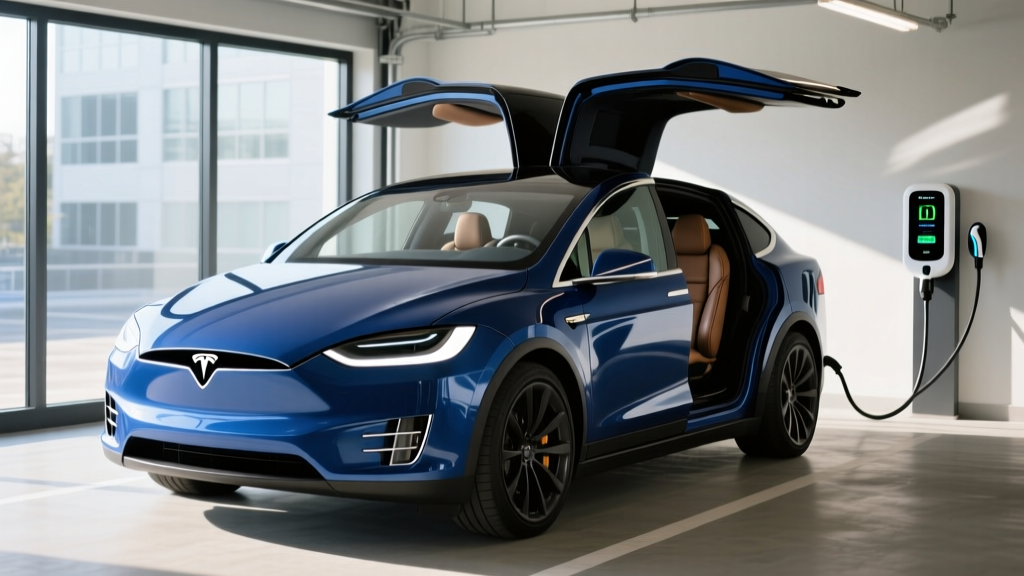
The 2020 Model X seats six (standard, with second-row captain's chairs) or seven (optional bench second row). Third-row access is via the Falcon Wing doors, which open vertically and provide excellent headroom for entry. However, the Falcon Wings have a mixed reputation: they're attention-grabbing and functional in tight parking spaces (requiring only 12 inches of side clearance), but they're slower to operate than conventional doors, can leak in heavy rain on early-build examples, and have been subject to multiple service bulletins.
Cargo capacity:
- Behind third row: 25.7 cubic feet
- Third row folded: 56.6 cubic feet
- Both rows folded: 88.1 cubic feet
- Front trunk (frunk): 6.5 cubic feet
The 17-inch touchscreen runs Tesla's infotainment system, which in 2020 included navigation, streaming media (Spotify, Netflix, YouTube while parked), a web browser, and over-the-air updates. The 2020 Model X does not have the newer "Rear Entertainment Screen" found in 2021+ refreshes. Autopilot (basic) is standard, including adaptive cruise control and lane-keeping assist. Full Self-Driving (FSD) capability was a $7,000 option — but remember, this is SAE Level 2 driver assistance, not autonomous driving. You must remain engaged and supervise the system at all times.
Pricing and Federal Tax Credits
On the used market in 2026, expect to pay approximately $35,000–$48,000 for a 2020 Model X Long Range and $42,000–$58,000 for a Performance trim, depending on mileage, condition, and battery health. These figures represent significant depreciation from the original $84,990–$104,990 MSRPs.
- Buyer income cap: $75,000 single / $112,500 head of household / $150,000 joint (modified AGI)
- Vehicle sale price must be $25,000 or less to qualify for the full $4,000 (partial credit above that)
- Vehicle must be at least 2 model years old (2020 qualifies in 2026)
- Must purchase from a licensed dealer (private-party sales do not qualify)
- Credit can be transferred to the dealer at point of sale for an immediate price reduction
Battery Health, Warranty, and Longevity
The 2020 Model X battery warranty covers 8 years or 150,000 miles (whichever comes first) with a minimum 70% capacity retention guarantee. Since 2020 models are now 6 years old in 2026, most examples will have 2–4 years of battery warranty remaining, assuming they're under 150,000 miles.
Tesla's NMC battery packs from this era typically show 8–12% degradation over the first 100,000 miles based on owner-reported data. A 2020 Model X with 60,000 miles and 90% battery health would still offer approximately 292 miles of range (Long Range), which is entirely adequate for most use cases.
Pre-purchase checklist for battery health:
- Check the in-car "Battery Health" screen (introduced in 2023 via OTA update) for degradation percentage
- Review Supercharging history — frequent DC fast charging (more than 80% of total charges) may indicate fleet/ride-share use and accelerated wear
- Verify the car has not had a battery replacement under warranty (this resets the battery warranty clock)
- Look for software-reported "maximum range" at 100% charge and compare to the original EPA sticker
Pros and Cons
- Genuine 270+ mile real-world range for road trips
- Access to Tesla Supercharger network (most reliable DC fast-charging infrastructure)
- Three-row seating with Falcon Wing doors for easy third-row access
- Strong performance even in Long Range trim (4.4s 0-60)
- Over-the-air updates continue to add features years after purchase
- Significant depreciation makes it more accessible on the used market
- Falcon Wing doors are slow, prone to service issues, and polarizing
- Pre-refresh interior feels dated compared to 2021+ models
- Air suspension can be expensive to repair out of warranty
- Lower efficiency (MPGe) than newer, more aerodynamic EV SUVs
- No rear entertainment screen or yoke steering option
- Insurance costs are above average for the segment
Who Should Buy the 2020 Tesla Model X?
Buy it if:
- You need three-row seating and genuine 250+ mile range for family road trips
- You value Supercharger network access for reliable long-distance travel
- You want strong performance and AWD capability in a used EV
- You can charge at home (Level 2) and have access to destination charging or Superchargers for trips
- You find a well-maintained example with documented battery health
Consider alternatives if:
- You primarily drive in cities and don't need three rows (a Model Y or Hyundai Ioniq 5 offers better efficiency and lower cost)
- You want the latest interior tech and design (wait for a 2021+ Model X refresh or consider a BMW iX)
- You're concerned about potential out-of-warranty repair costs for air suspension or Falcon Wing mechanisms
- You need towing capacity beyond 5,000 pounds (the Model X is rated for 5,000 lbs, but real-world range while towing drops by 40–50%)
Frequently Asked Questions
What is the real-world range of the 2020 Tesla Model X?
Expect 270–290 miles on the highway in mild weather, and 240–260 miles in cold conditions (below 40°F). The EPA rates the Long Range at 325 miles, but sustained highway speeds and battery thermal management reduce that figure in practice.
How fast does the 2020 Model X charge at home and on road trips?
At home on a Level 2 charger (240V, 48A), it adds approximately 34 miles per hour, requiring about 10 hours for a full charge. On a V3 Supercharger (250 kW), it charges from 10–80% in roughly 35 minutes, though peak speeds taper significantly above 50% state of charge.
Does the 2020 Tesla Model X qualify for the federal EV tax credit?
Not the new-vehicle §30D credit (that expired for Tesla in 2019). However, it may qualify for the §25E used clean vehicle credit: up to $4,000 (30% of sale price) if purchased from a dealer and your income is below IRS caps ($75k single / $150k joint). The credit can be applied at point of sale. See IRS.gov for full eligibility rules.
Is the 2020 Model X worth buying vs. newer competitors?
At $35,000–$48,000 used, it offers compelling value for families needing three rows and long range. However, the 2021+ refresh brought significant improvements (Plaid powertrain, updated interior, rear screen). If your budget allows $55,000+, a 2021 Model X or a BMW iX xDrive50 may offer better long-term satisfaction. For budget-conscious buyers, the 2020 remains a solid choice with proper pre-purchase inspection.
What are the biggest reliability concerns?
The Falcon Wing door mechanisms, air suspension, and MCU (Media Control Unit) screen delamination are the most commonly reported issues. Battery and drive unit failures are rare under 100,000 miles. Verify all doors open/close smoothly, suspension raises/lowers without warning messages, and the touchscreen is responsive with no discoloration.
Can I use non-Tesla DC fast chargers with the 2020 Model X?
Yes, but you'll need a CCS-to-Tesla adapter (approximately $250 from Tesla or third-party suppliers). The Model X can charge at CCS stations like Electrify America and EVgo, though you'll typically see speeds limited to 150–180 kW depending on the station's capability and your battery's state of charge.