Quick Verdict: The 2016 Model S 70D a Decade Later
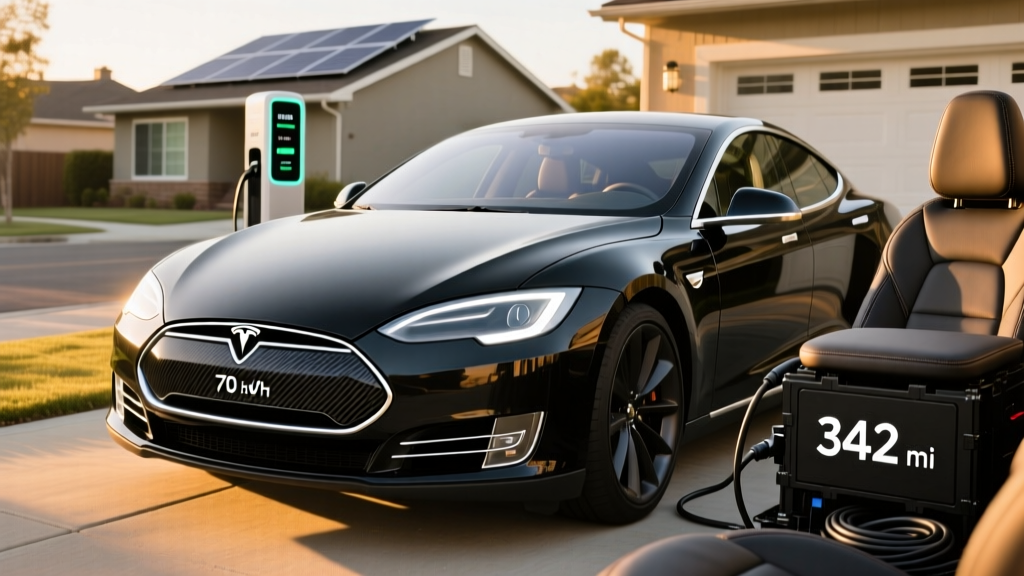
The 2016 Tesla Model S 70D occupies a fascinating position in the used EV market in 2026. It was Tesla's dual-motor, all-wheel-drive entry point — a luxury sedan that delivered 240 miles of EPA-estimated range, 329 horsepower, and a 5.2-second 0-60 mph time at a base MSRP of $71,200 when new. Today, it trades on the used market between roughly $14,000 and $22,000 depending on mileage, battery state of health (SoH), and Autopilot hardware generation.
For budget-conscious buyers seeking a premium electric sedan with genuine road-trip capability and access to the Tesla Supercharger network, the 70D remains compelling — but only if the battery checks out. Degradation on early 70D packs (which used Panasonic NCA chemistry) is the single most important variable in this purchase. Let's break down exactly what you're getting.
Range, Battery, and Efficiency
| Spec | Value |
|---|---|
| EPA Range | 240 miles |
| Battery Capacity (Total) | 71.2 kWh |
| Battery Capacity (Usable) | ~68.8 kWh |
| Battery Chemistry | Panasonic NCA (Nickel Cobalt Aluminum) |
| EPA Efficiency | 101 MPGe combined (33 kWh/100mi) |
| Drivetrain | Dual Motor AWD |
The 70D's battery pack uses 18650-format Panasonic cells with NCA cathode chemistry — the same cell format Tesla used across the original Model S lineup before transitioning to the larger 2170 cells in later vehicles. NCA offers excellent energy density but is more susceptible to calendar degradation than the LFP (lithium iron phosphate) chemistry Tesla introduced in later Model 3/Y Standard Range vehicles.
According to aggregated fleet data, a 10-year-old Model S battery with ~100,000–130,000 miles typically retains 78–88% of its original capacity. That means a 70D that started with ~68.8 kWh usable might now offer 54–61 kWh — translating to roughly 195–220 miles of real-world range in mixed driving. This is the critical inspection point for any buyer.
Charging Speed: Supercharger and Home
| Charging Method | Max Power (kW) | Speed | Notes |
|---|---|---|---|
| DC Fast Charge (Supercharger V2) | ~120 kW peak | 10–80% in ~38–42 min | Peak rate sustained only below 50% SoC; tapers sharply above 70% |
| DC Fast Charge (CHAdeMO adapter) | ~50 kW | 10–80% in ~75 min | Requires optional Tesla CHAdeMO adapter |
| Level 2 (240V, 48A onboard charger) | 11.5 kW | ~29 miles/hr | Dual charger option required for full 48A; base is 40A (9.6 kW) |
| Level 2 (240V, 40A standard) | 9.6 kW | ~24 miles/hr | Standard single onboard charger |
| Level 1 (120V, 12A) | 1.4 kW | ~3 miles/hr | Emergency/trickle only |
The 2016 70D charges natively via Tesla's proprietary connector, which gives it direct access to the Tesla Supercharger network — still the most reliable and widespread DC fast-charging network in the US. At a V2 Supercharger (150 kW capable), the 70D peaks around 120 kW but only sustains that rate up to roughly 45–50% state of charge. Above 70% SoC, the charge curve tapers significantly, dropping below 40 kW. This means the 10–80% charge takes roughly 38–42 minutes — acceptable for road-trip stops but noticeably slower than modern EVs on 800V architectures that achieve 10–80% in 18–20 minutes.
At home on a Level 2 wall connector, the 70D's onboard charger is the bottleneck. Base models came with a 40A (9.6 kW) onboard charger; the optional dual-charger configuration supports 48A (11.5 kW). On a 48A circuit, you'll add roughly 29 miles of range per hour — enough to fully recharge the pack in about 6.5 hours from empty. Most 70D owners install a Tesla Wall Connector or a 48A-capable Level 2 unit on a 60A circuit.
Important for 2026 buyers: Tesla now sells a NACS-to-CCS adapter, and many third-party networks are installing NACS (Tesla-style) connectors. The 70D's native Tesla port is actually an advantage as the industry converges on NACS.
Performance and Driving Dynamics
| Metric | Value |
|---|---|
| 0–60 mph | 5.2 seconds |
| Horsepower | 329 hp (combined dual motor) |
| Torque | 387 lb-ft |
| Top Speed | 140 mph |
| Drivetrain | Dual Motor AWD (front + rear AC induction motors) |
| Curb Weight | ~4,688 lbs |
The dual-motor setup pairs two AC induction motors — one front, one rear — for permanent all-wheel drive with torque-vectoring capability. The 5.2-second 0-60 time still feels genuinely quick in 2026 traffic, and the instant torque delivery from standstill is something no gas sedan at this price point can match. The 70D lacks the air suspension found on higher trims (85D, P85D, P90D) unless equipped as an option; most 70Ds ride on the standard coil spring suspension, which delivers a firm but well-damped ride.
Regenerative braking on the 70D is strong enough for one-pedal driving in most city conditions. There is no adjustable regen setting — Tesla's single-mode regen was standard across the fleet at this time. Highway driving is quiet and stable, though the large glass roof does let in noticeable heat on summer days (the pano roof lacks a powered shade).
Interior, Tech, and Driver Assistance
The 2016 Model S interior centers on the now-iconic 17-inch portrait touchscreen, which in 2016 was revolutionary and in 2026 still impresses for its size, though the resolution and responsiveness lag behind Tesla's newer Ryzen-powered infotainment systems. The instrument cluster is a small digital display behind the steering wheel — functional but dated compared to modern EV competitors with heads-up displays and augmented-reality navigation.
Autopilot Hardware: This is a critical fork for 2016 Model S buyers. Vehicles built before approximately October 2016 have Hardware 1 (HW1), which uses a single forward-facing camera and Mobileye-based processing. HW1 supports basic Autopilot (lane centering, adaptive cruise, auto emergency braking) but cannot run Full Self-Driving (FSD) software. Vehicles built from late October 2016 onward have Hardware 2 (HW2), which includes 8 cameras and NVIDIA-based processing. HW2 vehicles received an HW3 computer retrofit (free from Tesla) enabling current FSD (Supervised) capability.
Cargo and Passenger Space:
- Rear trunk: 26.3 cu ft (with rear seats up)
- Front trunk (frunk): 5.3 cu ft
- Total cargo with rear seats folded: 58.1 cu ft
- Rear legroom: 35.4 inches
- Front legroom: 42.7 inches
- Optional rear-facing third-row seats (2 small children): available but extremely rare on 70D
The Model S remains one of the most practical luxury sedans for cargo, with a massive hatchback-style trunk opening and a usable frunk. Five adults can ride comfortably on shorter trips, though the rear center position is compromised by the floor tunnel (housing wiring and cooling lines, unlike a flat-floor EV skateboard).
Pricing, Tax Credits, and Used-EV Economics
| Item | Value |
|---|---|
| Original Base MSRP (2016) | $71,200 |
| Typical As-Tested Price (2016) | $76,000–$82,000 (with options) |
| 2026 Used Market Range | $14,000–$22,000 |
| Federal Used EV Tax Credit (§25E) | Up to $4,000 (30% of sale price, max $4,000) |
| §25E Income Cap (2026) | $75K single / $112.5K head of household / $150K joint |
| §25E Vehicle Price Cap | $25,000 sale price |
| New EV Credit (§30D) Eligibility | Not eligible — new-vehicle credit only applies to new purchases |
The 2016 Model S 70D does not qualify for the new-vehicle federal tax credit (IRS §30D) since it is a used vehicle. However, it may qualify for the Used Clean Vehicle Credit (§25E), which provides 30% of the sale price up to a maximum of $4,000. To qualify:
- The vehicle must be purchased from a licensed dealer (private-party sales do not qualify)
- The sale price must be $25,000 or less
- Buyer adjusted gross income must fall under IRS caps ($75K single, $150K joint filers for 2026)
- The vehicle must be at least two model years old (2016 qualifies)
- The credit can be transferred to the dealer at point of sale for an immediate price reduction
At a typical $18,000 sale price, a qualifying buyer could receive $4,000 off (30% of $18,000 = $5,400, but the cap is $4,000), bringing the effective cost to roughly $14,000. This makes the 70D one of the most affordable entries into the Tesla Supercharger ecosystem. Verify current rules at IRS.gov §25E before purchasing, as incentive rules are subject to legislative change.
Warranty and Battery Longevity
When new, the 2016 Model S 70D came with:
- Battery & Drive Unit Warranty: 8 years / 125,000 miles (whichever comes first), with no explicit capacity retention guarantee — Tesla replaced packs that fell below approximately 70% SoH within the warranty period
- New Vehicle Limited Warranty: 4 years / 50,000 miles (expired on all 2016 models)
In 2026, virtually all 2016 70Ds are out of battery warranty unless the vehicle is under 125,000 miles and still within 8 years of its original in-service date (some late-2016 deliveries may have warranty extending into early 2025). This is a major consideration: a replacement battery pack from Tesla costs approximately $12,000–$16,000 for the 70D, and third-party refurbished packs run $8,000–$12,000 installed.
Battery care tips for a 2016 70D owner:
- Charge daily to 80–90% (NCA chemistry does not tolerate sitting at 100% for extended periods)
- Avoid letting SoC drop below 10% for more than a few hours
- Minimize DC fast charging to road trips only — daily Level 2 charging extends pack life
- Precondition the battery before Supercharging (the car does this automatically when a Supercharger is set as the navigation destination)
Pros, Cons, and Who Should Buy
- Access to Tesla Supercharger network (most reliable DC fast-charging in the US)
- Genuine AWD capability with dual-motor traction
- Massive cargo capacity for a sedan (26.3 cu ft trunk + frunk)
- Over-the-air software updates still supported in 2026
- Used EV tax credit (§25E) can save up to $4,000
- Strong regenerative braking for one-pedal city driving
- 17-inch touchscreen still impressive for the price point
- Out of battery warranty — replacement costs $12K–$16K
- NCA battery degradation reduces real-world range to 190–210 mi (or less)
- DC fast charging peaks at ~120 kW and tapers early — slow vs. modern EVs
- HW1 Autopilot vehicles cannot run FSD; verify hardware generation before buying
- No heat pump — resistive cabin heater reduces winter range significantly
- Aging interior materials (door handles, seat bolsters, MCU screen delamination)
- Insurance costs can be elevated for older Tesla vehicles
Who the 2016 Model S 70D suits best:
- Budget-conscious Tesla enthusiasts who want Supercharger access and the Tesla ecosystem under $20K
- Daily commuters with round trips under 120 miles who can charge at home nightly
- Two-car households where the 70D serves as the primary daily driver and a gas/long-range vehicle handles road trips
- Snow-belt drivers who value the dual-motor AWD system
Who should look elsewhere:
- Frequent road-trippers who need 300+ miles of range — consider a used Model 3 Long Range or a newer Model S 100D
- Buyers without home charging — the 70D's slower DC charging makes public-only charging frustrating
- FSD seekers — only late-2016 HW2+ vehicles support it; most 70Ds on the market are HW1
Frequently Asked Questions
What is the real-world range of the 2016 Model S 70D?
The EPA rates the 70D at 240 miles. In real-world highway driving at 70–75 mph in moderate temperatures, expect 190–210 miles. In freezing weather, that drops to 140–170 miles. With 10–15% battery degradation typical at this age, subtract another 20–35 miles from these figures.
How fast does the 2016 Model S 70D charge?
At a Tesla V2 Supercharger, the 70D peaks at roughly 120 kW and charges from 10–80% in approximately 38–42 minutes. At home on a 48A Level 2 charger, it adds about 29 miles of range per hour. The onboard charger is limited to 9.6 kW (standard) or 11.5 kW (dual charger option).
Does the 2016 Model S 70D qualify for the federal EV tax credit?
Not the new-vehicle credit (§30D). It may qualify for the Used Clean Vehicle Credit (§25E): up to $4,000 off (30% of sale price) if purchased from a dealer for $25,000 or less, and buyer income falls under IRS caps. Verify at IRS.gov.
Is the 2016 Model S 70D worth buying vs. competitors?
At $14K–$22K used, the 70D competes with the used BMW i3, Chevrolet Bolt EV, and early Nissan Leaf. The 70D wins on performance (329 hp, AWD), cargo space, and Supercharger access. It loses on battery warranty (all are expired or nearly so), charging speed, and modern interior tech. If Supercharger access matters to you, the 70D is the value leader.
What are the biggest risks of buying a 2016 Model S 70D?
Battery replacement cost ($12K–$16K) is the primary financial risk. Also inspect for: MCU1 screen delamination (the yellowish tint on older touchscreens), drive unit whine or failure, door handle mechanism failures, and air suspension leaks (if equipped). A pre-purchase inspection by a Tesla-qualified independent shop is strongly recommended.
Can the 2016 Model S 70D use non-Tesla chargers?
Yes, with adapters. Tesla sells a NACS-to-J1772 adapter for Level 2 public charging. For DC fast charging on CCS networks (Electrify America, EVgo), Tesla offers a CCS adapter for older vehicles, though compatibility with 2016 Model S should be confirmed with Tesla directly, as some older vehicles require a firmware update. The native Tesla port remains the most convenient option.