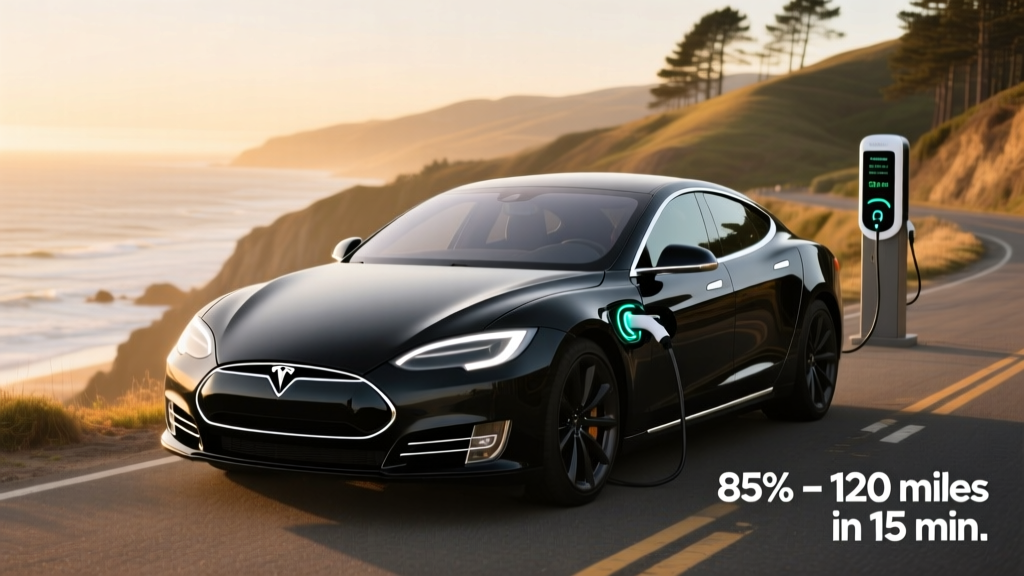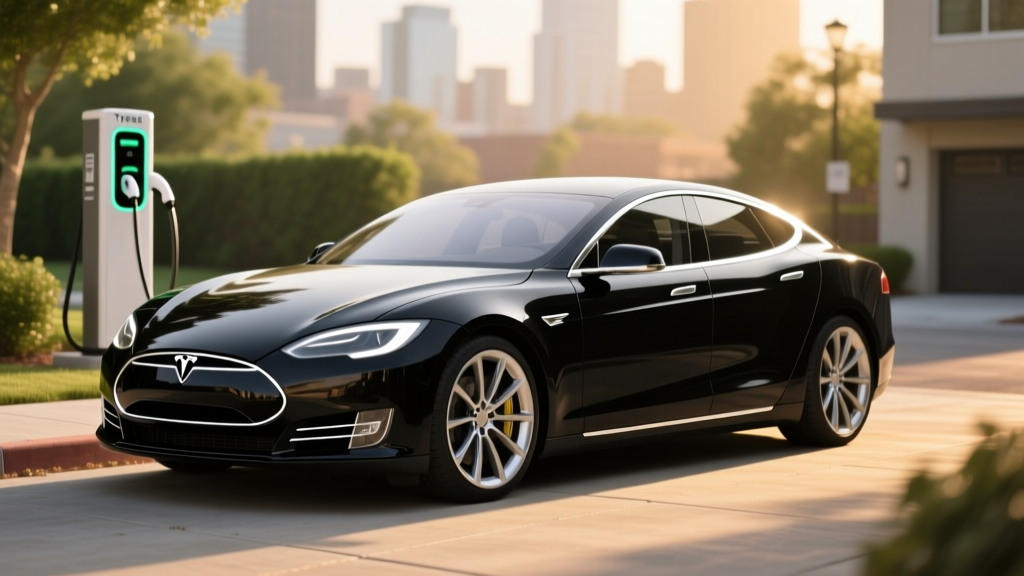
The 2015 Tesla Model S sedan was a watershed vehicle — the first long-range electric luxury sedan to prove that a battery-electric car could compete with German stalwarts on performance, technology, and daily usability. More than a decade later, it remains one of the most searched used EVs on the market. Buyers are drawn by its still-sleek styling, access to the Tesla Supercharger network, and prices that have dropped well below $20,000 on the used market.
But buying a decade-old EV requires a different calculus than buying a new one. Battery degradation, outdated charging hardware, expired warranties, and the absence of modern driver-assist capabilities all factor in. This guide covers the exact specs, real-world range expectations, charging realities, and ownership economics of the 2015 Model S so you can decide whether it's a smart used-EV buy in 2026.
Quick Verdict: Who Should Buy a Used 2015 Model S?
The 2015 Model S suits budget-conscious buyers who want a spacious, fast, tech-forward electric sedan with access to Tesla's Supercharger network — and who are willing to accept older charging speeds, some interior wear, and the real possibility of battery or drive-unit replacement. It is not ideal for buyers who need modern Level 2 driver-assist features, the latest infotainment, or a warranty that still has meaningful coverage remaining.
Choose the 2015 Model S if: You want a spacious luxury EV under $20K, prioritize Supercharger access, can verify battery health pre-purchase, and primarily drive in moderate climates.
Look elsewhere if: You need guaranteed battery warranty coverage, want the latest Autopilot hardware, require fast DC charging above 150 kW, or live in an extreme-cold region where range loss will be punishing.
2015 Tesla Model S Sedan: Core Specifications
| Spec | Model S 60 | Model S 70D | Model S 85 | Model S P85D | Model S 90D |
|---|---|---|---|---|---|
| EPA Range | 208 mi | 240 mi | 265 mi | 253 mi | 294 mi |
| Battery (usable) | ~60 kWh | ~68.8 kWh | ~80.8 kWh | ~80.8 kWh | ~83.5 kWh |
| Battery Chemistry | NMC (NCA cathode) | NMC/NCA | NMC/NCA | NMC/NCA | NMC/NCA |
| Drivetrain | RWD | AWD (Dual Motor) | RWD | AWD (Dual Motor) | AWD (Dual Motor) |
| Horsepower | 302 hp | 328 hp | 362 hp | 691 hp | 417 hp |
| 0–60 mph | 5.7 s | 5.2 s | 5.4 s | 3.2 s | 4.0 s |
| MPGe (combined) | 95 MPGe | 101 MPGe | 89 MPGe | 89 MPGe | 102 MPGe |
| Original MSRP | ~$71,200 | ~$76,200 | ~$82,200 | ~$108,200 | ~$92,200 |
| 2026 Used Price (est.) | $10,000–$13,000 | $12,000–$16,000 | $14,000–$19,000 | $16,000–$22,000 | $17,000–$23,000 |
Sources: EPA fueleconomy.gov, Tesla historical press releases, Kelley Blue Book / Edmunds used-market data (Jan 2026).
Real-World Range: What to Actually Expect
EPA Sticker: 208 mi (60) to 294 mi (90D)
Real-World Highway (70 mph, moderate temps): Expect 160–220 mi depending on trim — roughly 75–80% of EPA.
Cold Weather (below 32°F): Range drops 20–35%. An 85 kWh owner might see 150–175 mi on the highway in winter.
City / Stop-and-Go: Closest to EPA figures, sometimes exceeding them thanks to regenerative braking.
The 2015 Model S predates Tesla's more efficient heat-pump thermal management (introduced with the 2021 Model S refresh). Instead, it uses resistive cabin heating, which draws significant energy from the traction battery in cold weather. Owners in northern climates consistently report 25–35% range loss in sub-freezing conditions. Highway driving at 75+ mph also cuts range substantially due to the Model S's relatively high drag coefficient and large frontal area compared to modern EVs.
A critical consideration for used buyers: battery degradation. After 10 years and 100,000+ miles, most 2015 Model S batteries have lost 10–20% of original capacity. A 90D that originally delivered 294 EPA miles might now realistically offer 235–260 miles at full charge — before cold-weather or highway penalties apply. Always check the vehicle's State of Health (SoH) via the Tesla service menu or a pre-purchase inspection before buying.
Charging: DC Fast Charge, Level 2, and Supercharger Access
The 2015 Model S uses Tesla's proprietary connector (pre-NACS standardization) for both Supercharging and Level 2 AC charging. It does not natively support CCS or CHAdeMO without an adapter. Tesla now sells a CCS adapter for older Model S vehicles, but DC fast-charge speeds remain limited by the car's older onboard hardware.
| Charging Level | Connector | Max Power | Speed (approx.) | 10–80% Time |
|---|---|---|---|---|
| Level 1 (120V AC) | Tesla Mobile Connector | ~1.4 kW | ~3–4 mi/hr | N/A (days) |
| Level 2 (240V AC) | Tesla Wall Connector / J1772 adapter | 10 kW (single charger) 20 kW (dual chargers) |
~29 mi/hr (10 kW) ~58 mi/hr (20 kW) |
~6–9 hrs (single) ~3–5 hrs (dual) |
| DC Fast Charge (Supercharger V2) | Tesla proprietary | ~120 kW peak | ~200–280 mi/hr (peak) | ~40–55 min |
| DC Fast Charge (CCS adapter) | CCS1 (via adapter) | ~120 kW peak | Similar to V2 SC | ~40–55 min |
Charging-curve reality check: The 120 kW peak rate is not sustained. The 2015 Model S tapers charging speed significantly above 60% State of Charge (SoC). Expect roughly 90–120 kW from 10–50%, dropping to 40–60 kW from 50–80%, and below 20 kW above 80%. This is why a "10–80%" charge takes 40–55 minutes despite the 120 kW headline number.
One major advantage of the 2015 Model S over other used EVs from the same era: Supercharger network access. Unlike a 2015 Nissan Leaf or Chevy Spark EV, the Model S can use Tesla's extensive and generally reliable Supercharger network for road trips. Many 2015 Model S vehicles came with "free unlimited Supercharging" that transfers to subsequent owners — verify this with Tesla before purchase, as it adds significant value.
Performance and Driving Dynamics
Even by 2026 standards, the 2015 Model S — particularly the P85D — delivers thrilling acceleration. The P85D's dual-motor AWD system produces 691 horsepower and rockets to 60 mph in 3.2 seconds, which was supercar territory in 2015 and remains genuinely quick today. The standard 85 kWh RWD model manages 5.4 seconds, still brisk for a 4,600-pound sedan.
Ride quality is comfortable and composed, though the air suspension on higher trims is a known maintenance concern — replacement struts cost $1,500–$2,500 per corner. Steering is precise but numb compared to a BMW 5 Series, and the regenerative braking (single-mode, strong) enables near one-pedal driving once you acclimate.
Drivetrain note: The 2015 model year introduced Tesla's Dual Motor AWD system (the "D" in 70D, 90D, P85D). Dual-motor variants offer better traction, slightly higher efficiency, and improved performance. If you live in a snowy climate, a D variant is strongly preferred over the RWD 60 or 85.
Interior, Cargo, and Technology
The 2015 Model S interior was controversial at launch and has aged unevenly. The centerpiece 17-inch touchscreen remains impressive in size, but the underlying software (MCU1 hardware) is sluggish by modern standards. Tesla offered an MCU2 upgrade ($2,500) that enables newer software features, faster maps, and Netflix/YouTube streaming — check whether the vehicle you're considering has been upgraded.
Passenger space:
- Front legroom: 42.7 in
- Rear legroom: 35.4 in
- Front headroom: 38.8 in
- Seating: 5 adults (optional rear-facing third-row jump seats for 2 children, bringing total to 7 — rare and not recommended for safety reasons)
Cargo volume:
- Rear trunk: 26.3 cu ft (31.6 cu ft with rear seats folded)
- Front trunk (frunk): 5.3 cu ft
- Total with seats folded: ~58.1 cu ft
The frunk is a practical advantage over competitors like the 2015 BMW i3 or Mercedes B-Class Electric. Combined cargo space is generous for a sedan and competitive with midsize SUVs.
Driver assistance: The 2015 Model S introduced Tesla's Autopilot Hardware 1 (AP1), which enables basic adaptive cruise control and lane-keeping. This is SAE Level 2 driver-assist — it is not self-driving, and the driver must remain fully engaged. AP1 lacks the camera suite and neural-net processing of modern Tesla FSD (Supervised). Do not expect automatic lane changes, stop-sign recognition, or city-street navigation on AP1 hardware.
SAE Automation Level: Level 2 (Partial Automation). The 2015 Model S Autopilot (AP1) provides lane-centering and adaptive cruise but requires continuous driver supervision. Hands must remain on the wheel. This is not Level 4 driverless capability.
Pricing, Tax Credits, and Ownership Costs
The 2015 Model S is no longer eligible for the federal §30D new-vehicle EV tax credit — that credit applies only to new vehicle purchases. However, it may qualify for the used-EV tax credit (also under §30D / §25E), which provides up to $4,000 or 30% of the sale price (whichever is less) for qualifying used EVs.
| Trim | Used Price Range | Max Used-EV Credit (30%) | Effective Price After Credit |
|---|---|---|---|
| 60 | $10,000–$13,000 | $3,000–$3,900 | $7,000–$9,100 |
| 70D | $12,000–$16,000 | $3,600–$4,000 | $8,000–$12,400 |
| 85 | $14,000–$19,000 | $4,000 | $10,000–$15,000 |
| P85D | $16,000–$22,000 | $4,000 | $12,000–$18,000 |
| 90D | $17,000–$23,000 | $4,000 | $13,000–$19,000 |
Used-EV Tax Credit (§25E) Requirements:
- Vehicle must be at least 2 model years old (2015 qualifies ✓)
- Sale price must be $25,000 or less (most 2015 Model S vehicles qualify ✓)
- Buyer income cap: $75,000 (single), $112,500 (head of household), $150,000 (joint)
- Credit is 30% of sale price, max $4,000
- Must purchase from a licensed dealer (private-party sales do not qualify)
- Buyer can claim the credit only once every 3 years
- Credit is non-refundable — you must have sufficient tax liability
Source: IRS.gov — Used Clean Vehicle Credit. Rules current as of 2026; consult a tax professional for personal eligibility.
Insurance: The 2015 Model S carries higher-than-average insurance costs for its price bracket. Expect $1,800–$2,800/year depending on your profile and state. Tesla's own insurance program may offer competitive rates in some states.
Maintenance considerations: While EVs eliminate oil changes and transmission service, the 2015 Model S has known cost centers: air suspension struts ($1,500–$2,500 each), MCU1 screen delamination ($1,500+ repair or MCU2 upgrade), drive-unit replacement ($5,000–$8,000), and 12V battery replacement ($300–$500). Budget $1,500–$3,000/year for maintenance and repairs on a vehicle of this age.
Battery Health, Warranty, and Longevity
The 2015 Model S uses NMC/NCA lithium-ion battery chemistry — not the LFP (lithium iron phosphate) chemistry found in newer standard-range Teslas. NMC/NCA offers higher energy density (more range per pound) but degrades somewhat faster than LFP, especially if frequently charged to 100% or exposed to extreme heat.
Original battery warranty: 8 years / unlimited miles for the 60 kWh; 8 years / 125,000 miles for the 85 kWh and larger packs. As of 2026, nearly all 2015 Model S vehicles have exceeded their original battery warranty. This is a critical risk factor.
Degradation data: Based on aggregated owner reports and Tesla fleet data, 2015 Model S batteries typically show:
- 5–8% capacity loss at 50,000 miles
- 10–15% capacity loss at 100,000 miles
- 15–22% capacity loss at 150,000+ miles
A replacement battery pack for the 2015 Model S costs $12,000–$20,000 at a Tesla Service Center (remanufactured pack) or $8,000–$14,000 from independent EV shops. This is a potentially deal-breaking expense — factor it into your purchase decision. A pre-purchase battery health inspection is non-negotiable.
Tips for maximizing battery life:
- Charge to 80% daily (use the car's charge-limit setting)
- Avoid leaving the car at 100% SoC for extended periods
- Use Level 2 home charging as your primary method; minimize frequent DC fast charging
- Precondition the battery in cold weather (the car does this automatically when navigating to a Supercharger)
Pros and Cons at a Glance
Pros
- Access to Tesla Supercharger network — best road-trip charging infrastructure
- Spacious interior with frunk + large trunk (58+ cu ft total)
- Strong performance even in base trims; P85D is a 3.2-second rocket
- Over-the-air software updates still delivered (basic features)
- Free unlimited Supercharging on many examples (verify with Tesla)
- Eligible for up to $4,000 used-EV tax credit
- Timeless exterior design still looks modern
Cons
- Original battery warranty expired — $12K–$20K replacement risk
- DC fast-charge limited to ~120 kW peak; 40–55 min for 10–80%
- MCU1 infotainment hardware is slow and dated without upgrade
- Autopilot AP1 is basic Level 2 — no FSD capability
- Air suspension and drive-unit failures are expensive
- Resistive cabin heating causes major winter range loss (25–35%)
- No native CCS charging without adapter
- Insurance costs above average for price bracket
2015 Model S vs. Key Used-EV Competitors
At the $12,000–$23,000 price point, the 2015 Model S competes with several other used EVs. Here's how it stacks up against the most common cross-shops:
| Spec | 2015 Model S 85 | 2017 Chevy Bolt EV | 2018 Nissan Leaf (60 kWh) | 2016 BMW i3 (94 Ah) |
|---|---|---|---|---|
| EPA Range | 265 mi | 238 mi | 226 mi | 114 mi (180 mi w/ REx) |
| DC Fast Charge | 120 kW (Tesla) | 55 kW (CCS) | 100 kW (CHAdeMO) | 50 kW (CCS) |
| Cargo Space | 31.6 cu ft | 16.9 cu ft | 23.6 cu ft | 15.1 cu ft |
| 0–60 mph | 5.4 s | 6.5 s | 7.9 s | 6.9 s |
| Used Price (2026) | $14K–$19K | $10K–$14K | $12K–$16K | $10K–$14K |
| Charging Network | Tesla Supercharger | CCS public networks | CHAdeMO (declining) | CCS public networks |
The Model S wins on range, performance, cargo space, and charging infrastructure. The Bolt wins on price and lower repair-cost risk. The Leaf and i3 are harder to recommend in 2026 due to CHAdeMO's declining network and the i3's limited range, respectively.
Frequently Asked Questions
What is the real-world range of the 2015 Tesla Model S sedan?
Expect 160–220 miles on the highway in moderate temperatures, depending on trim and battery health. The EPA sticker ranges from 208 mi (60 kWh) to 294 mi (90D), but real-world highway driving typically yields 75–80% of that. In cold weather, subtract another 20–35%. A 10-year-old battery with 15% degradation will further reduce these numbers.
How fast does the 2015 Model S charge at home and on the road?
At home on a 240V Level 2 charger, the 2015 Model S charges at 10 kW (single onboard charger) or 20 kW (dual onboard chargers), adding roughly 29–58 miles of range per hour. A full overnight charge takes 6–9 hours (single) or 3–5 hours (dual). On Tesla Superchargers (V2), it peaks at approximately 120 kW, with a 10–80% charge taking 40–55 minutes due to significant tapering above 60% SoC.
Does the 2015 Tesla Model S qualify for any federal EV tax credit?
It does not qualify for the new-vehicle §30D credit. However, it may qualify for the used-EV tax credit (§25E) — up to $4,000 or 30% of the sale price, whichever is less. The sale price must be $25,000 or below, the buyer must meet income caps ($75K single / $150K joint), and the purchase must be through a licensed dealer. Consult a tax professional and review IRS guidance before claiming.
Is the 2015 Model S worth buying in 2026 vs. competitors?
It depends on your risk tolerance. The Model S offers more range, space, performance, and charging-infrastructure access than any used EV at a similar price. However, the expired battery warranty and potential $12K–$20K replacement cost are serious financial risks. If you can verify strong battery health (less than 10% degradation), the 85 or 90D trims represent compelling value. If you want lower risk, a newer (2018+) Chevy Bolt EV with remaining battery warranty may be a safer bet, though it sacrifices range, space, and Supercharger access.
What are the biggest problems with the 2015 Tesla Model S?
The most common and costly issues are: (1) battery degradation beyond warranty coverage, (2) air suspension strut failure ($1,500–$2,500 per corner), (3) MCU1 touchscreen delamination or failure, (4) drive-unit (motor) replacement on high-mileage examples, and (5) door-handle mechanism failures. A thorough pre-purchase inspection by a Tesla-qualified technician is essential.
Does the 2015 Model S have Autopilot or Full Self-Driving?
Many 2015 Model S vehicles are equipped with Autopilot Hardware 1 (AP1), which provides basic adaptive cruise control and lane-keeping at SAE Level 2. This is not self-driving — the driver must remain fully engaged. AP1 hardware cannot support Tesla's FSD (Supervised) software, which requires HW3 or later. Do not purchase a 2015 Model S expecting modern autonomous capabilities.
Can I charge a 2015 Model S at non-Tesla charging stations?
Yes, with adapters. The 2015 Model S comes with a J1772 adapter for Level 2 public charging. Tesla also sells a CCS1 adapter that enables DC fast charging at Electrify America, EVgo, and other CCS networks. However, CHAdeMO adapters for the Model S were discontinued and are difficult to find. For road trips, the Tesla Supercharger network remains the most reliable option.