Quick Verdict: The Pioneer That Still Commutes
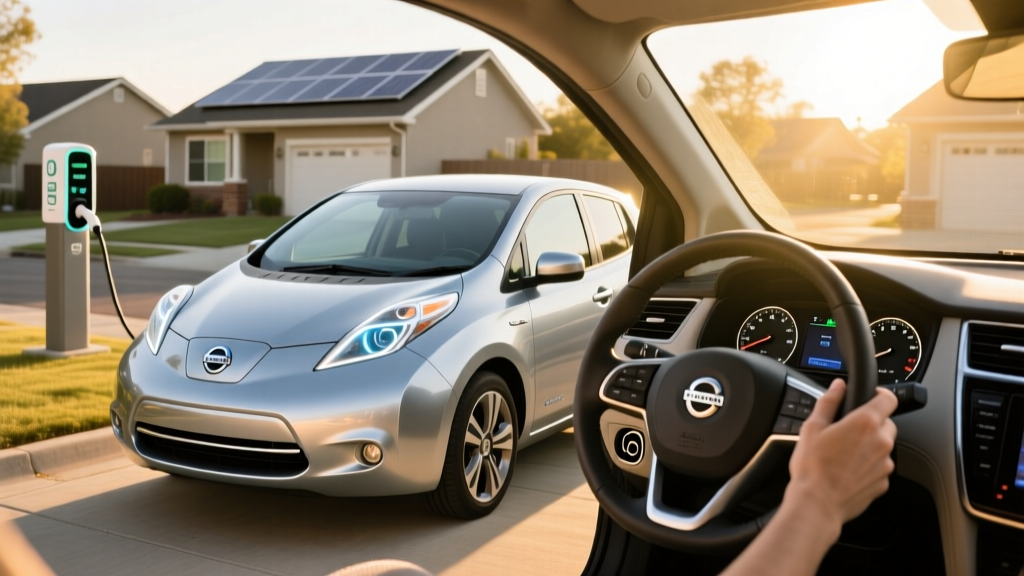
The 2015 Nissan Leaf hatchback was the best-selling electric vehicle on the planet when it debuted, and over a decade later, it remains one of the most accessible entry points into EV ownership on the used market. With an EPA-rated 84 miles of range, a 24 kWh lithium-ion battery, and a comfortable, practical hatchback body, the 2015 Leaf is a dedicated city commuter and grocery-getter — not a road-trip machine.
If you're shopping the used EV market in 2026 and your daily round trip stays under 50 miles, the 2015 Leaf can still deliver reliable, ultra-cheap electric transportation. But you need to understand its battery degradation reality, its CHAdeMO charging limitations, and exactly what you're getting before signing any paperwork.
| Spec | Value |
|---|---|
| EPA Range | 84 miles |
| Battery Capacity (usable) | ~21.6 kWh usable (24 kWh gross) |
| Battery Chemistry | NMC (nickel manganese cobalt), passive air cooling |
| Motor Output | 80 kW / 107 hp, 187 lb-ft torque |
| Drivetrain | FWD (front-wheel drive) |
| 0–60 mph | ~11.5 seconds |
| MPGe (combined) | 114 MPGe |
| Energy Consumption | 30 kWh/100 mi |
| DC Fast Charge (max) | ~40 kW (CHAdeMO) |
| Level 2 Charge Rate | 6.6 kW (onboard charger) |
| Cargo Volume | 24.0 cu ft (rear seats up) / 30.0 cu ft (folded) |
| Original MSRP (base S trim) | $29,010 (before incentives) |
| Typical Used Price (2026) | $5,500–$9,000 depending on battery health |
| Battery Warranty (original) | 8 years / 100,000 miles (capacity loss warranty) |
Range and Efficiency: What 84 EPA Miles Means in 2026
The 2015 Nissan Leaf carries an EPA-estimated range of 84 miles on a full charge when new. That number was competitive in 2015 against the Fiat 500e (84 mi) and ahead of the Smart ED (68 mi), but it's modest by modern standards where a 2026 base Leaf offers 212 miles and the Chevy Equinox EV delivers over 300.
The 2015 Leaf's efficiency is respectable: 114 MPGe combined (126 city / 101 highway) according to fueleconomy.gov. That translates to roughly 30 kWh per 100 miles, or about $0.04–$0.05 per mile on residential electricity rates — dramatically cheaper than any gasoline vehicle.
Battery Health: The Make-or-Break Factor for Used Buyers
The single most important thing to evaluate on a used 2015 Leaf is battery State of Health (SoH). Nissan's 24 kWh pack uses NMC chemistry with passive air cooling — a design choice that keeps costs low but makes the battery more vulnerable to heat-induced degradation. Leafs in hot climates (Arizona, Texas, Southern California) typically show more capacity loss than those in cooler regions.
Nissan provides a battery capacity gauge on the dashboard: 12 bars when new. Most 2015 Leafs in 2026 show between 8 and 11 bars, depending on climate, charging habits, and mileage. A Leaf at 9 bars has roughly 75% of its original capacity, translating to about 63 miles of range. At 8 bars (~67% capacity), you're looking at roughly 56 miles.
The original battery warranty was 8 years / 100,000 miles against capacity dropping below 9 bars (out of 12). For a 2015 model, that warranty expired in 2023. Any battery replacement is now an out-of-pocket expense. A refurbished 24 kWh pack from Nissan runs roughly $6,500–$8,500 installed, which can exceed the vehicle's value — so factor battery health heavily into your purchase price.
Checking Battery Health Before You Buy
- Dashboard bars: Check the capacity bars on the instrument cluster (far right gauge). 12 bars = excellent; 10–11 = acceptable; 9 or below = negotiate hard or walk away.
- Leaf Spy app: Use an OBD-II dongle and the Leaf Spy app to read exact State of Health percentage, cell voltage variance, and Hx (battery health index). This is the gold standard for used Leaf evaluation.
- Climate history: A 2015 Leaf from Phoenix with 90,000 miles will almost certainly have worse degradation than one from Portland with 50,000 miles.
Charging: CHAdeMO in an Increasingly NACS/CCS World
The 2015 Leaf charges via three methods, but its connector choice is its biggest long-term liability. Nissan adopted CHAdeMO for DC fast charging — a standard that has been largely abandoned in North America in favor of CCS and now NACS (Tesla's connector).
| Charging Level | Connector | Max Power | Time / Rate |
|---|---|---|---|
| Level 1 (120V) | J1772 | 1.4 kW | ~4.5 miles per hour of charging |
| Level 2 (240V) | J1772 | 6.6 kW | Full charge in ~4 hours; ~21 mi/hr |
| DC Fast Charge | CHAdeMO | ~40 kW peak | 0–80% in ~30 minutes (at peak rate) |
Level 2 home charging is where the Leaf shines for daily use. The 6.6 kW onboard charger is generous for a 2015 EV — it replenishes the small 24 kWh battery in about 4 hours, making overnight top-ups effortless. Any standard 240V Level 2 home charger with a J1772 connector will work.
DC fast charging peaks around 40 kW — slow by 2026 standards (modern EVs hit 150–350 kW) — but adequate for the small battery. You can add roughly 60 miles in 30 minutes on a CHAdeMO station. The problem is finding one: Electrify America, EVgo, and other networks have been deprioritizing CHAdeMO stalls, and no new CHAdeMO stations are being built in the US. Adapter solutions (CHAdeMO-to-CCS) exist but are expensive ($300–$500) and not universally reliable.
The passive air-cooled battery also limits repeated fast charging. Nissan's battery management system throttles charge speed when the pack gets warm — a phenomenon Leaf owners call "Rapidgate." On a hot day or after two consecutive DC fast charges, you may see peak power drop to 20 kW or less.
Performance and Driving Experience
The 2015 Leaf's 80 kW (107 horsepower) AC synchronous motor delivers 187 lb-ft of torque to the front wheels. That instant electric torque makes the Leaf feel surprisingly peppy around town — 0–30 mph is brisk — but the 0–60 mph time of roughly 11.5 seconds is leisurely by modern EV standards. Highway merging requires planning, and the Leaf tops out around 90 mph.
Ride quality is comfortable and compliant, with a soft suspension tuned for city streets. The cabin is quiet at low speeds, though wind and tire noise become noticeable above 60 mph. The low center of gravity (battery pack under the floor) gives it decent handling for an economy hatchback, but the thin, low-rolling-resistance tires prioritize efficiency over grip.
Regenerative Braking
The Leaf offers two regen modes: standard Drive (D) and Eco mode with enhanced regen. The Eco pedal also limits throttle response for maximum efficiency. Unlike modern EVs, the 2015 Leaf does not offer true one-pedal driving — it will creep at low speeds and requires the brake pedal for a full stop. The B-mode on the shifter increases regen but still falls short of the strong one-pedal feel in a Bolt or Tesla.
Interior, Cargo, and Technology
The 2015 Leaf's interior is functional and spacious for its class. The hatchback body provides 24.0 cubic feet of cargo space behind the rear seats and 30.0 cubic feet with the 60/40 split rear seats folded — enough for a week of groceries or a couple of suitcases. Rear legroom is a generous 33.3 inches, comfortably fitting two adults.
Technology is dated by 2026 standards:
- Infotainment: A 5-inch (S trim) or 7-inch (SV/SL) touchscreen with navigation on upper trims. No Apple CarPlay or Android Auto — these weren't available until the 2016 refresh.
- Driver assists: SL trim includes a 360-degree Around View Monitor, which remains genuinely useful for parking. No adaptive cruise, no lane-keeping assist, no automatic emergency braking.
- Unique features: The CARWINGS telematics system (now rebranded NissanConnect EV) allowed remote climate control pre-conditioning and charge scheduling via smartphone — a standout feature in 2015 that still works on many units.
- Heat pump: The SV and SL trims include a heat pump for cabin heating, which is significantly more energy-efficient than resistive heating and preserves range in cold weather. The base S trim uses a resistive heater that can draw 3–5 kW — a major range drain in winter.
Pricing, Tax Credits, and Used Value in 2026
The 2015 Nissan Leaf originally started at $29,010 (S trim) before the $7,500 federal tax credit and any state incentives. Today, it exists exclusively on the used market, and pricing depends heavily on battery health, mileage, and region.
| Trim | Original MSRP | Typical Used Price (2026) | Used EV Tax Credit (§25E) |
|---|---|---|---|
| S (base) | $29,010 | $5,500–$7,000 | Up to $4,000 (30% of sale price, capped) |
| SV (mid) | $32,700 | $6,500–$8,000 | Up to $4,000 |
| SL (top) | $35,680 | $7,500–$9,000 | Up to $4,000 |
Used EV Tax Credit (IRS §25E)
The 2015 Leaf does not qualify for the new-vehicle §30D credit (it's no longer sold new). However, it may qualify for the Used Clean Vehicle Credit (§25E), which provides up to $4,000 or 30% of the sale price (whichever is less) on qualifying used EVs. Key eligibility rules per IRS.gov:
- Sale price cap: The vehicle must be sold for $25,000 or less (easily met by the 2015 Leaf).
- Buyer income limits: Modified AGI cannot exceed $75,000 (single), $112,500 (head of household), or $150,000 (joint filers).
- Dealer requirement: The vehicle must be purchased from a licensed dealer (private-party sales do not qualify).
- Vehicle age: Must be at least 2 model years old (easily met).
- First transfer: The credit can only be claimed once per vehicle VIN after August 16, 2022 — verify the VIN hasn't already been used for this credit.
On a $7,000 used Leaf SV, the §25E credit would be $2,100 (30% of sale price), bringing your effective cost to roughly $4,900 — making it one of the cheapest ways to get into an electric vehicle in 2026.
Pros and Cons
Pros
- Extremely low running cost (~$0.04–$0.05/mile on home electricity)
- 6.6 kW Level 2 onboard charger — fast home charging for the battery size
- Spacious hatchback cargo area (24 cu ft) for its footprint
- Heat pump on SV/SL trims preserves winter range
- Proven, simple powertrain — minimal maintenance needs
- Eligible for up to $4,000 used EV tax credit (§25E)
- Comfortable ride, quiet cabin at city speeds
Cons
- 84-mile EPA range (new); expect 50–75 mi real-world with degradation
- CHAdeMO DC fast-charging standard — disappearing infrastructure
- Passive air-cooled battery — prone to heat degradation and Rapidgate
- No Apple CarPlay, Android Auto, or modern driver assists
- Original battery warranty expired (8yr/100k ended in 2023)
- Battery replacement cost ($6,500–$8,500) can exceed vehicle value
- 11.5-second 0–60 time — sluggish for highway merging
Who Should Buy the 2015 Nissan Leaf?
The 2015 Leaf is a narrow-use-case vehicle in 2026. It works best for:
- Short-distance commuters: If your round trip is under 40 miles and you can charge at home overnight, the Leaf is a remarkably cheap, quiet, and comfortable daily driver.
- Second-car households: As a dedicated errand-runner and local-traffic car paired with a longer-range vehicle for road trips, the Leaf excels.
- Budget-conscious EV adopters: With used prices starting around $5,500 (before the §25E credit), the Leaf is the cheapest path to electric driving available.
- City dwellers with home charging: The compact hatchback size and tight turning radius make it ideal for urban environments.
It is not suitable for long-distance road trips, cold-climate drivers without garage parking, households needing a single do-everything vehicle, or anyone without reliable home or workplace Level 2 charging access.
Competitor Comparison: 2015 Leaf vs. the Field
In the 2015 model year, the Leaf's main competitors were the Fiat 500e (84 mi EPA), the VW e-Golf (83 mi EPA, later 125 mi in 2017), and the Chevrolet Spark EV (82 mi EPA). Among these, the Leaf offered the most cargo space and the fastest Level 2 charging. The e-Golf drove better but had a smaller trunk. The Fiat 500e was fun but cramped.
Looking at the broader used EV market in 2026, the 2017+ Chevrolet Bolt EV (238 mi EPA, CCS charging, ~$10,000–$13,000 used) is a substantially more capable vehicle if your budget allows. The Bolt offers three times the range, modern infotainment, and CCS fast-charging infrastructure that is far more future-proof than CHAdeMO.
Frequently Asked Questions
What is the real-world range of a used 2015 Nissan Leaf?
With battery degradation factored in, most 2015 Leafs in 2026 deliver between 55 and 75 miles of real-world range on a full charge. Highway driving and cold weather can push that down to 40–55 miles. Always check the battery capacity bars on the dash or use Leaf Spy to verify exact State of Health before purchasing.
How fast does the 2015 Leaf charge at home and on DC fast chargers?
At home on a 240V Level 2 charger (J1772 connector), the Leaf charges at 6.6 kW — a full charge from empty in about 4 hours, adding roughly 21 miles per hour of charging. On a CHAdeMO DC fast charger, it peaks at approximately 40 kW, reaching 80% in about 30 minutes under ideal conditions. However, the passive air-cooled battery throttles charging speed when warm (Rapidgate).
Does the 2015 Nissan Leaf qualify for any EV tax credit?
It does not qualify for the new-vehicle §30D credit since it is no longer sold new. However, it may qualify for the Used Clean Vehicle Credit (§25E) — up to $4,000 or 30% of the sale price (whichever is less) — if purchased from a licensed dealer for $25,000 or less, and if the buyer meets income requirements ($75K single / $150K joint). Consult a tax professional and review current rules at IRS.gov.
Is the 2015 Leaf worth buying compared to newer used EVs?
If your budget is under $7,000 and your commute is short, yes — the Leaf remains the cheapest entry into EV ownership. But if you can stretch to $10,000–$13,000, a used 2017–2019 Chevrolet Bolt EV offers 238 miles of range, CCS fast charging, and a far more modern interior. The Leaf's CHAdeMO connector and degraded battery are growing liabilities.
What are the biggest risks of buying a used 2015 Leaf?
The primary risk is battery degradation. The passively air-cooled NMC battery degrades faster than liquid-cooled packs, especially in hot climates. A degraded battery means less range and a potential $6,500–$8,500 replacement cost that can exceed the car's value. Always verify battery health with Leaf Spy before purchasing, and factor replacement cost into your total budget.
Can I still find CHAdeMO chargers in 2026?
CHAdeMO infrastructure is shrinking. Most new DC fast-charging stations in North America use CCS or NACS connectors. Some legacy Electrify America and EVgo stations still have CHAdeMO plugs, but availability varies by region. Third-party CHAdeMO-to-CCS adapters exist but cost $300–$500 and are not universally compatible. Plan your charging routes carefully using PlugShare or A Better Routeplanner.
Final Assessment: A Budget Commuter, Not a Future-Proof EV
The 2015 Nissan Leaf hatchback remains a legitimate used EV option for a very specific buyer: someone with a short commute, home charging access, a tight budget, and realistic expectations about range. At $5,500–$9,000 before the §25E credit, it's remarkably affordable to acquire and costs pennies per mile to operate.
But its limitations are real and growing. The CHAdeMO charging standard is fading, the battery has no active thermal management, and 84 miles of EPA range (less with degradation) confines it firmly to local duty. If your needs extend beyond a predictable daily commute, invest in a newer, longer-range used EV with CCS or NACS charging. The Leaf was a pioneer — and for the right buyer, it still gets the job done — but it's no longer the EV to aspire to.