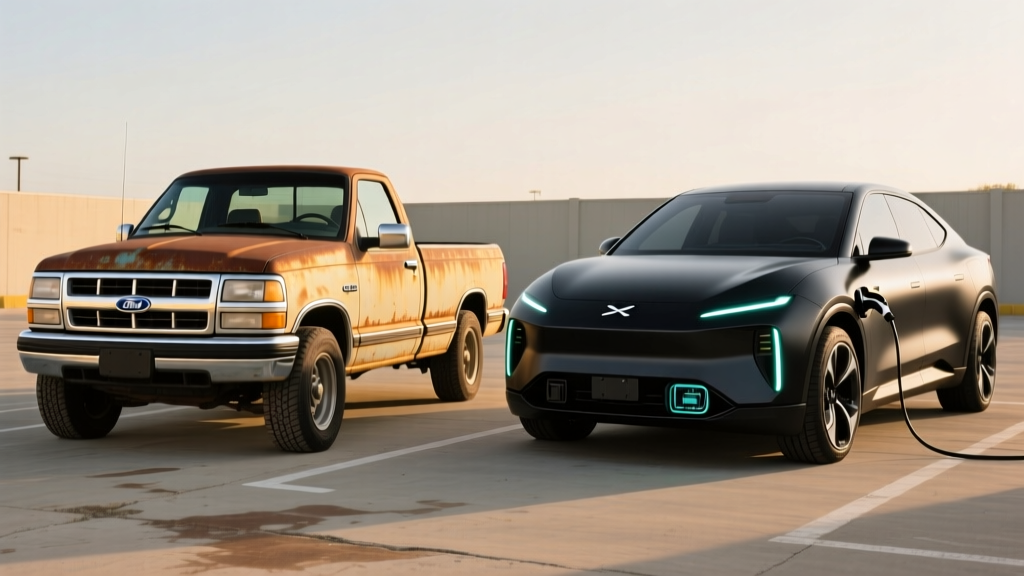
The search for a 1999 F150 Lightning has taken on a completely new meaning in 2026. Once a quest for Ford's supercharged SVT performance truck with its 5.4L V8, today's searches are increasingly driven by EV conversion enthusiasts who see the square-body OBS (Old Body Style) F-150 platform as the ideal candidate for an electric powertrain swap. Whether you're a classic truck fan looking to electrify a project or a buyer weighing a conversion against a new Ford F-150 Lightning, this guide breaks down the real numbers, costs, and trade-offs.
Why the 1999 F-150 Is the EV Conversion World's Favorite Truck
The 1997–1999 Ford F-150 (and its heavy-duty sibling, the F-250) occupies a sweet spot for EV converters. The chassis is body-on-frame, meaning the original engine, transmission, fuel tank, and exhaust can be removed cleanly, leaving a flat platform for battery boxes and an electric motor. The engine bay is cavernous enough to fit large motor-controller assemblies, and the 1999 model year specifically is prized because it uses a relatively simple OBD-II system with fewer integrated electronics than newer trucks.
Companies like EV West, Zero EV, and Stealth EV have built complete kits and turnkey conversions on this exact platform. The result: a classic-looking pickup that runs silent, produces zero tailpipe emissions, and delivers instant torque that would embarrass the original SVT Lightning's 360 hp supercharged V8.
Typical 1999 F150 Lightning EV Conversion Specs
There is no single "spec sheet" for a conversion since every build is custom. However, most professional 1999 F-150 EV conversions in 2026 cluster around a well-established configuration using salvaged Tesla drive units or NetGain Hyper9 motors paired with modular battery packs. Here's what a typical mid-tier professional build delivers:
| Specification | Typical Conversion Build |
|---|---|
| Battery Capacity | 60–100 kWh (salvaged Tesla modules or new LFP packs) |
| Battery Chemistry | NMC (Tesla salvage) or LFP (new modular packs) |
| EPA-Equivalent Range | 120–200 miles (varies by pack size and truck weight) |
| Motor Output | 250–450 hp (single or dual motor) |
| 0–60 mph | 5.0–7.5 seconds (depending on motor and weight) |
| Drivetrain | RWD (most common) or AWD (dual-motor builds) |
| DC Fast Charging | 50–150 kW (CCS1 via aftermarket controller) |
| Level 2 Charging | 7.2–11.5 kW (25–45 miles per hour of charging) |
| 10–80% DC Fast Charge | 35–55 minutes (highly pack-dependent) |
| Efficiency | 45–60 kWh/100 mi (~56–74 MPGe equivalent) |
| Weight (curb) | 5,200–5,800 lbs (battery adds ~800–1,400 lbs) |
| Payload Capacity | 1,000–1,400 lbs (reduced from stock) |
Real-World Range Reality Check
A 1999 F-150 EV conversion with an 80 kWh NMC pack might achieve 160 miles of mixed-use range in mild weather. Expect 120–140 miles on the highway at 70 mph (the brick-like aerodynamics of the OBS body are brutal on efficiency), and 100–120 miles in freezing temperatures due to battery chemistry limitations and cabin heating load. Unlike production EVs, most conversions lack a heat pump, relying on resistive PTC heaters that can draw 3–5 kW continuously.
Charging: What to Expect from a Converted 1999 F-150
Charging infrastructure compatibility is where conversions diverge sharply from production EVs. Most professional shops now install CCS1-compliant charge ports using controllers from Open Inverter or Elithion, meaning you can use Electrify America, EVgo, and most public DC fast-charging networks.
| Charging Level | Power (kW) | Speed (mi/hr added) | Notes |
|---|---|---|---|
| Level 1 (120V household) | 1.4 kW | 2–3 mi/hr | Emergency/trickle only; 50+ hours for full charge |
| Level 2 (240V home/public) | 7.2–11.5 kW | 25–45 mi/hr | Overnight charge in 6–10 hours; requires 40–60A circuit |
| DC Fast Charge (CCS1) | 50–150 kW peak | 120–250 mi/hr (peak) | Charge curve tapers heavily above 75% SoC; sustained rate often 30–60 kW |
A critical point that conversion buyers often miss: peak kW is not sustained kW. A build advertised as "150 kW capable" may only hold that rate between 10–40% State of Charge (SoC). Above 75%, most salvaged Tesla modules taper to 20–30 kW to protect cell health. Plan your road trips around this reality — a "30-minute charge stop" often stretches to 50+ minutes if you need to charge past 80%.
For home charging, a Level 2 installation on a 60-amp circuit (providing 11.5 kW/48A continuous) will replenish an 80 kWh pack in roughly 7–8 hours. Installation costs for a dedicated 240V circuit typically run $800–$2,500 depending on panel proximity and whether your home's electrical panel needs an upgrade to 200A service. Always get a licensed electrician to assess your panel capacity before committing to equipment.
Conversion Cost vs. Buying a 2026 Ford F-150 Lightning
This is the core decision. Here's how the economics compare when you stack up a professional 1999 F-150 EV conversion against Ford's current production electric truck:
| Cost Factor | 1999 F-150 EV Conversion | 2026 Ford F-150 Lightning (XLT) |
|---|---|---|
| Donor vehicle / Base MSRP | $5,000–$15,000 (used 1999 F-150) | $55,990 (XLT Standard Range) |
| Conversion / Build cost | $35,000–$70,000 (parts + labor) | N/A |
| Total out-of-pocket | $40,000–$85,000 | $55,990–$70,000 (as-tested, options) |
| Federal §30D Tax Credit | Not eligible (not a new qualifying vehicle) | Up to $7,500 (subject to MSRP, income, and battery-sourcing rules) |
| Effective cost after credit | $40,000–$85,000 (no credit) | $48,490–$62,500 (if eligible) |
| Warranty | None (or shop-specific 1–2 yr limited) | 8 yr / 100,000 mi battery & powertrain |
| EPA Range | Not EPA-certified (est. 120–200 mi) | 240 mi (Standard Range) / 320 mi (Extended Range) |
The math is stark. A professional conversion almost always costs more than a new F-150 Lightning XLT after the federal tax credit, while delivering less range, no warranty, no advanced driver assists, and no access to Ford's BlueCruise or OTA updates. The conversion route is a passion project, not an economic optimization.
Federal Tax Credit Details (§30D)
The IRS §30D clean vehicle credit applies only to new qualifying vehicles purchased from a manufacturer. A 1999 F-150 EV conversion does not qualify, regardless of how much you spend on the electric drivetrain. The used EV credit (§25E) of up to $4,000 also requires the vehicle to be sold by a licensed dealer and meet specific model-year and MSRP thresholds — a custom conversion won't qualify.
For the 2026 F-150 Lightning, the $7,500 credit requires:
- Buyer AGI under $150,000 (single) / $300,000 (joint)
- Vehicle MSRP under $80,000 (trucks)
- Battery components and critical minerals meeting domestic-sourcing thresholds (phasing in stricter rules annually)
- Point-of-sale transfer available at participating dealers
Always verify current-year eligibility on fueleconomy.gov before purchasing, as sourcing requirements tighten each year.
What a 2026 F-150 Lightning Gives You That a Conversion Cannot
For context on what you're trading away by going the conversion route, the current 2026 F-150 Lightning (Extended Range, Lariat trim) delivers:
- 320 miles EPA range (real-world highway: ~260–280 mi; cold weather: ~220–250 mi)
- 131 kWh usable battery (NMC chemistry, liquid-cooled with heat pump)
- 150 kW DC fast charging, 10–80% in ~41 minutes
- 580 hp / 775 lb-ft torque, 0–60 mph in 3.8 seconds
- Pro Power Onboard (up to 9.6 kW V2L — run job-site tools or power your home during outages)
- BlueCruise (SAE Level 2 hands-free highway driving on approved roads — not self-driving; driver must remain attentive)
- 18 cu ft front trunk (frunk), 52.8 cu ft bed volume, 2,235 lbs max payload, 10,000 lbs towing
- 8-year / 100,000-mile battery warranty (minimum 70% capacity retention)
- Full NHTSA and IIHS crash testing and 5-star safety ratings
No conversion shop can match this combination of range, warranty, safety certification, and integrated technology. The production Lightning benefits from billions in Ford engineering investment, federal crash-testing, and a dealer service network.
Who Should Consider a 1999 F-150 EV Conversion?
Conversion Pros
- Classic OBS styling with modern EV drivetrain — a one-of-a-kind show truck
- Instant torque far exceeding the original SVT Lightning's supercharged V8
- Zero tailpipe emissions on a recycled chassis
- Full customization: choose your battery size, motor, suspension, and interior
- No dealer markups, no waiting lists, no factory trim-level compromises
Conversion Cons
- $40,000–$85,000 total cost with no federal tax credit eligibility
- No warranty — battery replacement could cost $15,000–$25,000 out of pocket
- Limited range (120–200 mi) with poor highway and cold-weather performance
- No modern safety features (airbags may be retained, but no AEB, lane-keep, or crash-test certification)
- Resale value is highly uncertain; niche buyer pool
- Insurance can be difficult and expensive to secure for a modified vehicle
- DC fast charging often slower and less reliable than production EV systems
Best Use Cases for a Conversion
A 1999 F-150 EV conversion makes sense if you:
- Want a weekend/show truck and already own a daily driver
- Are a hands-on builder who will do significant labor yourself (reducing cost to $20,000–$35,000 in parts)
- Have a short commute or use the truck primarily around town where Level 2 overnight charging is sufficient
- Value the aesthetic and heritage of the OBS platform and refuse to drive a modern crossover-shaped EV truck
Best Use Cases for a 2026 F-150 Lightning
The production Lightning makes sense if you:
- Need a daily-driver truck with real range for highway trips and towing
- Want a warranty, safety certification, and dealer service support
- Can benefit from the $7,500 federal tax credit and point-of-sale transfer
- Need integrated technology like BlueCruise, Pro Power Onboard, and OTA updates
- Plan to finance the vehicle (conversions are nearly impossible to finance through conventional auto lenders)
Key Competitor Comparison
| Attribute | 1999 F-150 Conversion (80 kWh) | 2026 F-150 Lightning Ext. Range | 2026 Chevy Silverado EV 4WT | 2026 Rivian R1T Dual-Motor |
|---|---|---|---|---|
| Est. Range | ~160 mi | 320 mi (EPA) | 385 mi (EPA) | 352 mi (EPA) |
| Battery | 80 kWh (NMC/LFP) | 131 kWh (NMC) | 200+ kWh (NMC) | 149 kWh (NMC) |
| DC Fast Charge (10–80%) | ~45 min | ~41 min | ~35 min | ~30 min |
| 0–60 mph | ~6.5 sec | 3.8 sec | ~5.5 sec | 3.5 sec |
| Base Price | $40K–$85K (total) | $55,990 | $55,900 (est.) | $71,700 |
| Tax Credit | None | Up to $7,500 | Up to $7,500 | Up to $7,500 |
| Warranty | None/shop limited | 8yr/100K mi | 8yr/100K mi | 8yr/175K mi |
| Towing | Not rated (est. 3,000–5,000 lbs) | 10,000 lbs | 10,000 lbs | 11,000 lbs |
Frequently Asked Questions
What is the real-world range of a 1999 F-150 EV conversion?
With a typical 80 kWh pack, expect 140–160 miles in mixed city/highway driving in moderate temperatures. Highway-only driving at 70+ mph drops this to 120–140 miles due to the truck's poor aerodynamics. In sub-freezing weather, plan for 100–120 miles. Larger 100 kWh builds can push 180–200 miles but add significant weight and cost.
How fast does a converted 1999 F-150 charge?
On a DC fast charger, most builds peak at 50–150 kW but sustain 30–60 kW through the middle of the charge curve, reaching 10–80% in roughly 35–55 minutes. At home on Level 2 (240V, 48A/11.5 kW), a full charge takes 7–10 hours. Level 1 (120V) is impractical for daily use at 1.4 kW.
How much does a 1999 F-150 EV conversion cost after tax credits?
Total cost ranges from $40,000 to $85,000 (donor truck + parts + professional labor). There are no federal tax credits available for EV conversions — the §30D credit applies only to new qualifying vehicles, and the §25E used credit requires dealer sale of a qualifying production model. Some states offer rebates for EV conversions, but these vary widely by jurisdiction and change frequently.
Does a 1999 F-150 EV conversion qualify for the federal EV tax credit?
No. The IRS §30D new clean vehicle credit requires the vehicle to be new, assembled by a qualified manufacturer, and meet battery-sourcing and MSRP thresholds. A conversion of a 27-year-old truck does not meet any of these criteria. The used EV credit (§25E) also does not apply, as it requires a dealer-sold qualifying production EV model.
Is a conversion worth it vs. buying a 2026 F-150 Lightning?
For daily driving, towing, road trips, and total cost of ownership — no. The production Lightning offers more range, a warranty, safety certification, tax credit eligibility, and modern technology for less money. A conversion is worth it only as a passion project, show vehicle, or for builders who value the classic OBS aesthetic and want a unique truck that no one else has.
What are the biggest risks of an EV conversion?
The top risks are: no warranty (battery replacement can cost $15,000–$25,000), insurance difficulty (many insurers won't cover modified vehicles at full value), safety uncertainty (no crash-test data for the modified vehicle), and resale challenges (the buyer pool for a custom EV conversion is very small). Additionally, poorly executed conversions can have electrical fire risks — always choose a reputable shop with documented builds.
Can I do a 1999 F-150 EV conversion myself?
Experienced fabricators and electricians with high-voltage training can do DIY conversions using kits from companies like EV West or Open Inverter, reducing parts-only cost to $15,000–$30,000. However, working with 400V+ battery systems is lethal without proper training and equipment. If you lack high-voltage electrical experience, hire a professional shop. Also check your state's DMV requirements for registering a converted vehicle — some states require special inspections.
The Verdict
The 1999 F150 Lightning search term now bridges two worlds: the nostalgia of Ford's supercharged SVT era and the growing EV conversion movement. As a conversion project, the 1999 F-150 platform is genuinely excellent — its body-on-frame design, spacious engine bay, and simple electronics make it one of the best trucks to electrify. But as a practical vehicle purchase, the math doesn't favor a conversion over a 2026 Ford F-150 Lightning. The production truck offers more range, a real warranty, federal tax credit eligibility, modern safety systems, and lower total cost. Choose the conversion if you're building a dream truck. Choose the Lightning if you need a truck that works every day.