The e-TNGA Platform: A Joint Venture Explained
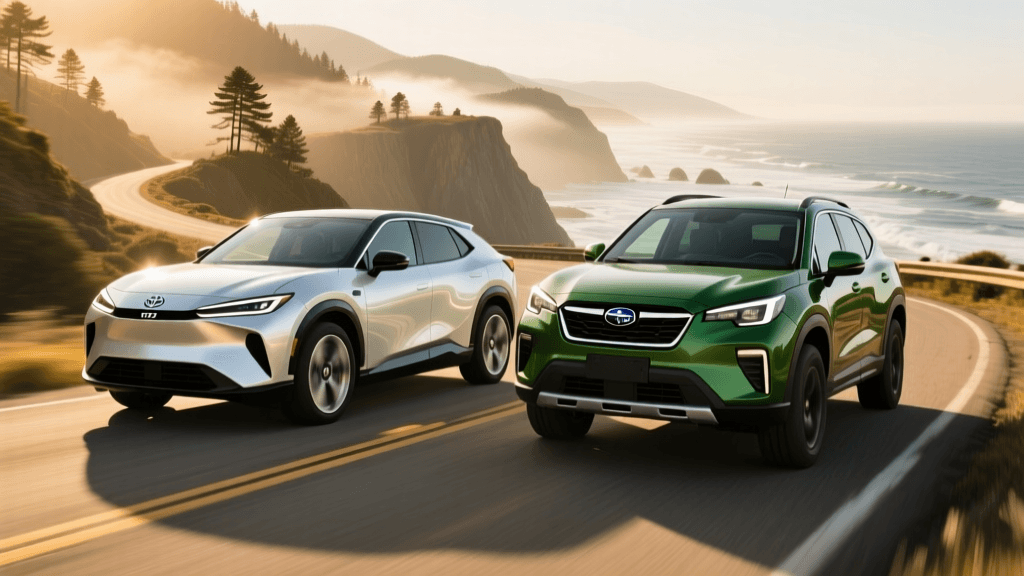
When Toyota and Subaru announced a partnership to develop a dedicated electric vehicle platform, the automotive world paid close attention. The result of this collaboration is the e-TNGA (Toyota New Global Architecture) platform, which underpins both the Toyota bZ4X and the Subaru Solterra. While these two compact electric SUVs share the same fundamental bones, battery packs, and electric motors, they are far from identical clones. Each automaker has applied its unique brand philosophy, engineering priorities, and target demographics to the final product.
Toyota approached the bZ4X with a focus on efficiency, futuristic styling, and mainstream commuter appeal. Subaru, on the other hand, leaned heavily into its heritage of ruggedness, standard all-wheel drive, and off-road capability. For EV buyers, this creates a fascinating head-to-head showdown. Do you prioritize maximum range and a sleek aesthetic, or do you need standard AWD and trail-ready technology? In this comprehensive comparison, we break down the range, price, charging speed, performance, interior space, and total cost of ownership to help you decide which twin EV deserves a spot in your driveway.
Exterior Design and Dimensions
At first glance, the familial resemblance is undeniable, but the styling diverges significantly in the details. The Toyota bZ4X features a more aerodynamic, sloping roofline and a futuristic, hammerhead front fascia. It looks like a modern crossover designed to slice through the wind and maximize efficiency. The Subaru Solterra adopts a much more traditional, rugged SUV stance. It features heavy black plastic wheel arch cladding, a more upright rear hatch, and standard roof rails with integrated tie-down points.
Dimensionally, the vehicles are nearly identical in length and wheelbase, but the Solterra's suspension tuning and larger standard wheel options give it a slight edge in ground clearance. The bZ4X offers approximately 8.1 inches of ground clearance, which is respectable for a crossover. However, the Solterra boasts 8.3 inches, paired with specific off-road tires on higher trims, making it significantly more capable when the pavement ends.
Performance, Drivetrain, and Off-Road Capability
This is where the two vehicles take distinctly different paths. The Toyota bZ4X is offered in both Front-Wheel Drive (FWD) and All-Wheel Drive (AWD) configurations. The FWD model utilizes a single front-mounted electric motor producing 201 horsepower and 196 lb-ft of torque. The AWD version adds a rear motor, bumping the output to 214 horsepower and 248 lb-ft of torque.
Subaru, staying true to its brand identity, offers the Solterra exclusively with All-Wheel Drive. It utilizes the same dual-motor setup as the AWD bZ4X, producing 214 horsepower and 248 lb-ft of torque. However, the software tuning is entirely different. According to testing and reviews by Car and Driver, the Solterra's throttle mapping and torque distribution are calibrated for low-traction environments.
The X-MODE Advantage
The Solterra features Subaru’s renowned X-MODE, which includes specialized drive settings for Snow/Dirt and Deep Snow/Mud, along with Grip Control (a low-speed off-road cruise control). The bZ4X AWD does have a rudimentary snow mode and decent traction control, but it entirely lacks the sophisticated, driver-selectable off-road software found in the Subaru. If you plan on tackling forest service roads, snowy mountain passes, or muddy campsites, the Solterra is the undisputed champion.
Range, Battery, and Charging Speeds
Both vehicles are equipped with a 71.4 kWh usable lithium-ion battery pack. However, the drivetrain and aerodynamic differences result in varying EPA-estimated range figures.
- Toyota bZ4X FWD: Up to 252 miles (with 18-inch wheels)
- Toyota bZ4X AWD: Up to 228 miles
- Subaru Solterra: Up to 228 miles (Touring trim drops to 222 miles)
If maximum range is your primary concern, the FWD bZ4X is the clear winner. However, for those requiring AWD, the range is a dead tie. It is worth noting that real-world highway range at 75 mph can drop closer to 180-190 miles for both AWD models, so frequent road trippers should plan their charging stops accordingly.
Charging Speeds and Battery Conditioning
Early versions of both vehicles faced criticism for sluggish DC fast-charging speeds and battery degradation concerns in extreme climates. Both automakers have since issued over-the-air and dealer-applied software updates to improve the charging curve and battery thermal management. Both vehicles now peak at around 150 kW on a DC fast charger, capable of charging from 10% to 80% in roughly 30 to 35 minutes under optimal conditions.
Actionable Advice: To achieve these peak charging speeds, you must use the vehicle's native navigation system to route to a DC fast charger. This triggers the battery preconditioning sequence, warming or cooling the battery to the optimal temperature before you arrive. For a deeper understanding of how lithium-ion batteries respond to temperature and charging, the U.S. Department of Energy's Fuel Economy site provides excellent foundational guidelines on EV battery care and charging fundamentals.
Interior Space, Comfort, and Technology
Step inside either vehicle, and the shared architecture is immediately obvious. The dashboard layout, center console, and door panels are nearly identical. Both feature a massive 12.3-inch infotainment touchscreen (on higher trims) and a digital instrument cluster positioned high on the dash, designed to be viewed over the steering wheel rather than through it.
Toyota initially offered a controversial aircraft-style 'yoke' steering wheel in certain markets, which requires zero hand-over-hand turning. In the US, however, the traditional round steering wheel is standard and widely preferred by reviewers. Subaru sticks exclusively to a traditional, thick-rimmed round steering wheel wrapped in synthetic leather.
Rear seat space is generous in both, offering ample legroom for adults, though the sloping roofline of the bZ4X slightly cuts into rear headroom compared to the boxier Solterra. Cargo space is also nearly identical at roughly 27 cubic feet behind the rear seats, expanding to about 56 cubic feet with the seats folded. Neither vehicle offers a front trunk (frunk), which is a missed opportunity for extra storage.
Head-to-Head Specification Table
| Feature | Toyota bZ4X (AWD) | Subaru Solterra (Premium) |
|---|---|---|
| Starting MSRP | ~$46,700 | ~$46,220 |
| Drivetrain | FWD or AWD | AWD (Standard) |
| Horsepower | 214 hp (AWD) | 214 hp |
| EPA Range (AWD) | 228 miles | 228 miles |
| Ground Clearance | 8.1 inches | 8.3 inches |
| Off-Road Tech | Basic Traction Control | X-MODE & Grip Control |
| Towing Capacity | Not Rated | Not Rated |
| Battery Warranty | 8 yrs / 100,000 miles | 8 yrs / 100,000 miles |
Pricing, Warranties, and Total Cost of Ownership
When comparing apples to apples—specifically the AWD versions of both SUVs—the pricing is remarkably close, often separated by less than $1,000 depending on the exact trim and destination fees. However, the value proposition shifts depending on your needs. Because Subaru includes AWD, roof rails, and X-MODE as standard equipment on the base Premium trim, it represents a slightly better value for buyers in snow-belt states or those who enjoy outdoor recreation.
Toyota, conversely, offers a lower entry price if you are willing to accept the FWD drivetrain. This makes the bZ4X an attractive option for urban commuters in milder climates who want to maximize range and minimize upfront costs. Both vehicles come with a standard 3-year/36,000-mile bumper-to-bumper warranty and an 8-year/100,000-mile battery warranty. According to Car and Driver's long-term analysis, both vehicles suffer from steeper-than-average depreciation curves typical of early-generation EVs, meaning leasing or buying with the intention of holding the vehicle long-term may be the smartest financial play.
The Final Verdict: Which Twin EV Wins?
The Toyota bZ4X and Subaru Solterra are a masterclass in platform sharing, yet they successfully cater to distinct buyer profiles. There is no single 'winner' here; rather, the right choice depends entirely on your lifestyle and geographic location.
Choose the Toyota bZ4X if:
- You live in a mild climate and want to maximize your driving range by opting for the FWD model.
- You prefer a sleeker, more aerodynamic, and futuristic exterior design.
- You are primarily using the vehicle for urban commuting and highway cruising where off-road capability is unnecessary.
Choose the Subaru Solterra if:
- You live in an area with harsh winters, heavy snow, or frequent rain, making standard AWD a necessity.
- You regularly travel on unpaved roads, dirt trails, or need the utility of standard roof rails for gear.
- You value the confidence of Subaru's X-MODE and superior ground clearance for weekend camping trips.
Ultimately, both the bZ4X and Solterra offer comfortable rides, spacious interiors, and a smooth, quiet electric driving experience. By identifying whether your priority is maximum efficiency or all-weather ruggedness, you can confidently select the twin that perfectly fits your electric journey.