Welcome to the Electric Truck Revolution
If you are stepping into the world of electric vehicles (EVs) for the first time, the truck segment is arguably the most exciting and confusing space to navigate. For decades, the pickup truck market was dominated by a few legacy automakers running on gasoline and diesel. Today, two futuristic heavyweights are battling for the title of the ultimate zero-emission utility vehicle: the polarizing, stainless-steel Tesla Cybertruck and the rugged, adventure-ready Rivian R1T. For a beginner, choosing between these two radically different approaches to the electric pickup requires understanding not just horsepower and towing capacity, but battery chemistry, charging networks, and real-world utility.
In this comprehensive beginner's guide, we will strip away the marketing jargon and break down exactly how the Tesla Cybertruck and Rivian R1T compare in everyday scenarios. Whether you need a daily commuter that can haul lumber on the weekend, or an overlanding rig designed for off-grid camping, this head-to-head comparison will help you make an informed decision.
EV Truck Terminology: A Beginner's Glossary
Before diving into the specs, it is crucial to understand a few key terms that dictate how these trucks perform in the real world:
- kWh (Kilowatt-hour): Think of this as the size of your 'gas tank.' A higher kWh number generally means a larger battery and more potential range.
- MPGe (Miles Per Gallon equivalent): A metric created by the EPA to compare the energy consumption of an EV to a gas vehicle. Higher is better.
- NACS vs. CCS: These are charging plug standards. Tesla uses the North American Charging Standard (NACS), while Rivian currently uses the Combined Charging System (CCS), though the industry is shifting toward NACS.
- Regenerative Braking: A feature that captures kinetic energy when you lift off the accelerator, slowing the truck down while feeding electricity back into the battery.
- Payload vs. Towing: Payload is the weight you can put *inside* the truck (bed and cabin). Towing is the weight you can pull *behind* it on a trailer.
Design and Build: Stainless Steel vs. Modern Utility
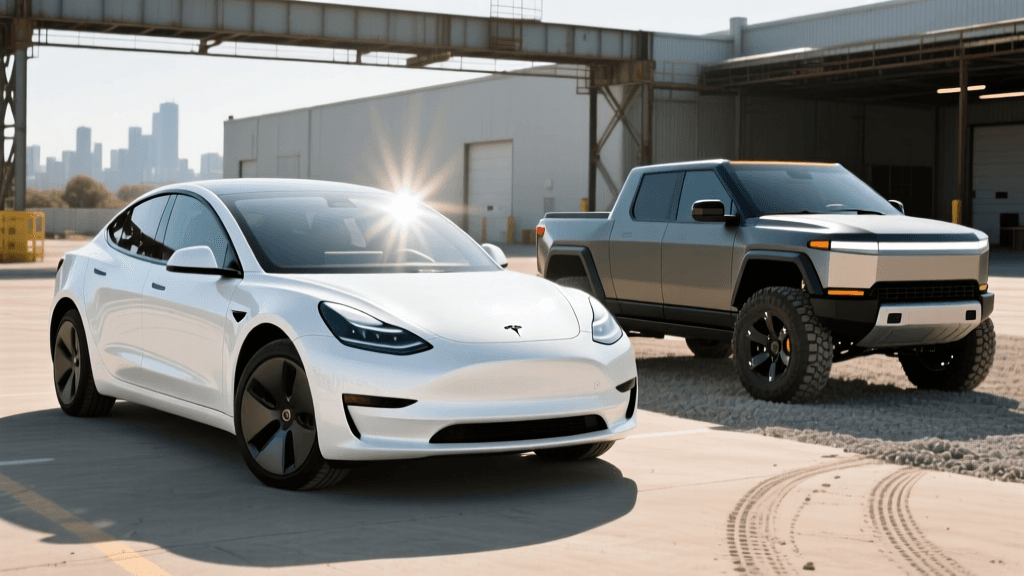
The most obvious difference between these two trucks is their exterior design. According to Tesla's official Cybertruck specifications, the vehicle is wrapped in an ultra-hard 30X cold-rolled stainless-steel exoskeleton. This eliminates the need for traditional paint, making it highly resistant to dents and scratches from trail debris. However, its sharp, wedge-like angles are polarizing, and the massive footprint can make it intimidating to navigate through tight city streets or narrow drive-thrus.
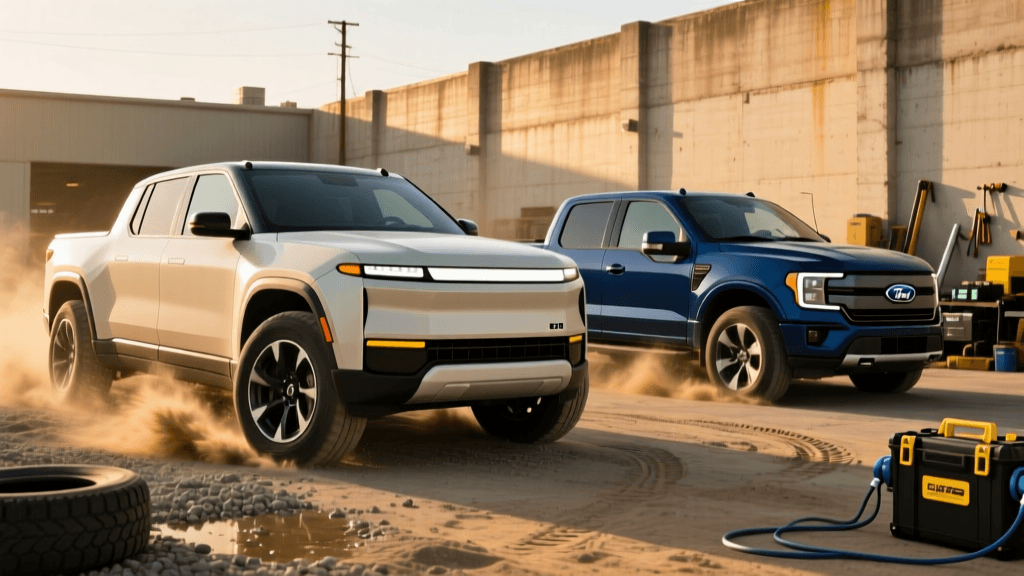
The Rivian R1T, conversely, adopts a more traditional truck silhouette blended with modern, minimalist SUV cues. It features a unibody construction built on Rivian's 'skateboard' battery platform. While it uses traditional painted aluminum and steel body panels that can dent or scratch, its proportions feel much more familiar to anyone stepping out of a Ford F-150 or Toyota Tacoma. The R1T's design prioritizes approachability and clever packaging over brutalist invincibility.
The Towing Reality Check: What Beginners Must Know
Both trucks boast impressive maximum towing capacities on paper. The Cybertruck AWD and Cyberbeast models claim up to 11,000 pounds, while the Rivian R1T Dual-Motor is rated for 11,000 pounds as well. However, as a beginner, you must understand the 'EV Towing Penalty.'
Pushing a heavy, un-aerodynamic trailer drastically increases energy consumption. In real-world testing by various automotive journalists, towing a 5,000-pound camper at highway speeds can reduce an EV truck's range by 40% to 50%. If your truck has an EPA-estimated range of 320 miles, expect to stop and charge after roughly 160 to 190 miles when towing. Neither truck is currently ideal for long-distance cross-country towing without meticulous route planning around high-speed chargers.
Head-to-Head Specifications Comparison
Below is a structured breakdown of the core specifications for the most popular dual-motor and tri-motor variants of both trucks. Note that pricing and specs are subject to manufacturer updates.
| Feature | Tesla Cybertruck (AWD) | Rivian R1T (Dual-Motor Max) |
|---|---|---|
| Starting MSRP (Est.) | ~$79,990 | ~$89,000 |
| EPA Est. Range | 318 - 340 miles | 352 - 410 miles (Max Pack) |
| Battery Size | ~123 kWh (Est.) | 149 kWh (Max Pack) |
| Max Towing Capacity | 11,000 lbs | 11,000 lbs |
| Max Payload | 2,500 lbs | 1,760 lbs |
| Bed Length | 6 ft (up to 7 ft w/ tailgate down) | 4.5 ft (Bed) + Gear Tunnel |
| Charging Standard | NACS (Tesla Supercharger) | CCS (w/ NACS adapter available) |
| 0-60 MPH | 3.9 seconds | 4.5 seconds |
Range, Charging Ecosystems, and Road Trips
Range anxiety is the number one concern for EV beginners. The Rivian R1T offers the 'Max Pack' battery option, pushing its EPA-estimated range past 400 miles, which is a massive advantage for remote overlanding or long highway stretches. The Cybertruck relies on a slightly smaller battery but utilizes an advanced 800-volt architecture for incredibly fast charging speeds, capable of adding up to 154 miles of range in just 15 minutes at a V3 or V4 Supercharger.
The charging network is where Tesla historically held the crown. Tesla's Supercharger network is vast, reliable, and seamlessly integrated into the truck's navigation. Rivian uses the CCS standard but has secured access to Tesla Superchargers via an adapter. As noted by the U.S. Department of Energy's Alternative Fuels Data Center, the national charging infrastructure is rapidly expanding, but Tesla's proprietary network still offers a more frictionless plug-and-charge experience for beginners who do not want to fiddle with third-party apps and adapters.
Interior Space, Tech, and Clever Storage
Inside the cabin, the Cybertruck is brutally minimalist. There are no physical buttons; everything from the windshield wipers to the glovebox is controlled via a massive 18.5-inch center touchscreen. The steering yoke takes significant getting used to, especially when performing multi-point turns in a parking lot. However, the rear seating is surprisingly spacious, and the panoramic glass roof makes the cabin feel enormous.
The Rivian R1T feels more like a luxury SUV interior grafted onto a truck bed. It features premium sustainable materials, physical shortcut buttons, and a beautiful wood-grain dash. Where the R1T truly shines for beginners is its storage ingenuity. Because the R1T is slightly shorter overall, Rivian engineered the 'Gear Tunnel'—a massive, lockable, climate-controlled storage compartment that runs horizontally across the vehicle between the cabin and the bed. It is perfect for storing skis, fishing rods, or camping gear, keeping the 4.5-foot main bed free for dirty or bulky items.
The Cybertruck counters with the 'Vault,' a motorized, lockable tonneau cover that turns the entire bed into a secure, weatherproof storage space, capable of holding up to 750 lbs of gear out of sight.
Pricing and Total Cost of Ownership
Both trucks are premium, luxury-priced vehicles, often exceeding $90,000 once options and delivery fees are factored in. However, the Total Cost of Ownership (TCO) is where EVs begin to make financial sense compared to gas-guzzling V8 trucks. Electricity costs a fraction of premium gasoline per mile, and EVs eliminate the need for oil changes, transmission fluid flushes, and spark plug replacements.
According to Rivian's R1T owner portal, their vehicles feature over-the-air (OTA) software updates that continuously improve vehicle dynamics, battery management, and user interface without a trip to the dealership. Tesla is equally renowned for its OTA updates, frequently adding new features, games, and efficiency tweaks long after the truck is parked in your driveway. When calculating your budget, remember to factor in the cost of installing a Level 2 home charger (typically $500 to $1,500), which is essential for waking up to a 'full tank' every morning.
Final Verdict: Which Futuristic Truck is Right for You?
Choosing between the Tesla Cybertruck and the Rivian R1T ultimately comes down to your lifestyle, your tolerance for learning curves, and your aesthetic preferences.
Choose the Tesla Cybertruck if: You want the absolute latest in raw tech, you prioritize payload capacity and secure vault storage, you love the idea of a dent-resistant stainless-steel exterior, and you want the most frictionless Supercharger road-trip experience available.
Choose the Rivian R1T if: You prefer a more traditional, luxurious interior, you need the clever Gear Tunnel for outdoor sports equipment, you want maximum available battery range for off-grid adventures, and you appreciate a vehicle that blends into a traditional campground without looking like a spaceship.
Both trucks are marvels of modern engineering that prove electric vehicles can be rugged, capable, and incredibly fun to drive. As a beginner, test-driving both, evaluating your home charging setup, and honestly assessing your towing needs will guide you to the perfect electric truck for your driveway.