The Current Landscape: Budget EVs at a Crossroads
The electric vehicle market is undergoing a seismic shift, particularly in the highly contested budget and compact crossover segments. For the past few years, the Chevrolet Bolt EUV and the Kia Niro EV have served as the undisputed champions of affordable electric mobility. However, as we look toward the future of the automotive industry, the landscape is changing rapidly. The first-generation Bolt EUV was discontinued in late 2023 to make way for General Motors' next-generation Ultium platform, while Kia recently redesigned the Niro EV to align with its modern 'Opposites United' design language and future EV architecture.
For buyers navigating the current market, choosing between a slightly used Bolt EUV and a brand-new or leased Kia Niro EV requires a deep understanding of not just current specifications, but future industry trends. From the inevitable transition to the North American Charging Standard (NACS) to the shift in battery chemistry and federal tax credit eligibility, here is a comprehensive head-to-head comparison and future outlook for these two budget EV pioneers.
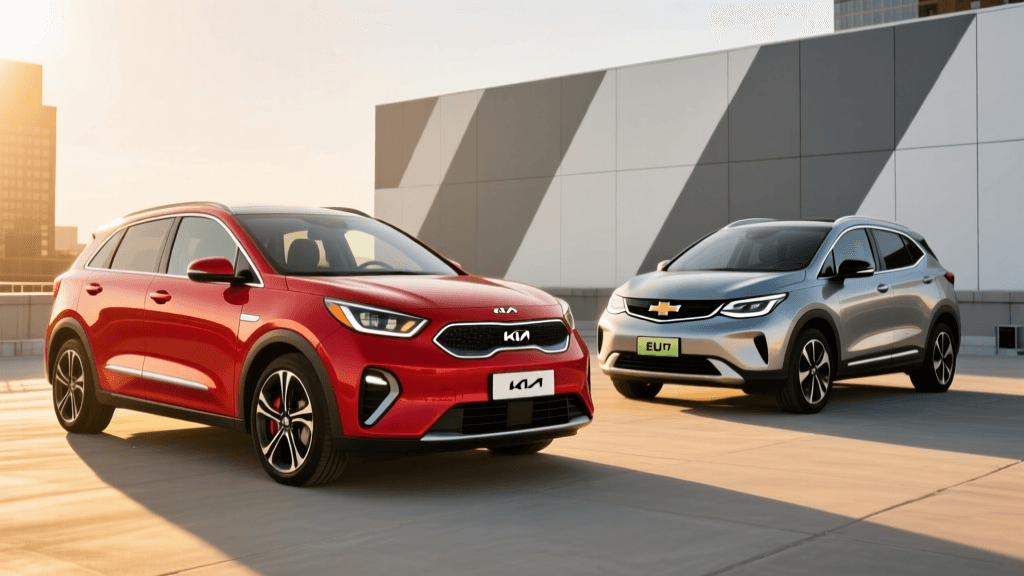
Head-to-Head: Kia Niro EV vs. Chevrolet Bolt EUV
Before diving into future trends, it is essential to understand the baseline metrics of these two vehicles. The Bolt EUV offers slightly more range and interior space, while the Niro EV provides faster DC fast charging and a more modern, albeit pricier, cabin experience.
| Feature | 2023 Chevrolet Bolt EUV (Premier) | 2024 Kia Niro EV (Wind/GT-Line) |
|---|---|---|
| Base MSRP / Market Price | ~$39,700 (New) / ~$18k-$23k (Used) | ~$39,600 (New) |
| EPA Estimated Range | 247 miles | 239 miles |
| Battery Capacity | 65 kWh (NMC) | 64.8 kWh (NMC) |
| Max DC Fast Charge Rate | 55 kW | ~85 kW |
| 10-80% DC Charge Time | ~70 minutes | ~45 minutes |
| Cargo Space (Max) | 56.9 cu. ft. | 53.0 cu. ft. |
| Charging Port Standard | CCS1 | CCS1 |
Future Trend 1: The NACS Charging Standard Transition
The most significant near-term industry trend affecting current and future EV buyers is the industry-wide adoption of Tesla's North American Charging Standard (NACS). As of today, both the outgoing Bolt EUV and the current Niro EV utilize the Combined Charging System (CCS1) port. According to the U.S. Department of Energy's Alternative Fuels Data Center, the national charging infrastructure is rapidly pivoting to accommodate NACS, which will soon unlock access to Tesla's expansive Supercharger network for non-Tesla vehicles.
Actionable Advice: If you purchase a Bolt EUV or Niro EV today, you are buying into the CCS ecosystem. However, both General Motors and Hyundai Motor Group (Kia's parent company) have committed to adopting native NACS ports on their future vehicles starting in 2025. To future-proof your budget EV purchase, you must factor in the cost and timing of a CCS-to-NACS adapter. GM has promised to provide or sell adapters for Bolt owners to access Superchargers, while Kia owners will need to purchase an official adapter once Kia's native NACS vehicles hit the road. When buying used, verify if the dealership includes the necessary adapter in the sale.
Future Trend 2: Battery Chemistry and the LFP Revolution
Both the current Bolt EUV and Niro EV utilize Nickel Manganese Cobalt (NMC) lithium-ion battery packs. NMC offers excellent energy density, which is why both vehicles can squeeze roughly 240 miles of range into relatively compact underfloor battery trays. However, the future of budget EVs relies heavily on Lithium Iron Phosphate (LFP) chemistry.
LFP batteries are cheaper to produce, do not require expensive cobalt, and offer vastly superior lifecycle longevity. The industry outlook suggests that the next generation of budget EVs—including the highly anticipated 2025/2026 return of the Chevrolet Bolt on the Ultium platform—will likely leverage LFP or advanced Ultium cell chemistries to drastically lower the base MSRP. For today's buyer, this means the current Niro EV and Bolt EUV represent the 'peak' of the older NMC budget era. If you plan to keep your vehicle for 10 years or 150,000 miles, NMC batteries require more careful charging habits (capping daily charges at 80%) compared to the LFP batteries that will dominate the budget sector in the coming years.
Strategic Buying: Tax Credits and Total Cost of Ownership
When evaluating the total cost of ownership, federal and state incentives completely alter the value proposition of these two vehicles. Because the Kia Niro EV is manufactured in South Korea, it does not qualify for the standard $7,500 federal new EV tax credit if purchased outright. However, buyers can leverage the 'lease loophole' (technically a commercial clean vehicle credit passed down via the leasing company) to secure significant lease cash incentives.
Conversely, the Chevrolet Bolt EUV is the undisputed king of the used EV market thanks to the IRS Used Clean Vehicle Credit. This legislation allows buyers purchasing a qualifying used EV from a licensed dealer for $25,000 or less to claim a tax credit equal to 30% of the sale price, up to a maximum of $4,000. Because the Bolt EUV originally retailed near $40,000 and has suffered steep depreciation, it is incredibly easy to find low-mileage examples under the $25,000 threshold. The U.S. Department of Energy provides comprehensive guidelines on how to transfer this credit at the point of sale, effectively acting as an immediate cash discount on the dealership floor.
Actionable Advice: If your budget is strictly under $25,000, a used Bolt EUV paired with the $4,000 used EV tax credit is arguably the best financial decision in the automotive market today. If you prefer a brand-new vehicle with a full factory warranty and are open to leasing, the Kia Niro EV offers a more premium, futuristic experience with heavily subsidized lease rates.
Industry Outlook: What Replaces the Budget Kings?
Looking ahead to 2025 and 2026, the budget EV segment will see a massive influx of new competitors. General Motors has officially confirmed the return of the Chevrolet Bolt nameplate, which will be the first vehicle to ride on GM's next-generation, more affordable Ultium battery architecture. This future Bolt is expected to feature native NACS charging, faster DC charge rates (addressing the current model's biggest flaw), and a starting price that could undercut the entire market.
Kia, on the other hand, is looking to its global EV3 and EV4 concepts to fill the sub-$35,000 void. While the Niro EV will remain a staple in Kia's lineup, the brand's future strategy involves dedicated EV platforms that maximize interior space while minimizing manufacturing costs. The current Niro EV shares a platform with its hybrid and plug-in hybrid siblings, a compromise that limits its frunk space and charging speeds compared to dedicated EV architectures like the Hyundai Ioniq 5.
The Verdict: Which Budget EV Fits Your Future?
Choose the Used Chevrolet Bolt EUV if: You are a pragmatic buyer focused on maximum value, interior utility, and leveraging the used EV tax credit. It remains the ultimate budget hack for families needing Supercharger access (via adapter) and over 240 miles of range for under $25,000 out the door.
Choose the New/Leased Kia Niro EV if: You prioritize modern styling, faster DC fast charging for road trips, and a premium tech interior. It is best suited for buyers who want a brand-new vehicle under warranty and are comfortable utilizing the lease loophole to bypass the new vehicle tax credit restrictions.
As the industry transitions toward LFP batteries and native NACS ports, both of these vehicles will eventually be replaced by next-generation platforms. However, for the immediate future, they remain the most practical, cost-effective gateways into electric mobility available on the market today.