The Heavyweights of the Three-Row EV Market
The three-row electric SUV market has rapidly evolved from a niche segment into a fiercely contested battleground for family buyers. For years, the Tesla Model X has been the undisputed, albeit polarizing, king of the electric family hauler hill. However, the arrival of the Kia EV9 has completely disrupted the status quo, offering a compelling blend of traditional SUV practicality, cutting-edge 800-volt charging architecture, and a much more accessible price point. If you are in the market for a premium, family-sized electric vehicle, the decision ultimately boils down to these two titans. In this head-to-head showdown, we will dissect the range, interior utility, charging capabilities, technology, and overall value of the Kia EV9 and Tesla Model X to help you determine which electric SUV deserves a spot in your garage.
Exterior Design and Dimensions
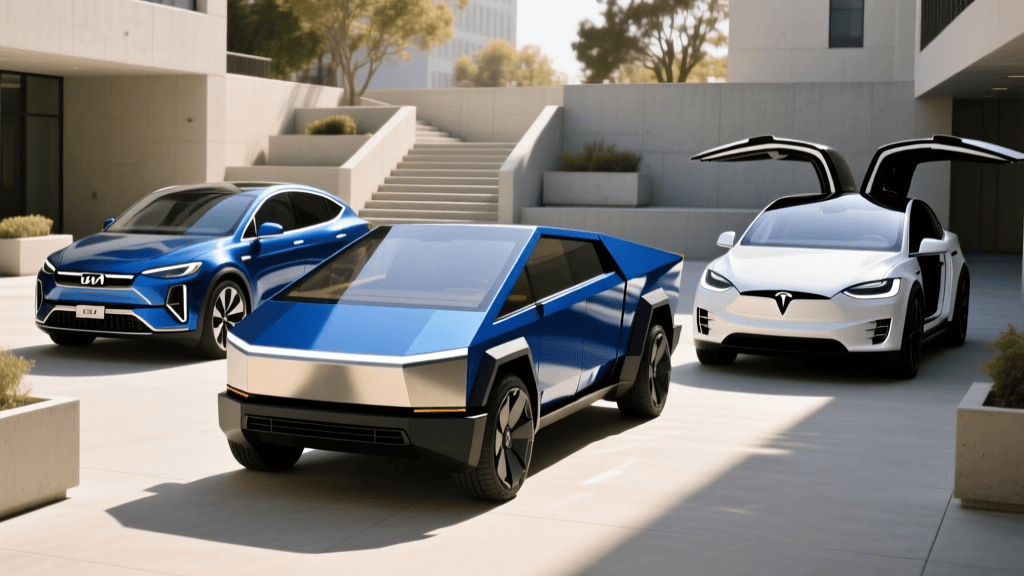
When it comes to exterior styling, the Kia EV9 and Tesla Model X take radically different approaches. The EV9 embraces a bold, boxy, and rugged aesthetic that maximizes interior volume. Its upright greenhouse and squared-off rear hatch give it the commanding presence of a traditional luxury SUV, drawing favorable comparisons to the Range Rover or Volvo XC90. Measuring 197.4 inches in length and 78.3 inches in width, the EV9 has a massive footprint that translates directly to passenger space.
Conversely, the Tesla Model X features a sleek, aerodynamic, teardrop silhouette designed to cheat the wind and maximize efficiency. At 199.1 inches long, it is slightly longer than the Kia, but its sloping roofline and curved glass heavily impact its rearward visibility and third-row headroom. The Model X’s signature Falcon Wing rear doors are undeniably cool and offer excellent access to the second row in tight parking spaces, but they add mechanical complexity and weight that the Kia avoids with its traditional, power-operated swing doors.
Interior Space and Cargo Utility
For buyers seeking a three-row SUV, passenger comfort and cargo utility are paramount. This is where the Kia EV9’s boxy design pays massive dividends. The EV9’s third row is genuinely usable for adults on longer trips, offering 32.0 inches of legroom and ample headroom. When the third row is folded flat, the EV9 reveals a cavernous 43.5 cubic feet of cargo space, expanding to an impressive 81.7 cubic feet with both rear rows folded. Furthermore, the EV9 offers a usable front trunk (frunk) for additional stowage.
The Tesla Model X, while spacious in the first two rows, struggles with third-row practicality. The sloping roofline severely limits headroom, making the rearmost seats suitable only for small children or very short trips. Cargo space behind the third row is a mere 13.3 cubic feet—barely enough for a few grocery bags or a couple of small duffels. Folding the third row opens up a much larger 70.9 cubic feet of space, but the sheer lack of utility in the full three-row configuration is a major drawback for large families.
Performance, Range, and Efficiency
Both vehicles offer dual-motor all-wheel-drive configurations, but their performance philosophies differ. According to Car and Driver's comprehensive testing of the Kia EV9, the dual-motor Land AWD trim produces 379 horsepower and 516 lb-ft of torque, rocketing the heavy SUV to 60 mph in a brisk 5.0 seconds. The EV9 is equipped with a 99.8-kWh battery pack, delivering an EPA-estimated range of up to 270 miles. While 270 miles is adequate for most daily tasks and road trips, it lags behind the industry's current long-range leaders.
The Tesla Model X Long Range, on the other hand, is a masterclass in efficiency and straight-line speed. As detailed in Car and Driver's Tesla Model X hub, the Long Range variant produces a staggering 670 horsepower and achieves a blistering 3.8-second 0-60 mph time. Thanks to its superior aerodynamics and roughly 100-kWh battery, the Model X Long Range boasts an EPA-estimated range of 326 miles. For the ultimate performance seeker, the 1,020-hp Model X Plaid shatters physics with a 2.5-second 0-60 mph sprint, though its range drops slightly to 311 miles.
Charging Speed and Infrastructure
Charging infrastructure and speed are critical for family road trips. The Kia EV9 is built on Hyundai Motor Group’s E-GMP platform, featuring an advanced 800-volt electrical architecture. This allows the EV9 to accept peak DC fast-charging rates of up to 236 kW, enabling a 10% to 80% charge in roughly 24 minutes at a compatible 350-kW Electrify America or EVgo station. This ultra-fast charging curve significantly reduces highway rest-stop anxiety.
Tesla relies on a traditional 400-volt architecture in the Model X, which limits its peak charging speed to around 250 kW. However, Tesla’s proprietary Supercharger network remains the gold standard for reliability, ease of use, and geographic coverage. While the Kia’s peak charging speed is competitive, the real-world reliability of the Supercharger network gives the Model X a distinct edge in cross-country travel convenience. It is worth noting that Kia has partnered with Tesla to provide access to the Supercharger network for future EVs via a NACS adapter, but native integration and seamless plug-and-charge billing remain a Tesla-exclusive advantage for now.
Technology, Safety, and Driver Assistance
Inside the cabin, the technology divide is stark. The Tesla Model X utilizes a minimalist approach, dominated by a massive 17-inch central touchscreen that controls nearly every vehicle function, including the glovebox and steering wheel tilt. While the interface is incredibly responsive and features top-tier over-the-air updates, the lack of physical buttons for climate control and volume can be distracting while driving. Tesla’s Autopilot and optional Full Self-Driving (FSD) capabilities remain industry benchmarks for advanced driver assistance systems (ADAS), though they require constant driver supervision.
The Kia EV9 offers a more traditional, luxury-oriented tech layout. It features dual 12.3-inch screens (one for the instrument cluster, one for infotainment) alongside a dedicated 5-inch climate control panel. Crucially, Kia retains physical toggle switches and buttons for essential functions, making it much easier to operate on the move. Safety is a strong suit for the Kia; the Insurance Institute for Highway Safety (IIHS) awarded the 2024 EV9 the prestigious Top Safety Pick+ rating, praising its standard Highway Driving Assist 2 system and superior crashworthiness. The Model X has historically performed well in crash tests but has faced scrutiny over panel gaps and interior material quality that the Kia easily surpasses.
Pricing, Trims, and Total Cost of Ownership
Value is arguably the most decisive factor in this comparison. The Kia EV9 starts at an MSRP of approximately $54,900 for the base rear-wheel-drive Light trim, with the highly recommended dual-motor Land AWD trim coming in around $63,900. Even fully loaded in the GT-Line trim, the EV9 stays under the $75,000 threshold, making it eligible for various state incentives and highly competitive when considering its feature set.
The Tesla Model X is positioned as a premium luxury vehicle, with a starting MSRP hovering around $79,990 for the Long Range model and climbing past $94,000 for the Plaid variant. While the Model X includes standard air suspension and unparalleled performance, the massive price premium over the Kia is difficult to justify for buyers who simply need a comfortable, spacious family transporter. Furthermore, Kia’s 10-year/100,000-mile powertrain warranty vastly outshines Tesla’s 8-year/150,000-mile battery warranty and basic 4-year vehicle coverage, providing superior long-term peace of mind.
Head-to-Head Specification Table
| Feature | Kia EV9 (Land AWD) | Tesla Model X (Long Range) |
|---|---|---|
| Starting MSRP (Base AWD) | $63,900 | $79,990 |
| Horsepower | 379 hp | 670 hp |
| 0-60 MPH | 5.0 seconds | 3.8 seconds |
| EPA Range | 270 miles | 326 miles |
| Max DC Fast Charge | 236 kW (800V) | 250 kW (400V) |
| Cargo (Behind 3rd Row) | 43.5 cu-ft | 13.3 cu-ft |
| 3rd Row Usability | Excellent (Adult-friendly) | Poor (Children only) |
The Final Verdict: Which Family SUV Wins?
The choice between the Kia EV9 and the Tesla Model X ultimately depends on your specific family needs and budget. The Tesla Model X is the clear winner for tech enthusiasts, performance junkies, and frequent road-trippers who prioritize the unmatched reliability of the Supercharger network and superior EPA range. Its blistering acceleration and iconic Falcon Wing doors offer a sense of theater that the Kia cannot match.
However, for the vast majority of families, the Kia EV9 is the superior, more rational choice. It completely outclasses the Model X in third-row passenger comfort, cargo utility, and interior material quality, all while undercutting the Tesla's price tag by tens of thousands of dollars. Its 800-volt fast-charging capability and top-tier safety ratings make it a phenomenal daily driver and road-trip companion. If your primary goal is moving up to seven passengers in comfort and style without breaking the bank, the Kia EV9 takes the crown in this three-row EV showdown.