Quick Answer: Kent Rockport Electric Cruiser Bike vs. a Budget EV
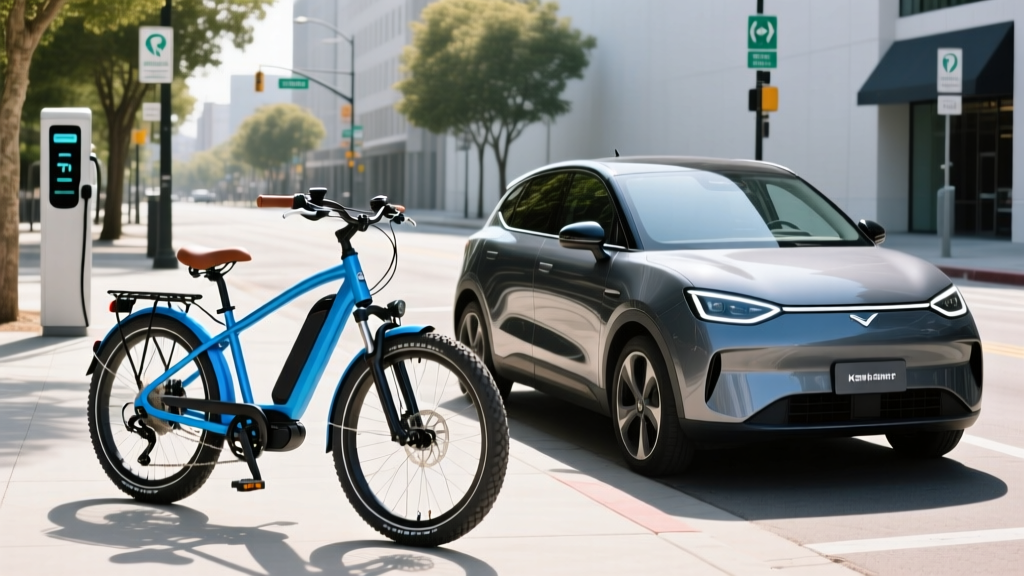
The Kent Bicycles Rockport electric cruiser bike is a ~$1,000–$1,200 pedal-assist e-bike with roughly 20–30 miles of electric range and a 36V battery. It costs pennies per charge, requires no insurance or registration, and eliminates fuel costs entirely for short urban commutes. A budget EV like the 2026 Chevrolet Bolt EV (~$28,000 before incentives) offers 259 miles of EPA range, climate protection, cargo space, and highway capability — but at 25× the upfront cost. If your round-trip commute is under 20 miles and you don't need highway speeds or weather protection, the Rockport e-bike saves thousands per year. If you need range, passengers, or all-weather capability, an EV is the practical choice.
The Kent Rockport electric cruiser bike occupies a space that surprises many first-time EV shoppers: it's an electrified vehicle, but not an electric car. For buyers researching battery-powered transportation, the Rockport and similar e-bikes raise a legitimate question — do you actually need a full EV, or can an electric bicycle cover your daily driving? This guide breaks down the real numbers on cost, range, charging, and ownership so you can decide where your money goes furthest.
What the Kent Rockport Electric Cruiser Bike Actually Offers
The Kent Rockport is a pedal-assist cruiser-style e-bike typically equipped with a 350W rear-hub motor and a 36V lithium-ion battery pack (approximately 10 Ah / 360 Wh of energy capacity). Here's what those specs translate to in practice:
- Electric-assisted range: 20–30 miles depending on assist level, rider weight, terrain, and wind
- Top assisted speed: ~20 mph (Class 1/2 e-bike limit under most US regulations)
- Charge time: 3–5 hours on a standard 120V household outlet
- Battery chemistry: Lithium-ion (typically NMC cells in this price segment)
- Weight: ~55–65 lbs
- Retail price: $900–$1,200 depending on retailer and model year
The 360 Wh battery is roughly 1/165th the energy capacity of a 60 kWh EV battery. That's not a criticism — it reflects the dramatically lower energy required to move a bicycle and rider versus a 3,500-pound car. Efficiency is where e-bikes shine: you're getting 20+ miles from the same energy a household LED bulb consumes in an afternoon.
Head-to-Head: E-Bike vs Budget EV Commute Costs
To make this comparison concrete, we'll stack the Kent Rockport against the 2026 Chevrolet Bolt EV (259 miles EPA, ~$28,000 MSRP before credits) and a comparable gas car (2026 Honda Civic, ~$25,000 MSRP, 35 MPG combined). The scenario: a 15-mile round-trip commute, 250 workdays per year.
| Category | Kent Rockport E-Bike | 2026 Chevy Bolt EV | 2026 Honda Civic (Gas) |
|---|---|---|---|
| Purchase price | $1,100 | $28,000 ($20,500 after §30D credit if eligible) | $25,000 |
| Energy cost per mile | ~$0.003 | ~$0.04 (at $0.15/kWh, 3.5 mi/kWh) | ~$0.10 (at $3.50/gal, 35 MPG) |
| Annual energy cost | ~$11 | ~$150 | ~$375 |
| Insurance (annual) | $0–$150 (optional) | $1,400–$2,000 | $1,200–$1,800 |
| Registration/taxes | $0 | $150–$400 | $150–$400 |
| Maintenance (annual) | $50–$150 (tires, brake pads, chain) | $300–$500 | $400–$700 |
| Year 1 total cost | $1,200–$1,400 | $22,500–$31,000 | $26,800–$28,300 |
| Year 2+ annual cost | $60–$300 | $1,850–$2,900 | $2,125–$3,300 |
The numbers are stark. Even after the Bolt EV's potential §30D federal tax credit (up to $7,500 if the vehicle, your income, and battery sourcing all qualify), the e-bike saves $1,800–$2,600 per year in ongoing costs. Over five years, total e-bike ownership can stay under $2,500 while even a credit-qualified Bolt EV exceeds $30,000 all-in.
Range, Charging, and Real-World Limitations
This is where the e-bike's practicality narrows sharply. The Kent Rockport's 360 Wh battery delivers 20–30 miles of real-world range — adequate for short urban commutes but nothing more. Consider these constraints honestly:
Range Reality Check
- Manufacturer-claimed range: Up to 30 miles (light rider, flat terrain, low assist)
- Realistic range: 18–24 miles with moderate assist on mixed terrain
- Cold-weather impact: Expect 20–30% range loss below 40°F — lithium-ion batteries lose capacity in cold, same as EVs
- Hill penalty: Sustained climbs can cut range by 30–40%
Charging Practicality
The Rockport charges from a standard 120V outlet using its included charger (typically ~2A output). A full 0–100% charge takes 3–5 hours. Unlike an EV, there's no DC fast charging option, no public charging network, and no preconditioning. You charge at home, at a desk, or not at all.
For comparison, a Level 2 home charger (240V, 32–48A) adds roughly 25–37 miles of range per hour to an EV like the Bolt — and a DC fast charger can add 100+ miles in 20 minutes. The e-bike's charging is simple but slow and home-dependent.
What the E-Bike Can't Do
Being honest about limitations is essential before you invest:
- No highway capability — 20 mph top speed means local roads and bike lanes only
- Weather exposure — rain, snow, extreme heat, and wind are your problem, not the vehicle's
- No passenger or cargo capacity beyond a backpack or pannier bags
- No climate control — you are the climate control
- Limited safety structure — no crumple zones, airbags, or NHTSA crash ratings
- Theft vulnerability — a $1,100 e-bike locked to a rack is a higher theft risk than a car in a garage
Tax Credits, Incentives, and the Cost Gap
The financial comparison shifts depending on which incentives you qualify for. Here's the current landscape:
EV Federal Tax Credit (§30D)
The IRS §30D credit offers up to $7,500 for qualifying new EVs, but eligibility depends on multiple factors that change frequently:
- MSRP cap: $55,000 for cars, $80,000 for SUVs/trucks
- Income cap: $150K single / $300K joint modified AGI
- Battery sourcing: Critical minerals and battery components must meet escalating domestic-content thresholds
- Point-of-sale transfer: You can apply the credit at purchase rather than waiting for tax filing
Always verify current eligibility on IRS.gov before purchasing — rules shift as battery sourcing requirements tighten.
E-Bike Incentives
There is currently no federal tax credit for e-bikes. However, some states, cities, and utilities offer rebates ranging from $100–$1,500 for e-bike purchases — often income-tiered. Check your local utility and state energy office. These rebates can make the Rockport effectively free in the best-case scenario, widening the cost gap with an EV enormously.
Decision Framework: E-Bike, EV, or Both?
Choose the Kent Rockport E-Bike If:
- Your round-trip commute is under 20 miles on local roads or bike lanes
- You live in a mild climate or are willing to ride in rain and cold
- You have secure storage (garage, indoor space) to prevent theft
- You want to minimize total transportation spending
- You already have access to a car (owned, shared, or rideshare) for longer trips
- Your route has safe cycling infrastructure
Choose a Budget EV (Bolt, LEAF, etc.) If:
- Your commute involves highways or exceeds 25 miles one way
- You need to carry passengers or significant cargo regularly
- You live in a region with harsh winters, extreme heat, or heavy rain
- You lack secure e-bike storage
- You need one vehicle to handle all transportation needs
- You can install a Level 2 home charger or have reliable workplace charging
Consider Both If:
- You own an EV for longer trips and want to eliminate car use for short daily errands
- Your household has two commuting adults — one takes the EV, one takes the e-bike
- You want to reduce EV battery wear and tire costs by keeping short-trip miles off the car
Common Misconceptions: E-Bikes vs EVs
| Myth | Fact |
|---|---|
| "E-bikes don't count as electric vehicles" | E-bikes are electrified transportation — they use lithium-ion batteries, electric motors, and grid electricity. They're just a different vehicle class. |
| "An e-bike can replace my car entirely" | For 15–25% of US commuters with short, flat, fair-weather trips — possibly. For the majority who need highway speeds, cargo space, or weather protection — no. |
| "E-bike batteries degrade just like EV batteries" | Both use lithium-ion cells, but e-bike batteries are smaller, cheaper to replace ($200–$400 vs $5,000–$15,000 for EV packs), and typically last 500–800 full charge cycles before noticeable degradation. |
| "Charging an e-bike is basically free" | Nearly, but not zero. At $0.15/kWh, a full 360 Wh charge costs about $0.05. Over 250 commute days, that's roughly $11/year — real money, just very little. |
| "I don't need a helmet or insurance for an e-bike" | Helmet laws vary by state and locality. While most states don't require e-bike insurance, homeowner's or renter's policies may not cover e-bike theft or liability — check your policy. Dedicated e-bike insurance runs $100–$300/year. |
| "The Kent Rockport is as fast as a moped" | No. The Rockport is limited to ~20 mph under motor assist and is classified as a low-speed electric bicycle under federal law (CPSC), not a motor vehicle. It doesn't require a license, registration, or insurance in most jurisdictions. |
Ownership Realities: What First-Time E-Bike Buyers Should Know
If you're coming from a car-only mindset, e-bike ownership has learning curves that matter:
Battery Care and Longevity
The Rockport's lithium-ion battery will degrade over time, similar to an EV pack but on a smaller, cheaper scale. Expect 70–80% capacity retention after 500–800 full charge cycles (roughly 3–5 years of daily commuting use). To maximize battery life:
- Store the battery between 32°F and 104°F — never leave it in a freezing garage or hot car
- Avoid regularly draining to 0% or charging to 100% if your usage allows — the 20–80% rule applies here too
- Bring the battery indoors during winter; charge at room temperature
- Budget for a replacement battery ($200–$400) every 3–5 years
Maintenance Differences
E-bikes require bicycle maintenance, not automotive maintenance. Budget for:
- Tire replacement: $30–$60 per tire, every 1,500–3,000 miles
- Brake pads: $15–$30, every 1,000–2,000 miles (e-bikes are heavier and harder on brakes)
- Chain: $15–$30, every 2,000–3,000 miles
- Tune-up: $50–$100 annually at a local bike shop
Total annual maintenance runs $50–$150 for typical commuting use — dramatically less than any car, EV or gas.
Safety and Infrastructure
Your experience on the Kent Rockport depends almost entirely on local cycling infrastructure. Protected bike lanes, low-speed streets, and paved trails make e-bike commuting practical and enjoyable. Four-lane arterials with no shoulder make it dangerous and unpleasant. Check your route on Google Maps' cycling layer or your city's bike map before committing.
Frequently Asked Questions
Is the Kent Rockport electric cruiser bike street-legal?
Yes, in most US jurisdictions. The Rockport's 350W motor and ~20 mph top speed classify it as a low-speed electric bicycle under federal consumer product law. Most states treat Class 1 and Class 2 e-bikes like regular bicycles — no license, registration, or insurance required. However, some states and localities have specific e-bike regulations regarding age limits, helmet requirements, and where you can ride (bike lanes, paths, sidewalks). Check your state and local laws.
Can I ride the Kent Rockport in the rain?
The Rockport's electrical components have basic water resistance, and the bike can handle light rain. However, it is not waterproof. Avoid submerging the motor or battery, don't ride through deep puddles, and dry the bike after wet rides. Heavy rain, combined with reduced visibility from cars, makes cycling significantly more dangerous — this is a real limitation versus an enclosed EV.
How does e-bike range compare to EV range in cold weather?
Both e-bikes and EVs lose range in cold weather because lithium-ion batteries are less efficient at low temperatures. EVs typically lose 15–30% of EPA range at 20°F; e-bikes can lose 20–35% because their smaller batteries have less thermal mass and no active thermal management system. The bigger practical difference: in an EV, you have a heated cabin. On an e-bike, you lose comfort and dexterity in cold, which limits practical riding days more than battery range does.
Should I buy an e-bike instead of an EV to save money?
If your daily transportation needs are limited to a short, local commute and errands, an e-bike saves $15,000–$25,000+ in upfront cost and $1,500–$3,000 per year in operating costs compared to an EV. But if you need to drive on highways, carry passengers, travel in bad weather, or take trips over 30 miles, an EV is a necessary tool that an e-bike cannot replace. Many households find the best financial outcome is one EV plus one e-bike — using the e-bike for daily short trips and the EV for everything else.
What's the battery replacement cost for the Kent Rockport?
A replacement 36V lithium-ion battery for the Rockport typically costs $200–$400 depending on capacity and source. This is dramatically cheaper than EV battery replacement ($5,000–$15,000+). Most riders will need one replacement battery over 5–7 years of regular use. Some third-party battery rebuilders can re-cell your existing battery pack for $150–$250, often with higher-capacity cells than the original.
Does the Kent Rockport qualify for any tax credits?
There is currently no federal tax credit for e-bikes under §30D or any other IRS provision. However, several states (including California, Colorado, Massachusetts, and others) and many local utilities offer e-bike purchase rebates ranging from $100 to $1,500, often with income-based tiers. Check your state energy office and utility provider for current programs.
The Kent Bicycles Rockport electric cruiser bike and a budget EV solve fundamentally different transportation problems at fundamentally different price points. The Rockport is a $1,100 tool for short, fair-weather, local trips — and it performs that job at pennies per mile. An EV is a $28,000+ tool for all-weather, all-distance, multi-passenger transportation. Neither replaces the other universally, but understanding the real numbers — not the marketing — lets you decide which belongs in your garage, or whether both do.