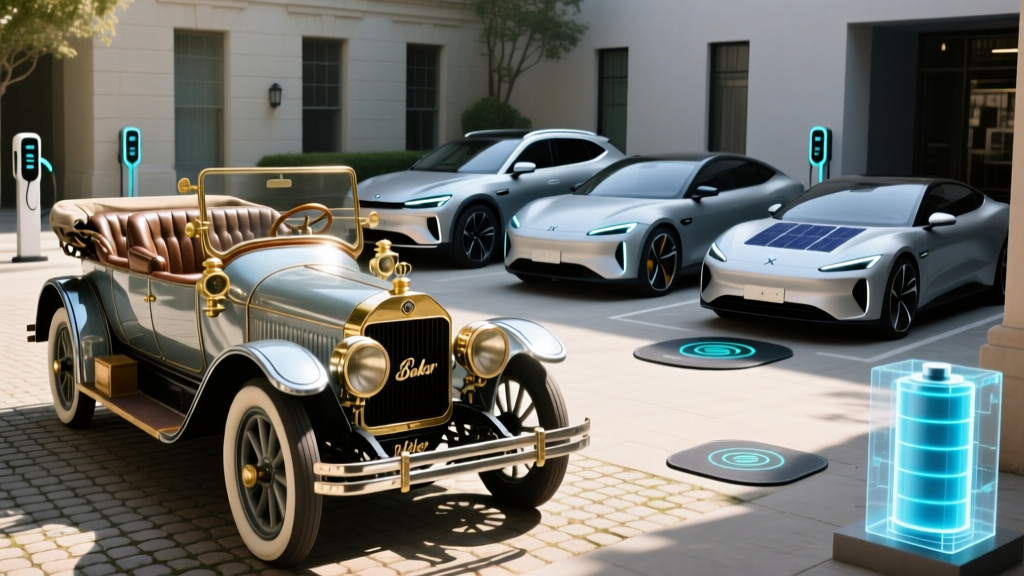
Quick Answer: The 1909 Baker Electric Car offered roughly 50–100 miles of range at a top speed of 14 mph, cost about $2,000 (equivalent to ~$68,000 today), and required 8–10 hours to recharge its lead-acid batteries. A 2026 EV like the Chevrolet Equinox EV delivers 319 miles of EPA range, charges 10–80% in ~20 minutes at 150 kW DC, and starts at $33,600 before potential federal tax credits. Over a century of battery chemistry, motor efficiency, and charging infrastructure development has transformed the electric car from a niche urban carriage into a practical daily driver.
Why the 1909 Baker Electric Car Still Matters in EV History
Before Tesla, before the Nissan Leaf, before even the Toyota Prius, there was the Baker Motor Vehicle Company of Cleveland, Ohio. The 1909 Baker Electric was one of the most popular electric cars of its era — a time when electric vehicles actually outsold gasoline cars in American cities. In 1900, roughly 38% of automobiles on US roads were electric, 40% were steam-powered, and only 22% ran on gasoline, according to data from the Hagley Museum & Library.
The Baker Electric appealed to urban drivers — particularly women — because it was quiet, clean, and didn't require hand-cranking to start. Clara Ford, wife of Henry Ford himself, reportedly drove a Baker Electric. But the Baker's limitations were severe by any modern standard, and understanding those limitations illuminates exactly why modern EV technology represents such a dramatic leap.
1909 Baker Electric vs 2026 EVs: The Numbers Side by Side
Spec-for-spec, the gap between a century-old electric car and today's offerings is enormous. This comparison uses the 2026 Chevrolet Equinox EV 3LT (a mainstream, mid-priced EV) as a representative modern benchmark.
| Specification | 1909 Baker Electric | 2026 Chevrolet Equinox EV 3LT |
|---|---|---|
| Battery Chemistry | Lead-acid | Ultium NMC (lithium-ion) |
| Battery Capacity | ~12 kWh (estimated) | 85 kWh usable |
| Range | 50–100 miles (varies by speed/load) | 319 miles (EPA est.) |
| Top Speed | ~14 mph | ~130 mph (electronically limited) |
| Motor Power | ~3.5 hp | 213 hp (FWD) / 288 hp (AWD) |
| 0–60 mph | Not achievable | ~8.0 seconds (AWD) |
| Charge Time (full) | 8–10 hours (AC mains) | ~10 hours (Level 2, 11.5 kW); 10–80% in ~20 min (DC fast charge at 150 kW) |
| Vehicle Weight | ~2,500–3,000 lbs | ~4,800 lbs |
| Original Price | ~$2,000 (~$68,000 in 2026 dollars) | $33,600 MSRP (before incentives) |
| Braking | Mechanical drum, no regen | Regenerative braking with one-pedal driving |
| Thermal Management | None | Active liquid cooling/heating with heat pump available |
A few things jump out from this table. First, energy density: modern NMC lithium-ion cells store roughly 10–15 times more energy per kilogram than lead-acid batteries, which is why an 85 kWh pack weighs a fraction of what an equivalent lead-acid bank would weigh. Second, the Baker's price in inflation-adjusted dollars is more than double the Equinox EV's MSRP — and the Equinox delivers vastly more capability. Third, regenerative braking and thermal management, technologies that simply didn't exist in 1909, are now standard features that extend range and preserve battery health over decades of use.
Real Costs: Then vs Now vs Gasoline
Comparing ownership costs across 117 years requires some translation, but the exercise reveals how EV economics have shifted.
| Cost Category | 1909 Baker Electric | 2026 Equinox EV | 2026 Gas Car (Toyota RAV4, ~28 MPG combined) |
|---|---|---|---|
| Purchase Price (nominal) | $2,000 | $33,600 | $30,000 |
| Purchase Price (2026 adjusted) | ~$68,000 | $33,600 | $30,000 |
| Fuel/Energy Cost per Mile | ~$0.02 (early electricity rates, ~$0.10/kWh equiv.) | ~$0.04 (at $0.14/kWh avg, 3.2 mi/kWh) | ~$0.11 (at $3.10/gal, 28 MPG) |
| Annual Fuel/Energy (12,000 mi) | ~$240 (1909 dollars) | ~$480 | ~$1,320 |
| Maintenance (annual) | Battery replacement every 1–2 years (~$300–$600 in 1909 dollars) | ~$300–$500 (tire rotation, cabin filter, fluid checks) | ~$800–$1,200 (oil changes, filters, belts, brakes) |
| Battery Replacement | Frequent — lead-acid degraded rapidly | Rare — 8-year/100,000-mile warranty; degradation ~10–15% over 10 years |
The Baker's lead-acid batteries were its Achilles' heel. They required regular water topping, were extremely heavy, lost capacity quickly in cold weather, and needed full replacement every year or two. Modern lithium-ion packs, by contrast, are warrantied for 8 years or 100,000 miles (the federal minimum per fueleconomy.gov) and typically retain 85–90% of original capacity at the 10-year mark based on fleet data from Tesla, Hyundai, and Nissan.
On a per-mile energy basis, the 2026 Equinox EV costs roughly $0.04/mile to fuel on home electricity, compared to $0.11/mile for a comparable gasoline RAV4. Over 12,000 miles per year, that's an annual fuel savings of approximately $840 — or $4,200 over five years. If you qualify for the federal §30D tax credit (up to $7,500, subject to MSRP caps, income limits, and battery sourcing requirements per the IRS), the Equinox EV can actually cost less upfront than the gas alternative.
What a First-Time EV Buyer Should Know in 2026
If you're researching EVs and stumbled onto the Baker Electric's history, you might be wondering how practical a modern EV actually is. Here's the honest, data-grounded picture.
Home Charging Is the Single Biggest Factor
Level 2 home charging (240V, typically 32–48 amps / 7.7–11.5 kW) adds roughly 25–40 miles of range per hour of charging. For a car with 300+ miles of range, an overnight charge from 20% to 80% takes about 6–8 hours. Installation costs range from $500–$1,500 if your electrical panel has spare capacity, to $2,500–$5,000+ if a panel upgrade (from 100A to 200A service) is required. Approximately 75–80% of EV owners charge primarily at home, and those who can't (apartment dwellers, street parkers) report significantly lower satisfaction.
Real-World Range Is Less Than the EPA Sticker
The EPA range estimate assumes a mix of city and highway driving at moderate temperatures. In practice:
- Highway driving at 70+ mph: Expect 80–90% of EPA range (a 319-mile EV delivers ~255–287 miles)
- Cold weather (below 32°F): Expect 60–80% of EPA range depending on severity, unless the vehicle has a heat pump
- City driving with regen braking: You may match or slightly exceed EPA range
DC Fast Charging Is Not Linear
When a manufacturer advertises "200 kW DC fast charging," that's a peak rate, not a sustained one. Most EVs charge fastest between 10–50% State of Charge (SoC), then taper significantly above 80% to protect the battery. A session from 10–80% at a 150 kW charger might take 20 minutes, but 80–100% could take another 20–30 minutes. Plan road-trip stops around 10–80% charges for the best time efficiency.
Federal Tax Credit Eligibility Is Complex
The §30D Clean Vehicle Credit can provide up to $7,500, but eligibility in 2026 depends on:
- Buyer income: AGI must not exceed $150,000 (single), $225,000 (head of household), or $300,000 (joint)
- MSRP caps: $55,000 for sedans; $80,000 for SUVs, vans, and trucks
- Battery sourcing: Critical minerals and battery components must meet phased-in domestic/free-trade-partner thresholds
- Assembly: Vehicle must undergo final assembly in North America
Always verify current eligibility on the IRS Clean Vehicle Credit page and consult a tax professional — rules have shifted annually since 2023.
Common EV Misconceptions — Fact vs Fiction
| Myth | Fact |
|---|---|
| "EV batteries need replacing every few years, like the 1909 Baker." | Modern lithium-ion packs are warrantied 8 yr/100,000 mi. Fleet data shows ~10–15% degradation at 10 years. Full replacement is rare and costs $5,000–$15,000 depending on the vehicle. |
| "EVs are worse in cold weather, so they're impractical." | Cold reduces range 20–40%, but preconditioning (warming the battery while plugged in) recovers much of that loss. Norway, where winters are severe, has the world's highest EV adoption rate (~90% of new car sales). |
| "There aren't enough chargers for road trips." | The US had over 200,000 public charging ports as of early 2026, including 50,000+ DC fast chargers. Coverage is uneven — rural corridors in the Mountain West and Great Plains remain sparse — but major interstates are well-served. |
| "EVs are more expensive than gas cars." | Upfront MSRPs are converging. After the §30D credit, several 2026 EVs (Equinox EV, Hyundai Kona Electric, Nissan Leaf) have effective prices at or below comparable gas models. Total cost of ownership over 5 years is typically lower due to fuel and maintenance savings. |
| "EVs are slow and boring to drive." | Electric motors deliver instant torque. Even mainstream EVs like the Hyundai Ioniq 5 (0–60 in 5.1s, AWD) out-accelerate most gas cars in their price range. The Baker Electric's 14 mph top speed is a relic of its era. |
Decision Framework: Is a 2026 EV Right for You?
Choose a Battery Electric Vehicle (BEV) if:
- You have access to Level 2 home charging (garage, driveway, or workplace)
- Your daily driving is under 80 miles round-trip (covers ~90% of US commutes)
- You want the lowest per-mile fuel cost (~$0.04/mi on home electricity)
- You qualify for the §30D tax credit and it materially reduces your purchase price
- You're willing to plan charging stops on road trips of 300+ miles
Choose a Plug-in Hybrid (PHEV) if:
- You lack reliable home charging but want some electric-only driving (typically 25–45 miles)
- You take frequent long road trips and don't want to depend on DC fast-charging infrastructure
- You want a transitional step — electric for daily commuting, gas for flexibility
Wait on a full EV if:
- You live in an apartment or park on the street with zero charging access
- Your regular routes pass through known charging deserts (parts of rural Montana, the Dakotas, West Texas)
- Your budget is under $25,000 and you can't find a qualifying used EV under the §25E used-EV credit ($4,000 max)
From the Baker to Today: What Changed — and What Didn't
The core value proposition of the 1909 Baker Electric — quiet, clean, low-maintenance urban transportation — is exactly what modern EVs deliver, just at vastly higher capability. What changed was battery chemistry (lead-acid → NMC/LFP lithium-ion), motor efficiency (~3.5 hp → 200+ hp from motors weighing less), and infrastructure (a single AC outlet → a national network of 150–350 kW DC fast chargers).
What hasn't changed: EVs still work best when you can charge where you park. The Baker's owners in 1909 needed access to electrical service — a luxury not universal at the time. In 2026, home charging access remains the single strongest predictor of EV ownership satisfaction. The technology has transformed; the fundamental ownership equation hasn't.
If you're evaluating an EV purchase today, the right question isn't whether electric propulsion is viable — that was settled long ago, arguably as early as the Baker Electric proved it in Cleveland's streets. The right question is whether your specific driving patterns, housing situation, and budget align with current EV strengths. For most American drivers with home charging access, the answer in 2026 is yes.
Frequently Asked Questions
Why did the 1909 Baker Electric Car disappear if EVs were so popular?
Three factors converged between 1910 and 1920: the mass-produced Ford Model T dropped to $260 (far cheaper than a $2,000 Baker), Texas oil discoveries made gasoline cheap, and the electric starter (invented 1912) eliminated the dangerous hand-crank that made gas cars unappealing. Range limitations and sparse rural electricity sealed the EV's fate for nearly a century.
How far could the 1909 Baker Electric actually go on a charge?
Advertised range was 50–100 miles depending on speed and battery configuration, but real-world range at anything above 10 mph dropped significantly. Lead-acid batteries sagged under load, and the Baker lacked any form of regenerative braking to recover energy.
What's the cheapest new EV available in 2026?
The Nissan Leaf S starts around $28,140 and offers 149 miles of EPA range. After the §30D credit (if eligible), effective cost can drop below $21,000. The Chevrolet Equinox EV starts at $33,600 with 319 miles of range — significantly more practical for most buyers.
Do modern EV batteries degrade like the Baker's lead-acid batteries did?
Not comparably. Lead-acid batteries lost significant capacity within months and required full replacement every 1–2 years. Modern lithium-ion (NMC or LFP) batteries degrade roughly 1.5–2.5% per year under normal use. At 10 years, most retain 80–90% of original capacity, and they're warrantied to retain at least 70% for 8 years/100,000 miles.
Can I charge a modern EV as easily as the Baker charged in 1909?
Easier. The Baker required access to early AC electrical service (not universal in 1909) and took 8–10 hours for a full charge. A 2026 EV on a home Level 2 charger (11.5 kW) reaches 80% in roughly 6 hours, and DC fast charging can add 150+ miles of range in 15–20 minutes on a road trip.