The Reality of EV Towing: Beyond the Window Sticker
When evaluating the best electric vehicles for towing, maximum capacity is only half the story. Electric trucks and SUVs boast instantaneous torque, heavy-duty payload capacities, and impressive max towing ratings that often rival or exceed their internal combustion counterparts. However, for anyone planning a road trip with a camper, boat, or utility trailer in tow, the most critical metric is not how much weight the EV can pull, but how far it can pull it. The real-world range impact of towing is the ultimate stress test for battery technology, aerodynamics, and powertrain efficiency.
In this expert guide, we rank the best EVs for towing based specifically on their real-world towing range retention. We will also break down the physics behind the notorious 'range drop' and provide actionable best practices to help you maximize your miles when hauling heavy loads.
The Science Behind EV Towing Range Impact
Why do electric vehicles lose between 40% and 60% of their EPA-estimated range when towing? The answer lies in the physics of aerodynamic drag and rolling resistance. According to the U.S. Department of Energy's Alternative Fuels Data Center, electric vehicles are highly efficient because they convert over 77% of the electrical energy from the grid to power at the wheels. However, that efficiency is heavily dependent on the vehicle's aerodynamic profile.
When you attach a traditional box-style travel trailer to the back of an EV, you are essentially deploying a parachute. Aerodynamic drag increases exponentially with speed. While an EV's regenerative braking system can recapture some energy on downhill grades, it cannot overcome the massive energy deficit created by pushing a 7,000-pound, flat-fronted trailer through the air at highway speeds. Furthermore, the Environmental Protection Agency (EPA) notes that external factors like high speeds, aggressive driving, and heavy cargo loads significantly reduce real-world efficiency compared to window sticker estimates. When towing, you are maximizing all three of these range-depleting factors simultaneously.
Top EVs for Towing Ranked by Range Retention
To determine the best EVs for towing, we look past the maximum towing capacity and focus on the usable battery size, the vehicle's native aerodynamics, and real-world testing data regarding miles per kWh while under load. Below is our ranked comparison of top electric trucks and SUVs.
| EV Model | Max Towing | EPA Est. Range | Est. Towing Range | Range Impact |
|---|---|---|---|---|
| Chevrolet Silverado EV RST | 10,000 lbs | 440 miles | ~240 miles | ~45% Drop |
| Rivian R1T Dual-Motor Max | 11,000 lbs | 410 miles | ~205 miles | ~50% Drop |
| Ford F-150 Lightning Ext. | 10,000 lbs | 320 miles | ~160 miles | ~50% Drop |
| Tesla Model X | 5,000 lbs | 311 miles | ~185 miles | ~40% Drop |
| GMC Hummer EV Pickup | 7,500 lbs | 329 miles | ~150 miles | ~54% Drop |
1. Chevrolet Silverado EV RST (Best Overall Towing Range)
The Chevrolet Silverado EV RST takes the top spot purely due to its massive 200+ kWh Ultium battery pack, which yields an astonishing 440 miles of EPA-estimated range. When applying the standard 45-50% towing penalty, the Silverado EV still manages an estimated 220 to 240 miles of real-world towing range. This is a game-changer for EV towing, as it pushes the single-charge towing distance past the critical 200-mile threshold, making it viable for longer highway stretches between charging stops.
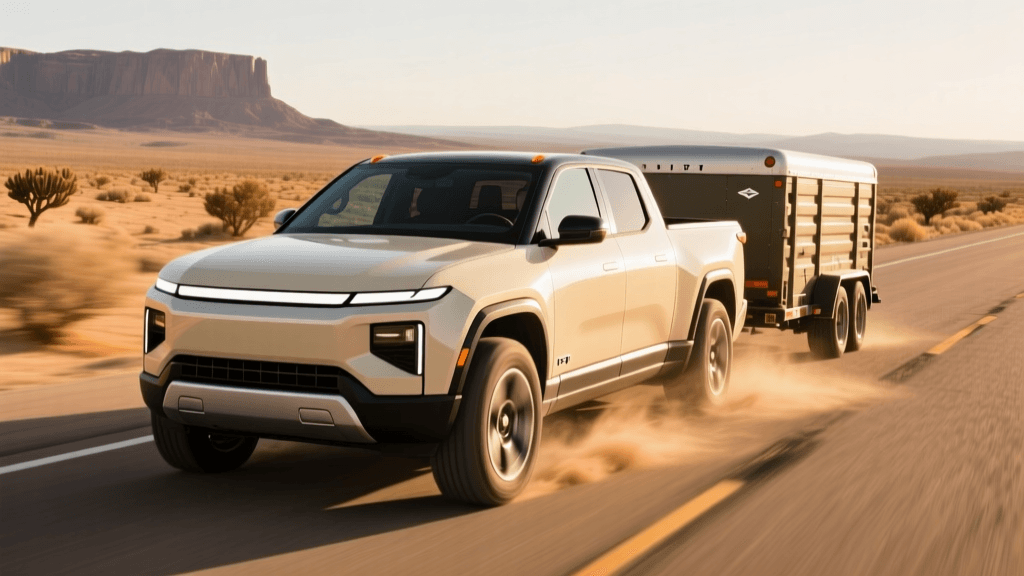
2. Rivian R1T Dual-Motor Max Pack (Best Adventure Towing)
Rivian's R1T with the Max Pack battery (149 kWh) offers 410 miles of range. The R1T's clever aerodynamics, including the full-coverage belly pan and active air suspension that lowers the truck at highway speeds, help it slice through the air better than traditional boxy pickups. Real-world tests towing 7,000-pound campers show the R1T achieving roughly 1.0 to 1.1 miles per kWh, yielding a usable towing range of around 200 miles. Its integrated trailer brake controller and excellent tow mode software make it a top-tier choice for off-grid campers.
3. Ford F-150 Lightning Extended Range (Best Value Towing)
The F-150 Lightning with the 131 kWh Extended Range battery is rated for 320 miles. However, its traditional truck aerodynamics and heavy curb weight penalize it slightly when towing. Owners frequently report dropping to 1.3 to 1.5 miles per kWh when pulling a 6,000-pound load, resulting in a towing range of 140 to 160 miles. While the range drop is steep, the Lightning's widespread compatibility, Pro Power Onboard for running camper appliances, and excellent ride quality keep it high on the list.
4. Tesla Model X (Best SUV Range Retention)
While its 5,000-pound max towing capacity limits it to small teardrop campers and light boat trailers, the Tesla Model X deserves a spot on this list for its exceptional range retention percentage. Because it is a unibody SUV with a highly aerodynamic profile, it suffers less from the 'parachute effect' than body-on-frame trucks. Towing a 3,500-pound aerodynamic trailer, the Model X can retain up to 60% of its 311-mile range, yielding roughly 185 miles of towing range while utilizing the Supercharger network.
5. GMC Hummer EV Pickup (Highest Capacity, Worst Efficiency)
The Hummer EV is a marvel of engineering with its 24-module battery and crab-walk capabilities, but it is a victim of its own mass. Weighing over 9,000 pounds empty, the energy required to move the truck itself is immense. When you add a trailer, the efficiency plummets. Despite its 329-mile EPA range, real-world towing range often dips below 150 miles. It is best suited for short-distance, heavy-equipment hauling rather than cross-country camper towing.
Expert Tips & Best Practices for Maximizing Towing Range
Understanding your vehicle's limitations is only the first step. As an EV owner planning a towing trip, you can employ several expert strategies to mitigate range anxiety and stretch your battery's usable capacity.
1. Respect the 65 MPH Threshold
Aerodynamic drag increases with the square of your speed. The difference in energy consumption between driving 65 MPH and 75 MPH while towing a boxy trailer can be as high as 20%. If your route planner shows you arriving at a charger with 1% battery left, dropping your cruising speed by 10 MPH is the most reliable way to guarantee you reach the plug. Set your adaptive cruise control to 65 MPH and stay in the right lane.
2. Choose Aerodynamic Trailers
If you are shopping for a camper specifically to tow with an EV, prioritize aerodynamics over square footage. Teardrop trailers, Airstreams, and campers with rounded front caps and boat-tails will drastically reduce your range impact compared to traditional flat-fronted travel trailers. A highly aerodynamic trailer can reduce your range penalty from 50% down to 30%.
3. Optimize Payload vs. Towing Weight
According to data from the DOE Fuel Economy Guide, moving weight requires energy, but moving weight inside the vehicle is more efficient than towing it. If you have the choice between putting 500 pounds of gear in the truck bed or loading it into a trailer, put it in the bed. You eliminate the rolling resistance of the trailer's extra axles and the aerodynamic drag of the trailer's increased frontal area.
4. Master Route Planning with ABRP
Standard vehicle navigation systems often fail to account for the severe range penalties of towing. Use third-party applications like A Better Routeplanner (ABRP). ABRP allows you to input your specific EV model, the exact weight of your trailer, and even the trailer's frontal area and drag coefficient. This provides a highly accurate prediction of your energy consumption and automatically routes you through chargers capable of handling your truck's size.
5. Utilize Tow Mode and Regenerative Braking
Always engage your vehicle's dedicated Tow/Haul mode. This adjusts the throttle response, stiffens the steering, and, most importantly, alters the regenerative braking profile. When towing thousands of pounds, aggressive regen can cause trailer sway or jackknifing. Tow mode smooths out the regen curve and integrates the trailer's electric brakes (if equipped via a 7-pin connector) to safely scrub speed on long mountain downgrades, safely recapturing energy without compromising stability.
Final Verdict
Towing with an electric vehicle requires a paradigm shift. You can no longer look at the window sticker range and expect to see those numbers with a trailer attached. The Chevrolet Silverado EV RST currently offers the best raw towing range due to its massive battery, while the Rivian R1T provides the best balance of adventure-ready software, aerodynamics, and range retention. By respecting the laws of physics, managing your speed, and choosing the right trailer, EV towing is not just possible—it is a remarkably quiet, torque-rich, and enjoyable experience.