The True Cost of Family EV Hauling
When shopping for a family vehicle, cargo capacity and passenger comfort usually dictate the shortlist. However, in the electric vehicle (EV) market, buyers must also weigh these practical needs against premium upfront costs. As automakers release larger, more capable electric SUVs, the challenge for parents and road-trippers is finding the sweet spot between interior volume, range, and overall value. At AutoEdgeView, we believe that an EV's true worth isn't just about its sticker price or zero-to-sixty time; it is about how efficiently it serves your family's daily logistics and weekend adventures.
To help you navigate this rapidly expanding segment, we have ranked the best electric SUVs for families through a strict 'Cost & Value Breakdown' lens. We analyze the price per cubic foot of cargo, total cost of ownership (TCO), and the real-world utility of each vehicle's storage solutions.
How We Measure EV Cargo Value
Our ranking methodology focuses on three core pillars:
- Maximum Cargo Volume: Measured in cubic feet behind the front seats (or second row for 3-row SUVs), including the front trunk (frunk) where applicable.
- Price-Per-Cubic-Foot Ratio: We divide the base MSRP by the maximum cargo capacity to determine which vehicles offer the most hauling real estate for your dollar.
- Family Utility & TCO: We factor in seating configurations, Vehicle-to-Load (V2L) capabilities for camping, and long-term savings on fuel and maintenance.
1. Tesla Model Y Long Range: The Cargo-to-Cost Champion
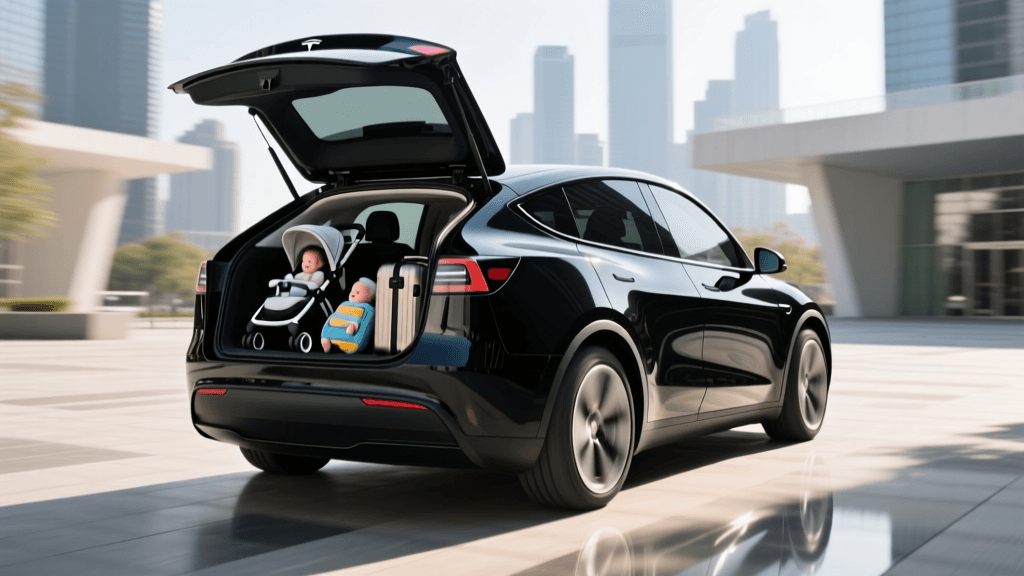
The Tesla Model Y remains the undisputed benchmark for families seeking maximum cargo space without stepping up to a massive, truck-based SUV. Despite being classified as a compact crossover, the Model Y's hatchback design yields an astonishing 76.2 cubic feet of cargo space with the second row folded flat. Additionally, the rear sub-trunk and the 4.1-cubic-foot frunk provide secure, hidden storage for charging cables, groceries, or stroller accessories.
Cost & Value Breakdown
With a starting MSRP hovering around $44,990 (before incentives), the Model Y delivers a remarkable price-to-space ratio of roughly $590 per cubic foot. Furthermore, Tesla's Supercharger network eliminates the range anxiety often associated with family road trips, saving parents time and stress. While the optional third-row seat is available, it is strictly for small children; for families needing genuine 7-passenger space, the Model Y is best utilized as a premium 5-seater hauler.
2. Kia EV9: The 3-Row Family Value King
For larger families, the 3-row electric SUV segment has historically been dominated by ultra-luxury options. The Kia EV9 disrupts this market by offering genuine three-row utility at a mainstream price point. Behind the third row, you get 20.2 cubic feet of space—enough for a double stroller and several grocery bags. Fold the third row down, and you unlock 43.5 cubic feet; fold both rear rows, and the EV9 expands to a massive 81.9 cubic feet.
Cost & Value Breakdown
Starting at approximately $54,900 for the Light Long Range trim, the EV9's price-per-cubic-foot ratio sits at an impressive $670. Kia also includes V2L (Vehicle-to-Load) functionality, allowing you to power campsite appliances or tailgate equipment directly from the battery. When you factor in available federal and state incentives, the EV9's value proposition becomes nearly unbeatable for families of five or more.
3. Hyundai Ioniq 5: The Compact Crossover Sweet Spot
If your family consists of one or two children and your cargo needs lean toward sports gear and luggage rather than massive furniture hauls, the Hyundai Ioniq 5 is a masterclass in interior packaging. Built on a dedicated EV platform with a flat floor, the Ioniq 5 features a sliding rear bench that moves up to 5.3 inches. This allows parents to prioritize either rear legroom or rear cargo space (up to 59.3 cubic feet) on the fly.
Cost & Value Breakdown
Priced from $41,800, the Ioniq 5 comes in at $704 per cubic foot. While slightly less efficient on the cargo-to-cost metric than the Model Y, the Ioniq 5 redeems itself with its 800-volt ultra-fast charging architecture. On a family road trip, the ability to charge from 10% to 80% in just 18 minutes means less time waiting at rest stops and more time making memories.
4. Rivian R1S: The Premium Adventure Hauler
The Rivian R1S is the ultimate electric SUV for outdoorsy families who demand luxury, off-road capability, and massive storage. While it lacks the traditional 'gear tunnel' found in the R1T pickup, the R1S compensates with a large front trunk and a deep under-floor storage bin in the rear cargo area, perfect for hiding muddy boots or wet wetsuits. Maximum cargo space reaches an expansive 104.7 cubic feet with the front passenger seat folded forward.
Cost & Value Breakdown
With a starting price of $74,900, the R1S commands a premium, resulting in a $715 per-cubic-foot ratio. However, its value is derived from its dual-motor all-wheel-drive capability, integrated camp kitchen options, and advanced air suspension that makes loading heavy gear effortless. It directly replaces legacy luxury haulers like the BMW X7 or Cadillac Escalade, offering vastly superior running costs.
Head-to-Head Data Comparison
| EV Model | Starting MSRP | Max Cargo (cu ft) | Cost per Cu Ft | EPA Range | 3rd Row? |
|---|---|---|---|---|---|
| Tesla Model Y LR | $44,990 | 76.2 | $590 | 310 mi | Optional (Small) |
| Kia EV9 LR | $54,900 | 81.9 | $670 | 304 mi | Yes |
| Hyundai Ioniq 5 | $41,800 | 59.3 | $704 | 303 mi | No |
| Rivian R1S Dual | $74,900 | 104.7 | $715 | 352 mi | Yes |
Factoring in Total Cost of Ownership (TCO)
When evaluating the best EV for your family, the sticker price is only half the equation. Electric vehicles offer substantial long-term savings that dramatically improve their overall value proposition.
Maintenance and Fuel Savings
According to the U.S. Department of Energy's Alternative Fuels Data Center, electric vehicles cost significantly less to maintain than internal combustion engine (ICE) vehicles. With fewer moving parts, no oil changes, and regenerative braking that extends brake pad life, EVs average roughly 6.1 cents per mile in maintenance compared to 10.1 cents for gas-powered cars. Over a 100,000-mile family ownership cycle, this translates to thousands of dollars kept in your college fund.
Federal Tax Incentives
Upfront costs can be heavily mitigated by government incentives. Many of the SUVs listed above may qualify for the Federal Clean Vehicle Credit, which offers up to $7,500 in tax credits for eligible buyers and vehicles. Furthermore, the ability to transfer this credit to the dealer at the point of sale as an instant rebate effectively lowers the MSRP, instantly improving the price-per-cubic-foot ratios detailed in our table above.
Safety as a Value Metric
For families, safety is a non-negotiable aspect of value. The heavy battery packs in these SUVs provide a low center of gravity, drastically reducing rollover risks. When cross-shopping, always verify a vehicle's crash test performance through the National Highway Traffic Safety Administration (NHTSA) 5-Star Safety Ratings. Vehicles like the Model Y and Ioniq 5 have historically excelled in these rigorous evaluations, providing peace of mind that no price tag can quantify.
Final Verdict: Which EV Fits Your Family's Budget?
The 'best' electric SUV ultimately depends on your family's specific spatial needs and financial parameters. If you are a family of four seeking the absolute best cargo-to-cost ratio and road-trip infrastructure, the Tesla Model Y remains the mathematical and practical winner. For larger families requiring a usable third row without crossing into luxury-car pricing, the Kia EV9 is a generational leap in family EV value. Meanwhile, the Hyundai Ioniq 5 serves as the perfect urban and suburban runabout for smaller families, and the Rivian R1S stands alone for those who view weekend wilderness adventures as a core family value.
AutoEdgeView Pro Tip: Before signing a lease or purchase agreement, always use your VIN to verify the vehicle's exact battery component sourcing on the IRS portal to ensure you qualify for the maximum $7,500 point-of-sale rebate. This single step can shift a vehicle from 'good value' to 'exceptional deal'.