The Heavy Haulers: Electric Trucks Ranked by Towing and Payload
When transitioning to an electric vehicle (EV) truck, buyers are often drawn by the promise of instant torque, massive horsepower, and a frunk large enough to swallow a week's worth of groceries. However, the ultimate stress test for any pickup is its ability to tow and haul. Electric trucks face a unique physics problem: while electric motors are phenomenal for pulling heavy loads from a standstill, the immense weight of the battery packs eats into payload capacity, and aerodynamic drag severely impacts range at highway speeds.
To help you solve the heavy-hauling dilemma, we have ranked the top electric trucks on the market based on their maximum towing and payload capacities. Following the rankings, we provide a comprehensive troubleshooting guide to solve the most common problems EV truck owners face when towing, from severe range anxiety to payload sag and charging logistics.
Electric Truck Towing and Payload Comparison Chart
| EV Truck Model | Max Towing Capacity | Max Payload Capacity | Key Towing Feature |
|---|---|---|---|
| Chevrolet Silverado EV (4WT) | 20,000 lbs | 1,800 lbs | Available Max Trailering Package |
| GMC Sierra EV (Denali) | 20,000 lbs | 1,800 lbs | CrabWalk / 4-Wheel Steering |
| Rivian R1T (Quad-Motor) | 11,000 lbs | 1,760 lbs | Camp Kitchen & Air Suspension |
| Tesla Cybertruck (AWD) | 11,000 lbs | 2,500 lbs | Adaptive Air Suspension & Steer-by-Wire |
| Ford F-150 Lightning (Ext. Range) | 10,000 lbs | 2,235 lbs | Pro Power Onboard & Smart Hitch |
1. Chevrolet Silverado EV & GMC Sierra EV: The 20,000-lb Titans
General Motors has engineered the Ultium-based Silverado EV and Sierra EV to be the undisputed kings of heavy towing. When equipped with the Max Trailering Package, the commercial-focused Silverado EV 4WT boasts a staggering 20,000-pound towing capacity. The consumer-focused GMC Sierra EV matches this figure in higher trims. The primary advantage here is the massive battery pack (over 200 kWh), which provides the raw energy required to move immense weight. However, the trade-off is a lower payload capacity compared to some competitors, and the sheer size of the batteries makes these trucks incredibly heavy even when empty.
2. Rivian R1T & Tesla Cybertruck: The 11,000-lb Innovators
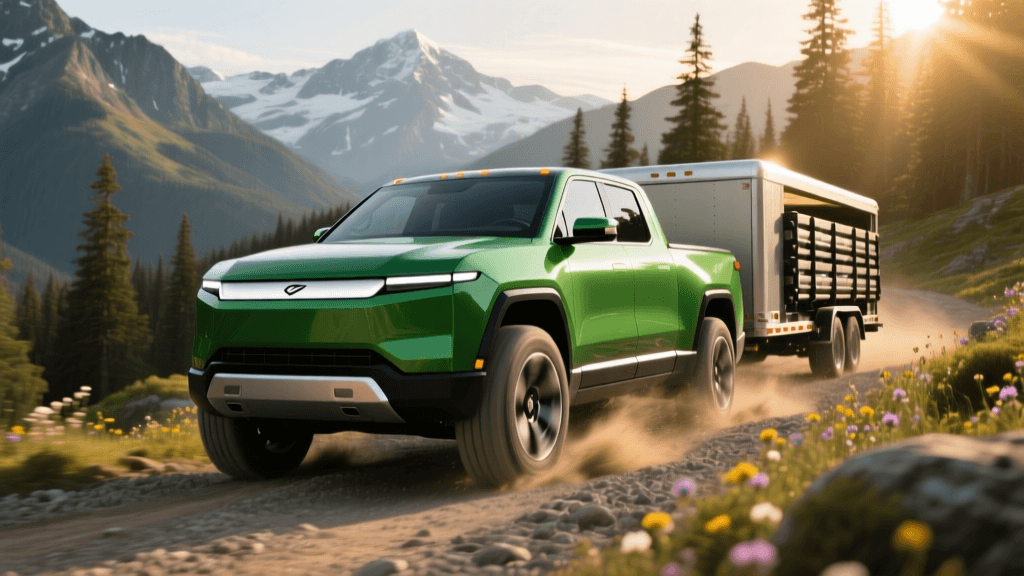
The Rivian R1T and Tesla Cybertruck tie for second place with 11,000-pound towing limits. The R1T utilizes a sophisticated quad-motor setup and hydraulic roll control to keep the truck perfectly level when towing, eliminating the need for traditional sway bars. The Cybertruck leverages its stainless steel exoskeleton and 48-volt electrical architecture to handle heavy loads while offering the highest payload capacity in the EV segment at 2,500 pounds. Both trucks excel in off-road trailering scenarios, though their unique bed sizes (the R1T's shorter 4.5-foot bed) require careful planning for larger cargo.
3. Ford F-150 Lightning: The 10,000-lb Workhorse
The Ford F-150 Lightning Extended Range caps out at 10,000 pounds of towing and 2,235 pounds of payload. While it sits at the bottom of this specific ranking, it remains the most practical and user-friendly truck for traditional towing. Ford's integration of the Smart Hitch (which automatically calculates tongue weight) and the Pro Power Onboard system (turning the truck into a massive mobile generator) makes it the ultimate problem-solver for contractors and campers who need reliable, familiar utility without a steep learning curve.
Troubleshooting the EV Towing Dilemma: Fixing Range and Payload Issues
Ranking the trucks is only half the battle. The reality of towing with an electric truck introduces a host of new problems. According to the U.S. Department of Energy's Alternative Fuels Data Center, electric motors provide instant torque, making them excellent for towing, but aerodynamic drag heavily impacts battery efficiency at highway speeds (AFDC). Below, we troubleshoot the four biggest problems EV truck owners face on the road.
Problem 1: Severe Highway Range Drop While Towing
The Symptom: You hook up a 7,000-pound travel trailer, and your truck's estimated range drops by 40% to 50%. You find yourself stopping to charge every 90 miles.
The Cause: The U.S. Department of Energy notes that while EVs are highly efficient, towing heavy, un-aerodynamic loads can reduce range drastically due to the physics of drag and rolling resistance (Energy.gov). EV batteries are already heavy; adding a blunt-force trailer creates a massive aerodynamic wall.
The Fix:
- Speed Management: Aerodynamic drag increases with the square of your speed. Dropping your highway speed from 75 mph to 65 mph can recover 15% to 20% of your lost towing range.
- Trailer Selection: If you are shopping for a camper, choose one with a teardrop or sloped front profile. Box-style trailers act like parachutes. Ensure the trailer's frontal area does not exceed the truck's frontal area.
- Tire Pressure: Verify both the truck and trailer tire pressures. Under-inflated tires increase rolling resistance, which silently drains the battery pack.
Problem 2: Payload Sag and Suspension Overload
The Symptom: The rear of your EV truck sags noticeably when the trailer is connected, causing the front headlights to point upward and degrading steering response.
The Cause: EV trucks have lower payload capacities than their gas counterparts because the battery packs add 1,500 to 2,500 pounds of curb weight. A heavy tongue weight (the downward force of the trailer on the hitch) quickly maxes out the rear Gross Axle Weight Rating (GAWR).
The Fix:
- Use a Weight-Distribution Hitch (WDH): A WDH uses spring bars to distribute the tongue weight across all axles of the truck and the trailer. This levels the ride and restores steering geometry.
- Leverage Air Suspension: If you are driving a Rivian R1T or Tesla Cybertruck, use the onboard air suspension to raise the rear and level the truck after hitching. Do not rely solely on the air suspension to carry the weight; a WDH is still required for heavy loads.
- Calculate Tongue Weight: Use the Ford F-150 Lightning's built-in Smart Hitch scale, or buy a standalone tongue weight scale. Keep tongue weight between 10% and 15% of the total trailer weight.
Problem 3: Trailer Brake Controller Calibration Errors
The Symptom: The trailer brakes feel grabby at low speeds, or the truck feels like it is being pushed when going downhill.
The Cause: EV trucks use regenerative braking to slow the vehicle and recharge the battery. When towing, the truck's regenerative braking can confuse the trailer's electronic brake controller, or the controller's 'gain' (braking force) may be set incorrectly for the specific load.
The Fix:
- Adjust the Gain: Access the integrated Trailer Brake Controller on your truck's center screen. Set the gain between 6.0 and 8.0 for most mid-size trailers.
- The 'Pull Test': Find an empty, dry parking lot. Drive at 25 mph and use the manual override slide on the brake controller. If the trailer wheels lock up and skid, the gain is too high. Lower it by 0.5 increments until the brakes engage firmly without locking.
- Adjust Regen Settings: When towing heavy loads downhill, switch your truck's regenerative braking to 'Low' or 'Tow/Haul' mode. This prevents the truck from decelerating faster than the trailer, which can induce dangerous trailer sway.
Problem 4: Charging Logistics and the 'Pull-Through' Problem
The Symptom: You arrive at a DC Fast Charging station with your 30-foot trailer attached, only to find that all chargers are designed for pull-in parking. You are forced to unhitch the trailer in a crowded parking lot to charge.
The Cause: Most public EV charging infrastructure was built with passenger cars in mind, not 60-foot truck-and-trailer combinations.
The Fix:
- Route Planning Apps: Never rely solely on the truck's native navigation when towing. Use apps like A Better Routeplanner (ABRP) and enable the 'Towing' profile. ABRP factors in the massive energy penalty of towing and routes you to chargers capable of sustaining high speeds.
- Seek Pull-Through Lanes: Use the PlugShare app and filter for 'Pull-Through' stations. Truck stops like Flying J and Love's are rapidly installing high-speed DC fast chargers specifically designed for semi-trucks and RVs, allowing you to charge without unhitching.
- Pre-Conditioning: Always precondition your battery while still plugged in at home or your last stop. This brings the battery to optimal temperature, ensuring you get the maximum possible charge rate when you do pull into a public station, minimizing your wait time.
Final Verdict: Matching the Truck to Your Towing Profile
Troubleshooting EV towing is less about fixing broken parts and more about managing physics and expectations. If your primary goal is moving massive, heavy equipment over short to medium distances, the Chevrolet Silverado EV and GMC Sierra EV are your best solutions. If you need a lifestyle adventure vehicle that can handle off-road trailering and offers brilliant suspension management, the Rivian R1T is the superior choice. Finally, if you want the most seamless, user-friendly towing experience with integrated scales and onboard power for your job site, the Ford F-150 Lightning remains the gold standard for practical utility. By applying the troubleshooting steps above, you can conquer range anxiety and tow safely, efficiently, and confidently.