The Business Case for Workplace EV Charging
As electric vehicle (EV) adoption accelerates across the globe, the demand for reliable, accessible charging infrastructure has never been higher. For commercial real estate owners, facility managers, and corporate HR departments, workplace EV charging has transitioned from a niche perk to a strategic business imperative. Employees who drive EVs frequently cite workplace charging as a top factor in their daily commuting decisions, while companies are leveraging these installations to meet aggressive Environmental, Social, and Governance (ESG) goals and prepare for the inevitable electrification of corporate fleets.
However, deploying a commercial charging network requires a significant capital expenditure. Understanding the true return on investment (ROI) requires a granular breakdown of upfront hardware costs, installation variables, ongoing network fees, and the tangible and intangible value generated over the system's lifecycle. According to the U.S. Department of Energy's Alternative Fuels Data Center, workplace charging is one of the most effective ways to support EV adoption, yet the financial modeling behind these projects can be complex. This guide provides a comprehensive cost and value breakdown for implementing workplace EV charging programs.
Breaking Down the Hard Costs: Hardware, Installation, and Software
The initial capital outlay for a workplace charging station is divided into three primary categories: the charging hardware, the electrical installation and civil work, and the network management software.
1. Commercial Hardware Costs
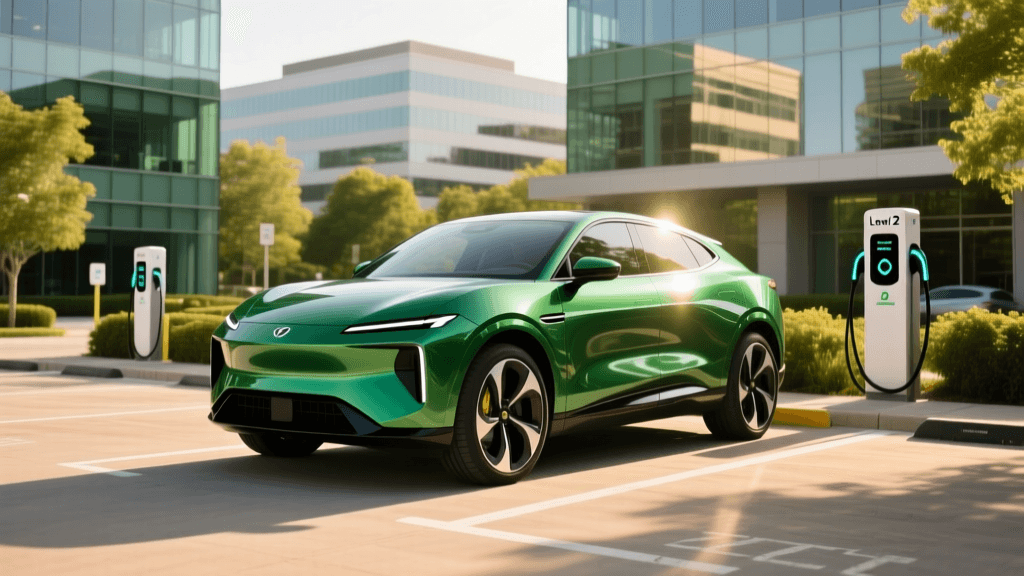
For most workplace environments, dual-port Level 2 (240V) chargers are the gold standard. They provide enough power to fully recharge an EV battery during an 8-hour workday without the exorbitant electrical demands and costs associated with DC Fast Charging (DCFC). Popular commercial models include the ChargePoint CT4000 series, Blink Series 3, and Enel X JuiceBox Pro Commercial. A single dual-port Level 2 commercial pedestal typically costs between $4,500 and $7,500. If your facility requires wall-mounted units to save space, hardware costs can drop to $1,500 to $3,000 per single-port unit.
2. Installation and Civil Work
Installation is often the most unpredictable variable in the budget. Costs depend heavily on the distance from the main electrical panel to the parking spaces, the need for trenching through concrete or asphalt, and whether a facility requires a main electrical panel upgrade. On average, installation costs range from $2,500 to $12,000 per port. If a utility transformer upgrade is required, costs can spike significantly. To mitigate this, many companies utilize "smart" load management systems that allow multiple chargers to share a single electrical circuit, dynamically distributing power and avoiding costly panel upgrades.
3. Network and Software Fees
Modern workplace chargers are networked, meaning they connect to the cloud via Wi-Fi or cellular networks. This allows facility managers to track energy usage, set pricing, restrict access to employees, and generate ESG reports. Network management software typically costs between $20 and $50 per port, per month. Additionally, commercial chargers often require extended warranty and maintenance packages, adding roughly $300 to $500 annually per pedestal.
Offsetting the Investment: Tax Credits and Utility Rebates
The sticker shock of commercial EV infrastructure is frequently softened by robust federal, state, and local incentives. The most significant federal incentive is the 30C Alternative Fuel Infrastructure Tax Credit. As detailed on the AFDC Federal Tax Credits page, businesses can claim a tax credit equal to 30% of the cost of hardware and installation, up to a maximum of $100,000 per single item of property. To qualify for the full 30%, the installation must meet prevailing wage and apprenticeship requirements, and it must be located in an eligible census tract (typically non-urban or low-income communities).
Beyond federal tax credits, local utility companies frequently offer "Make-Ready" programs. In these programs, the utility covers 100% of the infrastructure costs required to bring the electrical service to the charging site (trenching, conduit, and wiring), leaving the business to only pay for the actual charging pedestals. Combining a utility make-ready rebate with the 30C tax credit can reduce the net out-of-pocket cost of a workplace charging deployment by 50% to 80%.
Cost vs. Value Comparison Matrix
To visualize the financial and operational impacts of a workplace charging program, facility managers should weigh the direct costs against the long-term value drivers. The table below outlines a standard 10-port (5 dual-pedestal) deployment scenario.
| Category | Estimated Cost / Impact | Value Proposition & ROI Driver |
|---|---|---|
| Hardware (5 Dual-Port L2) | $30,000 - $37,500 | Future-proofing real estate; increasing property valuation. |
| Installation & Electrical | $15,000 - $50,000 | Leveraging utility Make-Ready rebates can reduce this to near $0. |
| Network Software (Annual) | $2,400 - $6,000 / year | Enables user billing, access control, and energy load balancing. |
| Electricity Costs | $0.12 - $0.25 / kWh | Can be passed to employees or subsidized as a tax-free fringe benefit. |
| 30C Federal Tax Credit | Up to 30% rebate | Dramatically lowers net CapEx; requires prevailing wage compliance. |
| Employee Retention | High Intangible Value | Attracts top talent; supports remote/hybrid workers who commute by EV. |
The Hidden Value: Employee Retention, ESG, and Fleet Readiness
While the hard costs are easily quantifiable, the value generated by workplace charging often manifests in strategic corporate advantages. First, workplace charging is a powerful tool for talent acquisition and retention. Surveys consistently show that EV-driving employees are highly loyal to employers who provide reliable charging, as it eliminates their need to rely on public fast-charging networks during the week. Furthermore, offering subsidized or free charging is viewed as a premium fringe benefit that costs the employer pennies per mile compared to traditional transit subsidies.
Secondly, commercial charging infrastructure directly supports corporate ESG mandates. By purchasing hardware that meets the ENERGY STAR EV Chargers specification, companies ensure their units are highly efficient, minimizing standby power draw and reducing the facility's overall carbon footprint. These installations also contribute to LEED (Leadership in Energy and Environmental Design) certification points for commercial buildings, which can increase property value and attract premium commercial tenants.
Finally, installing workplace chargers lays the groundwork for corporate fleet electrification. As companies transition their sales and delivery fleets to electric models, having the electrical infrastructure and load-management software already in place at corporate headquarters eliminates future bottlenecks and allows for seamless fleet scaling.
Best Practices for Maximizing Workplace Charging ROI
To ensure your workplace charging program delivers maximum value, facility managers should adopt the following actionable strategies:
- Implement Smart Load Management: Never install chargers without dynamic load balancing. Software from providers like ChargePoint and Blink allows you to connect multiple chargers to a single electrical breaker. The software communicates with the vehicles and throttles power delivery to ensure the main breaker never trips, saving tens of thousands of dollars in electrical panel upgrades.
- Establish Clear Workplace Charging Etiquette: Time limits are crucial. Implement a policy where vehicles are automatically disconnected or heavily fined via the app if they remain plugged in for more than 30 minutes after reaching an 80% state of charge. This prevents "ICEing" (internal combustion engine vehicles blocking spots) and ensures high turnover rates for employees who need a mid-day top-up.
- Adopt a Tiered Pricing Strategy: While some companies offer free charging, this often leads to charger hogging. A better ROI model is to offer charging at cost (e.g., $0.15/kWh) during work hours, and implement aggressive idle fees (e.g., $5.00/hour) once the vehicle is fully charged. This ensures the system pays for its own electricity and network fees while keeping spots open.
- Choose Networked, ENERGY STAR Certified Hardware: Non-networked "dumb" chargers might save $1,000 upfront, but they offer no usage data, no access control, and no ability to bill users. Always opt for networked, ENERGY STAR-certified units to track ROI, manage energy consumption, and qualify for local utility rebates that mandate smart-charging capabilities.
Conclusion
Deploying workplace EV charging stations is no longer just an environmental statement; it is a calculated financial investment with measurable returns. While the upfront costs for commercial Level 2 hardware and installation can range from $5,000 to $15,000 per port, the aggressive landscape of federal 30C tax credits and utility make-ready programs can drastically reduce the net capital required. When paired with the intangible benefits of employee retention, ESG compliance, and future fleet readiness, the ROI of workplace charging becomes undeniably clear. By utilizing smart load management, enforcing sensible charging etiquette, and leveraging networked software, businesses can turn their parking lots into powerful assets that drive long-term corporate value.