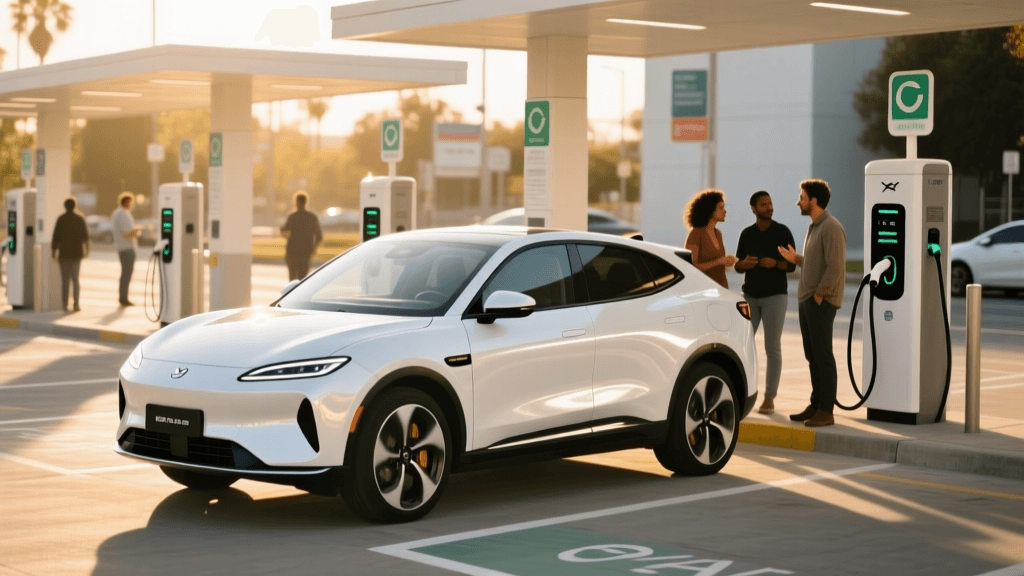
The Business Case for Workplace EV Charging
As electric vehicle (EV) adoption accelerates across the United States, the demand for reliable, accessible charging infrastructure has shifted from early-adopter novelty to a fundamental workplace expectation. For corporate facility managers, HR directors, and sustainability officers, installing workplace EV charging stations is no longer just a green initiative—it is a strategic investment in employee retention, corporate ESG (Environmental, Social, and Governance) goals, and long-term operational value. However, understanding the true return on investment (ROI) requires a granular breakdown of capital expenditures (CapEx), ongoing operational expenses (OpEx), available tax incentives, and the tangible benefits of workplace charging programs.
In this comprehensive cost and value analysis, we dissect the financial realities of deploying commercial Level 2 EV supply equipment (EVSE) at corporate campuses, office parks, and retail workspaces. By examining hardware costs, installation variables, and monetization strategies, business leaders can make data-driven decisions that align with both their financial constraints and sustainability mandates.
Hardware Costs: Commercial Level 2 Chargers Compared
The foundation of any workplace charging program is the commercial-grade Level 2 EVSE. Unlike residential chargers, commercial units must be networked, ruggedized for outdoor use, and capable of handling complex billing and access control software. Prices for dual-port commercial Level 2 stations typically range from $3,500 to $7,500 per pedestal, depending on the brand, cable management features, and networking capabilities.
Below is a comparison of three leading commercial EV charging networks frequently deployed in workplace environments:
| Brand / Model | Configuration | Max Power Output | Estimated Hardware Cost | Best Workplace Use Case |
|---|---|---|---|---|
| ChargePoint CT4000 Series | Dual-Port Pedestal | 25.6 kW (Total) | $5,500 - $7,000 | Large corporate campuses requiring robust fleet and employee management software. |
| Blink Networked Series 2 | Dual-Port Pedestal | 19.2 kW (Total) | $4,000 - $5,500 | Mid-sized office parks seeking a cost-effective, reliable networked solution. |
| EV Connectors (Enel X JuiceNet) | Single/Dual Options | Up to 19.2 kW | $3,500 - $5,000 | Facilities prioritizing flexible API integrations and custom branding. |
When evaluating hardware, it is crucial to look beyond the initial purchase price. According to ChargePoint's workplace solutions data, networked chargers provide facility managers with real-time energy usage dashboards, automated billing, and the ability to restrict access to employees during peak hours, which justifies the premium over non-networked "dumb" chargers.
Installation and Infrastructure Expenses
The most unpredictable variable in workplace EV charging deployment is the installation cost. While the hardware might cost $5,000, the electrical infrastructure required to support it can easily double or triple the total project cost. Commercial installations require licensed electrical contractors, permitting, and potentially significant civil engineering work.
Key Cost Drivers in Installation:
- Electrical Panel Upgrades: Older office buildings may lack the spare amperage required to support multiple 40-amp or 50-amp circuits. Upgrading a commercial switchgear or adding a dedicated sub-panel can cost between $5,000 and $20,000.
- Trenching and Conduit: If the parking lot requires underground trenching to run conduit from the main electrical room to the charging pedestals, costs can escalate by $50 to $150 per linear foot. Asphalt cutting, trenching, and repatching are labor-intensive and heavily regulated by local municipal codes.
- Load Management Systems: To avoid expensive utility demand charges or panel upgrades, many businesses install dynamic load management software. This hardware monitors the building's real-time energy use and throttles the chargers' output during peak building load times, ensuring the facility never exceeds its contracted electrical capacity.
On average, businesses should budget between $3,000 and $12,000 per port for installation, assuming standard surface-mounted conduit runs of less than 100 feet. Complex trenching projects will push this number significantly higher.
Offsetting CapEx: Tax Credits and Utility Rebates
The financial sting of hardware and installation is heavily mitigated by federal, state, and local incentives. The most significant federal incentive is the IRS Section 30C Alternative Fuel Vehicle Refueling Property Credit. Following updates under the Inflation Reduction Act, commercial properties located in eligible low-income or non-urban census tracts can claim a tax credit of up to 30% of the cost of hardware and installation, capped at an impressive $100,000 per single item of property. You can review the specific eligibility requirements and census tract mapping tools on the official IRS Alternative Fuel Vehicle Refueling Property Credit page.
Beyond federal tax credits, local utility companies frequently offer "Make-Ready" programs. In a Make-Ready program, the utility company covers 100% of the infrastructure costs (trenching, conduit, wiring, and panel upgrades) up to the charging pedestal, leaving the business responsible only for the cost of the EVSE hardware itself. Combining a utility Make-Ready program with the 30% federal tax credit can reduce the net out-of-pocket CapEx for a dual-port commercial station to under $2,000.
Network and Software Fees (OpEx)
Once the chargers are live, businesses must account for ongoing operational expenses. Networked chargers require cellular connectivity to communicate with the cloud-based management dashboard. Network providers typically charge a monthly or annual software fee per port.
- ChargePoint: Approximately $25 to $40 per port/month (often billed annually).
- Blink: Varies by membership tier, generally ranging from $20 to $35 per port/month.
- Payment Processing Fees: If the business chooses to charge employees or the public for electricity, payment gateways will take a standard transaction fee (typically 2.5% to 3.5% plus a flat per-transaction fee).
Facility managers must also budget for routine maintenance, such as replacing charging cables (which can degrade or be damaged over time) and ensuring the cellular modems remain connected to evolving network standards.
The Hidden Value: Employee Retention and ESG Goals
Calculating the ROI of workplace charging solely on direct financial returns misses the broader corporate value. In a competitive labor market, workplace amenities play a pivotal role in recruitment and retention. Surveys consistently show that EV-driving employees experience significant "range anxiety" if they cannot charge at work, particularly if they live in apartments or multi-family dwellings where home charging is impossible.
By offering subsidized or free workplace charging, companies provide a highly valued perk that costs a fraction of traditional benefits like on-site gyms or catered lunches. Furthermore, providing charging infrastructure directly supports corporate ESG reporting. As companies face increasing pressure from investors and regulatory bodies to reduce Scope 3 emissions (which include employee commuting), facilitating the transition to electric commuting is a measurable, reportable sustainability metric that enhances the company's public profile and stakeholder value.
Monetization and Cost Recovery Strategies
Businesses have several options for managing the cost of the electricity dispensed to employees. The strategy chosen often depends on local utility rates and corporate culture:
1. Fully Subsidized (Free to Employee)
The company absorbs the cost of electricity as an employee benefit. At an average commercial rate of $0.15 per kWh, charging a 75 kWh battery from 20% to 80% costs the company roughly $6.75. While this is highly appreciated by staff, it offers no direct cost recovery and requires the company to monitor for "camping" (employees leaving fully charged cars plugged in, blocking others).
2. Cost-Recovery Pricing (kWh Billing)
The company sets a price per kWh that exactly matches the utility's commercial rate plus a small margin to cover network fees and maintenance. This ensures the program is financially neutral. Many networks allow employers to set "employee-only" pricing that is discounted compared to public guest pricing.
3. Idle Fee Implementation
To maximize the utilization of a limited number of charging ports, businesses can implement idle fees. Once a vehicle reaches its charge limit or a set time threshold, the network automatically bills the employee an escalating hourly fee (e.g., $5.00/hour) until the vehicle is unplugged. This is critical for maintaining workplace charging etiquette and ensuring fair access across all shifts.
Final Verdict: Is the ROI Worth It?
From a pure cash-flow perspective, workplace EV charging is rarely a massive profit center for the host company unless it is deployed as a public-facing retail destination. However, when viewed through the lens of total value, the ROI is overwhelmingly positive. By leveraging federal tax credits like the IRS 30C incentive and local utility Make-Ready programs, the upfront CapEx can be reduced to highly manageable levels. When combined with the intangible benefits of employee retention, corporate ESG compliance, and future-proofing the commercial real estate asset, workplace EV charging transitions from an optional perk to an essential, high-value infrastructure investment for the modern enterprise.