The Beginner's Guide to DC Fast Charging (DCFC)
When transitioning to an electric vehicle (EV), understanding how to charge on the go is just as critical as knowing your vehicle's total range. While Level 1 and Level 2 chargers are perfect for overnight home charging or destination stops, DC Fast Charging (DCFC) is the absolute backbone of cross-country EV road trips. According to the U.S. Department of Energy's FuelEconomy.gov, DC fast chargers bypass the vehicle's onboard AC-to-DC converter to provide direct current (DC) power straight to the battery. This enables massive charging speeds that can replenish an EV's battery in minutes rather than hours.
However, not all DC fast charging networks are created equal. Advertised speeds, real-world capabilities, and network reliability vary wildly. In this comprehensive guide, we will break down the major EV charging networks, compare their maximum and real-world speeds, and teach you how to extract the fastest charge possible from your vehicle.
Understanding kW vs. kWh: The Water Pipe Analogy
Before comparing networks, beginners must understand the difference between kilowatts (kW) and kilowatt-hours (kWh). Think of your EV's battery as a water tank; its capacity is measured in kWh (e.g., a 75 kWh battery). The charger's speed is measured in kW, which represents the flow rate of the water through the pipe. A 350 kW charger is like a massive firehose, capable of filling your battery tank much faster than a 50 kW garden hose. However, just because a network advertises a 350 kW firehose doesn't mean your specific EV can accept that much water pressure at once.
Network Speed Comparison: The Major Players
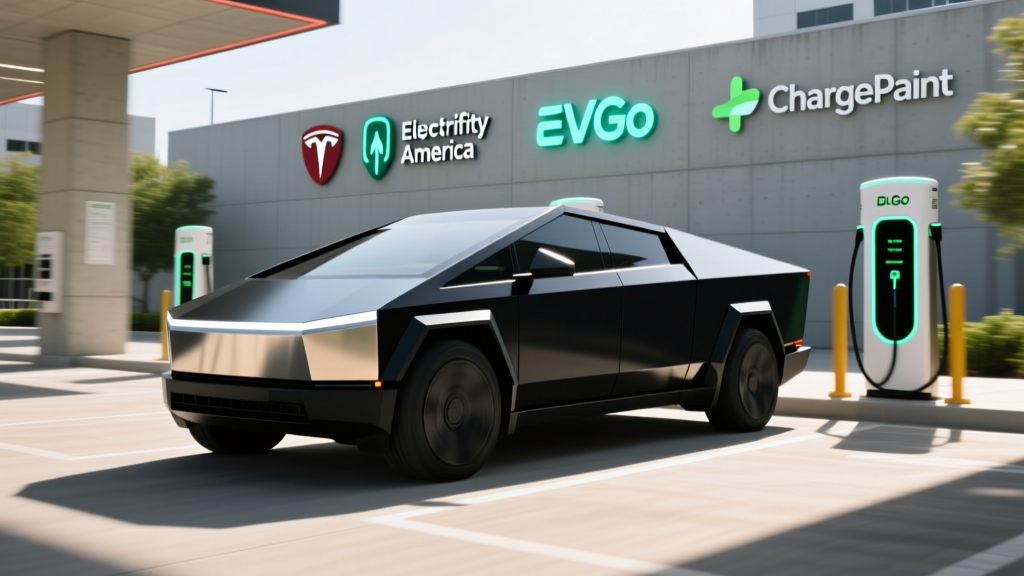
The public charging landscape in North America is dominated by a few key players, each with distinct hardware, speed tiers, and connector types. Here is how they stack up.
1. Tesla Supercharger Network
The Tesla Supercharger network is widely considered the gold standard for EV charging reliability and speed. Tesla operates multiple generations of chargers. The older V2 stalls peak at 150 kW, while the ubiquitous V3 stalls deliver up to 250 kW. Tesla is currently rolling out V4 Superchargers, which feature a new cabinet architecture capable of delivering up to 350 kW or more for future vehicles. For non-Tesla EVs, Tesla has begun equipping select Supercharger stalls with the "Magic Dock," a built-in adapter that allows CCS-equipped vehicles to tap into the network's legendary reliability and speed.
2. Electrify America (EA)
Electrify America is the largest open DC fast charging network in the U.S. EA stations typically feature a mix of 150 kW and 350 kW chargers. If you drive a vehicle with an 800-volt battery architecture—such as the Hyundai Ioniq 5, Kia EV6, or Porsche Taycan—you can utilize the 350 kW stalls to achieve incredibly fast 10% to 80% charge times (often under 20 minutes). However, standard 400-volt EVs will cap out around 150 kW to 175 kW, regardless of the charger's maximum capability. EA is also in the process of integrating NACS (North American Charging Standard) cables to accommodate the industry's shift toward Tesla's connector.
3. EVgo
EVgo operates a mix of legacy hardware and cutting-edge fast chargers. Historically, EVgo was known for its 50 kW CHAdeMO and CCS chargers, which are quite slow by modern standards and best used for quick top-ups rather than deep charges. Today, EVgo is aggressively deploying "EVgo eXtend" stations featuring 350 kW chargers. These newer stalls are often co-located with amenities and feature integrated cable management systems that make handling the heavy, liquid-cooled cables much easier for beginners.
4. ChargePoint
While ChargePoint is most famous for its vast network of Level 2 destination chargers, their DC fast charging offering, the Express Plus platform, is highly modular. ChargePoint's modular power blocks allow station owners to dynamically allocate power to different stalls based on vehicle demand. While you will find many older 50 kW and 125 kW ChargePoint stations, their newest deployments support up to 350 kW. ChargePoint is highly favored for its user-friendly app and seamless integration with vehicle infotainment systems via Plug & Charge technology.
Data Table: Network Speed & Specifications Comparison
| Network | Max Advertised Speed | Typical Real-World Peak | Primary Connector(s) | Best Used For |
|---|---|---|---|---|
| Tesla Supercharger | 250 kW (V3) / 350+ kW (V4) | 150 - 250 kW | NACS, CCS (via Magic Dock) | Reliable cross-country travel, seamless billing |
| Electrify America | 350 kW | 150 - 320 kW (Vehicle dependent) | CCS, NACS (Rolling out) | 800V architecture vehicles seeking ultra-fast charges |
| EVgo | 350 kW (eXtend) / 50 kW (Legacy) | 50 - 270 kW | CCS, CHAdeMO | Urban top-ups, newer highway eXtend stations |
| ChargePoint | 350 kW (Express Plus) | 100 - 250 kW | CCS, CHAdeMO | Plug & Charge convenience, retail locations |
The Reality Check: Advertised vs. Real-World Speeds
One of the most common frustrations for EV beginners is plugging into a "350 kW" charger and watching the app report a peak speed of only 110 kW. To understand why this happens, you must understand the EV charging curve and battery chemistry.
The EV Charging Curve Explained
DC fast charging is not a linear process. When you plug in with a low state of charge (e.g., 10%), the battery management system (BMS) allows maximum current to flow, resulting in peak kW speeds. However, as the battery fills up, the BMS intentionally throttles the charging speed to prevent overheating and battery degradation. According to infrastructure research from the National Renewable Energy Laboratory (NREL), managing thermal loads during high-power DC charging is critical for long-term battery health. Generally, charging speeds drop significantly after reaching 80% capacity. This is why the industry standard metric for fast charging is the "10% to 80%" time, rather than 0% to 100%.
Battery Temperature and Preconditioning
Lithium-ion batteries are highly sensitive to temperature. If your battery is too cold, the BMS will severely restrict charging speeds to prevent lithium plating, a phenomenon that causes permanent damage. Conversely, if the battery is too hot from aggressive highway driving, the car must spend energy cooling the pack before it can accept a fast charge. This is where "Preconditioning" comes in. Modern EVs allow you to set a charging station as your navigation destination. The car will then use its thermal management system to heat or cool the battery to the exact optimal temperature so that the moment you plug in, you hit peak charging speeds immediately.
Actionable Tips for Faster, Smoother Charging
- Always Precondition: Never navigate to a DC fast charger without entering it into your car's native navigation system first. This triggers the battery preconditioning sequence and can double your initial charging speed.
- Follow the 80% Rule: On road trips, plan your stops so you only charge from 10% to 80%. The time it takes to charge from 80% to 100% on a DC fast charger is often longer than it takes to charge from 10% to 80%. Get back on the road and let your destination's Level 2 charger handle the final 20%.
- Use Aggregator Apps: Do not rely solely on your car's built-in map. Apps like PlugShare and A Better Routeplanner (ABRP) provide real-time user check-ins, showing you if a station's 350 kW chargers are currently broken or occupied before you alter your route.
- Know Your Vehicle's Architecture: If you drive a standard 400-volt EV (like a Ford Mustang Mach-E or VW ID.4), you will rarely exceed 150 kW. Don't stress about finding a 350 kW charger; a 150 kW stall will perform identically for your vehicle and is often more readily available.
Conclusion
Mastering DC fast charging is the key to unlocking the true freedom of electric vehicle ownership. While networks like Tesla and Electrify America offer the highest peak speeds, your actual charging experience will be dictated by your vehicle's battery architecture, the ambient temperature, and your understanding of the charging curve. By utilizing preconditioning, adhering to the 80% rule, and understanding the hardware differences between major networks, you can plan road trips that are faster, cheaper, and infinitely more enjoyable. Welcome to the fast lane of EV ownership.