The Evolution of the American Interstate EV Corridor
The American road trip is undergoing its most significant transformation since the Eisenhower Interstate System was established. For early electric vehicle (EV) adopters, cross-country travel on routes like I-80, I-10, and I-40 was an exercise in extreme patience, plagued by 'charger deserts,' broken equipment, and agonizing wait times. However, the future of interstate highway EV charging corridor coverage is shifting rapidly from a fragmented patchwork of private investments to a highly regulated, federally backed grid. As we look toward 2025 and beyond, the convergence of federal infrastructure funding, 800-volt vehicle architectures, and standardized connector networks is poised to eliminate range anxiety on major highways.
The NEVI Program: Engineering the 50-Mile Standard
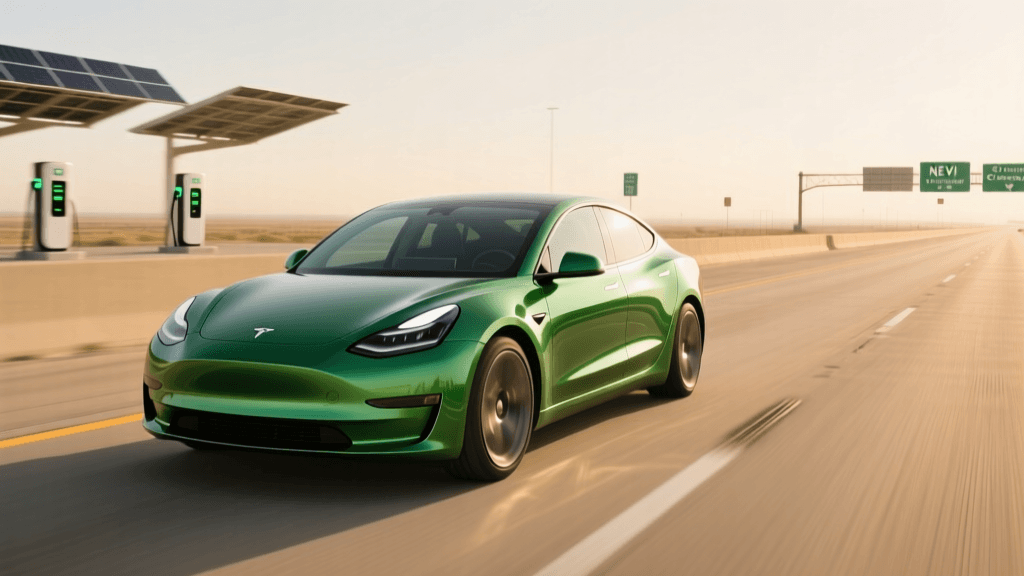
The cornerstone of the United States' highway charging future is the National Electric Vehicle Infrastructure (NEVI) Formula Program. Backed by $5 billion in federal funding, the NEVI program mandates a rigorous set of standards for charging stations located along designated Alternative Fuel Corridors (AFCs). According to the Federal Highway Administration, NEVI-funded stations must meet strict criteria to ensure reliability and accessibility for all drivers, regardless of their vehicle brand.
Key NEVI Mandates Shaping Future Corridors:
- Spacing Requirements: Stations must be located no more than 50 miles apart along designated interstate corridors, effectively eliminating the multi-hour gaps that previously plagued routes through the Mountain West and Great Plains.
- Port Minimums and Power Output: Each location must feature at least four direct current fast charging (DCFC) ports capable of delivering a minimum of 150 kW simultaneously. This ensures that a family in a Ford F-150 Lightning and a solo commuter in a Tesla Model 3 can charge at full speed without throttling each other's sessions.
- Uptime SLAs: NEVI-funded chargers are held to a strict 97% uptime Service Level Agreement (SLA), a massive leap forward from the historical 70-80% reliability rates seen on some legacy private networks.
- Payment and Accessibility: Stations must feature plug-and-charge capabilities, accept standard credit cards without requiring proprietary network apps, and be fully ADA compliant with adequate lighting and weather protection.
By enforcing these baselines, the Joint Office of Energy and Transportation is ensuring that future interstate corridors prioritize driver experience and hardware reliability over mere geographic coverage.
Hardware Evolution: From 150kW to Megawatt Charging
While 150 kW is the current NEVI baseline, the automotive industry is already outpacing it. Modern EVs built on 800-volt architectures—such as the Hyundai Ioniq 5, Kia EV6, Porsche Taycan, and Lucid Air—can accept peak charging rates of 250 kW to 350 kW. To accommodate this, network operators like Electrify America and EVgo are deploying next-generation liquid-cooled dispensers, such as the ABB Terra 360 and Tritium RTM units, capable of delivering continuous high power without thermal throttling.
Looking further ahead, the industry is developing the Megawatt Charging System (MCS). Spearheaded by organizations like CharIN, MCS is designed primarily for Class 8 electric semi-trucks, delivering up to 3.75 MW of power. However, the trickle-down effect of MCS infrastructure will heavily benefit passenger EVs. Future interstate travel plazas will likely feature segregated charging zones: ultra-high-power MCS bays for commercial freight, and 350 kW to 600 kW bays for passenger vehicles, drastically reducing dwell times to under 10 minutes for a 10% to 80% state-of-charge top-up.
The Connector Transition: NACS, CCS, and the Magic Dock
The most disruptive trend in highway charging is the industry-wide migration to the North American Charging Standard (NACS), originally developed by Tesla. By 2025, nearly every major automaker will transition their native vehicle ports from CCS1 to NACS. During this multi-year transition period, interstate corridors will feature a hybrid ecosystem.
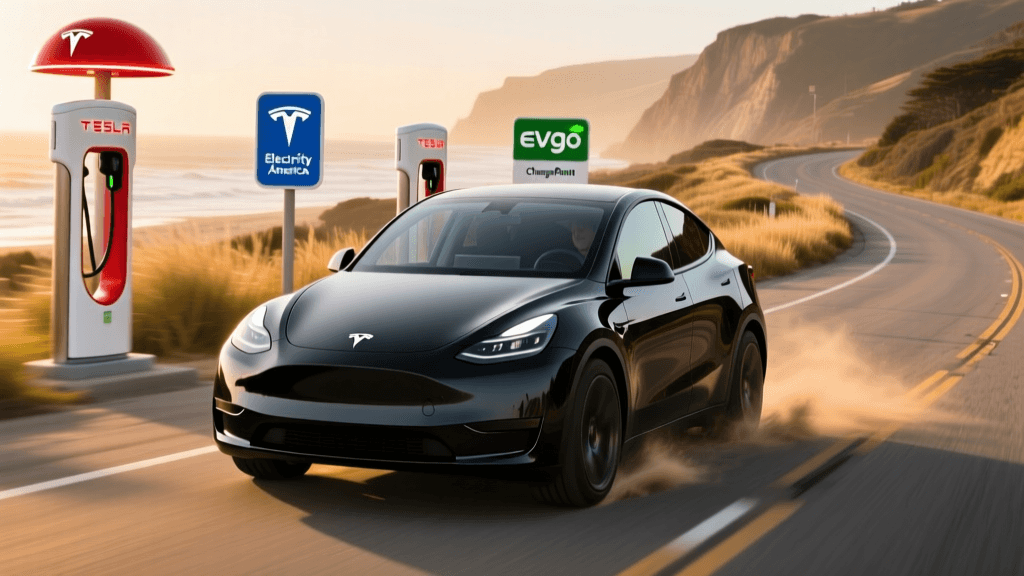
Tesla is actively opening its Supercharger network to non-Tesla vehicles using the 'Magic Dock'—a built-in CCS1 adapter attached directly to the Supercharger cable. Meanwhile, third-party networks are deploying dual-cable pedestals or retrofitting existing CCS1 stations with NACS cables. For the cross-country traveler, this means the total addressable charging network is expanding exponentially, but it also requires careful route planning to ensure your vehicle's native port matches the available hardware without relying on cumbersome third-party dongles, which can overheat or trigger software handshake failures at high amperages.
Projected Interstate Corridor Evolution (2024 vs. 2030)
The following table illustrates the anticipated shifts in interstate charging infrastructure metrics over the next six years, driven by NEVI deployment and private capital investment.
| Metric | 2024 Baseline | 2030 Projection |
|---|---|---|
| Average Interstate Spacing | 65 - 90 miles (varies by region) | Strict 50-mile maximum (NEVI compliant) |
| Dominant Peak Power Output | 150 kW - 250 kW | 350 kW - 600 kW (MCS trickle-down) |
| Network Uptime Reliability | ~75% - 85% | 97%+ (Federally enforced SLAs) |
| Connector Availability | CCS1 dominant, early NACS rollout | NACS dominant, CCS1 legacy support |
| Payment Systems | App-dependent, RFID cards | Universal Plug-and-Charge, Tap-to-Pay |
| Amenities & Canopies | Parking lot perimeters, exposed | Dedicated EV plazas, solar canopies, retail |
Actionable Road Trip Planning in the Transition Era
While the 2030 outlook is incredibly promising, drivers undertaking cross-country road trips today must navigate the current transitional landscape. Here is practical, actionable advice for maximizing efficiency and reliability on today's interstate corridors:
1. Leverage Advanced Routing Algorithms
Do not rely solely on your vehicle's native infotainment system for multi-state road trips. Use A Better Routeplanner (ABRP) and input your specific vehicle model, current battery degradation, and expected highway speeds (75 mph vs 80 mph drastically alters consumption). ABRP factors in real-time charger status, helping you avoid a 50-mile detour to a station that is currently offline.
2. Target Multi-Network Hubs Over Single-Station Outposts
When planning stops along I-80 or I-10, prioritize locations where multiple networks overlap (e.g., a travel center featuring both an Electrify America plaza and a Tesla Supercharger with Magic Docks). If one network experiences a software outage or a grid fault, you have immediate redundancy without having to limp to the next town on a 5% battery.
3. Master Battery Preconditioning
If your vehicle supports it (like the Porsche Taycan, Rivian R1T, or Tesla Model Y), always enter the charging station into your navigation system 30 to 45 minutes before arrival. This triggers the battery thermal management system to heat or cool the battery pack to the optimal temperature for DC fast charging. Arriving at a 350 kW charger with a cold battery can result in charging speeds throttled to 50 kW, adding 40 minutes to your stop.
4. The 80% Rule for Highway Efficiency
DC fast charging curves are non-linear. Charging from 10% to 80% might take 18 minutes, but pushing from 80% to 100% can take an additional 25 minutes due to battery protection protocols. On long interstate stretches, it is mathematically faster to charge to 80% and drive to the next 50-mile hub than to sit at a single station waiting for a 100% top-off.
Conclusion
The future of US interstate EV charging corridors is transitioning from a chaotic, fragmented landscape into a standardized, high-speed utility. Driven by the stringent requirements of the NEVI program, the rollout of 800-volt vehicle platforms, and the universal adoption of the NACS connector, the cross-country EV road trip of 2030 will closely mirror the convenience of the traditional gas station model. Until that infrastructure fully matures, strategic route planning, redundancy targeting, and understanding your vehicle's thermal management systems remain the keys to seamless interstate electric travel.