The Current State of Interstate EV Charging
The American interstate highway system, spanning over 48,000 miles, was originally engineered for the internal combustion engine. Today, it is undergoing the most significant infrastructural overhaul since the Eisenhower era. For early electric vehicle (EV) adopters, cross-country road trips required meticulous planning, reliance on fragmented charging networks, and a high tolerance for broken equipment. However, as EV market penetration accelerates past the early-adopter phase into mass-market adoption, the demand for seamless, reliable, and high-speed interstate charging corridors has become a national priority.
The transition from a patchwork of isolated charging plazas to a cohesive, continent-spanning grid is being driven by federal mandates, shifting connector standards, and private-sector innovation. Understanding the future trajectory of these highway corridors is essential for EV buyers, fleet operators, and road-trip enthusiasts alike. This analysis explores the legislative frameworks, technological shifts, and future projections that will define interstate EV travel through 2030.
The NEVI Program: Engineering the 50-Mile Mandate
The cornerstone of the United States' highway charging strategy is the National Electric Vehicle Infrastructure (NEVI) Formula Program, established under the Bipartisan Infrastructure Law. The program allocates $5 billion over five years to states to build a national network of EV chargers along designated Alternative Fuel Corridors. According to the Federal Highway Administration's NEVI guidelines, states must adhere to strict deployment criteria to unlock federal funding, fundamentally reshaping how highway rest stops and travel plazas are designed.
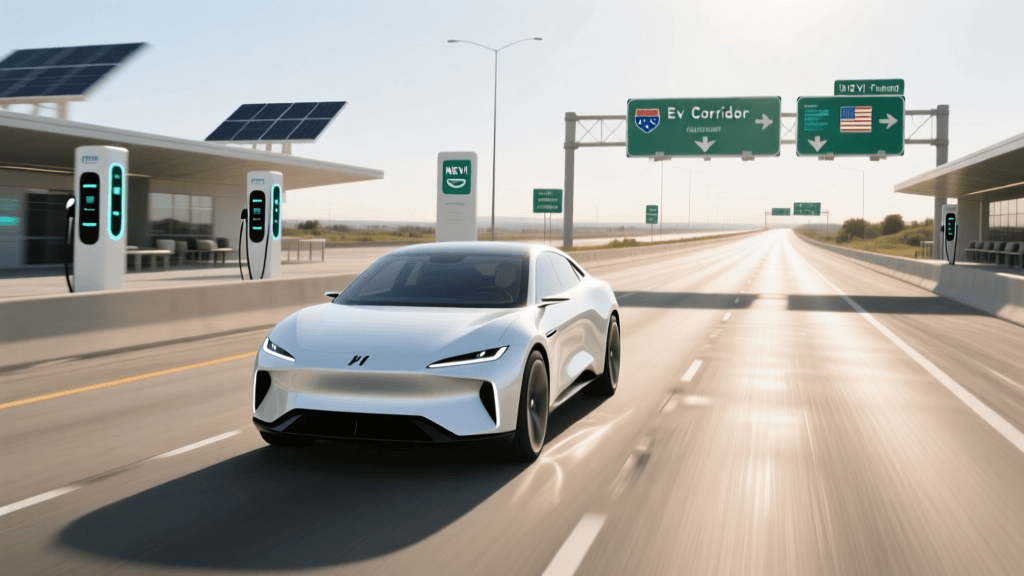
The core mandate requires NEVI-funded charging stations to be spaced no more than 50 miles apart along designated interstate routes and located within one mile of the highway exit. Furthermore, each plaza must feature a minimum of four Direct Current Fast Charging (DCFC) ports capable of delivering at least 150 kilowatts (kW) simultaneously. This 50-mile rule effectively eliminates the "range anxiety" gaps that have historically plagued rural stretches of interstates like I-70 through Utah or I-10 across West Texas.
However, the NEVI program also includes provisions for grid-constrained areas. In highly rural regions where utility upgrades would take years or cost millions, states can apply for temporary exemptions regarding the number of ports or maximum power output, provided they demonstrate a clear path to full compliance. As utility companies accelerate high-voltage transmission projects to meet these demands, the 50-mile corridor will transition from a legislative goal to a physical reality by the end of the decade.
The NACS Shift and the Pull-Through Revolution
Perhaps the most disruptive trend in highway charging infrastructure is the industry-wide migration to the North American Charging Standard (NACS). Following Tesla's decision to open its Supercharger network and connector design, major automakers including Ford, General Motors, Rivian, and Volvo have committed to adopting NACS for their future North American vehicles. This consolidation ends the fragmented "charging standard war" between CCS and NACS, streamlining the user experience and reducing manufacturing costs for charge point operators (CPOs).
For interstate highway corridors, the physical footprint of NACS is revolutionary. The smaller, lighter NACS connector and compact cabinet designs allow CPOs to retrofit existing travel plazas with more stalls in less space. More importantly, the shift is driving the adoption of "pull-through" charging stalls. Traditional EV charging spots are designed like standard parking spaces, which are virtually unusable for EVs towing camping trailers or boat trailers—a growing demographic of highway travelers. Future highway corridors will increasingly feature pull-through lanes, mirroring the design of diesel fueling islands, allowing trucks and SUVs to charge without unhitching their cargo.
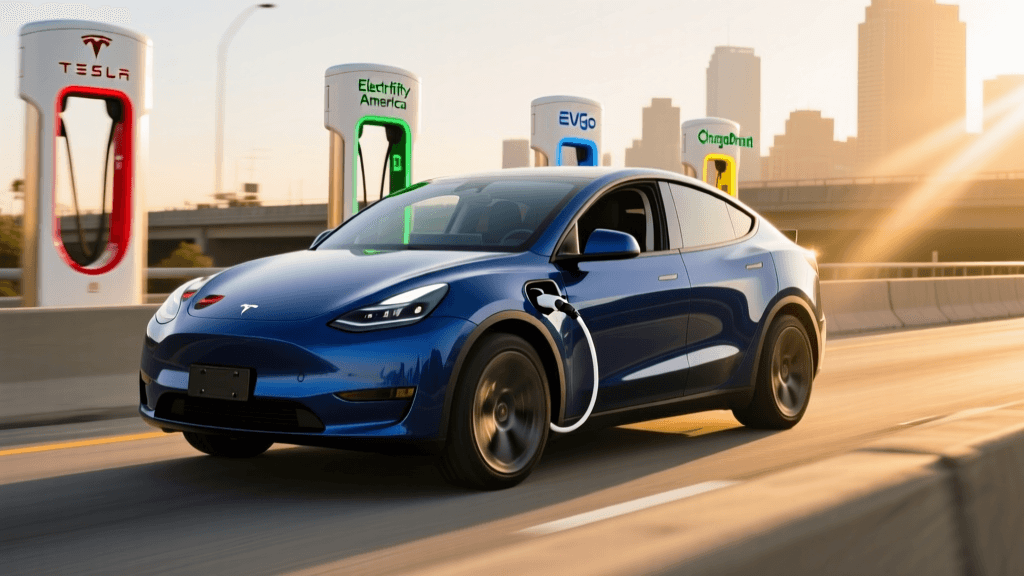
During the transition period (2024–2027), highway corridors will feature a hybrid ecosystem. Networks like Electrify America and EVgo are deploying "Magic Dock" built-in adapters and dual-cable dispensers to serve both legacy CCS vehicles and incoming NACS-native vehicles. By 2030, NACS will be the undisputed standard, with CCS relegated to legacy adapters.
Reliability Mandates and the 97% Uptime Rule
Historically, the greatest barrier to interstate EV travel has not been the distance between chargers, but the reliability of the chargers themselves. Broken screens, frayed cables, and payment gateway failures have plagued early highway networks. To combat this, the Joint Office of Energy and Transportation has enforced strict reliability and maintenance requirements for any station receiving NEVI funding.
NEVI-funded stations must maintain a minimum uptime of 97% across all charging ports. This is rigorously tracked via network APIs that report real-time operational status. Furthermore, the federal guidelines mandate payment interoperability. The era of downloading a different smartphone app for every charging network you encounter on a cross-country trip is ending. Future highway corridors will universally support "Plug and Charge" (ISO 15118) technology, where the vehicle and charger automatically authenticate and process payment the moment the cable is connected, alongside contactless credit card readers as a mandatory fallback.
Overcoming Grid Constraints with Battery Buffers
Deploying four 350 kW ultra-fast chargers at a rural highway exit requires megawatts of instantaneous electrical power—often more than the local rural utility grid can provide without massive, multi-year infrastructure upgrades. To accelerate corridor deployment without waiting for utility transformers, CPOs are increasingly turning to Battery Energy Storage Systems (BESS).
Companies like Freewire and Tesla are deploying integrated battery buffers at highway plazas. These systems slowly trickle-charge a massive onsite battery pack from the local grid over several hours. When an EV arrives, the station delivers ultra-fast 300+ kW charging speeds directly from the battery buffer. This "edge computing" approach to electrical power allows remote interstate exits to offer top-tier charging speeds immediately, bridging the gap between current grid limitations and future EV charging demands.
Projected Interstate Corridor Milestones (2024–2030)
The evolution of the American highway charging network will occur in distinct phases. The following table outlines the projected milestones for interstate corridor coverage over the next six years.
| Year | Infrastructure Milestone | Average Corridor Spacing | Dominant Connector | Avg Highway Speed |
|---|---|---|---|---|
| 2024 | Initial NEVI deployments; Tesla Supercharger network opens to select Ford/GM EVs via adapters. | 60-75 miles | CCS1 (with NACS adapters) | 150 kW |
| 2026 | First-generation NACS-native vehicles hit the road; Pull-through stalls become standard at major travel plazas. | 50 miles | NACS / CCS1 Hybrid | 200 kW |
| 2028 | NEVI Phase 2 complete; Battery-buffered stations dominate rural grid-constrained exits. | 40-50 miles | NACS (SAE J3400) | 250 kW |
| 2030 | Full Alternative Fuel Corridor compliance; Universal Plug & Charge; Megawatt charging for commercial freight overlaps. | 30-50 miles | NACS (SAE J3400) | 350+ kW |
Heavy-Duty Freight and the Megawatt Charging System (MCS)
While passenger vehicles dominate the conversation, the future of interstate corridors is heavily influenced by commercial freight. The Zero-Emission Freight Corridor initiative is paving the way for the Megawatt Charging System (MCS), capable of delivering over 1 megawatt (1,000 kW) of power to Class 8 electric semi-trucks. Because freight routes heavily overlap with major passenger interstates (like I-5 and I-95), the civil engineering and utility upgrades required for MCS plazas will inadvertently upgrade the local grid capacity for adjacent passenger EV charging stations, creating a rising tide that lifts all electric vessels.
Actionable Advice for Interstate EV Road Trippers
As the infrastructure transitions from the current patchwork to the 2030 vision, EV owners must adapt their road-tripping strategies. Here is actionable advice for navigating the highway corridors of today and tomorrow:
- Carry a Universal Adapter Kit: If you drive a NACS-native vehicle (like a Tesla or new Rivian), you must carry a high-quality NACS-to-CCS adapter (such as the Lectron or A2Z adapter) to access legacy Electrify America and EVgo highway stations that have not yet retrofitted their dispensers. Conversely, CCS vehicle owners should utilize OEM-provided NACS adapters to access the Tesla Supercharger network.
- Route with Live NEVI Data: Utilize advanced routing software like A Better Routeplanner (ABRP). ABRP integrates live API data from the Alternative Fuels Data Center and the Joint Office, allowing you to see real-time uptime status for NEVI-funded highway chargers, ensuring you aren't routed to a station with broken ports.
- Target 150kW Minimums for Highway Stops: When planning rest stops, filter your map for stations offering at least 150kW per port. Many older highway stations offer 50kW DCFC, which will add unnecessary hours to a cross-country trip. Look for travel plazas (like Pilot, Flying J, or Wawa) that are actively installing 350kW dispensers.
- Master Pull-Through Etiquette: As pull-through stalls begin appearing at highway locations, reserve them exclusively for vehicles towing trailers. If you are driving a standard sedan or crossover, use the standard perpendicular stalls to leave the pull-through lanes open for those who physically cannot unhitch their cargo to charge.
The future of the American interstate highway system is electric, standardized, and vastly more reliable. By understanding the legislative drivers and technological shifts shaping these corridors, EV drivers can confidently plan for the cross-country road trips of tomorrow.