EVgo Network Coverage & Pricing Breakdown: Is It Worth It?
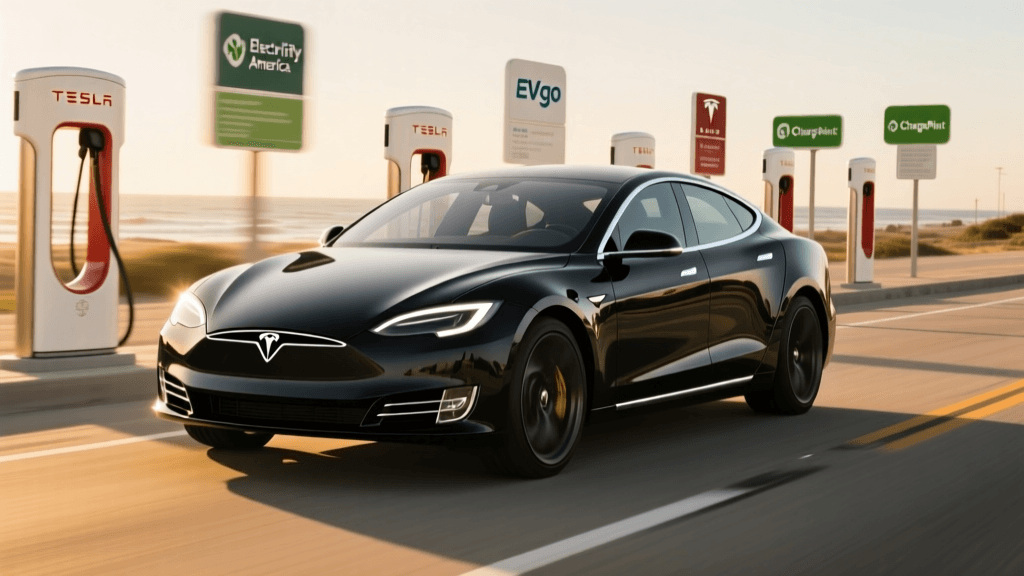
When it comes to public DC fast charging in the United States, the 'Big Three' networks—Tesla Supercharger, Electrify America, and EVgo—dominate the landscape. While Tesla leads in sheer reliability and Electrify America focuses heavily on highway corridors, EVgo has carved out a unique niche. But as public charging rates fluctuate and subscription models become more complex, how does EVgo stack up in terms of pure cost and value? In this comprehensive breakdown, we analyze the EVgo network footprint, decode their pricing structure, and determine if an EVgo Plus subscription actually saves you money.
EVgo Network Coverage: Urban Density and the ReNew Program
According to data tracked by the Alternative Fuels Data Center, the U.S. public charging infrastructure is growing rapidly, with EVgo maintaining a significant share of the fast-charging market. Unlike networks that prioritize remote highway waystations, EVgo’s historical strategy has been deeply rooted in urban and suburban density. You are far more likely to find an EVgo charger in a grocery store parking lot, a shopping mall garage, or a metropolitan downtown hub than at a desolate highway rest stop.
Currently, EVgo operates over 3,500 public fast chargers across more than 40 states. However, the raw number of chargers only tells half the story. The true value of the EVgo network lies in its aggressive 'ReNew' program. Over the past few years, EVgo has been systematically tearing out its legacy 50kW CHAdeMO and early CCS chargers, replacing them with state-of-the-art 350kW high-power dispensers. This is a massive value-add for modern EV owners. If you drive a vehicle capable of accepting high charge rates—like the Hyundai Ioniq 5, Kia EV6, or Porsche Taycan—EVgo’s upgraded urban stations allow you to charge from 10% to 80% in under 20 minutes, turning a mundane grocery run into a highly efficient charging session.
Furthermore, EVgo has been expanding its highway footprint through partnerships and new station builds, ensuring that cross-country road trippers are no longer entirely reliant on Electrify America. The integration of NACS (Tesla) connectors via adapters and native cable rollouts is also future-proofing their stations for the incoming wave of Ford, GM, and Rivian vehicles.
Decoding the EVgo Pricing Structure
Understanding how much you will actually pay at an EVgo station requires navigating a few different variables. The U.S. Department of Energy notes that public charging costs can vary wildly based on utility demand charges, local regulations, and network pricing models. EVgo primarily utilizes per-kilowatt-hour (kWh) billing, which is the most transparent and fair method for consumers. However, in certain states where local utility commissions have historically restricted third-party networks from reselling electricity by the kWh, EVgo is forced to bill by the minute.
Guest Rates vs. EVgo Plus™
If you pull up to an EVgo station without an account, you will be subjected to 'Guest' pricing. Guest rates are the most expensive tier, typically ranging from $0.40 to over $0.60 per kWh depending on the local market and time-of-use (TOU) utility rates. For the occasional road tripper, this is an unavoidable premium for convenience.
However, the real value proposition lies in the EVgo Plus™ subscription. EVgo has streamlined its membership tiers to offer substantial discounts on per-kWh rates in exchange for a flat monthly fee. Depending on your region, an EVgo Plus membership can reduce your charging costs by 10% to 25% compared to guest rates. Additionally, members often gain access to exclusive reserved charging spots at high-traffic urban locations, adding a layer of convenience that is difficult to quantify but highly valuable to daily commuters.
Cost Comparison: EVgo vs. The Competition
To truly understand the value of EVgo, we must compare its pricing structure to its direct competitors. Below is a breakdown of average costs across the major networks. Note that exact prices vary by zip code, time of day, and specific station utility rates.
| Network / Plan | Avg. Cost (per kWh) | Monthly Fee | Idle Fees |
|---|---|---|---|
| EVgo (Guest) | $0.42 - $0.65 | $0.00 | $0.30 / min |
| EVgo Plus™ | $0.32 - $0.50 | $4.99 - $14.99 | $0.30 / min |
| Electrify America Pass+ | $0.33 - $0.48 | $4.00 | $0.40 / min |
| ChargePoint (Varies by Host) | $0.35 - $0.60 | $0.00 | Host Dependent |
| Tesla Supercharger (NACS) | $0.25 - $0.38 | $0.00 | $1.00 / min |
As the table illustrates, EVgo’s guest rates are on the higher end of the spectrum, comparable to Electrify America but generally more expensive than Tesla’s Supercharger network. However, once you factor in the EVgo Plus subscription, the per-kWh cost becomes highly competitive. Furthermore, EVgo’s idle fees are significantly more forgiving than Tesla’s punitive $1.00-per-minute idle charges, which is a crucial value consideration for drivers who might need to run into a store while their vehicle finishes its charging curve.
The Math: When Does EVgo Plus Pay Off?
Is the monthly subscription actually worth your hard-earned money? Let’s break down the math with a practical scenario. Assume your local EVgo station charges $0.50 per kWh for guests and $0.38 per kWh for EVgo Plus members. The EVgo Plus subscription costs $9.99 per month.
- Scenario A (The Occasional User): You charge at EVgo twice a month, adding 60 kWh each time (120 kWh total). As a guest, you pay $60.00. With EVgo Plus, you pay $45.60 for the energy plus $9.99 for the subscription, totaling $55.59. Verdict: You save roughly $4.40. The subscription pays for itself, but the value is marginal.
- Scenario B (The Rideshare or Heavy Commuter): You rely on public fast charging three times a week, adding 40 kWh per session (roughly 480 kWh a month). As a guest, you pay $240.00. With EVgo Plus, you pay $182.40 for energy plus $9.99, totaling $192.39. Verdict: You save nearly $48.00 a month. The value proposition is exceptional.
If you are an Uber or Lyft driver, or an apartment dweller who relies entirely on public fast charging, the EVgo Plus subscription is an absolute no-brainer. The break-even point is usually reached after just one or two charging sessions per month.
Hidden Value: AutoCharge+, Partnerships, and Perks
Beyond the raw cost per kWh, EVgo offers several ecosystem perks that enhance its overall value. The most significant is AutoCharge+. Similar to Tesla’s Plug & Charge or Electrify America’s Plug&Charge, AutoCharge+ allows you to simply plug the connector into your vehicle and walk away. The station automatically identifies your car via the VIN and bills your EVgo account. This eliminates the frustration of opening an app, scanning a QR code in the rain, or dealing with a broken station screen. The time saved and friction removed adds immense qualitative value to the network.
Additionally, EVgo has established lucrative partnership programs. Through the American Airlines AAdvantage program, EVgo users can earn airline miles for every charging session, effectively providing a 'cash back' equivalent that offsets the cost of charging. EVgo also offers specialized discount programs for Uber and Lyft drivers, further cementing its position as a top-tier network for gig-economy workers who need to minimize their operational costs.
Final Verdict: Who is EVgo Best For?
EVgo is not without its flaws; like all public networks, you will occasionally encounter a broken screen or a connector that refuses to initiate a session. However, when evaluating the network through the lens of cost and value, EVgo shines brilliantly for a specific demographic: the urban and suburban fast-charger.
If your EV lifestyle consists of topping off at the grocery store, the mall, or your local downtown garage, EVgo’s dense urban footprint and rapidly expanding 350kW ReNew stations offer unparalleled convenience. While the guest pricing is steep, the EVgo Plus subscription brings the cost down to highly competitive levels, easily rivaling Electrify America and closing the gap with Tesla. When you factor in the AutoCharge+ convenience, forgiving idle fees, and rewards partnerships, EVgo delivers a compelling, high-value proposition for the modern EV owner.