The Paradigm Shift: From Dumb Plugs to Smart Grid Nodes
As the electric vehicle market matures, the conversation around home charging is rapidly shifting from mere convenience to active energy management. In the early days of EV adoption, a Level 2 charger was essentially a "dumb" appliance—a high-capacity relay that pushed 240 volts into a battery until it was full. Today, however, the modern home is becoming a microgrid, and your EV charger is the critical node connecting your vehicle to the broader energy ecosystem. This brings us to a crucial buying decision: should you invest in a WiFi-enabled smart charger or stick with a rugged, non-connected unit?
According to the U.S. Department of Energy, smart charging technologies are becoming essential for managing the increased electrical load that EVs place on local grids. As utility companies roll out complex rate structures and bidirectional charging capabilities loom on the horizon, understanding the future trajectory of WiFi-enabled versus non-connected EV chargers is vital for making a future-proof investment.
Feature Breakdown: WiFi-Enabled vs. Non-Connected Chargers
Before diving into future industry trends, it is important to establish the baseline differences between smart and non-connected Level 2 chargers. Below is a comprehensive comparison of what you can expect from each category today.
| Feature | WiFi-Enabled (Smart) Chargers | Non-Connected (Dumb) Chargers |
|---|---|---|
| Scheduling | App-based, TOU optimized, automated | Manual (via vehicle infotainment or physical timer) |
| Energy Monitoring | Real-time tracking, historical data, cost calculation | None (requires external smart panel monitoring) |
| Firmware Updates | Over-the-air (OTA) security and feature updates | None (hardware is static post-manufacture) |
| Utility Integration | Eligible for demand-response and OCPP rebates | Rarely eligible for utility incentive programs |
| Network Dependency | Requires 2.4GHz WiFi; may fail if network drops | 100% reliable; works entirely offline |
| Average Hardware Cost | $500 - $750 | $350 - $500 |
Future Trend 1: Time-of-Use (TOU) Optimization and Automated Savings
The most immediate financial benefit of a WiFi-enabled charger is its ability to interface with Time-of-Use (TOU) utility plans. Utilities across North America are increasingly shifting away from flat-rate billing to TOU structures, where electricity costs significantly more during peak evening hours (typically 4 PM to 9 PM) and drops to pennies per kilowatt-hour during the middle of the night.
While you can manually set a charging schedule inside your EV's infotainment system, WiFi chargers like the ChargePoint Home Flex or Emporia Vue offer a more robust, hardware-level scheduling interface. These apps pull real-time rate data from your specific utility provider, ensuring that your car only draws power when rates hit their absolute floor. Over the lifespan of a vehicle, the automated savings generated by a smart charger's TOU scheduling can easily eclipse the $150 to $200 premium you pay for the WiFi hardware upfront. Non-connected chargers force you to rely entirely on the vehicle's internal timer, which can sometimes be overridden by software glitches or valet modes, leading to accidental peak-hour charging sessions that spike your monthly utility bill.
Future Trend 2: OCPP Compliance and the Utility Rebate Goldmine
Looking ahead, the Open Charge Point Protocol (OCPP) is set to become the universal language between EV chargers and utility grids. As detailed by the Open Charge Alliance, OCPP allows centralized management systems to communicate with charging stations, enabling features like remote diagnostics, secure payment processing, and dynamic load limiting.
Why does this matter for home buyers? Because utility companies are beginning to mandate OCPP compliance for rebate eligibility. Many regional grid operators are launching "Bring Your Own Charger" (BYOC) programs, offering customers hundreds of dollars in bill credits or upfront rebates if they install a smart charger that can be remotely throttled during extreme grid stress events (like summer heatwaves). Non-connected chargers are entirely locked out of these incentive programs. If you live in a state with an aggressive grid-modernization agenda, such as California, New York, or Texas, purchasing a non-connected charger effectively means leaving hundreds of dollars of utility incentive money on the table.
Future Trend 3: Solar Integration, V2G, and Dynamic Load Balancing
The ultimate horizon for EV charging is the integration of solar arrays, home battery storage, and Vehicle-to-Grid (V2G) technology. The Environmental Protection Agency notes that pairing EVs with renewable energy sources significantly amplifies the environmental benefits of electric mobility. However, maximizing solar charging requires sophisticated software.
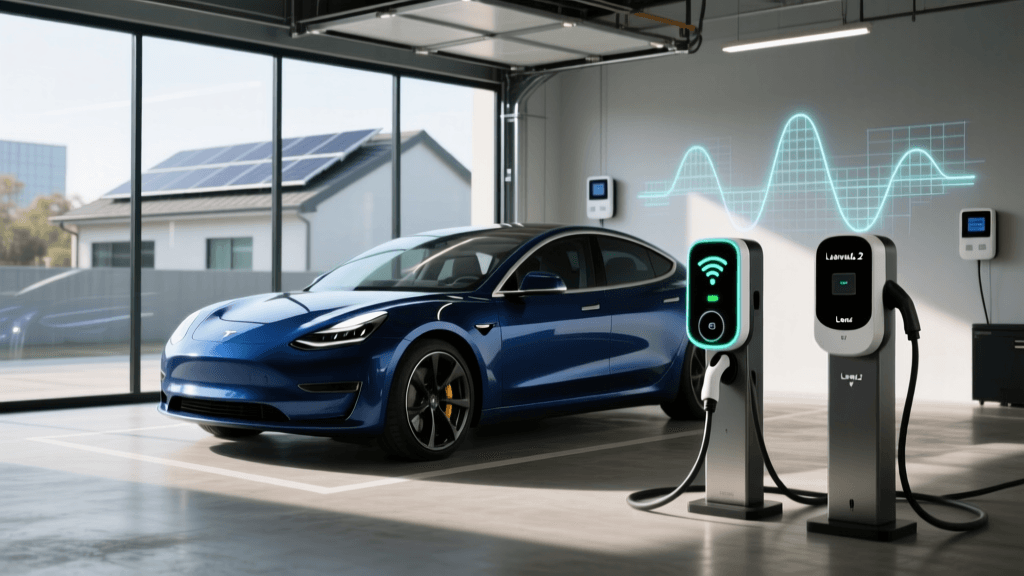
WiFi-enabled chargers are currently pioneering "Dynamic Load Balancing" and solar-matching features. For example, the Emporia Vue ecosystem allows the charger to communicate directly with your home's solar inverter and smart panel. If your solar panels are generating 3kW of excess power, the smart charger dynamically adjusts the EV's charging rate to exactly 3kW, ensuring you are fueling your car purely on free sunshine without pulling from the grid. Non-connected chargers lack the communication protocols required for this level of granularity; they simply pull a static amperage regardless of your solar production, forcing you to rely on complex, expensive third-party home automation hubs to approximate solar charging.
Furthermore, as bidirectional charging (V2G and V2H) becomes mainstream in the late 2020s, WiFi connectivity will be non-negotiable. Bidirectional energy flow requires constant, secure telemetry between the vehicle, the charger, the home panel, and the utility grid to prevent back-feeding and ensure safety. A non-connected charger will be entirely obsolete in a bidirectional ecosystem.
Head-to-Head Spotlight: ChargePoint Home Flex vs. Grizzl-E Core
To illustrate the practical differences, let us compare two industry heavyweights that represent these diverging philosophies.
The Smart Contender: ChargePoint Home Flex (WiFi-Enabled)
- Amperage: Up to 50A (hardwired) or 40A (NEMA 14-50 plug)
- Smart Features: Alexa integration, detailed app scheduling, TOU optimization, OTA updates.
- Build: Sleek indoor/outdoor rated plastic, 23-foot cable.
- The Outlook: The Home Flex is designed for the modern, data-driven homeowner. Its WiFi module allows for seamless integration with utility demand-response programs. However, it requires a stable 2.4GHz WiFi signal reaching your garage; if your router is on the other side of a concrete wall, you will need a mesh extender.
The Rugged Traditionalist: Grizzl-E Core (Non-Connected)
- Amperage: Up to 40A (adjustable via internal DIP switches)
- Smart Features: None. Pure plug-and-play operation.
- Build: Heavy-duty aluminum enclosure, IP67 water resistance, rated for -40°C operation.
- The Outlook: The Grizzl-E Core is a tank. It is beloved by Canadians and those in extreme climates because it has no delicate screens or WiFi antennas to fail in deep freezes. It is the ultimate "set it and forget it" device. However, it offers zero energy tracking, zero utility rebate eligibility, and no pathway to participate in future smart-grid programs.
Actionable Buyer Advice: Which Should You Choose?
When deciding between a WiFi-enabled and non-connected charger, base your decision on your home's electrical infrastructure, your local utility's rate structure, and your timeline for upgrading your home's energy ecosystem.
- Buy a WiFi-Enabled Charger If: Your utility offers aggressive Time-of-Use rates, your local government or utility provider offers smart-charger rebates, you have or plan to install rooftop solar, or you want to track your exact charging costs and carbon footprint via a smartphone app.
- Buy a Non-Connected Charger If: You live in a rural area with poor WiFi coverage and a flat-rate electricity plan, you are installing the charger in a harsh, remote environment (like an unheated detached barn), or you are on a strict budget and plan to use your vehicle's internal infotainment system to handle all charging schedules.
Final Verdict: Future-Proofing Your Home EV Infrastructure
While non-connected chargers offer undeniable reliability and a lower upfront cost, they are fundamentally a legacy technology. The automotive and energy sectors are converging, and the EV charger is no longer just a cable—it is a bi-directional data and energy router. Investing in a WiFi-enabled, OCPP-compliant smart charger ensures that your home is ready for dynamic utility rates, solar integration, and the impending wave of Vehicle-to-Grid services. As the grid gets smarter, your charging hardware must evolve with it; otherwise, you risk turning your home into an isolated island in an increasingly connected energy landscape.