Introduction: The Ergonomic Bottleneck of EV Charging
As the electric vehicle market matures, the focus of home charging infrastructure has shifted from mere functionality to user experience and spatial design. While early Level 2 chargers were essentially utilitarian metal boxes with heavy, unwieldy cables, modern EV owners demand appliances that integrate seamlessly into their garages and driveways. The most significant pain point in daily EV charging is cable management. A 24-foot, heavy-gauge charging cable left on the ground is a tripping hazard, a target for moisture ingress, and an eyesore. In this technology deep dive, we examine the built-in cable management system of the Tesla Wall Connector (Gen 3), analyzing its mechanical design, thermal implications, material science, and long-term durability to determine if it sets the industry standard for home EVSE (Electric Vehicle Supply Equipment) ergonomics.
The Anatomy of the Integrated Cable Management System
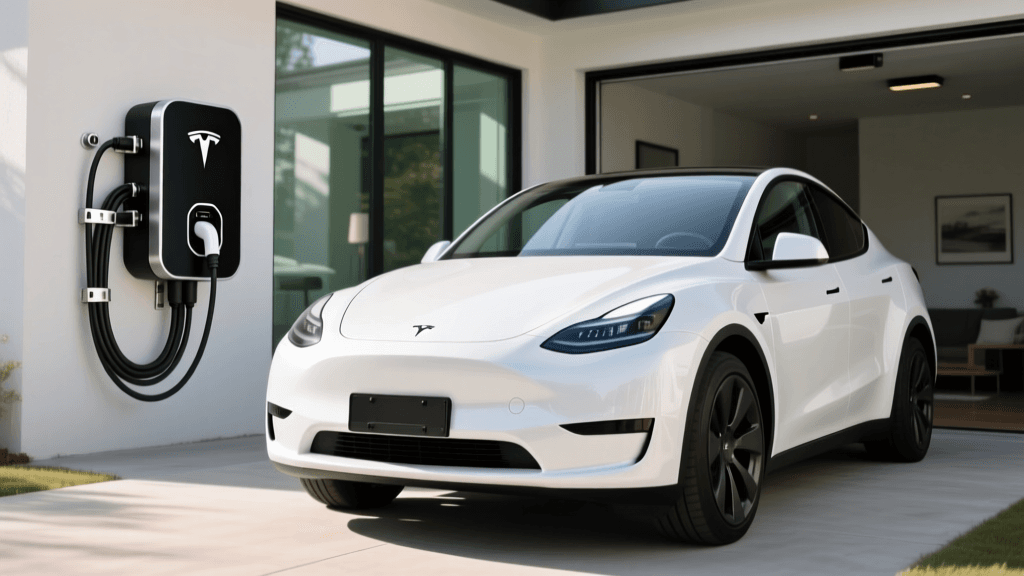
Unlike the ChargePoint Home Flex or the Emporia Vue, which rely on separate, wall-mounted J-holsters that require additional drilling and spatial planning, the Tesla Wall Connector features an integrated approach. According to Tesla's official Wall Connector documentation, the Gen 3 unit incorporates a wrap-around backplate design that houses both the connector holster and the cable management hooks directly on the main chassis. The holster itself is molded into the lower left quadrant of the unit, featuring a precision-milled channel that cradles the charging handle. Above the unit, two protruding, wide-radius hooks allow the user to wrap the excess 24-foot cable in a figure-eight or circular loop. This unified design eliminates the need for secondary mounting hardware, reducing installation time and ensuring that the weight of the heavy copper cable is distributed across the primary wall-mounting bracket rather than relying on drywall anchors used for separate holsters.
Thermal Dynamics and the Physics of Coiled Cables
One of the most common questions among EV enthusiasts is whether wrapping a high-amperage cable tightly around hooks induces dangerous thermal buildup. When an EVSE delivers a continuous 48-amp load, the internal conductors generate resistive heat. In traditional extension cords, coiling the cable can lead to inductive heating and catastrophic insulation failure because the magnetic fields of the tightly wound wires compound, trapping heat in the center of the coil. However, the Tesla Wall Connector's cable management system is engineered to mitigate this risk through spatial geometry.
The hooks on the Gen 3 Wall Connector are positioned to encourage a wide-radius wrap rather than a tight, concentrated coil. Furthermore, EV charging cables contain tightly twisted pairs of hot and neutral conductors, which inherently cancel out most electromagnetic fields, drastically reducing inductive heating risks. Nevertheless, heat dissipation remains a factor. The National Fire Protection Association (NFPA 70 / National Electrical Code) outlines strict guidelines for continuous loads and heat dissipation in bundled conductors. Tesla addresses this by utilizing highly conductive internal wiring and a thermally conductive outer jacket that allows ambient air to circulate through the loops created by the wide hooks, ensuring the cable operates safely within its thermal envelope even during multi-hour charging sessions in peak summer heat.
Material Science: TPU Jackets and Stress Cracking
The physical interaction between the cable jacket and the management hooks is a critical point of failure in lesser chargers. Many budget Level 2 chargers use PVC (Polyvinyl Chloride) jackets, which become stiff in cold weather and are prone to plasticizer migration and stress cracking when bent over sharp edges. Tesla utilizes a specialized Thermoplastic Polyurethane (TPU) blend for its cable jackets. TPU offers superior flexibility across extreme temperature ranges (-22°F to 122°F) and boasts exceptional abrasion resistance. The built-in management hooks on the Wall Connector are molded from a glass-fiber-reinforced polycarbonate with a smooth, rounded profile. This wide bend radius ensures that the TPU jacket is never subjected to acute folding angles, preventing the micro-fractures that eventually lead to moisture ingress and electrical faults. As noted by the U.S. Department of Energy's Alternative Fuels Data Center, maintaining the integrity of the EVSE cable jacket is paramount for outdoor installations where UV exposure and temperature cycling accelerate material degradation.
Spatial Geometry and Installation Ergonomics
The integration of the cable management system directly dictates installation height and spatial geometry. Because the cable must wrap over the top hooks and drop down into the lower holster without dragging on the floor, installers must carefully calculate the mounting height. For a standard 24-foot cable and an average vehicle charge port height of 30 inches, the optimal mounting height for the Wall Connector center-point is approximately 48 to 54 inches from the ground. This ensures that the wrapped cable clears the floor, protecting the connector pins from ground-level moisture, snow, and debris. The holster's internal geometry also features a subtle downward pitch, which utilizes gravity to keep the connector seated securely while allowing water to drain away from the electrical contacts, a vital feature for outdoor, uncovered installations.
Competitor Comparison: Cable Management Approaches
To understand the engineering merit of Tesla's integrated system, we must compare it against other leading Level 2 chargers on the market. Below is a structured comparison of how top-tier manufacturers handle cable management, strain relief, and holster integration.
| Feature | Tesla Wall Connector (Gen 3) | Wallbox Pulsar Plus | ChargePoint Home Flex |
|---|---|---|---|
| Cable Management Style | Integrated chassis hooks & holster | Compact wrap-around body holster | Separate wall-mounted J-holster |
| Max Continuous Amperage | 48 Amps | 48 Amps | 50 Amps |
| Cable Jacket Material | TPU (Thermoplastic Polyurethane) | TPU Blend | TPU / Silicone Blend |
| Strain Relief Design | Integrated flexible boot | Reinforced chassis grommet | External rubberized boot |
| Installation Complexity | Low (Single mount point) | Low (Single mount point) | Medium (Requires secondary drilling) |
As the table illustrates, while the Wallbox Pulsar Plus offers an incredibly compact footprint by wrapping the cable around the main body, it lacks the dedicated hook spacing that prevents tight coiling on longer 24-foot runs. The ChargePoint Home Flex offers excellent modularity but requires the user to manage a separate holster, which can be easily misplaced or mounted at an ergonomically poor height.
Smart Integration and Docking Status
A frequently overlooked aspect of built-in cable management is how the hardware communicates with the software. The Tesla Wall Connector's holster contains a microswitch and optical sensor that detects when the charging handle is properly docked. This hardware-level integration allows the Tesla app and the vehicle's infotainment system to verify that the cable is securely stored. If a user drives away without fully unwrapping the cable, the tension on the integrated hooks can trigger a fault sensor, pausing the charge or alerting the user via the app before physical damage occurs to the internal wiring. This synergy between physical cable management and digital monitoring represents the pinnacle of modern EVSE design, transforming a passive plastic hook into an active safety mechanism.
Conclusion: The Verdict on Integrated Cable Management
The Tesla Wall Connector's built-in cable management system is a masterclass in industrial design and electrical safety. By integrating the holster and wrap hooks directly into the main chassis, Tesla eliminates the spatial guesswork and secondary drilling associated with competitors like ChargePoint. More importantly, the wide-radius hooks and TPU cable jacket work in tandem to prevent the thermal and mechanical degradation that plagues poorly managed EV cables. For homeowners seeking a high-power, 48-amp Level 2 charging solution that prioritizes cleanliness, safety, and long-term durability, the Gen 3 Wall Connector's approach to cable management remains the gold standard in the industry. It proves that in the realm of EV infrastructure, how you store the power is just as important as how you deliver it.