The Hidden Engineering of EV Charger Cable Management
When evaluating Level 2 EV chargers, consumers and reviewers heavily prioritize amperage, Wi-Fi connectivity, and smart app features. However, one of the most critical points of failure in home charging infrastructure is often entirely overlooked: the physical cable. A standard 25-foot EV charging cable is a heavy, unwieldy bundle of thick copper stranding, shielding, and thermoplastic jackets. When left dangling, coiled improperly, or dragged across abrasive garage floors, the cable becomes a severe tripping hazard and a prime candidate for premature electrical failure.
While brands like ChargePoint and Wallbox rely on external, wall-mounted holsters to manage this bulk, the FLO X5 takes a fundamentally different engineering approach. In this technology deep dive, we dissect the built-in cable management system of the FLO X5, exploring the mechanical design, thermal dynamics, and material science that make integrated cable management a superior choice for long-term EV charging reliability.
The Physics of Copper Fatigue and Micro-Fractures
To understand why built-in cable management is a technological necessity rather than a mere aesthetic luxury, we must first examine the physics of cable degradation. Level 2 charging cables operating at 40 to 48 amps utilize heavy-gauge copper wiring. Copper, while highly conductive, is subject to work hardening and fatigue when subjected to repeated bending and flexing.
Every time a user wraps a heavy charging cable around their elbow or tightly coils it, they are forcing the internal copper strands past their optimal minimum bending radius. Over hundreds of charge cycles, this repetitive stress causes micro-fractures within the individual copper strands. These micro-fractures increase the electrical resistance of the cable at specific stress points. According to Joule's first law, increased resistance leads to increased heat generation. A localized hot spot inside a tightly coiled, damaged cable can eventually melt the internal insulation, leading to short circuits or, in extreme cases, electrical fires.
Integrated cable management systems are engineered specifically to enforce a safe bending radius, ensuring the cable is stored in a wide, natural loop rather than a tight, stress-inducing knot.
Technology Deep Dive: The FLO X5 Integrated System
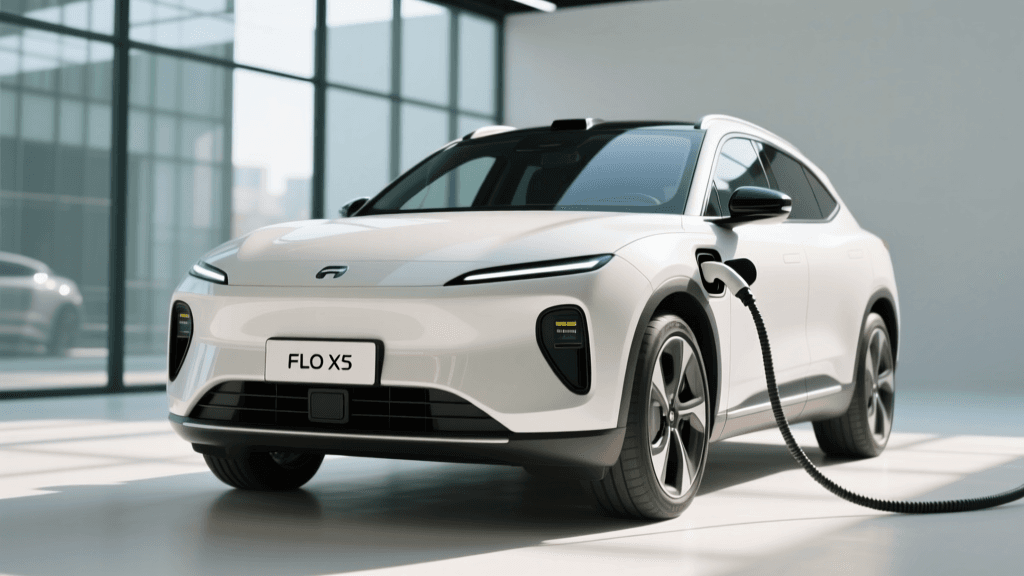
The FLO X5 is renowned in the commercial charging space for its ruggedness, and its residential iteration brings that same industrial-grade cable management to the home garage. Unlike chargers that require you to purchase a separate, wall-mounted cable wrap, the FLO X5 features a chassis-integrated management system.
Chassis-Integrated Winding and Holster Design
The FLO X5 utilizes a specialized outer casing geometry that incorporates a built-in, ergonomic wrapping channel. The cable is designed to rest flush against the reinforced polycarbonate housing, distributing the weight of the heavy 25-foot cord across a broad surface area rather than concentrating it on a single wall hook. The integrated J1772 connector holster is not an afterthought; it is seamlessly molded into the lower chassis, featuring a precision-fit locking mechanism that shields the connector pins from ambient garage dust, moisture, and physical impacts.
Material Science: TPU Jacket Synergy
The cable management system is paired with a highly specialized Thermoplastic Polyurethane (TPU) cable jacket. TPU is chosen for its high abrasion resistance and flexibility in extreme temperatures. The FLO X5’s built-in wrap is calibrated to the exact stiffness coefficient of this TPU jacket. When you wrap the cable around the FLO X5 chassis, the system’s curvature perfectly matches the TPU’s natural memory, meaning the cable lies flat against the unit without fighting to uncoil itself. This eliminates the 'spring-back' effect common in cheaper chargers, which often causes cables to slip off external hooks and fall onto the floor.
Comparative Analysis: Integrated vs. External Management
How does the FLO X5’s built-in system compare to the external holster solutions utilized by its top competitors? Below is a structural and functional comparison.
| Feature | FLO X5 (Integrated) | ChargePoint Home Flex (External) | Wallbox Pulsar Plus (External) |
|---|---|---|---|
| Management Type | Chassis-Integrated Wrap | Separate Wall-Mounted Holster | Separate Wall-Mounted Holster |
| Bending Radius Enforcement | Strict (Engineered Curvature) | User Dependent | User Dependent |
| Connector Shielding | Sealed Internal Housing | Exposed Prongs | Exposed Prongs |
| Wall Space Required | Minimal (Single Unit) | High (Unit + Wrap Hook) | High (Unit + Wrap Hook) |
| Hardware Points of Failure | None (Molded Chassis) | Wall Anchors, Plastic Clips | Wall Anchors, Plastic Clips |
Thermal Dynamics: Inductive Heating and Safety
One of the most critical, yet least understood, aspects of EV cable management is the phenomenon of inductive heating. When a high-amperage alternating current (AC) passes through a tightly coiled cable, it generates a concentrated magnetic field. This field induces eddy currents within the coiled copper, generating significant heat. If a 48-amp charger is left tightly wrapped in a small circle while actively charging, the internal temperature of the cable can spike well beyond the safety limits of the insulation.
According to safety guidelines outlined by the National Fire Protection Association (NFPA), proper cable management and avoidance of tight coiling are essential for preventing thermal events and ensuring safe home EV charging operations. The FLO X5 mitigates this risk through its physical design. The integrated chassis wrap forces the cable into a wide, elongated figure-eight or broad oval shape, drastically reducing the magnetic coupling that causes inductive heating. Furthermore, the spatial separation between the cable and the charger’s internal power electronics prevents the heat generated by the cable from transferring to the charger’s mainboard.
Weatherproofing and the IP65 Synergy
For outdoor installations, cable management is directly tied to the ingress protection (IP) rating of the unit. The FLO X5 boasts an IP65 rating, meaning it is completely protected against dust ingress and low-pressure water jets from any direction. However, an IP rating is only as strong as its weakest link—often the connector holster.
Because the FLO X5’s connector holster is built directly into the chassis with a custom-molded gasket, inserting the J1772 plug creates a watertight seal. In contrast, external holsters leave the connector exposed to the elements, or rely on secondary silicone caps that users frequently lose or forget to replace. By integrating the management system into the sealed enclosure, FLO ensures that the most vulnerable component of the charging ecosystem remains dry, preventing corrosion on the silver-plated contact pins.
Installation Best Practices for Cable Longevity
Even the most advanced built-in cable management system requires proper installation to function optimally. The U.S. Department of Energy emphasizes the importance of professional installation and optimal placement of home EV supply equipment (EVSE) to ensure safety and convenience.
- Mounting Height: To maximize the effectiveness of the FLO X5’s integrated wrap, the unit should be mounted at approximately 48 to 54 inches from the garage floor. This allows the cable to drape naturally to the vehicle’s charge port without creating excessive tension or dragging on the ground, which can compromise the TPU jacket over time.
- Tension Relief: When wrapping the cable, ensure there is zero tension pulling against the chassis connection point. The FLO X5 features an integrated strain relief boot where the cable enters the main housing; however, wrapping the cable loosely enough to prevent a 'tug-of-war' with the J1772 holster will extend the life of the internal crimps.
- Clearance: Leave at least 12 inches of clearance on the sides of the FLO X5 unit. This provides the physical space needed to wrap a thick, cold-weather cable (which becomes significantly stiffer in freezing temperatures) without forcing it into sharp bends.
Final Verdict: The Value of Integrated Engineering
The transition from external hooks to built-in cable management systems represents a maturation in EVSE design. The FLO X5 demonstrates that treating the cable as an integrated component of the charger, rather than a detachable accessory, yields massive dividends in safety, longevity, and user experience. By enforcing safe bending radii, mitigating inductive heating risks, and providing a sealed, weatherproof environment for the connector, the FLO X5’s built-in system sets a new benchmark for Level 2 charger hardware engineering. For EV owners seeking a 'plug-and-forget' solution that will endure years of daily use without cable degradation, integrated management is no longer optional—it is essential.