The North American EV Shift and the Need for Resilient Charging
As the electric vehicle (EV) market accelerates across North America, the residential infrastructure supporting it must evolve in tandem. According to the Edison Electric Institute, EV adoption is fundamentally altering residential load profiles, pushing homeowners to seek reliable, smart, and durable Level 2 charging solutions. Enter the Flo Home X5, a premium Level 2 EV charger engineered specifically to withstand the diverse and often harsh climates of the United States and Canada. In this comprehensive review, we analyze the Flo Home X5 through the lens of future industry trends, evaluating its build quality, smart grid integration, and long-term viability for North American EV owners.
Flo Home X5: Core Specifications and Build Quality
The Flo Home X5 is a 30-amp, 7.2 kW Level 2 charging station designed for residential use. While some competitors push 48-amp or 80-amp maximums, the 30-amp output of the X5 is a deliberate choice that balances rapid overnight charging with the electrical realities of older North American homes, which may not easily support the massive panel upgrades required for higher-amperage units. For the vast majority of EVs on the road today, 7.2 kW will replenish a depleted battery overnight, adding roughly 25 to 30 miles of range per hour of charging.
| Feature | Specification |
|---|---|
| Max Output | 30 Amps / 7.2 kW |
| Voltage | 240V AC |
| Cable Length | 25 Feet (7.6 m) |
| Enclosure Rating | NEMA 4X (Indoor/Outdoor) |
| Connector Type | SAE J1772 (Tesla adapters supported) |
| Smart Features | Wi-Fi, FLO App, Load Balancing |
| Warranty | 3 Years (Residential) |
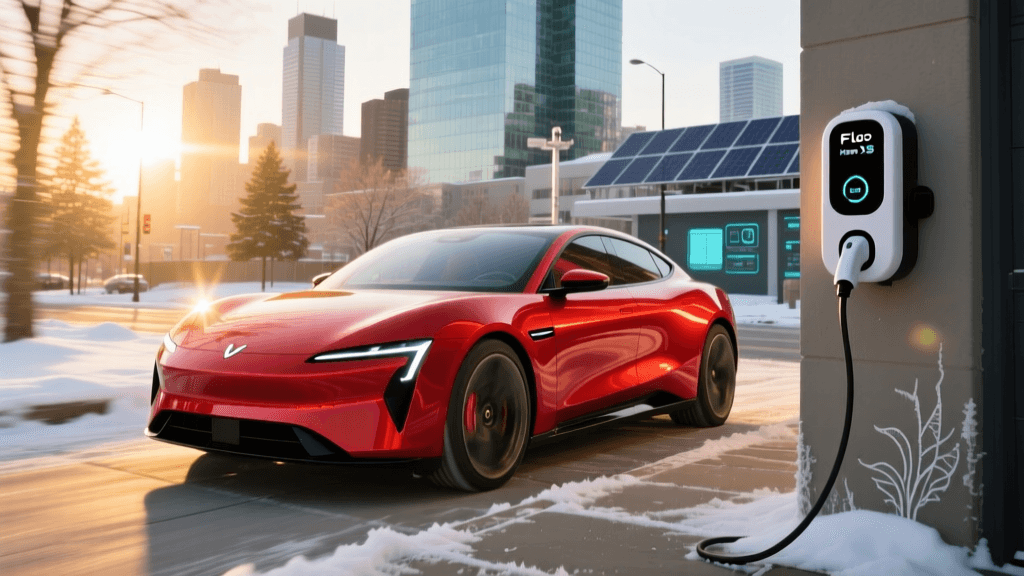
The standout feature of the X5 is its NEMA 4X-rated enclosure. Unlike standard NEMA 3R ratings found on cheaper alternatives, NEMA 4X provides complete protection against windblown dust, rain, hose-directed water, and ice formation. This makes it an elite choice for Canadian winters and coastal US environments where salt and moisture accelerate degradation.
Future Trends: Extreme Weather and Grid Resilience
Looking ahead, the North American charging landscape will be heavily influenced by climate resilience. With increasing frequencies of extreme weather events—from deep freezes in Alberta and Quebec to blistering heatwaves in Texas and California—consumer hardware must be ruggedized. The Flo Home X5’s aluminum and high-grade polymer casing is designed to operate flawlessly in temperatures ranging from -40°F to 122°F (-40°C to 50°C).
Furthermore, the 25-foot cable remains flexible even in sub-zero temperatures, a common pain point with cheaper PVC cables that stiffen and crack in Canadian winters. As the industry moves toward Vehicle-to-Home (V2H) and Vehicle-to-Grid (V2G) technologies, the physical durability of the charging node is paramount; you cannot have a smart grid bottlenecked by a fragile physical interface.
Smart Grid Integration: TOU Rates and the FLO App
The future of home charging is intrinsically linked to Time-of-Use (TOU) electricity rates and smart grid load balancing. The FLO app allows users to schedule charging sessions during off-peak hours when electricity is cheapest and the grid is least strained. For homeowners with solar panels, the app can be configured to prioritize charging during peak solar production hours, effectively running your EV on free, clean energy.
While the Flo Home X5 utilizes FLO’s proprietary ecosystem rather than the open OCPP (Open Charge Point Protocol) standard seen in commercial units, FLO’s network is one of the most robust in North America. The app provides granular data on energy consumption, CO2 savings, and charging history, which is increasingly important as utility companies begin offering demand-response rebates to EV owners who allow the grid to throttle their charging during peak demand events.
Installation Realities: Hardwired vs. NEMA 14-50
When installing the Flo Home X5, homeowners face a critical decision: hardwire or plug-in via a NEMA 14-50 receptacle. From a future-proofing perspective, hardwiring is highly recommended.
- Hardwired: Eliminates the risk of outlet overheating, a known issue with continuous 30-amp draws on standard residential receptacles. It also complies seamlessly with local codes that increasingly scrutinize high-draw EV outlets.
- NEMA 14-50: Offers portability if you plan to move soon, but requires a high-quality, commercial-grade receptacle (like a Hubbell or Bryant) to prevent melting, adding to the overall installation cost.
Because the X5 draws a continuous 30 amps, the National Electrical Code (NEC) requires the circuit to be rated for 125% of the continuous load. Therefore, you must install a 40-amp breaker and use appropriate gauge wiring (typically 8 AWG copper, though 6 AWG is recommended for future-proofing).
Navigating Rebates in the US and Canada
The financial barrier to Level 2 charging is lowering thanks to aggressive government incentives. In the United States, the U.S. Department of Energy outlines various federal and state-level tax credits that can cover up to $1,000 of the hardware and installation costs. Many local utilities also offer direct rebates for installing smart chargers like the Flo X5 that support TOU scheduling.
In Canada, the landscape is equally supportive. Through the Government of Canada's Zero Emission Vehicle program and various provincial initiatives (such as BC’s CleanBC Go Electric program or Quebec’s Roulez Vert), homeowners can reclaim significant portions of their purchase and installation costs. Always check local municipal databases, as cities often stack their own rebates on top of provincial and federal incentives.
Market Comparison: Flo X5 vs. ChargePoint vs. Tesla
How does the Flo Home X5 compare to the dominant players in the North American market? Below is a structured comparison of the top-tier residential Level 2 chargers.
| Feature | Flo Home X5 | ChargePoint Home Flex | Tesla Wall Connector |
|---|---|---|---|
| Max Amperage | 30A (7.2 kW) | Up to 50A (12 kW) | Up to 48A (11.5 kW) |
| Enclosure | NEMA 4X (Aluminum/Polymer) | NEMA 4 (Plastic) | NEMA 3R (Plastic/Glass) |
| Cable Length | 25 ft | 18 ft or 23 ft | 24 ft |
| Smart Features | FLO App, TOU Scheduling | Alexa, App, TOU | Tesla App, Power Sharing |
| Ideal Climate | Extreme Cold / Coastal | Moderate / Indoor | Moderate / Sheltered |
While the ChargePoint Home Flex and Tesla Wall Connector offer higher maximum amperages, they require massive 60-amp or 70-amp electrical circuits that many older homes cannot support without a $2,000+ panel upgrade. The Flo Home X5’s 30-amp ceiling is a pragmatic sweet spot, delivering excellent charging speeds without necessitating a complete home electrical overhaul. Furthermore, the X5’s NEMA 4X rating vastly outperforms the Tesla Wall Connector’s NEMA 3R rating in harsh, wet, or icy environments.
Final Verdict: Is the Flo Home X5 Future-Proof?
The Flo Home X5 is not just a charger; it is a piece of critical residential infrastructure designed for the realities of the North American climate and electrical grid. While it may not boast the absolute highest amperage on the market, its 7.2 kW output is perfectly calibrated for the average home’s electrical capacity, ensuring safer, more reliable installations.
For drivers in Canada and the northern US, the NEMA 4X enclosure and cold-weather cable flexibility make it arguably the most durable residential option available. When paired with the FLO app’s smart scheduling and load-balancing capabilities, the X5 positions homeowners to take full advantage of evolving TOU rates and utility demand-response programs. If you prioritize rugged longevity, smart grid integration, and hassle-free installation over raw, maximum-amp bragging rights, the Flo Home X5 is an exceptional, future-proof investment for your EV journey.