The Dawn of Automated and Wireless EV Charging
The transition to electric vehicles is no longer just about battery chemistry and range; it is equally about how electrons move from the grid to the vehicle. Over the past eighteen months, international patent databases have seen a massive surge in filings related to automated, robotic, and wireless EV charging technologies. For early adopters, commercial fleet managers, and electrical contractors, understanding these patent trends is not just an academic exercise—it is a critical step in future-proofing physical infrastructure.
While Level 2 wired chargers and DC Fast Charging (DCFC) stations dominate the current landscape, the next decade will be defined by hands-free charging. Major automotive and tech companies are aggressively patenting systems that eliminate the need for human intervention, paving the way for autonomous robotaxi fleets and ultra-convenient residential setups. In this expert guide, we break down the most significant recent charging technology breakthroughs and provide actionable, technical best practices to prepare your property for the next generation of EV infrastructure.
Breakthrough Patent Filings Shaping the Future
WiTricity and the SAE J2954 Inductive Standard
The push for wireless EV charging is heavily anchored in magnetic resonance technology. WiTricity, a pioneer in this space, holds foundational patents for high-efficiency wireless power transfer. Their technology allows for significant spatial misalignment between the ground pad and the vehicle receiver pad without catastrophic drops in charging efficiency. This technology is the backbone of the SAE J2954 standard, which establishes the interoperability, safety, and performance requirements for light-duty wireless EV charging systems. Recent patent filings by WiTricity and their automotive partners focus on foreign object detection (FOD) and living object protection (LOP), ensuring that debris or pets do not interfere with the electromagnetic field.
Tesla and Automated Robotic Charging Arms
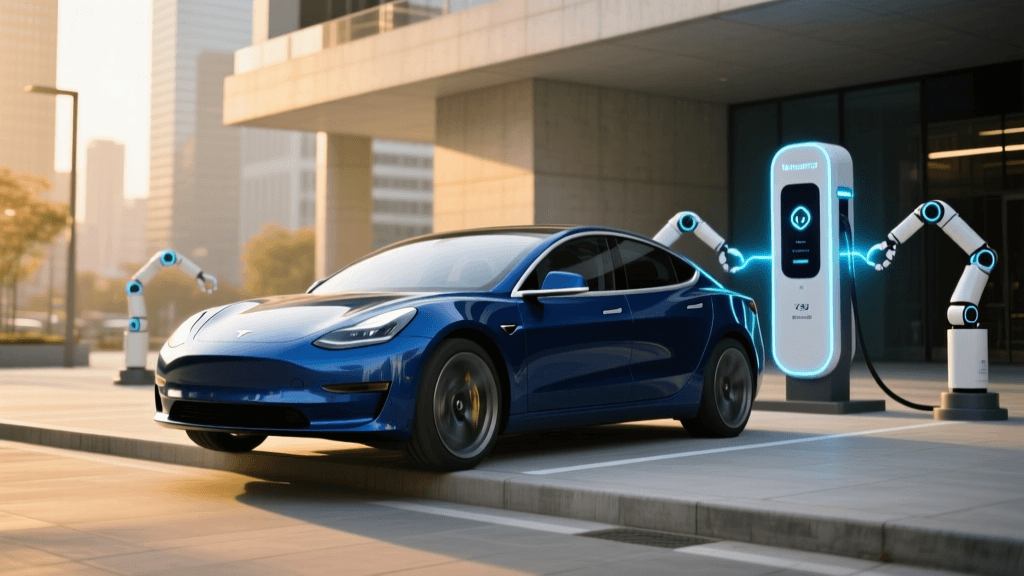
Tesla has continuously filed patents surrounding automated charging solutions, evolving from their early 'snake charger' concept to sophisticated robotic alignment systems. Recent intellectual property filings detail robotic arms equipped with LiDAR and optical sensors designed to locate the North American Charging Standard (NACS) port and insert the connector autonomously. This technology is vital for the future of autonomous vehicle fleets, which cannot rely on human drivers to plug in overnight. The patents also cover automated port door actuation and weather-sealing mechanisms to prevent ice or dirt from blocking the robotic arm.
Dynamic Wireless Power Transfer (DWPT)
Looking further ahead, companies like Qualcomm (through their Halo division) and various research universities are securing patents for Dynamic Wireless Power Transfer. DWPT involves embedding inductive charging coils directly into highway infrastructure, allowing vehicles to charge while in motion. While commercial deployment is still years away, the patent landscape shows a clear trajectory toward 'electric roads' that could drastically reduce the need for massive onboard battery packs.
Expert Best Practices: Future-Proofing Your Installation
As an electrical contractor, fleet manager, or tech-forward homeowner, you do not need to wait for these technologies to hit the consumer market to start preparing. Retrofitting concrete and upgrading electrical panels later is exponentially more expensive than doing it right the first time. Here are expert tips to future-proof your EV infrastructure based on current patent trajectories.
1. Oversize Conduit and Trenching for Future Ground Pads
Wireless charging requires a ground pad embedded in or resting on your garage floor or driveway. These pads require high-gauge wiring and dedicated communication lines. When trenching for your current wired Level 2 charger, always install additional, oversized conduit for future use.
- Conduit Sizing: Install a minimum 2-inch to 3-inch Schedule 80 PVC conduit alongside your active charger lines.
- Trench Depth: Bury the spare conduit at least 24 to 30 inches deep to comply with standard electrical codes and prevent future excavation damage.
- Pull Strings: Always leave a high-tensile nylon pull string inside the empty conduit. When wireless technology is ready for your driveway, you can easily pull the heavy-gauge wires required for a 10kW+ inductive pad without digging up your property again.
2. Design Spatial Clearances for Robotic Integration
If you are designing a commercial depot or a high-end residential garage, you must account for the physical footprint of robotic charging arms. These systems require specific clearances to operate safely and accurately.
- Lateral Clearance: Maintain a minimum 36-inch unobstructed lateral clearance on the driver's side (or charge port side) of the vehicle. Do not place storage racks, pillars, or walls within this zone.
- Optical Sightlines: Robotic arms rely on cameras and LiDAR to find the charge port. Avoid installing highly reflective surfaces, mirrors, or strobe lighting directly opposite the parking spot, as these can blind the robot's optical sensors.
- Parking Guides: Install physical wheel stops or magnetic floor guides to ensure the vehicle parks in the exact same millimeter-precise location every time, reducing the articulation range required by the robotic arm.
3. Calculate Electrical Overhead for Inductive Efficiency
According to data from the Alternative Fuels Data Center, planning your electrical load is critical for long-term infrastructure viability. Wired Level 2 charging operates at roughly 98% efficiency. However, current wireless inductive charging technology operates between 85% and 93% efficiency depending on alignment and air gap.
This 7% to 15% efficiency loss translates to additional heat and higher amp draw from your main panel. If you plan to install multiple wireless pads for a fleet or a multi-car household, you must oversize your electrical service. Upgrading to a 400A or 600A residential service panel, or installing a dedicated smart load-management sub-panel for the garage, will ensure you have the headroom to handle the thermal and electrical overhead of inductive charging without tripping main breakers.
Technology Comparison: Current vs. Patented Future Tech
To understand where your infrastructure investments should be directed, compare the operational metrics of today's wired solutions against the patented technologies of tomorrow.
| Charging Technology | Typical Power Output | Grid-to-Battery Efficiency | Infrastructure Prep Cost | Patent Maturity |
|---|---|---|---|---|
| Wired Level 2 (Current) | 7.2 kW - 19.2 kW | ~98% | Low (Standard Conduit) | Established |
| Wired DCFC (Current) | 50 kW - 350 kW | ~95% | High (Utility Upgrades) | Established |
| Static Inductive (SAE J2954) | 3.6 kW - 11 kW | 85% - 93% | Medium (Oversized Conduit) | Commercializing |
| Robotic Arm Alignment | 11 kW - 25 kW | ~98% (Wired connection) | High (Spatial Clearances) | Prototyping / Patented |
| Dynamic Wireless (DWPT) | 50 kW+ (Continuous) | 75% - 85% | Extreme (Road Reconstruction) | Early Patent Phase |
Strategic Takeaways for Fleet Managers and Homeowners
The patent landscape makes one thing abundantly clear: the future of EV charging is hands-free. For fleet managers, the immediate action item is to design depot layouts with modular parking spaces that can accommodate both wired pedestals today and robotic arms tomorrow. Ensure your depot's electrical switchgear has 20% spare capacity to account for the efficiency losses of future inductive charging pads.
For homeowners and custom builders, the focus should be on underground prep. Running an extra 3-inch conduit to the center of your primary garage parking spot costs less than $200 during new construction but could save you thousands in concrete cutting and driveway repair when wireless charging pads become a mainstream consumer product in the late 2020s.
By aligning your physical infrastructure preparations with the trajectory of global patent filings, you ensure that your property remains at the cutting edge of automotive technology, maximizing both convenience and long-term real estate value.