The Boom in Highway EV Charging Corridors
The electric vehicle landscape is undergoing a massive transformation, driven largely by government initiatives aimed at eliminating range anxiety on major roadways. In the United States, the Infrastructure Investment and Jobs Act (IIJA) allocated $7.5 billion to build out a national network of EV chargers, with $5 billion specifically dedicated to the National Electric Vehicle Infrastructure (NEVI) formula program. Similar initiatives, like the AFIR (Alternative Fuels Infrastructure Regulation) in Europe, are mandating charging pools along major TEN-T highway corridors.
Every week, headlines announce new "EV charging corridors" along major interstates like I-95, I-5, and I-80. However, this flood of press releases and government announcements has led to widespread confusion among EV owners. Many drivers are making critical road trip mistakes based on misunderstandings of what these corridor announcements actually mean. In this guide, we are busting the most common myths about highway charging corridors and providing actionable advice to ensure your next road trip is seamless.
Myth 1: "Corridor Announcements Mean Chargers Are Ready Today"
One of the most common mistakes EV road-trippers make is reading a press release about a new "I-80 EV Charging Corridor" and immediately booking a trip, assuming the chargers are live and ready to use. This is a fundamental misunderstanding of infrastructure deployment timelines.
When a state department of transportation or a private network announces a new corridor deployment, they are usually announcing funding awards or project approvals, not completed construction. According to the Federal Highway Administration's NEVI program guidelines, the journey from funding award to a ribbon-cutting ceremony involves several grueling phases:
- Site Selection and Lease Negotiations: 3 to 6 months.
- Utility Grid Interconnection Studies: 6 to 18 months (often the biggest bottleneck, as local utilities must upgrade transformers and run new medium-voltage lines).
- Permitting and Environmental Reviews: 3 to 9 months.
- Physical Construction and Commissioning: 3 to 6 months.
The Reality: A corridor announcement today means the chargers will likely be operational 12 to 24 months from now. Never route a road trip based on a press release. Always rely on real-time mapping software that only displays fully commissioned and active stations.
Myth 2: "Every New Corridor Station Offers 350kW Ultra-Fast Charging"
Many drivers assume that because a new highway corridor is being built with federal or state funds, it will feature the latest 350kW ultra-fast chargers capable of adding 200 miles of range in 10 minutes. While 350kW stations do exist, they are not the standard for government-funded corridor deployments.
To comply with federal NEVI standards, a highway charging station must feature a minimum of four DC Fast Charging (DCFC) ports, and each port must be capable of delivering at least 150 kW simultaneously. While some private networks (like Electrify America or Tesla Superchargers) may install 350kW units at premium locations, the baseline guarantee for a new government-backed corridor hub is 150 kW.
Understanding the difference between 150kW and 350kW is vital for managing your time on a road trip. Here is a comparison of what to expect when charging a typical 75kWh battery (like a Tesla Model 3 Long Range or Hyundai Ioniq 5) from 10% to 80% state of charge:
| Charger Type | Max Output | 10-80% Charge Time | Typical Corridor Availability |
|---|---|---|---|
| Level 2 AC | 19.2 kW | 4+ Hours | Hotels, Destinations (Not Corridors) |
| DCFC (NEVI Minimum) | 150 kW | ~32 Minutes | Standard Highway Corridors |
| Ultra-Fast DCFC | 350 kW | ~18 Minutes | Select Premium Hubs & Flagship Stations |
Actionable Advice: When using route planners like A Better Routeplanner (ABRP), set your expected charger speed to 150kW for new, non-premium corridor stops. This will give you a much more realistic estimate of your travel time and prevent frustration when your vehicle tapers its charging speed at a 150kW post.
Myth 3: "Highway Corridor Chargers Will Always Have CCS Plugs"
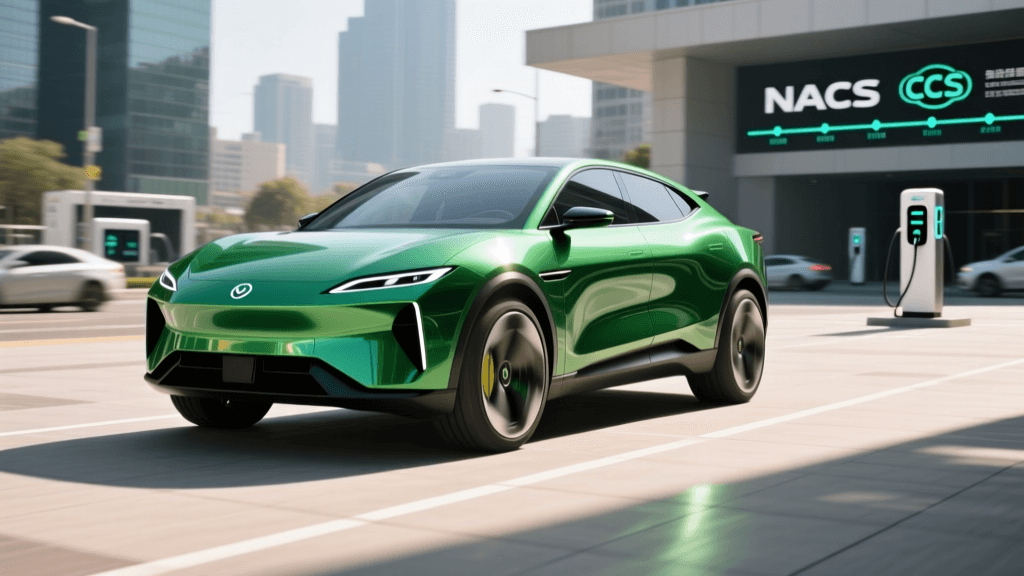
For the last few years, the Combined Charging System (CCS) was the undisputed standard for non-Tesla DC fast charging. However, the North American Charging Standard (NACS), pioneered by Tesla, has rapidly taken over the industry. This transition has created a massive myth regarding new corridor deployments.
Initially, NEVI guidelines strictly mandated that all federally funded highway corridor chargers feature CCS connectors. However, following the industry-wide shift toward NACS, the Joint Office of Energy and Transportation updated its guidance to allow states to include NACS connectors alongside or instead of CCS, provided they meet accessibility requirements.
The Mistake: Drivers of older non-Tesla EVs (which use CCS) are showing up to newly announced corridor hubs assuming CCS plugs will be plentiful, only to find that the site was built with native NACS cables and a single CCS adapter, or vice versa. Furthermore, Tesla's "Magic Dock" (a built-in CCS adapter at Superchargers) is not universally available at every corridor stop.
Pro Tip: A corridor announcement is a funding milestone, not a construction completion certificate. Always verify real-time station status, plug types, and user photos on apps like PlugShare before routing your road trip to a newly opened hub.
If you drive a vehicle with a native CCS port, you must carry a reliable NACS-to-CCS adapter if you plan to utilize the expanding Tesla Supercharger network along these corridors, and always check the Joint Office of Energy and Transportation portal for state-specific connector rollouts.
Common Mistake: Blindly Trusting Corridor Maps Without Checking Uptime
Another major pitfall is treating a corridor map as a guarantee of reliability. While the NEVI program mandates a strict 97% uptime requirement for all federally funded chargers, this rule applies specifically to the new stations built under the program. Many highway corridors are still dotted with legacy chargers installed years ago that suffer from broken screens, payment processing failures, or liquid cooling leaks.
Relying solely on the "green pin" on your vehicle's native navigation map is a recipe for being stranded in a rural stretch of I-40 or I-10. The native maps often pull from static databases that do not account for real-time hardware failures.
How to Vet a Corridor Stop Before You Arrive
To avoid the dreaded "out of order" sticker on a charger screen, adopt this three-step verification process for every corridor stop on your route:
- Check PlugShare or ChargeHub Comments: Look at the most recent user check-ins. If the last three comments from the past 48 hours mention "network error" or "broken handle," reroute immediately.
- Verify the Network App: If the corridor stop is operated by EVgo, Electrify America, or ChargePoint, open their proprietary app and check the real-time status of the specific stall. Network apps are usually the first to register a hardware fault.
- Look for Redundancy: A true, well-planned highway corridor should have charging options within a 15-mile radius. Never route a trip where a single 4-stall charger is the only option for 80 miles. According to the Alternative Fuels Data Center, robust corridor planning requires identifying backup charging locations in case your primary stop is offline or occupied by a queue of EVs.
The "One Mile Off The Exit" Rule: A Hidden Trip Planner Trap
Finally, EV drivers frequently misunderstand the geography of highway charging corridors. Under federal guidelines, NEVI-funded chargers must be located no more than 50 miles apart and within one travel mile of a highway exit.
While this sounds convenient, "one travel mile" can be deceptive. In rural areas or complex highway interchanges, a one-mile detour off the exit can involve navigating through unlit industrial parks, crossing multiple heavy-traffic intersections, or dealing with tight turning radiuses that are difficult for vehicles towing trailers.
Actionable Advice: If you are towing a small camper or utility trailer with your EV (like the Ford F-150 Lightning or Rivian R1T), do not rely blindly on corridor maps. Use satellite view on Google Maps to inspect the physical layout of the charging station. Many new corridor stations are built in cramped gas station corners or fast-food parking lots that are virtually impossible to navigate with a trailer. Look for "pull-through" corridor charging hubs specifically designed for towing, which are increasingly being announced by networks like Electrify America and Tesla.
Conclusion: Navigate the Corridor Boom with Confidence
The explosion of highway EV charging corridor announcements is a massive win for the future of electric mobility. However, the gap between political announcements, utility grid upgrades, and physical construction requires EV drivers to be more vigilant than ever. By understanding the realities of 150kW baseline speeds, keeping up with the NACS/CCS connector transition, and rigorously verifying real-time uptime, you can bypass the common mistakes that plague early adopters. Plan smart, verify your stops, and enjoy the open road.