The Great EV Infrastructure Divide: Plugs vs. Swaps
The electric vehicle (EV) industry is rapidly approaching a critical infrastructure inflection point. While plug-in DC fast charging (DCFC) remains the dominant paradigm in North America and Europe, battery swapping is carving out a massive, multi-billion-dollar niche in Asia and specific global commercial fleet applications. For investors, automakers, and fleet operators, understanding the diverging investment trends between battery swapping stations and traditional plug-in charging networks is essential for long-term strategic planning.
Historically, the debate was settled in favor of plugs due to the sheer simplicity of standardizing a cable over standardizing an entire vehicle chassis. However, advancements in automated robotics, the rise of Battery-as-a-Service (BaaS) models, and severe electrical grid constraints are forcing the industry to re-evaluate the financial viability of battery swapping. As we look toward the future of EV infrastructure, capital is flowing into both sectors, but for vastly different use cases and geographic markets.
Capital Expenditure (CapEx) and Operational Realities
When comparing infrastructure investments, the upfront capital expenditure (CapEx) and ongoing operational expenditure (OpEx) paint two very different pictures. A traditional DC fast charging plaza requires significant investment in grid upgrades, trenching, and high-capacity transformers. Conversely, a battery swap station requires a smaller physical footprint and less immediate grid capacity, but demands a massive upfront investment in proprietary battery inventory.
Below is a comparative breakdown of the infrastructure investment metrics for a standard commercial deployment:
| Metric | DC Fast Charging (350kW Plaza) | Battery Swapping Station (Automated) |
|---|---|---|
| Estimated CapEx | $250,000 - $500,000 | $700,000 - $1,200,000 (incl. battery inventory) |
| Grid Connection | 1MW - 3MW+ (High peak demand charges) | 500kW - 1MW (Can charge batteries off-peak) |
| Vehicle Turnaround Time | 15 - 30 minutes | 3 - 5 minutes |
| Land Footprint | 4 - 8 parking spaces | 3 - 4 parking spaces + automated vault |
| OEM Standardization | High (NACS / CCS) | Low (Proprietary packs, e.g., NIO, CATL) |
From an OpEx perspective, battery swapping holds a distinct advantage regarding utility demand charges. Because swap stations house dozens of batteries (e.g., NIO's Gen 4 stations hold 23 batteries), they can charge these packs slowly during off-peak hours when electricity rates are lowest, and even act as virtual power plants (VPPs) to sell energy back to the grid during peak hours. DCFC stations, by contrast, draw massive instantaneous power spikes when vehicles plug in, triggering punishing utility demand charges that can cripple station profitability.
Battery Swapping: Heavyweights and the Standardization Hurdle
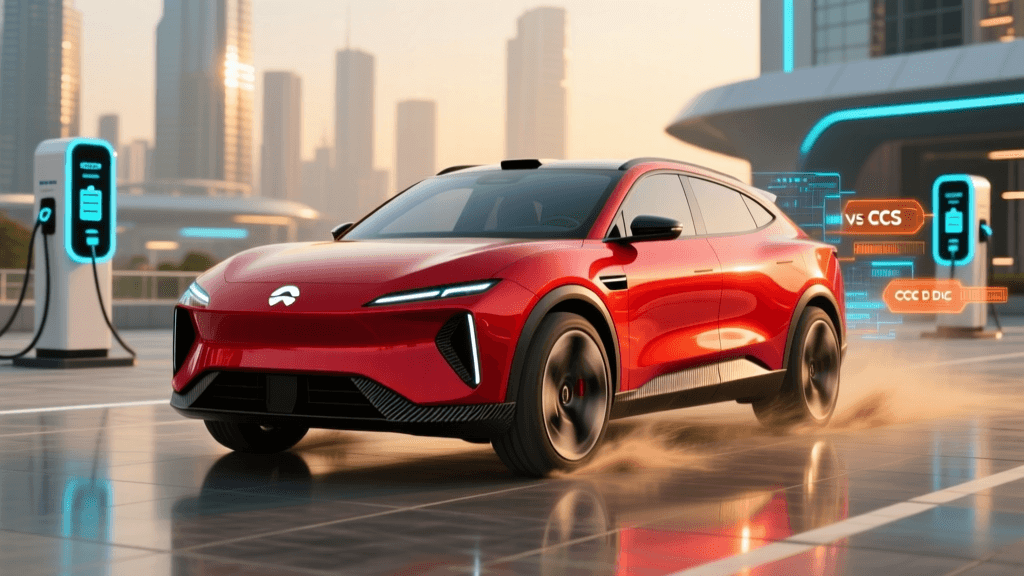
The battery swapping sector is currently dominated by Chinese heavyweights, though Western commercial applications are emerging. NIO remains the undisputed leader in the passenger vehicle space, operating over 2,400 swap stations globally. Their latest Gen 4 station can complete a swap in under 60 seconds and features advanced bidirectional charging capabilities. Meanwhile, battery giant CATL has entered the arena with its 'Choco-Swap' blocks, attempting to create a universal, modular battery standard that can be adopted by multiple automakers, thereby solving the industry's biggest swapping hurdle: proprietary hardware.
Despite these innovations, standardization remains a massive barrier to widespread investment. According to the IEA's Global EV Outlook 2024, the fragmentation of charging and battery standards continues to complicate infrastructure rollouts. Automakers are highly protective of their battery pack designs, viewing them as core intellectual property and a primary factor in vehicle safety, range, and packaging. Until a universal physical battery standard is adopted—similar to how the North American Charging Standard (NACS) unified plug-in ports—battery swapping will likely remain confined to specific OEM ecosystems or closed-loop commercial fleets.
DC Fast Charging: Grid Constraints and the NACS Monopoly
While swapping fights the standardization war, DC fast charging is battling the electrical grid. In North America, the transition to the NACS standard has unified the market, triggering a massive wave of investment from joint ventures like IONNA (formed by seven major automakers) and network expansions by Tesla and Electrify America. However, the physical reality of deploying 350kW to 600kW chargers is colliding with aging municipal grid infrastructure.
According to research from the National Renewable Energy Laboratory (NREL), integrating high-power EV charging into local distribution grids requires careful planning to avoid localized overloads and expensive infrastructure upgrades. In many urban centers, securing the necessary permits and transformer upgrades for a new 10-stall DCFC plaza can take 18 to 24 months. This grid bottleneck is precisely where battery swapping finds its strongest value proposition: a swap station can be deployed in locations where the local grid cannot support the megawatt-level instantaneous spikes required by modern DC fast chargers.
Future Investment Outlook: Where the Smart Money is Flowing
Looking ahead to the next five years, investment trends are bifurcating based on the end-user. For consumer passenger vehicles, venture capital and government grants are overwhelmingly favoring plug-in DCFC infrastructure. The consumer preference for owning a vehicle without the complexity of leasing a battery, combined with the universal adoption of NACS and CCS, makes plug-in charging the undisputed king of the retail market.
However, in the B2B, heavy-duty trucking, and last-mile delivery sectors, battery swapping is experiencing a renaissance. Companies like Ample are deploying modular battery swapping for commercial fleets in the US and Europe. For a delivery van or a port drayage truck, a 30-minute charging downtime represents lost revenue. A 3-minute battery swap keeps the asset moving. Furthermore, the BaaS model allows fleet operators to purchase vehicles without the battery (reducing upfront vehicle costs by up to 40%) while subscribing to the energy and swapping network, shifting the depreciation risk of the battery to the station operator.
Actionable Advice for Fleet Operators and Investors
For industry stakeholders looking to allocate capital or upgrade operations, consider the following strategic guidelines:
- Audit Local Grid Capacity Early: Before committing to a DCFC plaza, consult with local utilities regarding transformer availability and demand charge structures. If grid upgrades exceed $150,000 or timeline estimates exceed 12 months, pivot your feasibility study to include battery swapping or on-site stationary storage buffering.
- Calculate True Cost of Downtime: For commercial fleets, do not just compare the cost per kWh. Calculate the lost revenue per hour of vehicle downtime. If your vehicles operate on tight, continuous shifts (e.g., airport shuttles, mining trucks, port logistics), the higher CapEx of a swap station will yield a faster ROI through maximized vehicle utilization.
- Leverage Battery-as-a-Service (BaaS): If pursuing battery swapping, negotiate BaaS contracts that include battery health guarantees and end-of-life recycling. This protects your balance sheet from the rapid depreciation and technological obsolescence of lithium-ion chemistries.
- Target Hybrid Infrastructure Hubs: The most resilient future infrastructure sites will likely be hybrid. Investors should look for real estate that can support both automated swapping for commercial fleets and ultra-fast NACS plug-in chargers for retail consumers, maximizing land-use efficiency and revenue streams.
Conclusion
The battle between battery swapping and DC fast charging is not a zero-sum game; it is a market segmentation exercise. While NACS and CCS plug-in networks will undoubtedly capture the vast majority of consumer passenger vehicle charging, battery swapping is quietly securing a highly lucrative, defensible moat in commercial fleets, heavy-duty transport, and grid-constrained urban environments. Smart investors and fleet operators will look past the consumer hype and deploy capital where the physics of the grid and the economics of downtime dictate the highest returns.