The New EV Charging Landscape: Partnerships as Products
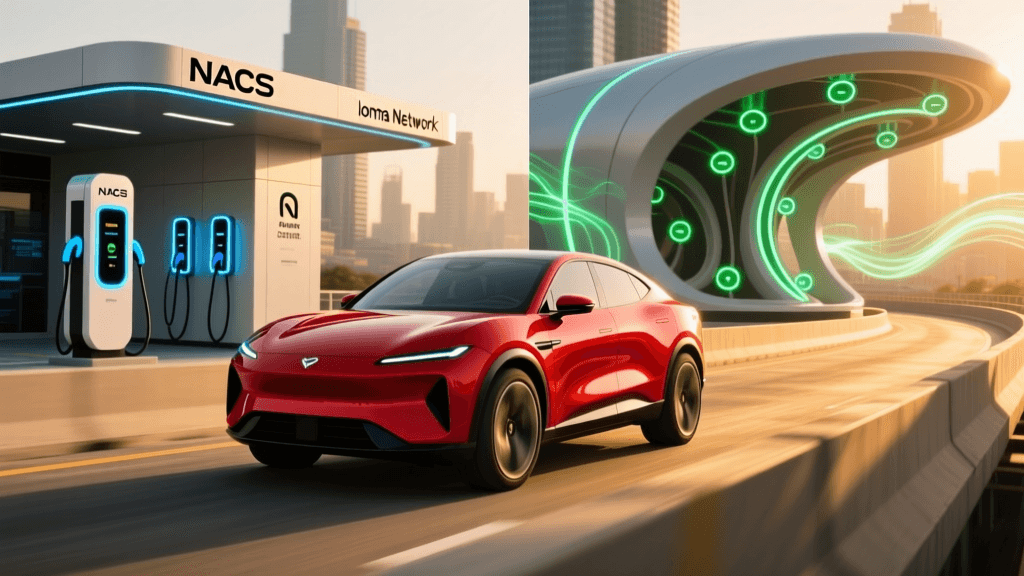
When you purchase a modern electric vehicle, you are no longer just buying a car; you are buying into an entire charging ecosystem. The latest battleground in the EV industry is not just about battery chemistry or 0-60 mph times—it is about the infrastructure partnerships forged by legacy automakers. Today, we are putting the two most significant ecosystem "products" head-to-head: the sprawling NACS Supercharger Alliance (spearheaded by Tesla, Ford, GM, Rivian, and others) versus the brand-new Ionna Joint Venture Network (a massive coalition of BMW, GM, Honda, Hyundai, Kia, Mercedes-Benz, and Stellantis).
As an EV buyer, choosing between a vehicle aligned with the Supercharger network or one leaning into the upcoming Ionna infrastructure is a critical decision. In this head-to-head showdown, we will break down the technical specifications, rollout timelines, user experience, and actionable advice for navigating this transitional era of EV charging.
Contender 1: The NACS Supercharger Alliance
The North American Charging Standard (NACS) was originally Tesla’s proprietary connector, but it has rapidly become the de facto industry standard. By adopting NACS, automakers like Ford, General Motors, Rivian, Volvo, and Nissan are effectively outsourcing their public fast-charging needs to Tesla’s highly mature Supercharger network. According to the Department of Energy's Electric Vehicles portal, the rapid consolidation around a single standard is crucial for long-term infrastructure stability.
Technical Specs and Hardware
The NACS connector is a marvel of minimalist engineering. Weighing in at roughly 8.5 pounds, the NACS cable is significantly lighter and more manageable than the 15-plus-pound liquid-cooled CCS cables currently in use. The Supercharger V4 architecture, currently being deployed, separates the charging cabinet from the dispenser pedestal. This allows for much longer cable reaches, solving the perennial issue of short cables that force Rivian R1T or Ford F-150 Lightning owners to park awkwardly across multiple stalls.
For current CCS-equipped vehicles from Alliance partners, Tesla has deployed the "Magic Dock" at select Superchargers. This built-in mechanical adapter locks onto the vehicle's CCS port, allowing non-Tesla EVs to charge seamlessly. However, native NACS ports will begin appearing on Ford and GM vehicles starting in the 2025 model year.
Network Footprint and Pricing
The Supercharger network boasts over 50,000 fast chargers globally, with a massive concentration in North America. Pricing is generally dynamic but averages between $0.30 and $0.50 per kWh, depending on time-of-use and local utility rates. The primary advantage here is sheer density and historical uptime, which consistently hovers above 95%.
Contender 2: The Ionna Joint Venture Network
Recognizing the risk of ceding total control of the charging experience to a rival, seven automotive giants—BMW, GM, Honda, Hyundai, Kia, Mercedes-Benz, and Stellantis—formed a joint venture in 2023, officially named Ionna in early 2024. This network is designed from the ground up to be a premium, highly reliable "product" that addresses the most common consumer complaints about public charging.
Technical Specs and Hardware
Ionna is not just deploying chargers; they are building destinations. Every Ionna site will feature a minimum of four high-power dispensers capable of delivering 350kW+ of continuous power, catering to the new wave of 800V battery architectures found in the Hyundai Ioniq 5 and Kia EV6. Crucially, Ionna stations will feature both CCS and NACS connectors natively, ensuring no driver is left behind.
The physical site design is where Ionna truly differentiates itself. Every location will feature weather-protective canopies, bright LED lighting, security cameras, and dedicated pull-through lanes for EVs towing trailers. Furthermore, Ionna has mandated that sites must be located near restrooms, food options, and Wi-Fi, directly addressing the barren, poorly lit parking lots that plague many existing third-party networks.
Network Footprint and Pricing
Ionna has committed to deploying at least 30,000 high-power chargers across North America by 2030. The first stations are slated to open in late 2024, with a heavy initial focus on the Southeast and Midwest regions where charging infrastructure is currently sparse. While exact pricing is yet to be finalized, Ionna has promised competitive rates and seamless "Plug & Charge" integration, where the vehicle automatically authenticates and bills the owner’s OEM account without the need for a smartphone app.
Head-to-Head Comparison Chart
| Feature | NACS Supercharger Alliance | Ionna Joint Venture |
|---|---|---|
| Founding Auto Partners | Tesla, Ford, GM, Rivian, Volvo, Nissan, Honda, BMW | BMW, GM, Honda, Hyundai, Kia, Mercedes, Stellantis |
| Plug Standard | NACS (CCS via Magic Dock adapter) | Native NACS and Native CCS |
| Target Station Count (2030) | 100,000+ (Continued expansion) | 30,000 High-Power Chargers |
| Average Stalls per Site | 8 to 12 stalls | Minimum 4 stalls (High-Power only) |
| Amenity Standard | Varies (often standalone parking lots) | Canopies, restrooms, Wi-Fi, lighting |
| Grid Buffering | Frequent use of Tesla Megapacks | Partnering with local utilities for MW upgrades |
Actionable Advice: Navigating the Transition Years
Choosing between these two ecosystem "products" requires strategic planning, especially as we navigate the messy transition period between 2024 and 2026. Here is our practical, actionable advice for EV buyers and current owners.
1. The Adapter Dilemma: Buy OEM or Risk Melting
If you purchase a 2024 Ford Mustang Mach-E or a Cadillac Lyriq, you will need a NACS-to-CCS adapter to access the Supercharger Alliance. Do not buy cheap, third-party adapters from unknown online marketplaces. High-speed DC fast charging pushes hundreds of amps through the pins. Substandard adapters lack the proper thermal sensors to communicate with the vehicle's Battery Management System (BMS), leading to melted plastic or damaged vehicle charge ports. Only use the OEM adapter provided by your automaker or the official Tesla CCS adapter. Expect to pay around $200 to $250 for a safe, certified unit.
2. Timing Your Purchase for Native Ports
If your budget allows, delay your vehicle purchase until the 2025 model year. Vehicles rolling off the assembly line in late 2024 and 2025 will feature native NACS ports. This eliminates the need for a bulky adapter, reduces points of failure, and ensures a seamless Plug & Charge experience via the ISO 15118 protocol. If you buy a vehicle with a native NACS port, you also gain access to the growing number of third-party NACS chargers from companies like Electrify America and EVgo, giving you the best of both worlds.
3. Route Planning and the 50-Mile Rule
When planning road trips, leverage the data from the Alternative Fuels Data Center. The federal government's EV infrastructure mandate emphasizes that chargers must be spaced no more than 50 miles apart along designated Alternative Fuel Corridors. While the Supercharger network already meets this requirement on most major interstates, Ionna is specifically targeting the "charging deserts" in the Southeast and rural Midwest. If you live in or frequently travel through states like Alabama, Mississippi, or the Dakotas, an automaker aligned with Ionna’s targeted rollout map may offer a more reliable long-term experience in your specific region.
4. Understand the 800V vs. 400V Bottleneck
Not all vehicles can utilize the maximum speeds these networks offer. The Ionna network is deploying 350kW+ dispensers. To actually pull 350kW, your vehicle must have an 800-volt battery architecture (like the Porsche Taycan, Hyundai Ioniq 5, or Kia EV9). If you drive a 400V vehicle (like the Ford F-150 Lightning or older Chevy Bolt), your charging speed will be physically capped by the vehicle's onboard hardware, usually peaking around 150kW to 170kW, regardless of whether you are plugged into a V4 Supercharger or an Ionna dispenser. Match your vehicle's voltage architecture to the network's hardware capabilities to avoid paying premium prices for speeds you cannot utilize.
The Verdict
The NACS Supercharger Alliance wins on current footprint, proven reliability, and immediate cross-country viability. It is the undisputed champion for drivers who need to travel coast-to-coast today without range anxiety. However, the Ionna Joint Venture is the superior "product" for the future of premium charging. By prioritizing canopies, amenities, native dual-standard connectors, and targeting underserved regions, Ionna is building the infrastructure that legacy automakers wish Tesla had built a decade ago. For the strategic EV buyer, the ideal move is to purchase a vehicle with a native NACS port, granting immediate access to the Supercharger Alliance today, while keeping an eye on the Ionna map as their premium, amenity-rich stations begin to light up the map in 2025 and beyond.