The Bottleneck of Class 8 Electrification
The transition to zero-emission freight is no longer a question of if, but when. However, the electrification of Class 8 heavy-duty trucks faces a massive physical and regulatory bottleneck: charging time. Unlike passenger electric vehicles, which typically feature battery packs ranging from 60 to 100 kWh, modern electric semi-trucks require massive battery capacities to achieve viable operational ranges. According to the U.S. Department of Energy's Alternative Fuels Data Center, Class 8 electric trucks frequently utilize battery packs ranging from 500 kWh to over 1,000 kWh to haul heavy payloads over regional routes.
When you plug a 500 kWh battery into a standard 350 kW Combined Charging System (CCS) fast charger, the math is unforgiving. Even assuming a perfect charging curve with zero tapering, it would take well over an hour and a half to reach an 80% state of charge. In reality, thermal throttling and charging curve tapering push that time closer to two and a half hours. This directly conflicts with the Federal Motor Carrier Safety Administration (FMCSA) Hours of Service (HOS) regulations, which mandate a 30-minute break after eight hours of driving. For electric freight to achieve parity with diesel, the industry needs a charging solution that can replenish a massive battery pack during a driver's mandatory rest break. Enter the Megawatt Charging System (MCS).
What is the Megawatt Charging System (MCS)?
The Megawatt Charging System is an ultra-high-power charging standard currently under development and active pilot testing, designed specifically for heavy-duty commercial vehicles, including Class 8 trucks, transit buses, marine vessels, and even electric aircraft. The Charging Interface Initiative (CharIN), the same global association that helped standardize CCS, has spearheaded the MCS Task Force to develop a unified global standard.
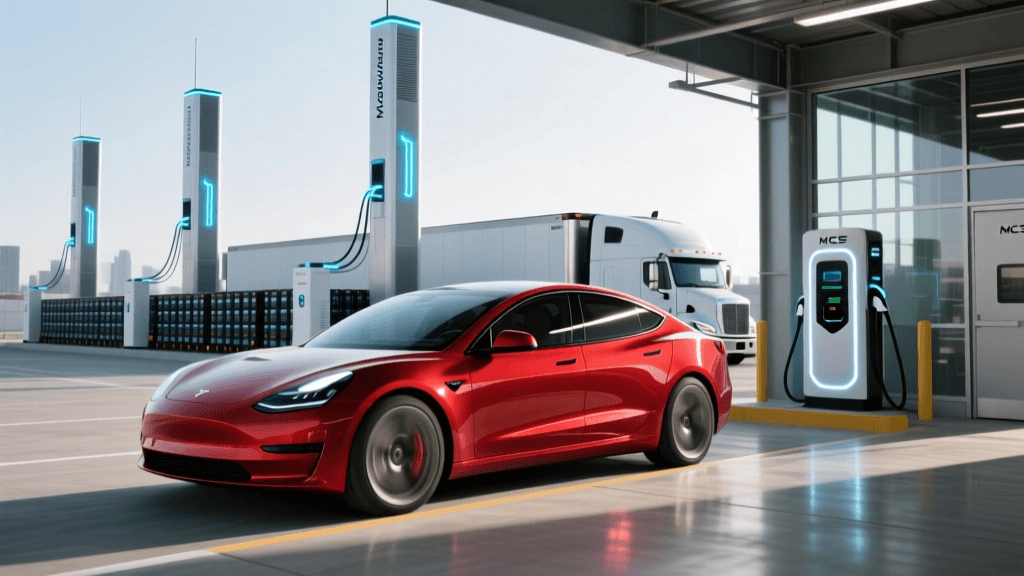
The MCS specification targets a maximum power output of 3.75 Megawatts (3,750 kW). It achieves this by pushing the limits of direct current (DC) electrical engineering, operating at a maximum voltage of 1,250V DC and a continuous current of 3,000 Amps. At 3.75 MW, an electric truck with a 500 kWh battery pack could theoretically charge from 10% to 80% in roughly 15 to 20 minutes, perfectly aligning with driver HOS rest mandates and minimizing fleet downtime.
Technical Deep Dive: Connector Design and Thermal Management
Delivering 3.75 MW of power is not as simple as scaling up existing CCS cables. The physical properties of electricity dictate that pushing 3,000 Amps through a standard copper cable would require a conductor so thick and heavy that a human operator could not physically lift or maneuver it. Furthermore, the resistive heat generated at that amperage would melt standard insulation.
To solve this, the MCS connector and cable assembly utilize advanced active liquid cooling. Coolant (typically a dielectric fluid or a propylene glycol mixture) is pumped directly through the cable and into the connector pins during the charging session. This thermal management system allows the copper conductors to remain relatively thin and flexible, keeping the overall cable weight manageable for truck drivers while safely dissipating the immense heat generated by high-current transfer.
The physical MCS connector features a distinct triangular/pentagonal geometry. This deliberate design choice ensures that an MCS plug cannot be accidentally mated with a standard CCS or CHAdeMO inlet, preventing catastrophic electrical faults. The pinout includes dedicated communication lines for advanced powerline communication (PLC) and thermal sensors that constantly monitor the temperature of the vehicle's inlet and the charger's connector, instantly throttling power if thermal thresholds are breached.
CCS vs. MCS: A Technical Comparison
| Feature | CCS (Combo 2) | Megawatt Charging System (MCS) |
|---|---|---|
| Max Power Output | 350 kW (up to 500 kW theoretical) | 3.75 MW (3,750 kW) |
| Max Voltage | 1,000V DC | 1,250V DC |
| Max Current | 500 Amps | 3,000 Amps |
| Cable Cooling | Passive or Active Liquid | Active Liquid Cooling (Mandatory) |
| Target Vehicles | Passenger EVs, Light Commercial | Class 8 Trucks, Buses, Marine, Aviation |
| Estimated 500kWh Charge Time (10-80%) | ~90 - 120 Minutes | ~15 - 20 Minutes |
Power Electronics and Grid Infrastructure
On the charger side, converting alternating current (AC) from the grid to 1,250V DC requires massive, highly efficient power electronics. Modern MCS chargers rely on Silicon Carbide (SiC) MOSFET inverters. SiC technology offers significantly higher thermal conductivity and lower switching losses compared to traditional silicon IGBTs, which is critical when operating at the megawatt scale. A single MCS dispenser often requires multiple 500 kW power cabinets networked together to pool and distribute the required 3+ MW of DC power dynamically.
However, the technology inside the charger is only half the battle. The grid infrastructure required to support MCS is staggering. A typical highway truck stop featuring ten MCS dispensers operating simultaneously would require a grid interconnection capable of delivering 30 to 40 Megawatts of power. To put this in perspective, 40 MW is enough electricity to power a small city or a massive industrial manufacturing plant. Research from the DOE Vehicle Technologies Office highlights that utility grid upgrades and transmission line expansions represent the most significant hurdle and longest lead time for heavy-duty EV infrastructure deployment.
Actionable Advice for Fleet Operators and Depot Planners
For fleet managers and depot developers looking to future-proof their operations for the MCS era, waiting for the standard to be fully ratified is not an option. Infrastructure development takes years. Here is actionable advice for preparing your facilities:
1. Initiate Utility Interconnection Talks Immediately
Do not wait until you order your electric trucks to speak with your local utility provider. Securing a new high-capacity feeder line or upgrading a local substation to support 10+ MW of depot charging can take anywhere from 18 to 36 months. Submit your load forecasting and site plans to your utility provider during the earliest phases of your fleet transition strategy. Ask about utility "Make-Ready" programs, which can subsidize the cost of bringing the necessary medium-voltage lines to your property line.
2. Design Depots with Pull-Through Lanes
Class 8 trucks with 53-foot trailers cannot easily back into standard perpendicular charging stalls without risking damage to the chargers or requiring extensive maneuvering space. When designing your depot layout or selecting public charging real estate, prioritize "pull-through" lane configurations. This allows a tractor-trailer to drive straight in, connect the heavy liquid-cooled MCS cable, and drive straight out, mirroring the workflow of a traditional diesel fueling island.
3. Integrate Battery Energy Storage Systems (BESS)
Drawing 3.75 MW from the grid instantly will trigger massive utility demand charges, which are based on your highest 15-minute power spike during a billing cycle. To mitigate this, integrate commercial Battery Energy Storage Systems (BESS) at your depot. A BESS can slowly trickle-charge from the grid overnight when electricity rates are lowest and demand is minimal, then discharge rapidly into the MCS chargers during peak daytime truck operations. This practice, known as peak shaving, can reduce your utility demand charges by tens of thousands of dollars annually while alleviating strain on the local grid.
The Road Ahead: Pilot Programs and Standardization
The MCS standard is rapidly moving from paper to pavement. Major pilot programs, such as the WattEV project in California and the Portland Electric Highway initiative, are already installing multi-megawatt charging plazas along critical freight corridors. Furthermore, OEMs like Tesla (with its Megacharger network for the Semi) and legacy truck manufacturers are aligning their vehicle architectures to support the 1,250V DC requirements of the upcoming CharIN MCS standard.
While the capital expenditure for MCS infrastructure is immense—often exceeding $1 million per dispenser when factoring in utility upgrades and civil work—the operational math favors electrification. Lower maintenance costs, elimination of diesel fuel volatility, and compliance with tightening emissions regulations in states like California (via the Advanced Clean Fleets rule) make MCS an unavoidable and essential pillar of the future supply chain. Fleet operators who secure grid capacity and optimize their depot layouts today will hold a distinct competitive advantage in the zero-emission freight economy of tomorrow.