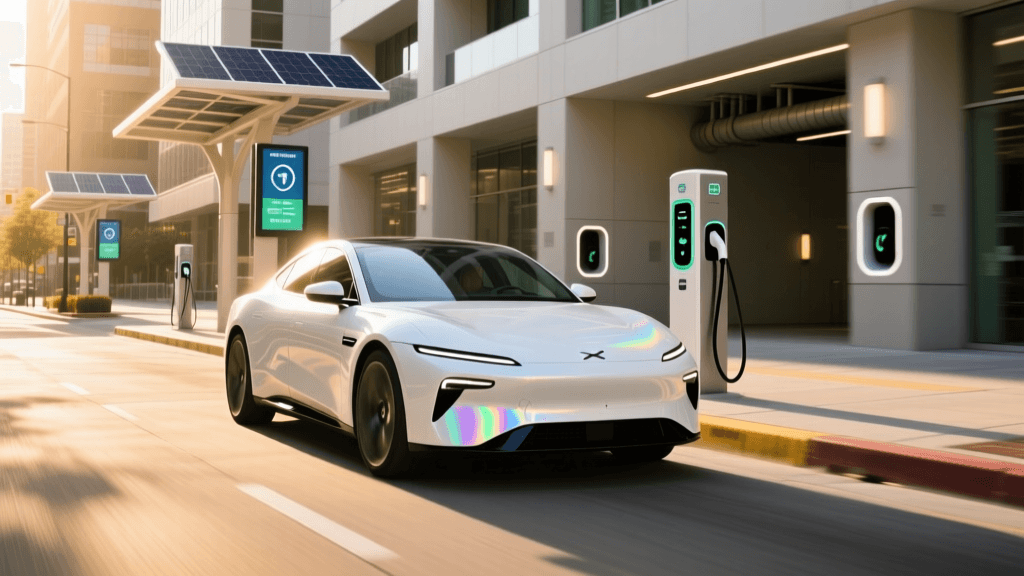
The Hidden Bottleneck: When EV Charging Meets Grid Limits
As electric vehicle adoption accelerates, Charge Point Operators (CPOs), fleet managers, and commercial real estate developers are running into a massive, often invisible roadblock: local distribution grid constraints. You might have the capital to deploy twenty 350 kW DC fast chargers or a depot of 100 Level 2 chargers, but if your local utility feeder lacks the hosting capacity, your project will stall. Troubleshooting these grid bottlenecks requires moving beyond basic electrical load calculations and diving deep into EV charging demand forecasting and comprehensive grid impact studies.
When transformers overheat or utility demand charges skyrocket, the root cause is rarely the EV hardware itself. Instead, it is a failure in forecasting coincident peak loads and managing the localized grid impact. In this guide, we will troubleshoot the most common grid strain issues and provide actionable, technology-driven solutions to keep your charging infrastructure online and profitable.
Step 1: Conducting a Localized Grid Impact Study
Before troubleshooting a grid overload, you must establish the baseline hosting capacity of your local grid node. A grid impact study evaluates how the addition of EV supply equipment (EVSE) will affect local voltage regulation, thermal limits of pad-mounted transformers, and harmonic distortion on the feeder.
For example, adding a 2 MW fleet charging depot to a standard 12.47 kV distribution feeder can cause voltage sags that trip protective relays or degrade power quality for neighboring businesses. To troubleshoot this pre-deployment, electrical engineers use simulation software like CYME or Synergi to model the feeder. According to the U.S. Department of Energy's EV charging infrastructure guidelines, early collaboration with utilities to assess transformer kVA ratings and feeder capacity is critical to avoiding million-dollar substation upgrade mandates.
Actionable Fix: Request a hosting capacity map from your local utility. If your site is on a constrained feeder, pivot your site design to include on-site generation or Battery Energy Storage Systems (BESS) rather than waiting 18 to 24 months for utility infrastructure upgrades.
Step 2: Troubleshooting Inaccurate Demand Forecasts
The most common cause of unexpected demand charges and transformer blowouts is relying on static, worst-case-scenario load profiles. If a fleet manager assumes all 50 electric delivery vans will plug in at 6:00 PM and draw maximum amperage simultaneously, the forecasted load will trigger massive utility infrastructure upgrade requirements and inflated peak demand charges.
To solve this, modern CPOs utilize probabilistic forecasting tools. The National Renewable Energy Laboratory's EVI-Pro tool is an industry-standard resource that simulates real-world driving patterns, dwell times, and charging behaviors. By inputting specific telematics data, operators can troubleshoot flawed assumptions and prove to utilities that the actual coincident peak demand is significantly lower than the sum of the chargers' nameplate ratings.
Comparison: Static vs. AI-Driven Forecasting Models
| Feature | Static Load Profiles (Legacy) | AI-Driven Probabilistic Forecasting |
|---|---|---|
| Assumption Basis | All chargers operate at 100% capacity simultaneously. | Uses telematics, dwell time, and state-of-charge (SoC) data. |
| Grid Impact Study Result | Overestimates load; triggers unnecessary utility upgrades. | Accurately sizes transformers; optimizes capital expenditure. |
| Demand Charge Mitigation | Poor; high risk of peak TOU penalties. | Excellent; enables predictive load shifting. |
| Tools Used | Basic spreadsheet NEC Article 220 calculations. | NREL EVI-Pro, AutoGrid, Tesla Autobidder. |
Step 3: Implementing Dynamic Load Management (DLM)
When a grid impact study reveals that the local 500 kVA or 1000 kVA pad-mounted transformer cannot handle the projected coincident peak, the immediate troubleshooting fix is Dynamic Load Management (DLM). DLM software communicates with OCPP-compliant chargers to throttle power delivery in real-time based on the transformer’s current thermal load.
Troubleshooting Setup for DLM:
- Hardware Right-Sizing: Deploy power cabinets like the Kempower S-Series or ABB Terra 360, which natively support dynamic power sharing across multiple dispensers from a single rectifier cabinet.
- Telemetry Integration: Install a smart meter or current transformer (CT) clamp on the site's main switchgear to monitor real-time amperage and feed this data back to the CPMS.
- Protocol Verification: Ensure your Charge Point Management System (CPMS) utilizes OCPP 1.6J or 2.0.1 Smart Charging profiles. This allows the system to automatically shed EV load when the building's HVAC or heavy machinery spikes, keeping the total site load below the utility's peak demand threshold.
Step 4: Co-Locating Battery Energy Storage Systems (BESS)
If DLM throttling results in unacceptable charge times for your end-users or fleet vehicles, the next troubleshooting tier is integrating a Battery Energy Storage System (BESS). A BESS acts as a buffer, trickle-charging from the grid during off-peak hours (when hosting capacity is high and electricity is cheap) and discharging at high rates during peak EV demand.
For instance, if your grid impact study limits your site to a 1 MW utility interconnection, but your DC fast charging plaza requires 3 MW during peak travel hours, a 2 MW / 4 MWh BESS can bridge the gap. This completely bypasses the need for a multi-year utility feeder upgrade and turns a grid constraint into an opportunity for energy arbitrage.
Real-World Troubleshooting: Fleet Depot Transformer Overloads
Consider a mid-mile logistics fleet transitioning to Class 8 electric trucks. The fleet operator installed twenty 150 kW DC chargers on a single 2000 kVA transformer. Within two weeks, the transformer's dissolved gas analysis (DGA) showed signs of severe thermal degradation due to prolonged coincident peak charging between 4:00 PM and 8:00 PM.
The Diagnosis: The operator used a static forecasting model, assuming trucks would return with 20% SoC and charge linearly. In reality, regenerative braking and varied route topographies meant trucks returned with 45% SoC, but the chargers were still manually commanded to pull maximum current to 'top off' the batteries unnecessarily.
The Solution: The operator integrated an AI-driven CPMS that utilized ISO 15118 Plug & Charge data. The software read the exact SoC and next-day route requirements of each truck, throttling the charge rate to just 40 kW per vehicle and spreading the load evenly over a 10-hour night shift. This eliminated the thermal strain on the transformer and reduced peak demand charges by 62% in the first billing cycle.
Future-Proofing Your Charging Infrastructure
Troubleshooting EV charging grid impacts is no longer just an electrical engineering problem; it is a data science challenge. By leveraging advanced grid impact studies, utilizing probabilistic forecasting tools like NREL's EVI-Pro, and deploying OCPP-enabled Dynamic Load Management, operators can solve local grid constraints without waiting years for utility upgrades. As the grid becomes more decentralized, the ability to forecast, manage, and store energy on-site will separate profitable charging networks from those stalled by infrastructure bottlenecks.