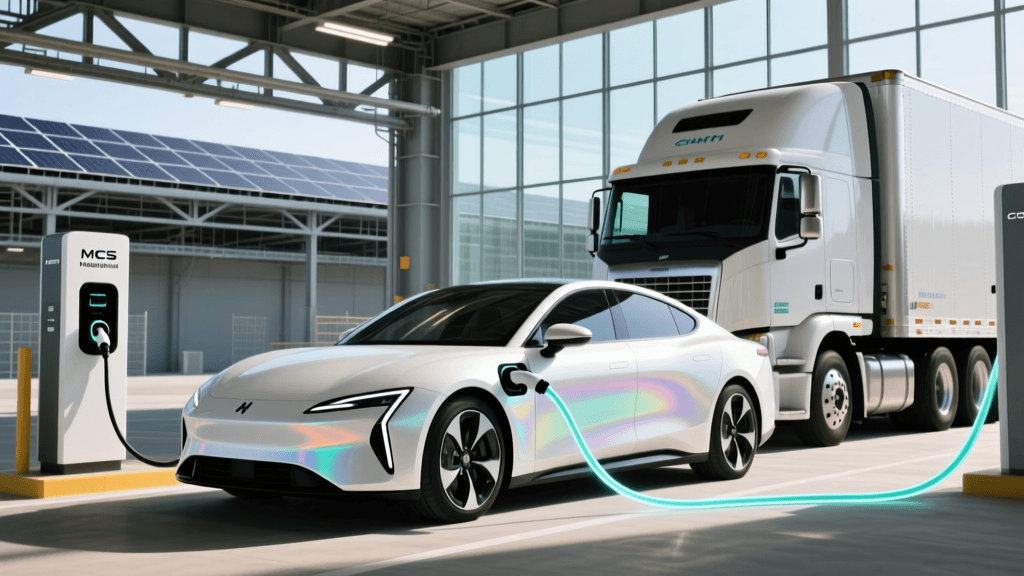
The electrification of heavy-duty commercial fleets represents one of the most complex engineering challenges in the modern automotive industry. While passenger electric vehicles (EVs) have largely settled on the Combined Charging System (CCS) or the North American Charging Standard (NACS) for DC fast charging, these standards fall drastically short for Class 8 semi-trucks and heavy commercial vehicles. A typical long-haul electric truck requires a battery pack ranging from 500 kWh to over 1 MWh. Charging a 1 MWh battery at a standard 350 kW CCS dispenser would take nearly three hours—an unacceptable downtime for commercial freight operations where drivers operate on strict, federally mandated hours-of-service schedules.
To solve this bottleneck, the industry has developed the Megawatt Charging System (MCS). This technology deep dive explores the technical architecture, infrastructure requirements, and deployment timelines of MCS, providing fleet operators and industry stakeholders with the actionable insights needed to prepare for the high-power charging revolution.
What is the Megawatt Charging System (MCS)?
The Megawatt Charging System is a next-generation DC fast-charging standard specifically engineered for heavy-duty vehicles (HDVs), including Class 8 semi-trucks, maritime vessels, and even electric aircraft. Spearheaded by CharIN, the global association driving charging interoperability, the MCS task force has designed a standard capable of delivering upwards of 1 Megawatt (1,000 kW) of continuous power, with a theoretical ceiling of 3.75 MW.
The primary goal of MCS is to align charging times with mandatory driver rest breaks. Under current federal regulations, commercial truck drivers must take a 30-minute break after eight hours of driving. By delivering power at 1 MW to 1.2 MW, an MCS dispenser can add roughly 300 to 400 miles of range to a heavy-duty truck in that exact 30-minute window, effectively neutralizing the operational disadvantage of electric freight.
Technical Specifications and Connector Design
Pushing past the 1-megawatt threshold requires overcoming severe thermal and electrical limitations. The MCS standard operates at a maximum voltage of 1,250V DC and a continuous current of up to 3,000 amps. To put this in perspective, a standard residential home draws roughly 24 kW at peak capacity; a single MCS charger pulls the equivalent of a small neighborhood's power draw.
To handle this immense energy transfer without melting the copper cabling, MCS relies on advanced liquid-cooled charging cables. Coolant is pumped directly through the cable's core, extracting heat generated by electrical resistance. Furthermore, the MCS connector itself is entirely distinct from CCS or NACS. It features a rectangular, shielded design with a specialized latching mechanism to ensure secure, high-voltage connections in harsh, high-vibration trucking environments. The connector also includes dedicated pins for communication and automated thermal monitoring, ensuring the charger and the truck's Battery Management System (BMS) remain in constant sync regarding thermal thresholds.
MCS vs. CCS: A Comparative Breakdown
Understanding the leap from light-duty to heavy-duty charging standards is critical for fleet depot planning. Below is a technical comparison between the current heavy-duty CCS standard and the emerging MCS standard.
| Feature | CCS2 (Heavy-Duty Adaptation) | MCS (Megawatt Charging System) |
|---|---|---|
| Target Vehicle Class | Light/Medium Duty, Vans, Box Trucks | Class 8 Semi-Trucks, Mining, Maritime |
| Maximum Voltage | 1,000V DC | 1,250V DC |
| Maximum Current | 500A (Liquid Cooled) | 3,000A (Liquid Cooled) |
| Peak Power Output | ~400 kW (Practical limit for HDV) | 1.2 MW to 3.75 MW |
| Charging Time (500 kWh Battery 10-80%) | ~75 - 90 Minutes | ~25 - 35 Minutes |
| Connector Form Factor | Circular, bulky, heavy | Rectangular, shielded, ergonomic |
Infrastructure Hurdles: Grid Capacity and Microgrids
While the charger hardware and vehicle architecture are rapidly advancing, the most significant barrier to MCS deployment is the electrical grid. According to data tracked by the Alternative Fuels Data Center, deploying heavy-duty electric fleets requires massive localized power upgrades. A single public truck stop featuring ten 1.2 MW MCS dispensers requires a minimum of 12 MW to 15 MW of grid capacity (accounting for overhead and simultaneous utilization). For context, 15 MW is enough power to supply roughly 10,000 residential homes.
Most highway rest stops and rural trucking corridors simply do not have medium-voltage or high-voltage transmission lines nearby. Upgrading these sites requires utility companies to install new substations, lay miles of heavy-gauge transmission wire, and upgrade local transformers. These utility-side infrastructure projects routinely carry lead times of 18 to 36 months, creating a major bottleneck for fleet operators waiting to deploy their zero-emission vehicles.
The Role of Battery Energy Storage Systems (BESS)
To bypass multi-year utility upgrade timelines, forward-thinking charging networks are integrating Battery Energy Storage Systems (BESS) into their MCS stations. A BESS acts as a massive buffer. It slowly trickles energy from a standard, lower-capacity grid connection over 24 hours, storing it in stationary lithium-iron-phosphate (LFP) battery banks. When an electric truck plugs in, the BESS discharges its stored energy at 1.2 MW directly into the truck.
This 'peak shaving' technique not only accelerates site deployment but also shields fleet operators from crippling utility 'demand charges'—fees assessed by utilities based on the highest 15-minute spike in power usage during a billing cycle.
Industry Rollout and Pilot Projects
The MCS ecosystem is moving from the drafting board to physical deployment. Several high-profile pilot projects are currently validating the technology in real-world freight corridors:
- WattEV: Backed by the California Energy Commission, WattEV is developing a network of heavy-duty charging plazas along major freight corridors in California. Their Bakersfield and Port of Long Beach sites are designed with MCS-ready infrastructure, combining solar canopies, BESS, and megawatt dispensers to serve drayage and long-haul trucks.
- Milence: A joint venture between TRATON GROUP (Freightliner, MAN, Scania) and Volvo Group, Milence is building out a massive high-power charging network across Europe. They are installing CCS-compatible high-power chargers today, with site layouts and grid interconnections specifically engineered to swap in MCS connectors as Class 8 electric trucks hit European highways.
- Hardware Manufacturers: Companies like ABB, Tritium, and ChargePoint are actively prototyping and testing MCS dispensers, focusing heavily on the reliability of the liquid-cooling pumps and the ruggedization of the connector holsters for harsh trucking environments.
Actionable Advice for Fleet Operators
For fleet managers and logistics directors planning the transition to heavy-duty EVs, waiting for MCS to become ubiquitous is not a viable strategy. Depot planning must begin years before the first electric truck is ordered.
- Initiate Utility Engagement Immediately: Contact your local utility provider's commercial EV team at least 24 months before your targeted fleet deployment date. Request a 'service capacity study' for your depot to understand if your current transformers can handle even Level 2 overnight charging, let alone future depot-based MCS hardware.
- Design for 'Make-Ready' Expansion: When trenching and pouring concrete for initial 150 kW or 350 kW depot chargers, lay empty conduit and oversized switchgear capable of handling future 1 MW+ MCS upgrades. The cost of asphalt cutting and re-trenching later will far exceed the upfront cost of oversized conduit.
- Evaluate BESS for Demand Charge Mitigation: If your utility provider enforces strict peak demand charges, model the ROI of installing a stationary BESS. The capital expenditure of the battery system can often be offset by the millions saved in avoided demand charges over a 10-year operational lifecycle.
- Monitor CharIN MCS Task Force Updates: The MCS standard is still undergoing final standardization and field testing. Ensure your charging hardware vendors are contractually obligated to provide MCS retrofit kits or software updates once the final connector pinout and communication protocols (ISO 15118-20 extensions) are officially ratified.
The Megawatt Charging System is not just an iterative upgrade; it is a fundamental reimagining of electrical distribution tailored for commercial freight. By understanding the technical realities of 1,250V architectures, liquid-cooled thermal management, and grid-scale BESS integration, fleet operators can future-proof their infrastructure and ensure their heavy-duty electric assets remain on the road, not stranded in the charging yard.