If you've just taken delivery of a new Tesla Model 3 Highland or are optimizing your current setup, two accessories dominate your daily experience: the built-in Tesla Model 3 wireless phone charger in the center console, and the home Level 2 EV charger you install in your garage. One tops up your phone at 15W; the other replenishes a 60–82 kWh traction battery at up to 11.5 kW. Understanding both — and the broader EV charging ecosystem — is the difference between effortless ownership and daily frustration.
This guide covers everything a Model 3 owner (or prospective buyer) needs to know about charging at home, in public, and on the road — with exact numbers, real costs, and equipment picks for 2026.
The Tesla Model 3 Wireless Phone Charger: What You Get
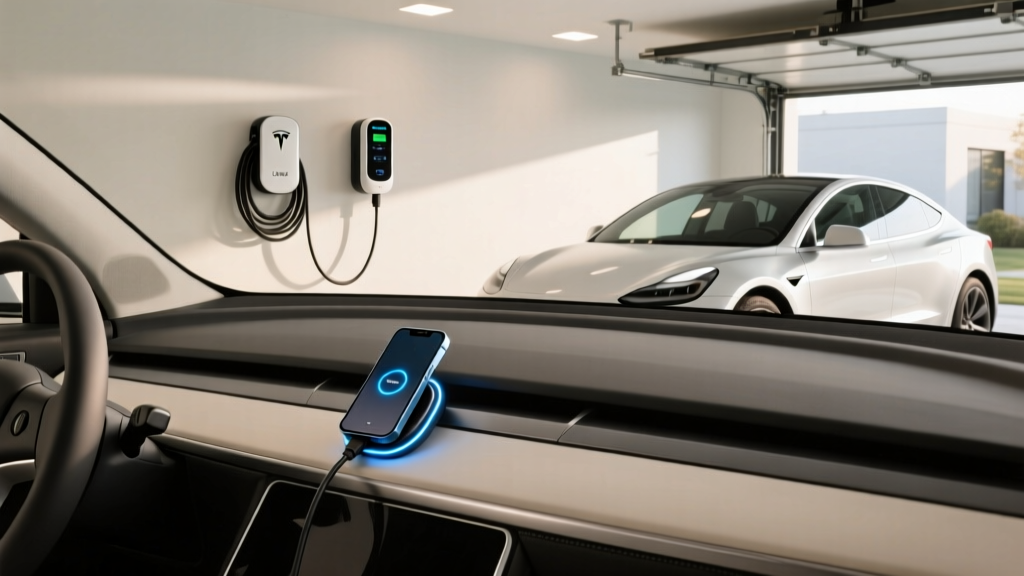
The Tesla Model 3 (2024–2026 Highland refresh) includes a Qi-compatible wireless phone charging pad integrated into the front center console shelf. Here's what to expect:
- Power output: Up to 15W (Qi standard), sufficient for iPhone 15/16 series and most modern Android flagships
- Active cooling: Ventilated pad prevents thermal throttling during navigation-heavy drives
- Placement: Angled shelf keeps the phone visible and prevents sliding during cornering
- Limitation: Thick cases (especially those with metal plates or MagSafe rings not aligned to Qi coils) can reduce charging speed or prevent charging entirely
While 15W won't rival a 30W USB-C cable for speed, it's ideal for maintaining charge during commutes. For faster charging, the Model 3's USB-C ports (up to 27W on the Highland) in the center console and rear cabin are your better bet on long road trips.
Charging Levels Explained: Speeds in kW and Miles Per Hour
The single most important distinction in EV ownership is between kW (kilowatts) — the rate of power delivery — and kWh (kilowatt-hours) — the total energy stored in your battery. Think of kW as how fast water flows from a hose, and kWh as the size of the bucket. A Tesla Model 3 Long Range has a ~75 kWh usable battery; a Rear-Wheel Drive has ~60 kWh usable.
| Level | Voltage | Max Power (kW) | Miles of Range Added Per Hour | Typical Use Case |
|---|---|---|---|---|
| Level 1 | 120V AC | 1.4–1.9 kW | 3–5 mi/hr | Emergency / overnight trickle |
| Level 2 | 240V AC | 7.2–11.5 kW | 25–44 mi/hr | Home daily charging |
| DC Fast (V3 Supercharger) | 400V DC | Up to 250 kW | ~1,000 mi/hr (peak) | Road trips, rapid top-ups |
| DC Fast (V4 Supercharger) | 800V DC | Up to 350 kW | ~1,200+ mi/hr (peak) | Newer Supercharger stations |
Home Level 2 Charger Installation: Requirements and Costs
Installing a Level 2 home charger is the single best upgrade a Model 3 owner can make. Here's what the electrical work actually involves:
Electrical Requirements
- Circuit: Dedicated 240V circuit — typically 60A breaker for a 48A continuous-load charger (NEC requires 125% headroom for continuous loads)
- Wire gauge: 6 AWG copper (or 4 AWG aluminum) for a 60A circuit
- Outlet vs. hardwired: NEMA 14-50 outlet offers portability; hardwired Wall Connector allows up to 48A (11.5 kW) without an outlet derating concern
- Panel capacity: Your main panel must have enough spare amperage. A 200A panel with existing heavy loads (electric range, dryer, HVAC) may require a panel upgrade to 300–400A or a load-management device
Installation Cost Breakdown
| Item | Low End | High End | Notes |
|---|---|---|---|
| EV charger equipment (Level 2) | $400 | $700 | Tesla Wall Connector, ChargePoint, Emporia |
| Electrician labor | $500 | $2,000 | Depends on run length, conduit, drywall work |
| Permit & inspection | $50 | $300 | Varies by municipality |
| Panel upgrade (if needed) | $1,500 | $4,000 | 200A→400A upgrade; older homes most affected |
| Total (no panel upgrade) | $950 | $3,000 | Most homes with adequate panel capacity |
| Total (with panel upgrade) | $2,450 | $7,000 | Homes with 100–150A panels or heavy loads |
Federal incentive: The residential clean energy credit (IRS §25C) covers 30% of EV charger equipment and installation costs, up to $1,000, for equipment placed in service through 2032. This is separate from the §30D vehicle tax credit. Check with a tax professional for eligibility.
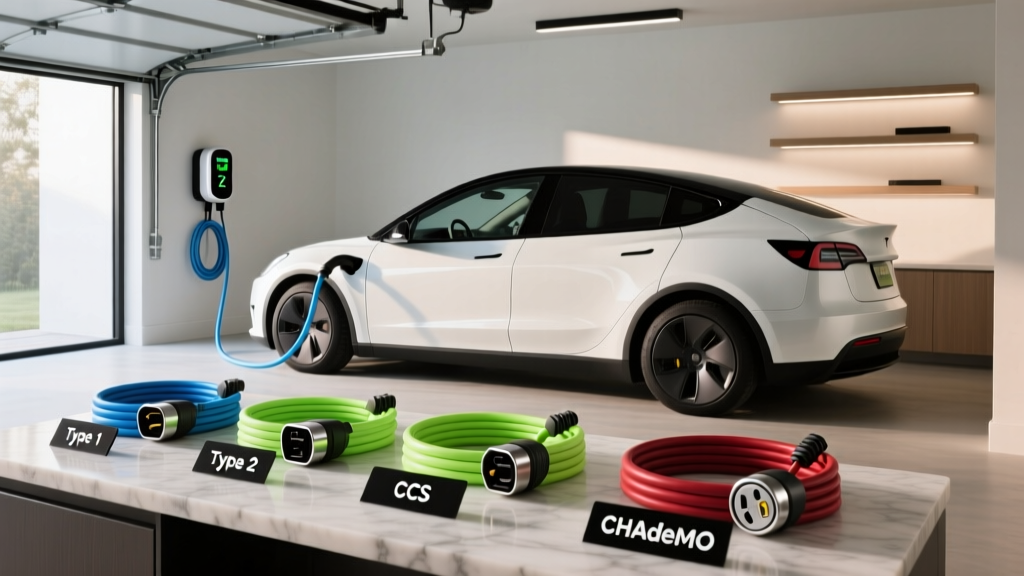
Which Connector Is Compatible with the Tesla Model 3?
Tesla uses the North American Charging Standard (NACS) connector — a compact, proprietary design now being adopted industry-wide. Here's how the connector landscape looks for a Model 3 owner in 2026:
| Connector | Native to Model 3? | Adapter Needed? | Where You'll Find It |
|---|---|---|---|
| NACS (Tesla) | Yes — native | No | Tesla Superchargers, Tesla Wall Connector, growing third-party networks |
| CCS1 | No | Yes — Tesla CCS adapter (~$175) | Electrify America, EVgo, some ChargePoint stations |
| CHAdeMO | No | Yes — third-party adapter (rare, ~$300+) | Largely legacy; being phased out in North America |
| J1772 (Level 2 public) | No | Yes — included J1772 adapter with Tesla | Public Level 2 stations, workplaces, hotels |
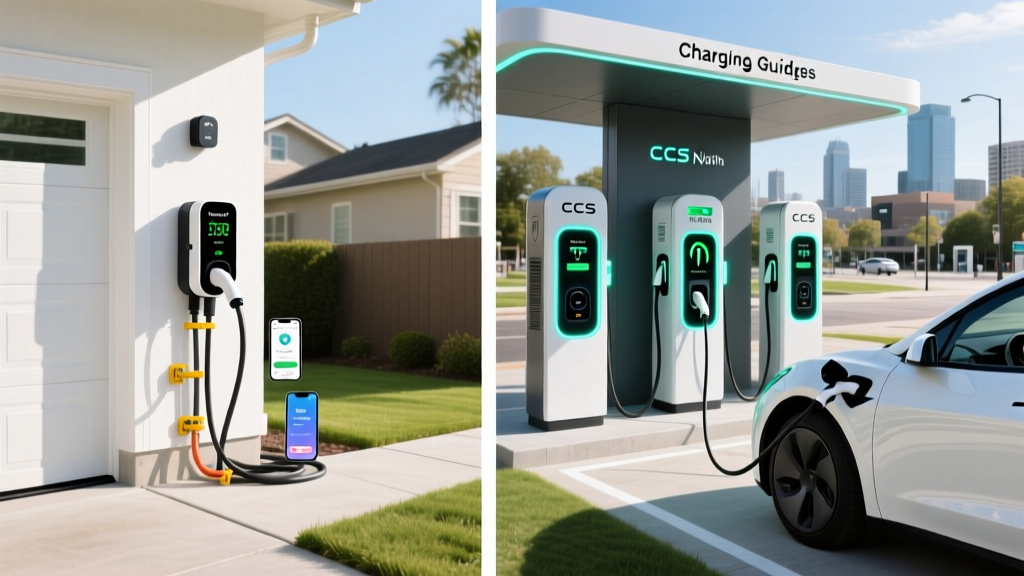
For home charging, the Tesla Wall Connector uses NACS natively — no adapter required. For public DC fast charging, Tesla's Supercharger network (20,000+ stalls in North America as of 2026) is the default. The included CCS adapter in newer deliveries opens up Electrify America and other CCS networks as a backup.
Equipment Recommendations: Best Level 2 Chargers for the Model 3
Tesla Wall Connector (Gen 3)
- Power output: Up to 11.5 kW (48A at 240V)
- Connector: NACS (native Tesla)
- Cable length: 24 feet
- Smart features: Wi-Fi firmware updates, power-sharing between two units, access control
- Price: ~$475
- Best for: Tesla-only households; highest charge rate for Model 3's 11.5 kW onboard charger
Emporia Vue Level 2 EV Charger
- Power output: Up to 11.5 kW (48A)
- Connector: J1772 (Tesla adapter included) or NACS version available
- Cable length: 24 feet
- Smart features: Energy monitoring via Emporia app, solar integration, scheduling
- Price: ~$400
- Best for: Multi-EV households or solar-panel owners who want energy tracking
ChargePoint Home Flex
- Power output: Up to 12 kW (50A, adjustable down)
- Connector: J1772 (NACS adapter needed for Tesla) or NACS version
- Cable length: 23 feet
- Smart features: Alexa/Google integration, ChargePoint app scheduling, flexible amperage
- Price: ~$550–$650
- Best for: Smart-home enthusiasts with mixed EV brands
Critical note on the Model 3's onboard charger: The Tesla Model 3's onboard AC charger maxes out at 11.5 kW (48A). Buying a 19.2 kW (80A) charger won't charge your Model 3 any faster — the car is the bottleneck. A 48A or 50A charger is the correct match.
Charging Costs: Per-Mile vs. Gas and $/kWh Scenarios
One of the strongest economic arguments for the Model 3 is fuel cost. Here's how home and public charging stack up against a comparable gas sedan (30 MPG combined, $3.40/gallon):
| Charging Scenario | $/kWh | Model 3 Efficiency (kWh/mi) | Cost Per Mile | Gas Sedan (30 MPG, $3.40/gal) |
|---|---|---|---|---|
| Home off-peak (utility rate) | $0.08–$0.14 | 0.26 kWh/mi | $0.02–$0.04 | $0.11/mi |
| Home standard rate | $0.16–$0.22 | 0.26 kWh/mi | $0.04–$0.06 | $0.11/mi |
| Tesla Supercharger (V3/V4) | $0.28–$0.38 | 0.26 kWh/mi | $0.07–$0.10 | $0.11/mi |
| Electrify America (CCS) | $0.35–$0.52 | 0.26 kWh/mi | $0.09–$0.14 | $0.11/mi |
The Model 3 Long Range achieves an EPA-rated 132 MPGe combined (source), translating to roughly 26 kWh per 100 miles or 0.26 kWh per mile. Even at Supercharger prices, you're nearly always beating gas on a per-mile basis. Home charging on off-peak rates makes the economics overwhelming — roughly $600–$900 annual fuel savings for a 15,000-mile driver.
Charging Time Examples: 10–80% for Common Scenarios
- Level 1 (120V, 1.4 kW): 10–80% on a 75 kWh battery ≈ 37+ hours. Not practical for daily use.
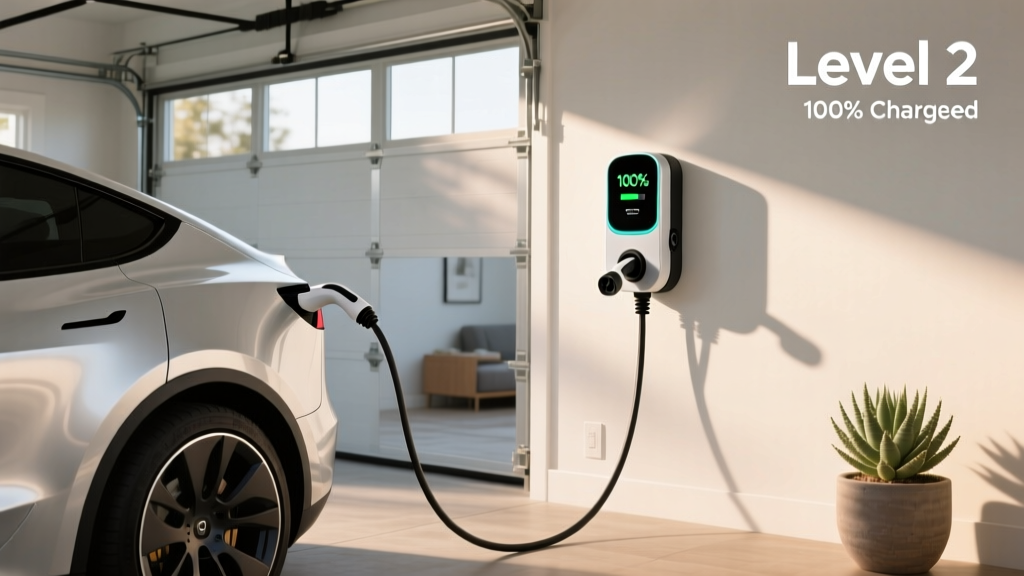
- Level 2 (240V, 11.5 kW — Tesla Wall Connector): 10–80% ≈ 4.5 hours. Ideal overnight charge.
- DC Fast — Tesla V3 Supercharger (250 kW peak): 10–80% in approximately 25–30 minutes. Peak rate of 250 kW is sustained only up to ~40% SoC, then tapers. The charge curve is not linear.
- DC Fast — Tesla V4 Supercharger (350 kW peak, compatible models): 10–80% in approximately 18–22 minutes for vehicles supporting higher charge rates.
Safety, Code, and Installation Best Practices
EV charging involves sustained high-amperage draw — far more demanding than intermittent appliances. Cutting corners here risks fire, failed inspections, or voided insurance.
- Dedicated circuit: Your Level 2 charger must be on its own dedicated breaker. Never share a circuit with a dryer, range, or HVAC compressor.
- GFCI protection: NEC 2020 and later require GFCI protection for EV charging outlets in garages. Hardwired installations may have different requirements — confirm with your electrician and local inspector.
- Outdoor rating: If your charger is installed outdoors (carport, driveway), ensure the unit is rated NEMA 4 (weatherproof) and the connector holster protects the plug from rain and debris. The Tesla Wall Connector is rated for indoor and outdoor use.
- Permit and inspection: Most jurisdictions require an electrical permit for a new 240V circuit. Skipping this can void homeowner's insurance claims related to electrical fires. Budget $50–$300 and 1–3 weeks for the inspection cycle.
- Load management: If your panel is near capacity but you want to avoid a full upgrade, devices like the Emporia Smart Load Management or Tesla Wall Connector power-sharing can dynamically limit charger draw based on real-time household consumption.
Frequently Asked Questions
How much does it cost to install a home EV charger?
For a standard Level 2 installation without a panel upgrade, expect $950–$3,000 total (equipment + electrician + permit). If your home needs a panel upgrade from 100–150A to 200–400A, add $1,500–$4,000. The IRS §25C credit covers 30% up to $1,000 of the cost.
How fast will each charging level add range to my Model 3?
Level 1 (120V) adds roughly 3–5 miles per hour. Level 2 (240V, 48A) adds about 44 miles per hour — enough for a full overnight replenishment. DC fast charging at a V3 Supercharger adds up to 175 miles in 15 minutes at peak rate, but tapers significantly above 50% SoC.
Which connector/charger is compatible with my Tesla Model 3?
The Model 3 uses the NACS connector natively. At home, the Tesla Wall Connector is the simplest match. For non-Tesla public Level 2 stations, use the J1772 adapter included with your car. For non-Tesla DC fast chargers (Electrify America), use the Tesla CCS adapter.
How much does charging cost per mile vs. gas?
Home charging at typical utility rates costs $0.03–$0.06 per mile for a Model 3. A comparable 30 MPG gas sedan at $3.40/gallon costs $0.11 per mile. Supercharger pricing ($0.28–$0.38/kWh) still undercuts gas at $0.07–$0.10 per mile.
What electrical upgrades might I need?
Homes with 100A or 150A panels, or 200A panels already near capacity (electric heat, range, dryer, hot tub), may need a panel upgrade to 300–400A. A licensed electrician can perform a load calculation to determine if your existing panel can support a 60A dedicated EV circuit. Alternatively, smart load-management devices can avoid a panel upgrade by dynamically throttling charger draw.
Does the Tesla Model 3 wireless phone charger affect the car's range or battery?
No. The 15W wireless phone charger draws negligible power from the 12V auxiliary system (which is continuously replenished by the DC-DC converter from the main traction battery). It has zero meaningful impact on your vehicle's EPA-estimated range.
Can I use a third-party Level 2 charger with my Model 3?
Yes. Any J1772 Level 2 charger works with the included Tesla J1772 adapter. Some third-party chargers now ship with NACS connectors natively. The Model 3's 11.5 kW onboard charger limits maximum AC charge rate regardless of the charger's rated output.