Minnesota's EV Charger Rebates: How Much Can You Actually Save?
If you're shopping for a home Level 2 charger in Minnesota, you're in one of the better incentive environments in the country. The state's Minnesota EV charger rebate programs — layered on top of utility-specific incentives and federal tax credits — can knock hundreds or even thousands of dollars off a home charging installation. But rebate eligibility depends on your utility provider, the charger you choose, and whether you're installing in a single-family home, multi-unit dwelling, or workplace.
This guide breaks down exactly what Minnesota offers in 2026, how to stack incentives, what a real installation costs before and after rebates, and which Level 2 chargers are worth your money.
- Xcel Energy: Up to $1,200 for residential Level 2 install (equipment + wiring)
- Minnesota Power: Up to $500 rebate on Level 2 charger purchase
- Otter Tail Power: Up to $400 rebate for residential EVSE
- Federal §30E tax credit: 30% of charger + install cost, max $1,000 (rural/low-income census tracts only)
- Some municipal utilities (e.g., Rochester Public Utilities, Lake Country Power) offer additional $200-$500 rebates
The key detail most buyers miss: Minnesota's utility rebates often require you to install the charger on a dedicated circuit and may require a smart/Wi-Fi-enabled charger that can participate in demand-response programs. We'll cover which chargers qualify below.
Charging Levels Explained: Speeds, Power, and Range Added
Before spending money on equipment or an electrician, understand what each charging level delivers. The critical distinction: kW (kilowatts) is power — how fast energy flows into your battery. kWh (kilowatt-hours) is energy — the total capacity of your battery. Think of kW as the width of a hose and kWh as the size of the bucket.
| Level | Power (kW) | Miles Added/Hour | Best For | 10-80% Time (75 kWh Battery) |
|---|---|---|---|---|
| Level 1 (120V) | 1.4 kW | 3-5 mi/hr | Overnight top-ups, PHEVs | ~37+ hours |
| Level 2 (240V) | 7.2-19.2 kW | 20-60 mi/hr | Daily home charging | 4-10 hours |
| DC Fast (CCS/NACS) | 50-350 kW | 150-1,000+ mi/hr | Road trips, highway stops | 18-45 minutes |
For a 75 kWh battery (common in vehicles like the Tesla Model Y Long Range or Hyundai Ioniq 5), a 48A Level 2 charger delivering 11.5 kW will take roughly 4.5 hours from 10-80% State of Charge. That's the sweet spot for overnight charging in Minnesota — plug in at 10 PM, wake up to a full-ish battery at 6 AM, even in January when cold-weather range loss demands more frequent charging.
DC fast charging is not for daily use. Sustained high-power DC charging accelerates battery degradation, and Minnesota's public DC fast-charging network along I-35, I-94, and I-90 is designed for road-trip legs, not routine fills. Plan on Level 2 at home doing 90% of your charging work.
Home EV Charger Installation Cost Breakdown in Minnesota
This is where the Minnesota EV charger rebate makes a measurable difference. A Level 2 home installation has three cost components: the charger hardware, the electrical work, and permits. Here's what Minnesota homeowners actually pay before any rebates are applied:
| Component | Simple Install | Complex Install | Notes |
|---|---|---|---|
| Level 2 Charger (hardware) | $400-$700 | $500-$800 | Smart/Wi-Fi models cost more |
| Electrician labor (run 240V circuit) | $400-$800 | $1,200-$2,500 | Varies with panel distance |
| Electrical permit | $50-$150 | $50-$200 | Required in most MN jurisdictions |
| Panel upgrade (if needed) | N/A | $1,500-$4,000 | 100A → 200A service upgrade |
| Total (before rebates) | $850-$1,650 | $3,250-$7,500 | Panel upgrade is the wild card |
The panel-upgrade gotcha: Many Minnesota homes built before 1990 have 100-amp electrical service. Adding a 40A or 48A dedicated circuit for an EV charger may push your panel past its safe capacity — especially if you already have an electric oven, dryer, and central AC. A licensed electrician will perform a load calculation (NEC Article 220) before quoting. If you need a 200A service upgrade, that's a $1,500-$4,000 add, and it must happen before the charger goes in.
After rebates, that simple install can drop to $200-$600 out of pocket. The complex install with a panel upgrade is still expensive, but stacking Xcel Energy's rebate with the federal §30E credit can recover $2,000+ of the cost.
Electrical Requirements for a Level 2 Charger
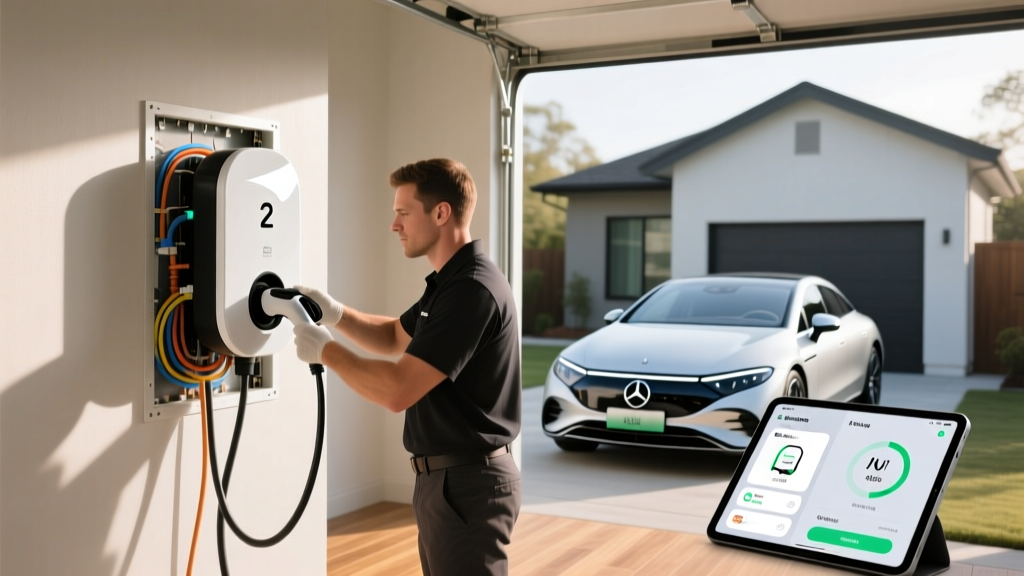
Most residential Level 2 chargers require a 240V dedicated circuit on a NEMA 14-50 or 6-50 outlet, or hardwired directly to the panel. Here's what your electrician will spec:
- 32A charger: Requires a 40A breaker (NEC requires 125% overcurrent protection for continuous loads)
- 40A charger: Requires a 50A breaker — most common residential setup
- 48A charger: Requires a 60A breaker — maximum for most home panels without upgrade
- GFCI protection: Required for outdoor installations per NEC 2020/2023 code (adopted in most MN municipalities)
- Wire gauge: 6 AWG copper for 40-50A circuits; 4 AWG for 60A
Outdoor installations need a charger rated NEMA 4 (weather-resistant) or a weatherproof enclosure. Minnesota winters demand equipment rated for at least -22°F (-30°C) operating temperature — all major chargers we recommend below meet this standard.
Which Connector Does Your EV Need?
Minnesota's EV fleet in 2026 is a mix of NACS (Tesla's North American Charging Standard), CCS1 (the legacy standard on most non-Tesla EVs), and a shrinking number of CHAdeMO vehicles (older Nissan Leafs). For home Level 2 charging, here's what you need to know:
| Connector | Brands Using It | Home Charger Needed | Adapter Required? |
|---|---|---|---|
| NACS (Tesla plug) | Tesla, Ford (2025+), GM (2025+), Rivian, Hyundai/Kia (2026+), Volvo, Polestar | NACS-equipped Level 2 | No (native on new models) |
| CCS1 | VW, BMW, older Ford/GM/Hyundai/Kia (pre-2025) | CCS1 Level 2 or J1772 | NACS-to-CCS adapter if charger is NACS |
| CHAdeMO | Nissan Leaf (2011-2025), Mitsubishi Outlander PHEV (older) | J1772 (Level 2 only) | No adapter needed for L2 — CHAdeMO is DC-only |
The NACS transition matters for your charger purchase. Starting in 2025, Ford, GM, Rivian, and others switched to NACS ports. By 2026, most new EVs sold in Minnesota use NACS natively. If you're buying a new EV, get a NACS-equipped home charger. If you own a pre-2025 CCS vehicle, buy a charger with a J1772 connector (which works with all CCS and CHAdeMO vehicles for Level 2) or use a NACS-to-J1772 adapter.
For Level 2 home charging, all EVs accept J1772 or NACS — the CHAdeMO connector only exists on DC fast chargers, so it's irrelevant for your garage installation.
Cost to Charge an EV in Minnesota vs. Gasoline
Minnesota's electricity rates vary by utility, but the statewide residential average in 2026 is approximately $0.14/kWh. With time-of-use (TOU) rates from Xcel Energy or Minnesota Power, off-peak overnight charging drops to $0.07-$0.09/kWh. Here's the real cost math:
| Scenario | Rate | Cost Per Mile* | Annual (12,000 mi) |
|---|---|---|---|
| Home charging (off-peak TOU) | $0.08/kWh | $0.024 | $288 |
| Home charging (standard rate) | $0.14/kWh | $0.042 | $504 |
| Public Level 2 (ChargePoint, etc.) | $0.25-$0.35/kWh | $0.08-$0.11 | $960-$1,320 |
| DC Fast Charging (public) | $0.35-$0.55/kWh | $0.11-$0.17 | $1,320-$2,040 |
| Gas vehicle (28 MPG avg, $3.10/gal MN) | $3.10/gal | $0.111 | $1,332 |
*Based on an EV averaging 3.3 miles/kWh (roughly 110 MPGe combined — typical for a Model Y, Ioniq 5, or Equinox EV in mixed driving).
The takeaway: home charging on off-peak rates is roughly 4-5x cheaper per mile than gasoline in Minnesota. Even at standard residential rates, EV charging costs less than half of what gas does. But relying exclusively on DC fast charging erases most of the savings — which is why a Level 2 home install pays for itself quickly.
Minnesota's cold winters do increase energy consumption. Expect your EV's efficiency to drop 15-30% in sub-freezing temperatures (December through March), which pushes your cost-per-mile up proportionally. A heat-pump-equipped EV (standard on the Ioniq 5, Model Y, and most 2025+ models) mitigates some of this loss.
Stacking the Minnesota EV Charger Rebate with Federal Credits
Minnesota EV owners can layer multiple incentives. Here's how the stacking works in practice for a typical Xcel Energy customer installing a $600 smart charger on a $900 electrical job ($1,500 total):
- Total install cost: $1,500 (charger + electrician + permit)
- Xcel Energy residential EV rebate: -$1,200 (covers equipment + wiring)
- Federal §30E Alternative Fuel Vehicle Refueling Property Credit: 30% of remaining cost, up to $1,000 — only if your home is in a qualifying rural or low-income census tract
- Net out-of-pocket: $300-$1,500 depending on §30E eligibility
⚠ The federal §30E credit has strict geographic requirements per the IRS. Use the IRS census tract lookup tool to verify your address before counting on it. Minnesota's urban cores (Minneapolis, St. Paul, Rochester) generally do NOT qualify; rural and some suburban tracts do.
For non-Xcel customers, your rebate amounts will differ. Minnesota Power offers up to $500, Otter Tail Power up to $400, and various co-ops and municipal utilities have their own programs. Check with your specific utility before purchasing equipment — some require pre-approval or restrict eligible charger models.
Best Level 2 Chargers for Minnesota Homes (2026 Picks)
These chargers meet Minnesota's climate demands (cold-rated), utility rebate requirements (smart/Wi-Fi enabled for demand-response), and the NACS transition. All prices reflect 2026 retail:
ChargePoint Home Flex (NACS)
Power: Up to 11.5 kW (48A, 240V)
Connector: NACS native (CCS adapter available)
Cable: 23 ft
Smart features: Wi-Fi, scheduling, TOU optimization, Alexa/Google Home, demand-response compatible
Price: ~$599
Cold rating: -22°F (-30°C)
Why for MN: Qualifies for most MN utility rebates requiring smart features; adjustable amperage (16A-48A) lets you match your circuit.
Tesla Wall Connector (Gen 4)
Power: Up to 11.5 kW (48A, 240V)
Connector: NACS native
Cable: 24 ft
Smart features: Wi-Fi, OTA updates, Powerwall integration, load sharing (multiple units on one circuit)
Price: ~$450
Cold rating: -22°F (-30°C)
Why for MN: Best value for Tesla/NACS owners; load-sharing feature is ideal for two-EV households sharing a 60A circuit.
Emporia Level 2 EV Charger
Power: Up to 11.5 kW (48A, 240V)
Connector: J1772 (NACS adapter included)
Cable: 24 ft
Smart features: Wi-Fi, energy monitoring, solar integration, TOU scheduling, utility demand-response
Price: ~$399
Cold rating: -22°F (-30°C)
Why for MN: Budget pick with robust app; energy monitoring helps track charging costs; works with both CCS and NACS vehicles via included adapter.
Grizzl-E Smart (United Chargers)
Power: Up to 10 kW (40A, 240V)
Connector: J1772 or NACS (configurable)
Cable: 24 ft
Smart features: Wi-Fi, OCPP protocol, utility integration, scheduled charging
Price: ~$549
Cold rating: -40°F (-40°C) — best-in-class for extreme cold
Why for MN: Built in Canada for harsh winters; -40°F rating exceeds Minnesota's coldest nights; aluminum enclosure is more durable than plastic competitors.
Safety, Code, and Installation Best Practices
Minnesota adopts the National Electrical Code (NEC) with state amendments. Your installation must comply with the following to pass inspection and qualify for most utility rebates:
- Dedicated circuit: Your Level 2 charger must be on its own breaker — no sharing with other outlets or appliances.
- GFCI protection: Required for all outdoor EV charging installations. Some jurisdictions also require it indoors for garages. Your electrician will install a GFCI breaker or use a charger with built-in ground-fault protection.
- Permit and inspection: Nearly all Minnesota cities and counties require an electrical permit for new 240V circuits. The permit fee is typically $50-$150, and a city inspector will verify the work before you energize the charger. Skipping the permit can void your utility rebate and your homeowner's insurance coverage.
- Outdoor rating: If installing outside, the charger must be rated NEMA 4 (weatherproof) and the receptacle (if using one) must have a weatherproof in-use cover.
- Cable management: Wall-mount the charger at 48-54 inches from the floor (ADA-compliant height) and use a cable holster or retractor to prevent tripping hazards and cable damage from ice/snow.
- Using a 14-50 outlet on a 40A breaker for a 48A charger — this creates a fire hazard. The breaker must be rated at 125% of the continuous load.
- Skipping the permit to save $100 — this invalidates Xcel Energy's rebate and can create insurance/liability issues.
- Running the circuit through an uninsulated exterior wall without cold-weather-rated cable — wire insulation can crack below -20°F.
- Installing in an attached garage without checking for required fire-rating between the garage and living space.
Frequently Asked Questions
How much does it cost to install a home EV charger in Minnesota?
A straightforward Level 2 installation (charger near the panel, no upgrade needed) runs $850-$1,650 before rebates. A complex install requiring long wire runs or a panel upgrade can reach $3,250-$7,500. After stacking the Minnesota EV charger rebate from your utility with the federal §30E credit (if eligible), most homeowners pay $300-$1,200 out of pocket for a simple install.
How fast will each charging level add range?
Level 1 (120V) adds 3-5 miles per hour — adequate for PHEVs with small batteries but impractical for full EVs. Level 2 (240V, 40-48A) adds 20-40 miles per hour, fully replenishing most EVs overnight. DC fast charging adds 150-1,000+ miles per hour at peak, but is designed for road-trip stops, not daily use.
Which connector/charger is compatible with my EV?
If you own a 2025 or newer Tesla, Ford, GM, Rivian, Hyundai, or Kia EV, your vehicle has a NACS port — buy a NACS-equipped Level 2 charger. If you own a pre-2025 non-Tesla EV, your vehicle uses CCS1/J1772 — buy a J1772 charger or use a NACS-to-J1772 adapter. All Level 2 home chargers work with all EVs via the correct connector or adapter; the CHAdeMO connector only applies to DC fast charging.
How much does charging cost per mile vs. gas in Minnesota?
Home charging on off-peak rates costs approximately $0.024/mile — about 4-5x cheaper than gasoline at $3.10/gallon and 28 MPG ($0.111/mile). Standard-rate home charging is about $0.042/mile. Public DC fast charging ($0.11-$0.17/mile) is comparable to or slightly more expensive than gas, which is why home Level 2 installation is essential for EV economics.
What electrical upgrades might I need?
If your home has a 100A electrical panel and you're adding a 40-48A EV charger circuit, you may need a 200A service upgrade ($1,500-$4,000). Your electrician will perform an NEC Article 220 load calculation to determine this. Alternatives to a full panel upgrade include installing a lower-amperage charger (32A on a 40A breaker) or using a smart load-management device that throttles the charger when other high-draw appliances are running.
Sources: IRS §30E Credit, U.S. Energy Information Administration (electricity rates), U.S. DOE Alternative Fuels Data Center. Utility rebate amounts are current as of early 2026 and subject to change — verify with your provider before purchasing. Electrical work should always be performed by a licensed Minnesota electrician.