Tesla Model 3+ Range, China Launch, and What It Means for Charging in 2026
The Tesla Model 3 Highland refresh brought measurable gains in efficiency, cabin quietness, and suspension tuning. For the 2026 model year, the global conversation has turned to the updated Long Range variant — often referred to in international markets as the Model 3+ — and its expanded rollout from the Gigafactory Shanghai line. While the US-spec Tesla Model 3 Long Range AWD carries an EPA-estimated 341 miles of range on its ~79 kWh (usable) LFP/NMC pack, the China-market Model 3+ variant has been positioned with slightly different battery sourcing and pricing to meet local incentive thresholds.
Whether you're tracking the China launch for import context, cross-shopping the US Long Range, or simply preparing your garage for any Model 3 variant, the charging fundamentals remain the same. This guide covers exactly what it takes to charge a 2026 Model 3 at home and on the road — with real numbers, real costs, and the electrical realities most buyers overlook.
EPA Estimate: 341 miles
Highway (70 mph, 75°F): ~295–310 miles
Cold Weather (30°F, mixed driving): ~250–275 miles
Range varies with speed, temperature, elevation, and HVAC use. LFP-equipped RWD variants may see slightly steeper cold-weather loss due to chemistry characteristics.
Understanding EV Charging Levels: kW, kWh, and Miles Per Hour
Before selecting equipment, the single most important distinction to internalize: kW (kilowatts) measures power — the rate of energy delivery, while kWh (kilowatt-hours) measures energy — the total capacity stored in the battery. Think of kW as the width of a pipe and kWh as the size of the tank you're filling. A 2026 Model 3 Long Range holds roughly 79 kWh of usable energy; how fast you fill it depends entirely on the kW rate of your charger.
| Level | Voltage | Power (kW) | Miles of Range Added Per Hour | Typical Use Case |
|---|---|---|---|---|
| Level 1 | 120V AC | 1.0–1.4 kW | 3–5 mi/hr | Overnight top-up, emergency, PHEVs |
| Level 2 | 240V AC | 7.2–19.2 kW | 25–65 mi/hr | Home daily charging, workplace, hotels |
| DC Fast Charge | 400V+ DC | 50–250+ kW | 180–900+ mi/hr (peak) | Road trips, highway corridors, quick top-ups |
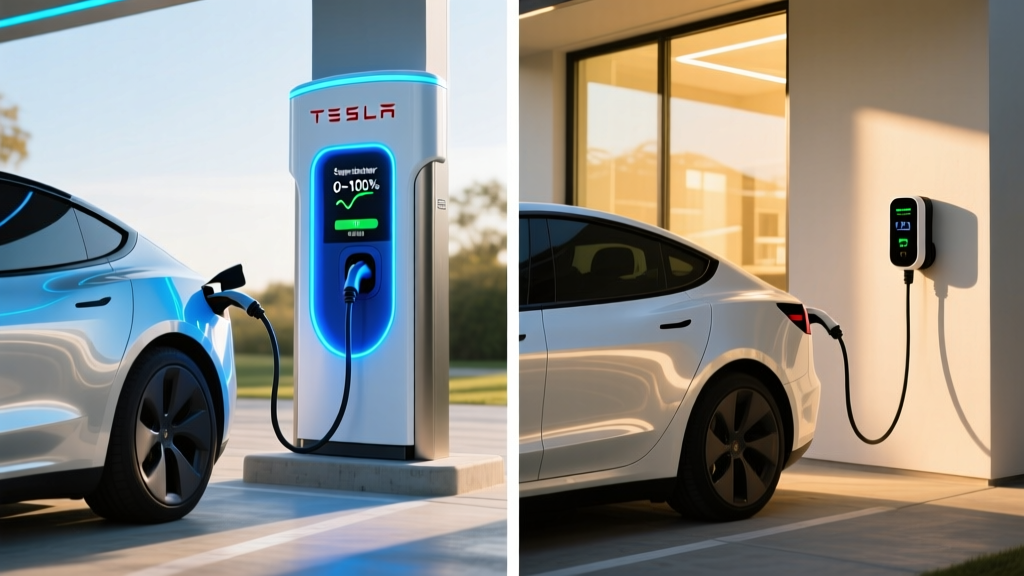
For a Model 3 Long Range, the onboard AC charger accepts up to 11.5 kW (48A) on Level 2. That means even if you install a 19.2 kW (80A) hardwired station, the car will only pull 11.5 kW — roughly 44 miles of range per hour. On DC fast charging, the Model 3 Long Range AWD peaks at approximately 250 kW at a V3 Supercharger, enabling a 10–80% charge in roughly 25–28 minutes under ideal thermal conditions.
Home Charger Installation: Electrical Requirements and True Costs
The most common question from new EV buyers: How much does it cost to install a home EV charger? The honest answer depends on your electrical panel's capacity, the distance from panel to garage, and local permit fees. Here's what a typical 240V/48A Level 2 installation requires:
- Circuit: Dedicated 60-amp breaker (for a continuous 48A charge rate per NEC 80% rule)
- Wiring: 6 AWG copper (THHN in conduit or 6/2 NM-B for short indoor runs)
- Panel capacity: Minimum 100A service; 200A preferred for homes with electric HVAC, dryer, and oven
- Permit: Required in most jurisdictions — electrical permit typically $50–$200
- GFCI protection: NEC 2020+ requires GFCI for garage receptacles; hardwired stations avoid this requirement and the nuisance-tripping issue
| Component | Low End | Typical | High End (Panel Upgrade) |
|---|---|---|---|
| Level 2 Charger (hardware) | $350 | $550 | $700 |
| Electrician labor (2–6 hrs) | $400 | $800 | $1,500 |
| Materials (wire, conduit, breaker) | $100 | $250 | $500 |
| Permit & inspection | $50 | $125 | $250 |
| Panel upgrade (if needed: 100A→200A) | — | — | $1,800–$3,500 |
| Total | $900 | $1,725 | $6,450 |
Panel upgrade gotcha: Homes built before 1990 often have 100-amp service. Adding a 60A EV circuit may exceed your panel's capacity, triggering a mandatory service upgrade. This is the single biggest cost variable. Have an electrician perform a load calculation before committing to equipment. Some utilities offer panel-upgrade rebates — check your local provider.
Connector Compatibility: NACS, CCS, and What the Model 3 Needs
As of 2026, Tesla's North American Charging Standard (NACS) has become the dominant connector in the US market. Every 2026 Tesla Model 3 ships with a native NACS port — no adapter needed at Superchargers or the growing number of third-party NACS stations from Electrify America, EVgo, and ChargePoint.
| Connector | Native Vehicles | Adapter Needed for Model 3? | Network Availability |
|---|---|---|---|
| NACS (Tesla) | Tesla, Ford, GM, Rivian, Volvo, others (2025+) | No — native port | Tesla Supercharger, growing third-party |
| CCS1 | Hyundai, Kia, BMW, VW, legacy non-Tesla | Yes — CCS-to-NACS adapter (~$200) | Electrify America, EVgo, ChargePoint |
| CHAdeMO | Nissan Leaf (legacy) | Yes — limited adapter availability | Declining; mostly legacy stations |
For the China-market Model 3+ variant: China uses the GB/T standard domestically. If you're evaluating the China launch for informational purposes or potential grey-market import, note that GB/T requires a different physical connector and communication protocol. US-registered vehicles cannot use GB/T infrastructure without specialized (and currently uncommon) adapters.
Charging Cost Per Mile: Home vs. Public vs. Gas
How much does charging cost per mile vs gas? This is where EV ownership economics become concrete. The 2026 Model 3 Long Range AWD achieves approximately 132 MPGe combined (source: fueleconomy.gov), consuming roughly 25 kWh per 100 miles.
| Scenario | Rate | Cost per 100 Miles | Cost per Mile |
|---|---|---|---|
| Home charging (off-peak utility rate) | $0.11/kWh | $2.75 | $0.028 |
| Home charging (average US residential) | $0.17/kWh | $4.25 | $0.043 |
| Public Level 2 (workplace/hotel) | $0.25/kWh | $6.25 | $0.063 |
| DC Fast Charge (Electrify America, etc.) | $0.48/kWh | $12.00 | $0.12 |
| Tesla Supercharger (average 2026) | $0.35/kWh | $8.75 | $0.088 |
| Gas sedan (30 MPG combined, $3.50/gal) | $3.50/gal | $11.67 | $0.117 |
Even at public DC fast-charging rates, the Model 3 competes with or undercuts a 30 MPG gas sedan. At home off-peak rates, the savings are dramatic — roughly $850–$1,100 per year for a driver covering 12,000 miles. Over five years, home-charging savings can offset a significant portion of the vehicle's price premium.
Charging Time Examples: What to Expect with the Model 3 Battery
Charging speed is not linear. The Model 3's charge curve peaks at ~250 kW between 10–30% State of Charge (SoC), then tapers progressively. By 80%, the rate drops to roughly 50–60 kW, and charging above 90% slows further to protect battery longevity. Here's what real charge sessions look like:
- Level 1 (120V/12A): 0–100% in ~65 hours. Practical only for PHEVs or emergency trickle. Adds ~4 miles overnight (10 hours).
- Level 2 (240V/48A, 11.5 kW): 0–100% in ~7.5 hours. 10–80% in approximately 5 hours. Full overnight recovery for any daily driving.
- DC Fast (250 kW V3 Supercharger): 10–80% in ~25–28 minutes. Adds ~200 miles in 15 minutes under optimal conditions.
- DC Fast (150 kW V2 Supercharger): 10–80% in ~35–40 minutes.
Preconditioning matters: Navigate to a Supercharger using the car's built-in navigation, and the Model 3 will automatically warm the battery to optimal charging temperature before arrival. Without preconditioning — especially in cold weather — peak charge rates can be 30–50% lower for the first several minutes.
Equipment Recommendations: Best Home Chargers for the Model 3 in 2026
Because the Model 3's onboard charger maxes at 11.5 kW (48A), you need a 60A circuit and a station rated for at least 48A to capture full Level 2 speed. Here are proven picks:
Tesla Wall Connector (Gen 3)
- Power Output: Up to 11.5 kW (48A)
- Connector: Native NACS — no adapter for Tesla vehicles
- Cable Length: 24 ft
- Smart Features: Wi-Fi, OTA updates, power sharing between two units, access control
- Price: ~$475
- Best For: Tesla-only households; cleanest integration
ChargePoint Home Flex
- Power Output: Configurable 16A–50A (up to 12 kW at 50A)
- Connector: NACS or J1772 (NACS version for 2025+)
- Cable Length: 23 ft
- Smart Features: Wi-Fi, app scheduling, utility demand-response integration, Alexa
- Price: ~$550–$650
- Best For: Multi-EV households; utility rebate compatibility
Emporia Vue Smart Charger
- Power Output: Up to 48A (11.5 kW)
- Connector: NACS or J1772 options
- Cable Length: 24 ft
- Smart Features: Wi-Fi, energy monitoring, solar integration, time-of-day scheduling
- Price: ~$399
- Best For: Budget-conscious buyers wanting smart features and energy tracking
Safety, Code, and Installation Best Practices
EV charging draws sustained high current for hours — this is not the same as plugging in a dryer. Key safety and code considerations for 2026 installations:
- Dedicated circuit: Your Level 2 charger must be on its own dedicated breaker — never shared with other appliances.
- Hardwired vs. receptacle: Hardwired installations avoid the NEC GFCI requirement for garage receptacles (NEMA 14-50), eliminating nuisance trips. Hardwired also allows full 48A; a NEMA 14-50 outlet is limited to 40A continuous (9.6 kW).
- Outdoor rating: If your charger is mounted outside or in an open carport, confirm it carries a NEMA 4 or IP65 rating for weather resistance.
- Wire gauge: 6 AWG copper for 48A circuits; 4 AWG aluminum is acceptable for longer runs to reduce voltage drop.
- Permit and inspection: Skipping the permit may void homeowner's insurance coverage for electrical fires. The inspection typically takes 15–30 minutes and verifies wire gauge, breaker sizing, and grounding.
- Utility notification: Some utilities require notification before adding a Level 2 circuit; others offer time-of-use (TOU) rates that cut charging costs by 40–60%.
Frequently Asked Questions
How much does it cost to install a home EV charger for a Tesla Model 3?
A typical 240V/48A hardwired installation runs $1,200–$2,200 including the Tesla Wall Connector, electrician labor, materials, and permit. If your home needs a panel upgrade from 100A to 200A service, add $1,800–$3,500. Total range: $900 for a simple install in a newer home with ample panel capacity, up to $6,000+ for older homes requiring service upgrades.
How fast will each charging level add range to the Model 3?
Level 1 (120V): 3–5 miles per hour. Level 2 (240V/48A): ~44 miles per hour. DC Fast (250 kW Supercharger): up to 200 miles in 15 minutes at peak rate, though the charge curve tapers significantly above 60% SoC.
Which connector is compatible with the 2026 Tesla Model 3?
The 2026 Model 3 uses a native NACS (North American Charging Standard) port. It connects directly to Tesla Superchargers and the growing network of third-party NACS stations. To use legacy CCS1 stations, you'll need a CCS-to-NACS adapter (available from Tesla for approximately $200).
How much does charging a Model 3 cost per mile compared to gas?
At the US average residential electricity rate of $0.17/kWh, the Model 3 Long Range costs approximately $0.043 per mile. A comparable 30 MPG gas sedan at $3.50/gallon costs $0.117 per mile — nearly three times more. Even at Supercharger rates ($0.35/kWh), the Model 3 costs $0.088/mile, still undercutting gas.
What electrical upgrades might I need for a Level 2 charger?
You need a dedicated 60-amp breaker on a panel with sufficient spare capacity. If your panel is at or near its rated capacity (common in homes with electric heat, dryers, and ranges), an electrician's load calculation may require a panel upgrade to 200A service — the most expensive variable in the installation. Homes with gas appliances and 200A panels rarely need upgrades.
Does the Tesla Model 3+ China launch affect US charging compatibility?
The China-market Model 3+ uses the GB/T charging standard and different battery sourcing to qualify for Chinese incentives. US-spec Model 3 Long Range vehicles use NACS. The China launch is relevant for global market analysis and battery supply-chain tracking, but China-spec vehicles are not directly compatible with US charging infrastructure without specialized adapters not currently available at consumer scale.
Sources: EPA Fuel Economy — Electric Vehicles, Tesla Model 3 Specifications, IRS §30D Clean Vehicle Credits.