If you own a Tesla — or any EV using the North American Charging Standard (NACS) — you've likely asked: how long does a Tesla Supercharger actually take, and how does that compare to plugging in at home? The answer depends on which charging level you're using, the size of your battery, and the state of charge (SoC) when you plug in.
This guide breaks down exact charging times across Level 1, Level 2, and DC fast charging (including Tesla Superchargers), with real-world data on speeds, costs, and home installation requirements.
Charging Levels Explained: kW, Miles Per Hour, and Real Speeds
Before comparing times, let's clarify the single most important distinction in EV charging: kW (kilowatts) measures power — how fast energy flows into your car. kWh (kilowatt-hours) measures energy — the total capacity of your battery. Think of kW as the width of a hose and kWh as the size of the bucket you're filling.
Here's what each charging level delivers in practice:
| Level | Voltage | Power (kW) | Miles of Range Added Per Hour | Typical Use Case |
|---|---|---|---|---|
| Level 1 | 120V AC | 1.0–1.4 kW | 3–5 miles | Emergency / overnight trickle |
| Level 2 | 240V AC | 7.2–19.2 kW | 25–75 miles | Home daily charging, workplace |
| DC Fast (Tesla V3 Supercharger) | 400V+ DC | Up to 250 kW | Up to 1,000 mi/hr (peak) | Road trips, quick top-ups |
| DC Fast (Tesla V4 Supercharger) | 800V+ DC | Up to 350 kW | Up to 1,200+ mi/hr (peak) | Next-gen road-trip charging |
The "miles per hour" figure varies by vehicle efficiency. A Tesla Model 3 (roughly 4 mi/kWh) gains range faster per kW than a heavier, less efficient vehicle like the Ford F-150 Lightning (~2.0 mi/kWh).
Tesla Supercharger Charging Time: 10–80% Real-World Data
EV batteries don't charge at a constant rate. Charging follows a charge curve: power ramps up quickly, peaks around 10–30% SoC, then tapers significantly above 80% to protect battery health. This is why manufacturers quote "10–80%" times rather than 0–100%.
Here's what to expect at a Tesla V3 Supercharger (250 kW peak) with common 2026 Tesla battery packs:
| Model | Battery (usable kWh) | Peak Charge Rate | 10–80% Time | Real-World Caveat |
|---|---|---|---|---|
| Model 3 Long Range | 75 kWh (LFP/NMC) | ~250 kW | ~25–28 minutes | Cold battery adds 5–10 min; preconditioning critical |
| Model Y Long Range | 75 kWh (NMC) | ~250 kW | ~27–30 minutes | Heavier pack, slightly slower taper |
| Model S | 95 kWh (NMC) | ~250 kW | ~35–38 minutes | Larger battery means longer sustained charge |
| Cybertruck | 123 kWh (NMC) | ~250 kW (V3) / ~350 kW (V4) | ~38 min (V3) / ~28 min (V4) | 800V architecture benefits from V4 stalls |
Why Charging Tapers Above 80%
Lithium-ion batteries face increasing internal resistance as cells approach full capacity. Charging a battery from 80% to 100% at a DC fast charger can take as long as charging from 10% to 80%. For road trips, the optimal strategy is to charge to 80%, then drive on — you'll reach your destination faster than waiting for a full charge.
Source: Tesla Supercharging Support
Level 2 Home Charging: Speed, Installation Cost, and Electrical Requirements
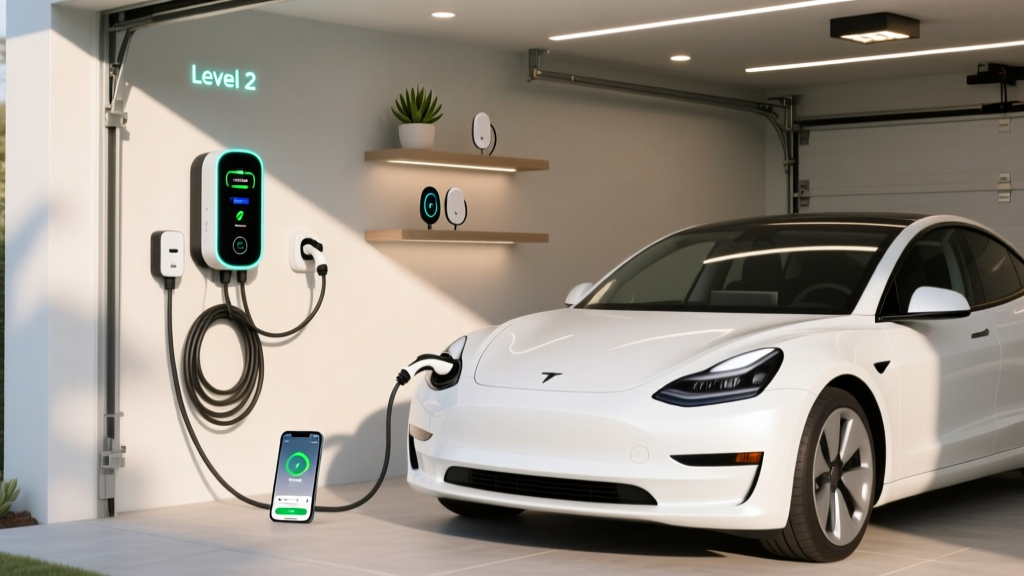
Most EV owners do 80%+ of their charging at home on a Level 2 charger. A Level 2 unit on a 240V circuit can fully recharge a Tesla Model 3 overnight — typically 8–10 hours from near-empty to 100%.
Electrical Requirements for Home Level 2
A standard home Level 2 installation requires:
- Voltage: 240V (same as a dryer or oven outlet)
- Amperage: 40A circuit for a 32A continuous charger, or 60A circuit for a 48A charger (National Electrical Code requires circuits rated at 125% of continuous load)
- Dedicated circuit: The EV charger must have its own breaker — you cannot share with other appliances
- Panel capacity: Your home's main panel must have enough spare amperage. A 200A panel is standard for modern homes; older homes with 100A panels often need an upgrade
How Much Does It Cost to Install a Home EV Charger?
Installation costs vary dramatically based on your home's electrical setup. Here's a realistic breakdown:
| Component | Simple Install (panel nearby, 200A) | Complex Install (long run or panel upgrade) |
|---|---|---|
| Level 2 Charger Equipment | $350–$700 | $350–$700 |
| Electrician Labor | $400–$800 | $1,200–$2,500 |
| Permit & Inspection | $50–$200 | $50–$200 |
| Electrical Panel Upgrade (if needed) | N/A | $1,500–$4,000 |
| Total Estimated Cost | $800–$1,700 | $3,100–$7,400 |
Safety and Code Considerations
The National Electrical Code (NEC) and local building codes govern EV charger installations. Key requirements:
- GFCI protection: Required for outdoor receptacles; hardwired installations may or may not require GFCI depending on local code
- Outdoor rating: If mounting outdoors, the charger must carry a NEMA 4 or IP65 weather rating
- Hardwired vs. plug: Hardwired chargers (no plug) support higher amperage (48A+) and avoid the NEC requirement for GFCI breakers on 240V receptacles, which can nuisance-trip with some EVSEs
- Cable management: Keep charging cables off the ground to prevent trip hazards and damage
Connector Compatibility: NACS, CCS1, and CHAdeMO in 2026
The connector landscape has consolidated significantly. As of 2026, the NACS (North American Charging Standard, originally the Tesla connector) has become the dominant standard in North America. Here's what fits what:
| Connector | Native Vehicles | Adapter Needed For | DC Fast Charger Availability |
|---|---|---|---|
| NACS (Tesla) | Tesla (all), Ford (2025+), GM (2025+), Rivian (2025+), Volvo, Polestar, Fisker | CCS vehicles via NACS-to-CCS adapter (~$200–$250) | Tesla Supercharger network (25,000+ stalls), growing third-party NACS stations |
| CCS1 | Hyundai, Kia, BMW, VW, legacy Ford/GM (pre-2025) | NACS vehicles via CCS-to-NACS adapter | Electrify America, EVgo, ChargePoint DC stations |
| CHAdeMO | Nissan Leaf (legacy) | No reliable adapter to NACS/CCS | Declining; fewer than 5% of new DC stalls |
For Tesla owners, the NACS connector is native. Non-Tesla EVs with CCS1 ports can access Tesla Superchargers using a Tesla-approved CCS-to-NACS adapter, though charging speeds may be limited by the vehicle's onboard charge acceptance rate.
Cost to Charge: Home vs. Public vs. Tesla Supercharger
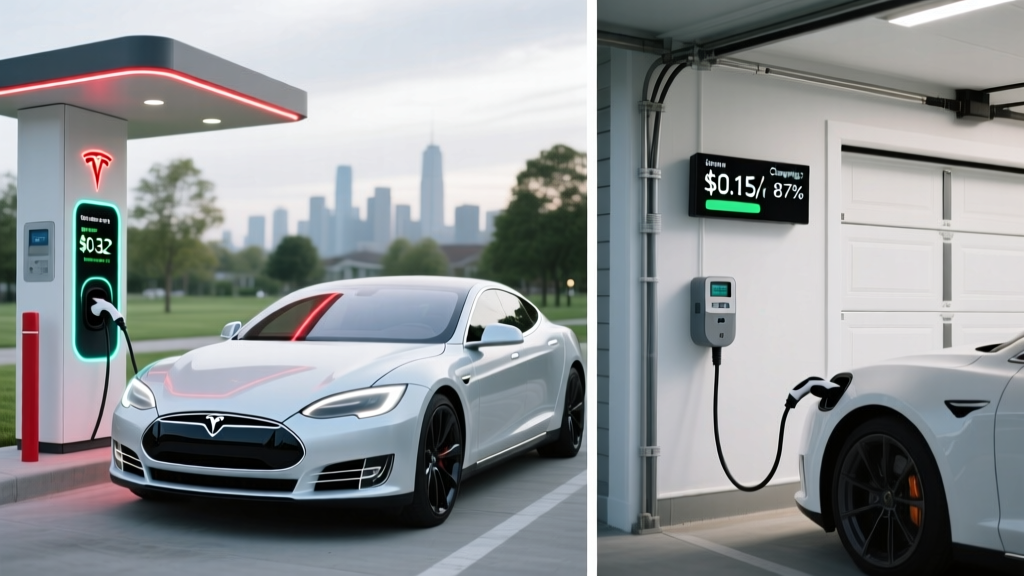
The cost gap between home charging and public DC fast charging is substantial. Here's how they compare on a per-kWh and per-mile basis:
| Charging Scenario | Cost per kWh | Cost per Mile (Model 3, ~4 mi/kWh) | Cost per Mile (F-150 Lightning, ~2 mi/kWh) |
|---|---|---|---|
| Home (off-peak utility rate) | $0.08–$0.14 | $0.02–$0.035 | $0.04–$0.07 |
| Home (standard rate, no TOU) | $0.13–$0.18 | $0.03–$0.045 | $0.065–$0.09 |
| Tesla Supercharger (member rate) | $0.25–$0.35 | $0.06–$0.09 | $0.125–$0.175 |
| Tesla Supercharger (non-Tesla) | $0.35–$0.50 | $0.09–$0.125 | $0.175–$0.25 |
| Electrify America / EVgo DC | $0.35–$0.55 | $0.09–$0.14 | $0.175–$0.275 |
Gas comparison: At $3.40/gallon and 28 MPG combined, a comparable gas sedan costs roughly $0.12/mile. A Model 3 charged at home on off-peak rates costs about $0.03/mile — a 75% savings. Even on Tesla Superchargers at $0.30/kWh, the Model 3 undercuts gas at ~$0.075/mile.
Source: fueleconomy.gov EV Side-by-Side
Best Level 2 Home Chargers for Tesla and NACS Vehicles (2026)
These are the chargers we recommend based on power output, build quality, smart features, and cable length — all with native NACS connectors or Tesla compatibility.
Tesla Wall Connector
- Power: Up to 11.5 kW (48A on 60A circuit)
- Connector: Native NACS
- Cable: 24 ft
- Smart features: Wi-Fi, OTA updates, load sharing between multiple units, power-sharing
- Price: ~$475
- Best for: Tesla owners wanting maximum speed and ecosystem integration
ChargePoint Home Flex (NACS)
- Power: Up to 12 kW (50A on 60A circuit, adjustable down to 16A)
- Connector: NACS (2025+ model) or J1772 with adapter
- Cable: 23 ft
- Smart features: Wi-Fi, app scheduling, Alexa/Google integration, energy dashboard
- Price: ~$550–$650
- Best for: Multi-EV households (NACS + CCS via adapter flexibility)
Emporia Level 2 EV Charger
- Power: Up to 11.5 kW (48A)
- Connector: J1772 (NACS adapter included)
- Cable: 24 ft
- Smart features: Real-time energy monitoring, solar integration, utility demand-response ready
- Price: ~$399
- Best for: Budget-conscious buyers with solar panels or energy monitoring needs
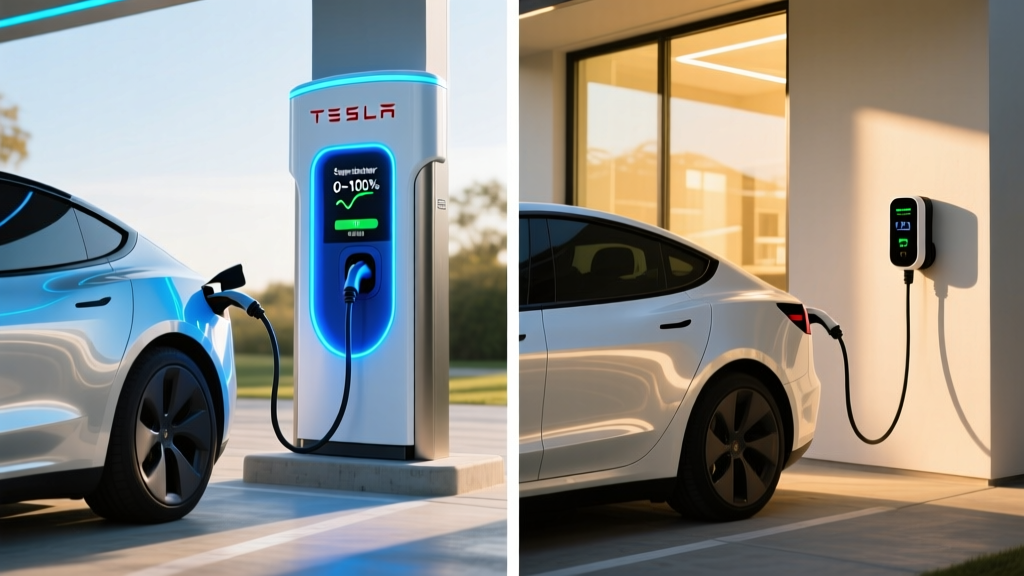
Home Charging Time vs. Tesla Supercharger: Side by Side
To put it all in perspective, here's how long it takes to add 200 miles of range to a 2026 Tesla Model 3 Long Range (75 kWh usable battery, ~4 mi/kWh) across different methods:
| Method | Power (kW) | Time to Add 200 mi | Cost (approx.) |
|---|---|---|---|
| Level 1 (120V outlet) | 1.2 kW | ~42 hours | $6.00 (home rate) |
| Level 2 — Tesla Wall Connector (48A) | 11.5 kW | ~4.3 hours | $6.00 (home rate) |
| Level 2 — 32A charger | 7.7 kW | ~6.5 hours | $6.00 (home rate) |
| Tesla V3 Supercharger (10–80%) | Up to 250 kW | ~18 minutes (for 200 mi) | $15–$20 (Supercharger rate) |
| Tesla V4 Supercharger (10–80%) | Up to 350 kW | ~13 minutes (for 200 mi) | $15–$20 (Supercharger rate) |
The takeaway: home Level 2 charging is ideal for daily use (you wake up to a full battery every morning), while Superchargers are purpose-built for road trips where you need 150–250 miles of range in 15–25 minutes.
Frequently Asked Questions
How fast will each charging level add range?
Level 1 (120V) adds 3–5 miles per hour — essentially useless for daily driving unless your commute is under 20 miles. Level 2 (240V, 48A) adds roughly 44 miles per hour to a Model 3 — enough to fully recharge overnight. DC fast charging (Tesla V3 Supercharger at 250 kW) can add up to 200 miles in about 18 minutes, but speed tapers significantly above 80% SoC.
How much does it cost to install a home EV charger?
A straightforward Level 2 install on an existing 200A panel with a short conduit run costs $800–$1,700 (equipment + electrician + permit). If your home needs a panel upgrade from 100A to 200A, total costs can reach $3,100–$7,400. Always get a load calculation from a licensed electrician before purchasing equipment.
Which connector is compatible with my EV?
All 2026 Tesla vehicles use the native NACS connector. Ford, GM, Rivian, Volvo, and Polestar have also adopted NACS. Hyundai, Kia, BMW, and VW still use CCS1 — but Tesla has opened Supercharger access to CCS vehicles via an approved adapter ($200–$250). CHAdeMO (Nissan Leaf) is effectively deprecated with no forward-compatible adapter path.
How much does charging cost per mile vs gas?
A Tesla Model 3 charged at home on off-peak electricity (~$0.12/kWh) costs roughly $0.03 per mile. A comparable gas sedan at $3.40/gal and 28 MPG costs $0.12 per mile — four times more. Even Tesla Supercharger rates ($0.30/kWh) yield about $0.075/mile, still 38% cheaper than gas.
What electrical upgrades might I need?
The most common upgrade is a panel capacity increase from 100A to 200A, needed in older homes. You may also need a new dedicated 60A breaker, conduit run from panel to garage or driveway, and a permit with inspection. Homes with solar panels or battery storage (like Tesla Powerwall) may need a smart charger that integrates with energy management to avoid overloading the system.
Does cold weather affect Tesla Supercharger charging time?
Yes. Cold batteries charge more slowly due to increased internal resistance. Tesla's navigation system automatically preconditions the battery when you route to a Supercharger — warming it to optimal temperature before you arrive. Without preconditioning, a cold-soaked battery (below 40°F) can add 5–15 minutes to a 10–80% session. Always navigate to the Supercharger using the Tesla app or in-car nav to trigger preconditioning.