Quick Answer: Tesla Home Charger Installation Costs in 2026
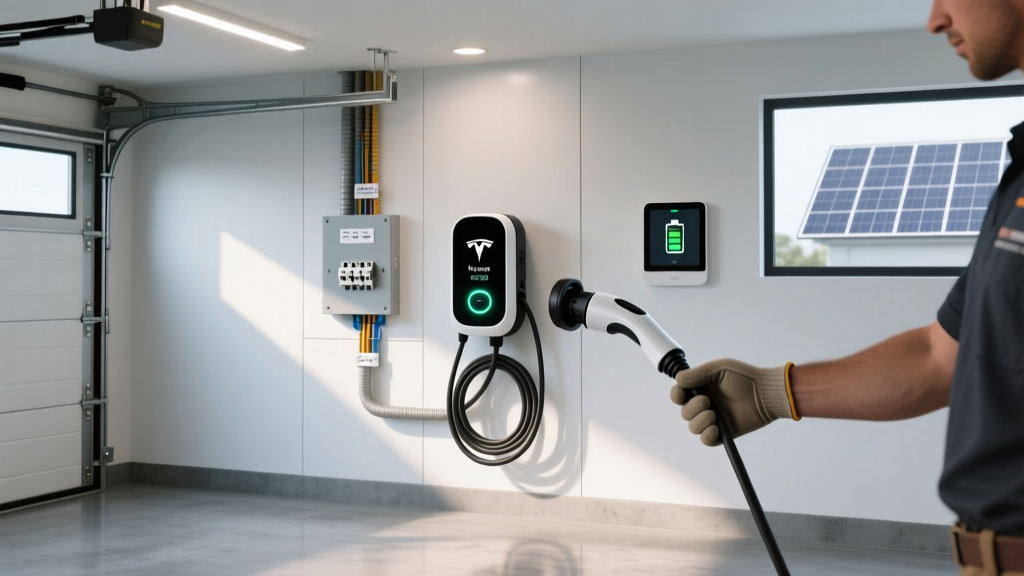
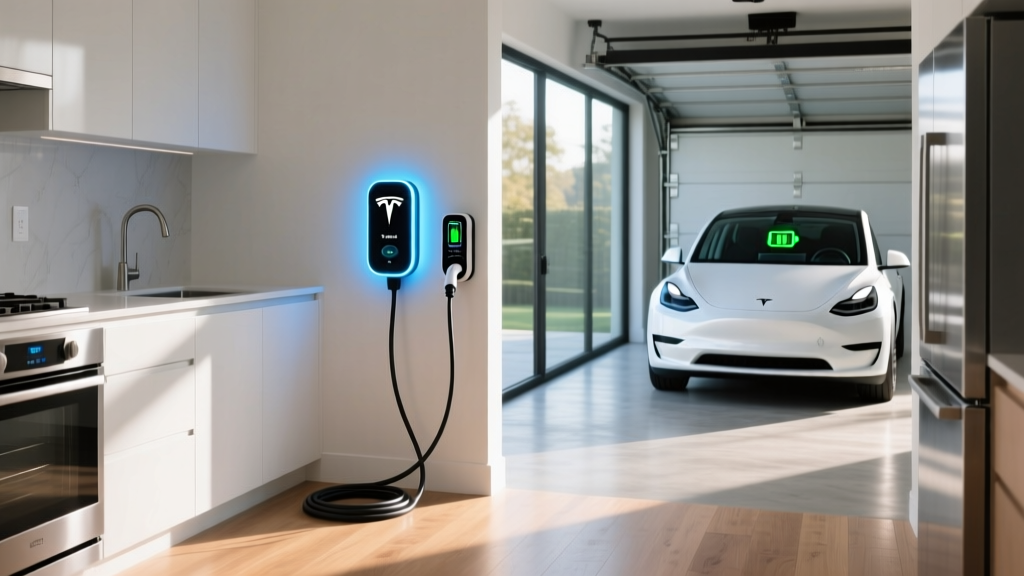
If you're asking how much does it cost to install a Tesla charger at home, the short answer is $600 to $2,500+ depending on your electrical panel, wiring distance, and local permit fees. That total includes the Tesla Wall Connector hardware (~$475), a licensed electrician's labor ($400–$1,500), and permits ($50–$250). Homes needing a panel upgrade from 100A to 200A service should budget an additional $1,500–$3,500.
Below, we break down every cost component, explain charging speeds in concrete numbers, and recommend the best equipment for Tesla and non-Tesla EVs alike. All figures reflect 2026 pricing and current National Electrical Code (NEC) requirements.
Understanding Charging Levels: Speed, Power, and What They Mean
Before budgeting an installation, you need to understand the three charging levels available to EV owners. The critical distinction: kW (kilowatts) measures power — how fast energy flows into your battery — while kWh (kilowatt-hours) measures energy — the total capacity of your battery. Think of kW as the width of a pipe and kWh as the size of the tank.
| Level | Voltage / Amperage | Max Power (kW) | Miles of Range per Hour | Typical Use Case |
|---|---|---|---|---|
| Level 1 | 120V / 12–16A | 1.4–1.9 kW | 3–5 mi/hr | Overnight trickle; PHEVs or low-mileage commutes |
| Level 2 (Home) | 240V / 32–48A | 7.7–11.5 kW | 25–44 mi/hr | Daily home charging; full overnight refill |
| DC Fast Charging | 400–800V DC | 50–350 kW | 150–1,000+ mi/hr | Road trips; 10–80% in 15–30 min |
For context, a Tesla Model Y Long Range has a usable battery of approximately 75 kWh. On Level 1 (1.4 kW), a full charge takes roughly 54 hours. On a Level 2 Tesla Wall Connector at 11.5 kW, that same charge takes about 6.5 hours — easily done overnight. On a 250 kW Tesla Supercharger, you can go from 10% to 80% in approximately 20–25 minutes, though charge speed tapers significantly above 80% to protect battery health.
Full Cost Breakdown: Installing a Tesla Wall Connector at Home
The total installed cost of a Tesla Wall Connector depends on four variables: hardware, electrical labor, permits, and whether your panel can handle the additional load. Here's what real-world installations look like in 2026:
| Component | Low Estimate | High Estimate | Notes |
|---|---|---|---|
| Tesla Wall Connector (hardware) | $475 | $475 | Single price; includes 24-ft cable, Wi-Fi, NACS connector |
| Electrician labor (simple install) | $400 | $800 | Short wire run (<30 ft), panel has capacity, drywall/conduit straightforward |
| Electrician labor (complex install) | $800 | $1,800 | Long wire run, conduit through masonry, attic/crawlspace routing, trenching |
| Permit & inspection | $50 | $250 | Varies by municipality; some jurisdictions bundle with inspection |
| Panel upgrade (if needed) | $1,500 | $3,500 | 100A → 200A service; not required if panel has spare capacity |
| Total (no panel upgrade) | $925 | $2,525 | Most common scenario for modern homes with 200A service |
| Total (with panel upgrade) | $2,425 | $6,025 | Older homes or those adding multiple high-draw appliances |
Do You Need a Panel Upgrade?
A licensed electrician will perform a load calculation per NEC Article 220 to determine if your panel has headroom for a 40A or 60A EV circuit. Homes with 200A service and gas appliances typically have enough capacity. Homes with 100A service, all-electric appliances (heat pump, electric range, electric dryer), or existing high-draw circuits are more likely to need an upgrade. Ask your electrician for this calculation before committing to a 48A charger — a 32A (7.7 kW) circuit may be sufficient and avoid the upgrade entirely.
Electrical Requirements: What Your Installer Will Specify
The Tesla Wall Connector is configurable for several circuit sizes. Your electrician will match the breaker and wire gauge to the amperage you select:
- 48A charging requires a 60A breaker with 6 AWG copper wire (or 4 AWG aluminum). This delivers up to 11.5 kW on a 240V circuit — the fastest Level 2 speed the Wall Connector supports.
- 40A charging requires a 50A breaker with 6 AWG copper wire. Delivers up to 9.6 kW.
- 32A charging requires a 40A breaker with 8 AWG copper wire. Delivers up to 7.7 kW — often the sweet spot for homes with limited panel capacity.
- 24A or 16A options exist for constrained panels, delivering 5.8 kW and 3.8 kW respectively.
Per NEC 625, EV charging circuits are classified as continuous loads, meaning the breaker must be rated at 125% of the actual charging amperage. That's why a 48A charger needs a 60A breaker (48 × 1.25 = 60).
Safety and Code Considerations
Your installation must meet these NEC and local code requirements:
- Dedicated circuit: The EV charger must have its own breaker — no sharing with other outlets or appliances.
- GFCI protection: NEC 2023 (and carried forward into 2026 adoptions) requires GFCI protection for all 240V EV charging outlets. Hardwired Wall Connectors have built-in ground-fault protection, which may satisfy this requirement without an external GFCI breaker. Confirm with your local inspector — jurisdictions interpret this differently.
- Outdoor rating: The Tesla Wall Connector is rated NEMA 4 (indoor/outdoor). If mounting outdoors, ensure the conduit entry is sealed and the unit is positioned to avoid direct sprinkler spray.
- Disconnect: Some jurisdictions require a visible disconnect switch within sight of the charger for hardwired installations. The Wall Connector's integrated power-off capability may or may not satisfy this — check local amendments.
Connector Compatibility: NACS, CCS, and Adapters
As of 2026, the North American Charging Standard (NACS) — originally Tesla's proprietary connector — has become the dominant EV charging connector. Nearly every major automaker (Ford, GM, Rivian, Hyundai, Kia, BMW, and others) has adopted NACS for new vehicles starting in the 2025–2026 model years.
| Connector | Used By | Home Charging | Public DC Fast Charging |
|---|---|---|---|
| NACS (Tesla) | All Tesla vehicles; Ford, GM, Rivian, Hyundai, Kia, BMW (2025+ models) | Tesla Wall Connector (native); J1772 chargers with adapter | Tesla Supercharger network; growing third-party NACS stations |
| CCS1 | Legacy models (pre-2025 VW, some Stellantis, older Hyundai/Kia) | J1772 Level 2 (native); CCS DC chargers | Electrify America, EVgo, ChargePoint DC stations |
| CHAdeMO | Nissan Leaf (discontinued in US after 2025); Mitsubishi Outlander PHEV | J1772 Level 2 (native) | Limited and declining availability |
| J1772 | All EVs (universal Level 2 AC connector standard) | Universal for Level 2; Tesla vehicles need J1772-to-NACS adapter (included with Tesla) | N/A (AC only, not used for DC fast charging) |
Adapter note: If you own a non-Tesla EV with a NACS port (e.g., 2026 Ford F-150 Lightning) and want to use a Tesla Wall Connector, it plugs in natively — no adapter needed. If you own a CCS-equipped EV (e.g., 2024 VW ID.4), you'll need a NACS-to-J1772 adapter (~$150–$250) to use a Tesla Wall Connector, or simply choose a J1772-native charger like the ChargePoint Home Flex or Emporia Vue.
Charging Time Examples: How Long Does a Full Charge Take?
Charge times depend on your battery size, the charger's kW output, and your vehicle's onboard charger limit. Here are realistic 10–80% times for common EVs on a Tesla Wall Connector at 48A (11.5 kW):
- Tesla Model 3 RWD (57.5 kWh usable, LFP battery): ~3.5 hours from 10–80%. LFP batteries can be charged to 100% regularly without degradation concerns — Tesla recommends periodic 100% charges for LFP calibration.
- Tesla Model Y Long Range (~75 kWh usable, NMC battery): ~4.5 hours from 10–80%. For NMC chemistry, daily charging to 80% maximizes long-term battery health.
- Ford F-150 Lightning Extended Range (131 kWh usable): ~8 hours from 10–80% on 11.5 kW. This is why truck owners often opt for the 80A Ford Pro Power Connect charger at 19.2 kW if their panel supports it.
- Hyundai Ioniq 5 (77.4 kWh usable): ~4.7 hours from 10–80% on 11.5 kW. Note: the Ioniq 5's 10.9 kW onboard charger caps AC charging speed, so a 48A circuit provides no benefit over a 40A circuit for this vehicle.
Charge Curve Reality Check
DC fast charging speeds are not linear. A Tesla Supercharger rated at 250 kW delivers that peak only between roughly 10–30% state of charge. From 30–60%, speed tapers to ~150 kW; from 60–80%, it drops to ~80 kW. Above 80%, speeds fall to Level 2 rates to prevent lithium plating. This is why manufacturers quote "10–80%" times — the final 20% takes disproportionately long. On a road trip, plan to charge to 80% and drive on rather than wait for a full charge.
Cost to Charge: Home vs. Public vs. Gas
One of the strongest arguments for home charging is cost. Here's how per-mile fueling expenses compare in 2026, using a Tesla Model Y Long Range (averaging 3.5 miles/kWh or ~286 Wh/mi) as our baseline:
| Scenario | Cost per kWh | Cost per Mile (Model Y) | Monthly Cost (1,200 mi) |
|---|---|---|---|
| Home (national avg. residential) | $0.17/kWh | $0.049 | $58 |
| Home (off-peak TOU rate) | $0.09/kWh | $0.026 | $31 |
| Home (California peak TOU) | $0.42/kWh | $0.120 | $144 |
| Tesla Supercharger (avg.) | $0.32/kWh | $0.091 | $110 |
| Electrify America DC fast | $0.48/kWh | $0.137 | $164 |
| Gas vehicle (25 MPG, $3.40/gal) | — | $0.136 | $163 |
According to the U.S. Energy Information Administration, the national average residential electricity price is approximately $0.17/kWh in early 2026. At that rate, home charging a Model Y costs roughly $0.05 per mile — about one-third the cost of fueling a comparable gas SUV. If your utility offers time-of-use (TOU) rates and you charge overnight, costs drop to under $0.03 per mile.
The breakeven math on your charger installation is straightforward: at $0.05/mi home charging vs. $0.14/mi gas, you save ~$0.09 per mile. Over 15,000 miles/year, that's $1,350 in annual fuel savings. A $1,500 charger installation pays for itself in roughly 13 months.
Equipment Recommendations: Best Home Chargers for Tesla and Non-Tesla EVs
The Tesla Wall Connector is an excellent choice for Tesla owners, but it's not the only option — and it's not always the best choice for mixed-EV households. Here are our top picks based on power output, connector type, smart features, and build quality:
Tesla Wall Connector (Gen 4)
- Power: Up to 11.5 kW (48A on 240V)
- Connector: NACS (native Tesla)
- Cable length: 24 ft
- Smart features: Wi-Fi, OTA updates, access control, power-sharing with second unit, scheduled charging
- Price: $475
- Best for: Tesla-only households; anyone wanting the cleanest NACS integration
ChargePoint Home Flex (J1772)
- Power: Up to 12 kW (50A on 240V)
- Connector: J1772 (universal Level 2; Tesla vehicles use included adapter)
- Cable length: 23 ft
- Smart features: Wi-Fi, app scheduling, Alexa/Google integration, detailed energy reporting
- Price: $649
- Best for: Households with both Tesla and non-Tesla EVs; J1772-native flexibility
Emporia Vue Smart EV Charger
- Power: Up to 11.5 kW (48A on 240V)
- Connector: J1772 (with NACS adapter option)
- Cable length: 24 ft
- Smart features: Wi-Fi, solar-aware charging integration with Emporia energy monitor, TOU scheduling
- Price: $399
- Best for: Budget-conscious buyers; solar-panel households wanting to charge on excess production
Grizzl-E Smart (United Chargers)
- Power: Up to 10 kW (40A on 240V)
- Connector: J1772 (NACS version available)
- Cable length: 24 ft
- Smart features: Wi-Fi, OCPP-compatible (future-proof for utility demand-response programs), adjustable amperage
- Price: $549
- Best for: Cold-climate installations (rated to -40°F); commercial/rental property use
Federal Tax Credit: Can You Get 30% Back on Your Charger?
The Alternative Fuel Vehicle Refueling Property Credit (IRS Form 8911) was revived under the Inflation Reduction Act and remains available for 2026. It provides a tax credit of up to 30% of the cost of home EV charging equipment and installation, capped at $1,000.
Key eligibility requirements:
- The equipment must be installed at your primary residence in the United States.
- The installation must be in a census tract that meets low-income or non-urban criteria — this was a significant restriction added by the IRA. Many suburban and urban areas do not qualify. Check your census tract using the DOE's eligibility tool.
- Both the hardware cost and electrician labor qualify toward the 30% calculation.
- The credit is non-refundable — it can reduce your tax liability to zero but won't generate a refund beyond that.
Example: If your total installation cost is $1,800 (hardware + electrician + permit) and you're in an eligible census tract, you'd claim 30% × $1,800 = $540 as a tax credit. Consult a tax professional to confirm eligibility — census tract rules are specific and change with updated IRS guidance.
Frequently Asked Questions
How much does it cost to install a Tesla charger if my panel is already 200A?
With a 200A panel that has spare capacity, expect to pay $925–$1,500 total: $475 for the Tesla Wall Connector, $400–$800 for electrician labor on a straightforward install, and $50–$250 for permits. This is the most common scenario for homes built after 2000.
Can I install a Tesla Wall Connector myself?
Tesla sells the Wall Connector as a hardwired unit that requires a licensed electrician for installation in virtually all jurisdictions. DIY installation of a 240V, 60A circuit violates NEC requirements in most areas, voids the product warranty, and creates serious fire and shock risk. Some municipalities allow homeowner electrical work with a permit and inspection, but the liability and insurance implications make professional installation strongly advisable.
Will a Tesla Wall Connector work with my non-Tesla EV?
If your non-Tesla EV has a NACS charge port (standard on 2025+ Ford, GM, Rivian, and others), the Tesla Wall Connector plugs in directly. If your EV has a CCS1/J1772 port, you'll need a NACS-to-J1772 adapter (~$150–$250), or you should choose a J1772-native charger like the ChargePoint Home Flex instead.
How fast will each charging level add range?
Level 1 (120V) adds 3–5 miles of range per hour. Level 2 at 48A (11.5 kW) adds 35–44 miles per hour depending on vehicle efficiency. DC fast charging at 250 kW can add 200+ miles in 15 minutes, but only at low states of charge — speed tapers significantly above 50–60% SoC.
What if my home only has 100A electrical service?
You have three options: (1) Install a lower-amperage charger (16A or 24A on a 20A or 30A breaker) that still provides adequate overnight charging for most commutes; (2) use a smart panel monitor like the Emporia Vue or Span drive to dynamically limit charger draw when other appliances are running; or (3) upgrade to 200A service for $1,500–$3,500. Option 1 is the most cost-effective if you drive under 40 miles daily.
Does the Tesla Wall Connector require Wi-Fi?
Wi-Fi is not required for basic charging — the Wall Connector will charge your vehicle without a network connection. However, Wi-Fi enables firmware updates, access control (restricting who can use your charger), energy tracking, and scheduled charging features. If your garage lacks Wi-Fi coverage, a simple mesh extender ($30–$50) resolves the issue.
How much does it cost to charge a Tesla at home vs. Supercharging?
At the national average residential rate of $0.17/kWh, home charging a Model Y costs approximately $0.05/mile. Tesla Superchargers average $0.32/kWh, or about $0.09/mile. Home charging is roughly 45% cheaper per mile than Supercharging and about 65% cheaper than gasoline. The savings widen further with off-peak TOU rates.