The Real Cost of DC Fast Charging: Superchargers, Public Networks, and Your Wallet
If you've searched "how much do Superchargers cost" and found only vague answers, you're not alone. Tesla's Supercharger network pioneered transparent pricing, but the broader DC fast-charging landscape remains confusing for EV buyers weighing their options. This guide breaks down exactly what you'll pay at Tesla Superchargers, third-party DC fast networks like Electrify America and EVgo, and how those costs compare to Level 2 home charging and gasoline.
Before we get to pricing, a critical distinction that trips up many new EV owners: kW (kilowatts) measures power — how fast energy flows into your battery. kWh (kilowatt-hours) measures energy — the total amount of electricity stored. You pay per kWh consumed, and the kW rate determines how quickly you accumulate those kWh. Think of kW as the width of the hose and kWh as the total gallons in the bucket.
Charging Levels Explained: Speed, Power, and What to Expect
Every EV owner interacts with three charging tiers. Here's how they stack up in real-world output:
| Level | Voltage | Typical Power (kW) | Miles of Range Added per Hour | Best Use Case |
|---|---|---|---|---|
| Level 1 | 120V AC | 1.0–1.4 kW | 3–5 miles | Overnight top-ups, PHEVs, low daily mileage |
| Level 2 | 240V AC | 7.2–19.2 kW | 25–70 miles | Daily home charging, workplace, shopping centers |
| DC Fast Charging | 400–800V DC | 50–350 kW | 150–1,000+ miles (per hour equivalent) | Road trips, rapid top-ups, commercial fleets |
A few real-world nuances: DC fast charging rates are peak values, not sustained. A Tesla Model Y peaking at 250 kW on a V3 Supercharger won't hold that rate for the entire session. Charging follows a curve — rapid from 10% to roughly 50% state of charge (SoC), then progressively tapering. A typical 10–80% session on a V3 Supercharger takes about 25–30 minutes for a 75 kWh battery. Above 80%, the rate drops sharply to protect battery longevity, which is why most road-trippers charge to 80% and move on.
How Much Do Superchargers Actually Cost Per kWh?
Tesla Supercharger pricing varies by location, time of day, and local utility rates. As of 2026, here's what typical Tesla owners are paying:
- Average Supercharger cost: $0.25–$0.40 per kWh (varies by state and site)
- Peak hours (4–9 PM in many markets): $0.35–$0.55 per kWh
- Off-peak hours (overnight/early morning): $0.18–$0.28 per kWh
- Idle fees: $0.50–$1.00 per minute if you remain plugged in after reaching your charge limit at a busy station
For a Tesla Model 3 Long Range with a ~75 kWh usable battery, a 10–80% session (roughly 52.5 kWh added) at an average $0.32/kWh would cost approximately $16.80. That's enough to restore about 230 miles of EPA-rated range.
Third-Party DC Fast Charging Costs
Non-Tesla networks price differently, and costs have risen as infrastructure matures:
- Electrify America: $0.31–$0.48 per kWh; Pass+ membership ($4/month) reduces rates by roughly 25%
- EVgo: $0.30–$0.45 per kWh; EVgo Plus plans offer discounted rates for a monthly fee
- ChargePoint (DC fast stations): $0.28–$0.45 per kWh, set by site host
- Ionity (Europe, for reference): €0.39–€0.79 per kWh (~$0.42–$0.85 USD)
Non-Tesla EVs using Tesla Superchargers via the NACS adapter or native NACS port (increasingly standard on 2025–2026 models from Ford, GM, Rivian, and others) generally pay the same per-kWh rate as Tesla owners, though some locations apply a small adapter surcharge.
Home Charging vs. Supercharger vs. Gas: Cost Per Mile Breakdown
The biggest financial advantage of EV ownership emerges when you charge at home. Here's a direct comparison using national averages:
| Charging/Fueling Method | Cost per kWh or Gallon | Vehicle Efficiency | Cost Per Mile |
|---|---|---|---|
| Home Level 2 (national avg. electricity) | $0.16/kWh | 3.5 mi/kWh (286 Wh/mi) | $0.046 |
| Home Level 2 (off-peak TOU rate) | $0.09/kWh | 3.5 mi/kWh | $0.026 |
| Tesla Supercharger (avg.) | $0.32/kWh | 3.5 mi/kWh | $0.091 |
| Electrify America (avg.) | $0.38/kWh | 3.0 mi/kWh (larger SUV) | $0.127 |
| Gasoline (30 MPG combined) | $3.30/gallon | 30 MPG | $0.110 |
| Gasoline (22 MPG combined, truck/SUV) | $3.30/gallon | 22 MPG | $0.150 |
Key takeaway: Home-charged electricity at standard rates costs roughly one-third to one-half what gasoline costs per mile. Even DC fast charging at Supercharger rates undercuts most gasoline vehicles — but relying exclusively on DC fast charging erodes the EV cost advantage significantly. If you can't charge at home or at work, your per-mile fuel cost may approach or exceed that of an efficient hybrid.
According to fueleconomy.gov, efficiency varies widely across EVs. A Tesla Model 3 achieves roughly 26–28 kWh/100mi (3.6–3.8 mi/kWh), while a Ford F-150 Lightning consumes 47–49 kWh/100mi (~2.1 mi/kWh). Your actual cost per mile depends heavily on your specific vehicle's efficiency.
How Much Does It Cost to Install a Home EV Charger?
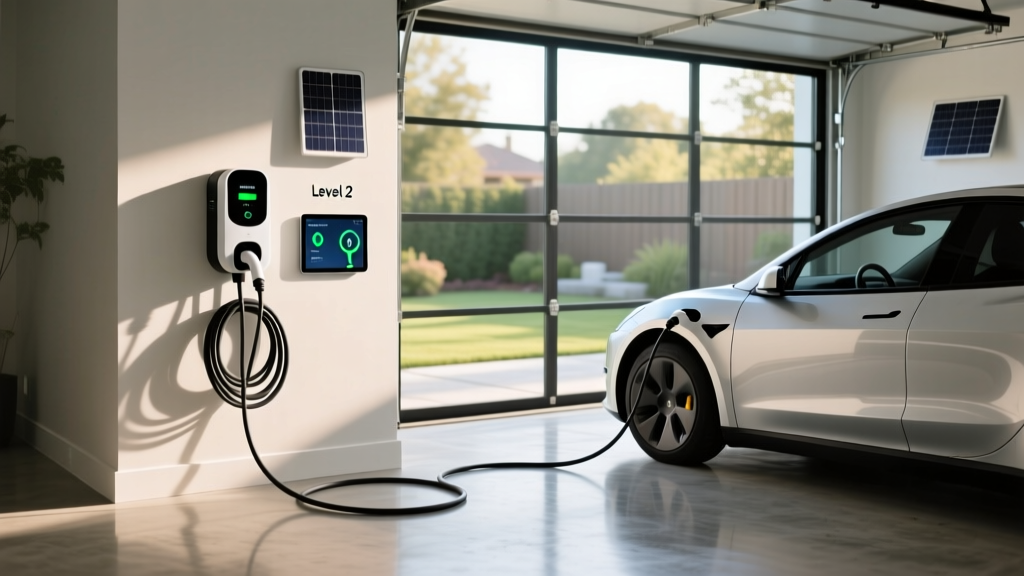
Installing a Level 2 home charger is the single most impactful upgrade for EV ownership convenience and cost savings. Here's a realistic breakdown:
| Component | Typical Cost Range | Notes |
|---|---|---|
| Level 2 EVSE (charger hardware) | $350–$750 | 32A–48A smart chargers; Wi-Fi enabled models at upper range |
| Electrician labor (standard install) | $500–$1,500 | Assumes panel is near garage; 240V/40–50A dedicated circuit |
| Permit and inspection | $50–$250 | Required in most jurisdictions; varies by municipality |
| Electrical panel upgrade (if needed) | $1,500–$3,500 | Upgrading from 100A to 200A service; common in older homes |
| Conduit/wiring (long runs) | $200–$800 | When panel is far from charging location; per-foot costs add up |
| Total (no panel upgrade) | $900–$2,500 | Most homes with 200A service and nearby panel |
| Total (with panel upgrade) | $2,400–$6,050 | Older homes with 100A service or maxed-out panels |
What Electrical Upgrades Might You Need?
Most Level 2 chargers require a 240V dedicated circuit at 40–60 amps. Here's what determines whether your home is ready:
- Panel capacity: A 200-amp electrical panel can typically support a 40A–50A EV circuit alongside existing loads. A 100A panel often cannot, especially if you have electric heat, an electric dryer, and an electric oven all drawing simultaneously.
- Available breaker slots: You need two adjacent slots for a 240V double-pole breaker. Full panels may require a sub-panel installation.
- Wire gauge: A 48A charger (60A circuit, per NEC 80% continuous-load rule) requires 6 AWG copper wire. Longer runs may need 4 AWG to prevent voltage drop.
- GFCI protection: The 2020 NEC (and 2023 NEC updates adopted by most states by 2026) requires GFCI protection for EV charging circuits — your electrician will include this.
The panel upgrade is the most expensive surprise for older-home buyers. If your home was built before 1990 with original 100A service, budget for the upgrade. A licensed electrician can perform a load calculation to confirm whether your panel has headroom — don't skip this step.
Which Connector and Charger Is Compatible With My EV?
The connector landscape has consolidated significantly since 2024, but it still matters for your purchase decisions:
| Connector | Also Known As | Compatible Brands (2026 Models) | Adapter Needed? |
|---|---|---|---|
| NACS | Tesla connector, J3400 | Tesla (all), Ford, GM, Rivian, Volvo, Polestar, Mercedes, Nissan (2026+) | No for native NACS; CCS→NACS adapters available (~$200–$300) |
| CCS1 | Combo | Hyundai, Kia, BMW, VW, legacy models from Ford/GM pre-2025 | CCS→NACS adapter needed for Tesla Superchargers |
| CHAdeMO | — | Nissan Leaf (legacy), Mitsubishi Outlander PHEV | Limited adapter options; network declining |
The North American Charging Standard (NACS) has effectively won the connector war. By 2026, nearly every major automaker has adopted NACS as the native port on new models. If you're buying a 2025–2026 EV, it likely has NACS. If you own an older CCS-equipped EV, a Tesla CCS-to-NACS adapter (~$200–$250) unlocks the Supercharger network — a significant advantage for road trips.
CHAdeMO is essentially a legacy standard. New CHAdeMO stations are rare, and most CHAdeMO owners rely on CCS/NACS networks with adapters or older stations that are being phased out.
Recommended Home Level 2 Chargers: Power, Features, and Price
Not all Level 2 chargers are equal. Here are four proven options across different budgets and needs:
ChargePoint Home Flex
- Power output: Up to 12 kW (50A) on a 60A circuit; configurable down to 16A
- Connector: NACS or J1772 (select at purchase)
- Cable length: 23 feet
- Smart features: Wi-Fi, app scheduling, Alexa integration, energy reporting
- Price: ~$550–$650
- Best for: Flexible amperage for homes with limited panel capacity
Tesla Wall Connector
- Power output: Up to 11.5 kW (48A) on a 60A circuit
- Connector: NACS native; J1772 adapter included
- Cable length: 24 feet
- Smart features: Wi-Fi, over-the-air updates, power sharing (link multiple units on one circuit), Tesla app integration
- Price: ~$475
- Best for: Tesla owners and NACS-native EVs; cleanest integration with Tesla vehicles
Emporia Level 2 EV Charger
- Power output: Up to 11.5 kW (48A)
- Connector: J1772 (NACS adapter available separately)
- Cable length: 24 feet
- Smart features: Wi-Fi, detailed energy monitoring, solar integration, time-of-use scheduling
- Price: ~$350–$400
- Best for: Budget-conscious buyers who want granular energy data and solar pairing
Grizzl-E Smart
- Power output: Up to 10 kW (40A) on a 50A circuit
- Connector: J1772 or NACS (select at purchase)
- Cable length: 24 feet
- Smart features: Wi-Fi, OCPP-compatible, adjustable amperage via dip switches
- Price: ~$450–$550
- Best for: Outdoor installations (IP67-rated, -40°C to +50°C operating range), extreme climates
For most homeowners with a 200A panel, a 48A charger on a 60A circuit delivers the best balance of charging speed and electrical headroom. If your panel is tight on capacity, choose a charger with adjustable amperage (like the ChargePoint Home Flex) and set it to 32A or 40A to avoid a panel upgrade.
Charging Time Examples: How Long Does a Full Session Take?
Charging time depends on battery size, charger power, and the vehicle's onboard charge acceptance rate. Here are realistic 10–80% session times for common scenarios:
- Tesla Model 3 Long Range (75 kWh, NACS): ~25–28 minutes on a 250 kW V3 Supercharger; ~8.5 hours on a 48A Level 2 home charger
- Ford F-150 Lightning Extended Range (131 kWh, NACS): ~40–45 minutes on a 150+ kW DC fast charger; ~14 hours on a 48A Level 2
- Hyundai Ioniq 5 (77.4 kWh, CCS1): ~18–22 minutes on a 350 kW Electrify America station (800V architecture enables ultra-fast charging); ~9 hours on a 40A Level 2
- Chevrolet Equinox EV (85 kWh, NACS): ~30–35 minutes on a 150 kW DC fast charger; ~10 hours on a 48A Level 2
Remember the charge curve: the last 20% (80–100%) takes nearly as long as the first 50% due to tapering. On road trips, charging from 10–80% and driving on is far more time-efficient than waiting for a full charge.
Safety, Code, and Installation Best Practices
EV charging involves sustained high-current draw — more like running an electric furnace for hours than plugging in a phone. Safety isn't optional:
- Dedicated circuit: Your EV charger must be on its own dedicated breaker. Sharing a circuit with other appliances risks tripping or overheating.
- NEC 80% rule: Continuous loads (defined as 3+ hours) must use only 80% of a circuit's rated capacity. A 48A charger requires a 60A breaker. A 40A charger requires a 50A breaker.
- GFCI protection: Required for all EV receptacles under current NEC. Hardwired EVSE units have GFCI built in; receptacle-based setups need a GFCI breaker.
- Outdoor rating: If your charger is outdoors, ensure it's rated NEMA 4 or IP65+ for weather resistance. Most quality EVSE units meet this standard.
- Permit and inspection: Most jurisdictions require an electrical permit for EV charger installation. The inspection ensures your wiring, breaker, and grounding meet code. Skipping this can void home insurance coverage for electrical fires.
- Use a licensed electrician: This is not a DIY project. Improper EV charger wiring has caused residential fires. A licensed electrician will pull the permit, perform the load calculation, and ensure code compliance.
Frequently Asked Questions
How much does it cost to charge a Tesla at a Supercharger?
At the 2026 national average of ~$0.32/kWh, fully charging a Tesla Model 3 Long Range (75 kWh usable battery) from 10% to 80% costs approximately $16–$17. A full 0–100% session would cost roughly $24, though charging above 80% is slow and rarely worth the time on a road trip. Prices vary by location, with California and Northeast stations often exceeding $0.40/kWh during peak hours.
Is it cheaper to charge at home or at a Supercharger?
Home charging is dramatically cheaper. At the national average residential rate of ~$0.16/kWh (per EIA data), home charging costs about $0.046 per mile for an average EV. Supercharger rates average $0.32/kWh, or about $0.091 per mile — roughly double. Over 12,000 annual miles, that's a difference of ~$540 per year in favor of home charging.
Do non-Tesla EVs pay more at Superchargers?
As of 2026, most Tesla Supercharger locations that accept non-Tesla vehicles (via the "Open Supercharging" program or native NACS ports on Ford, GM, and Rivian vehicles) charge the same per-kWh rate. Some locations previously applied a small surcharge for non-Tesla vehicles, but this has largely been eliminated as NACS adoption has become standard. Tesla membership plans (offering lower per-kWh rates) are available to all NACS-equipped vehicles.
How fast will a Level 2 home charger add range overnight?
A 48A Level 2 charger on a 60A circuit delivers up to 11.5 kW. For a typical EV consuming ~300 Wh/mile, that translates to roughly 38 miles of range per hour of charging. Over a 10-hour overnight session, you'd add approximately 380 miles — more than enough to fully recharge most EV batteries. Even a 32A charger (7.7 kW) adds ~25 miles per hour, or 250 miles overnight.
Can I install a Level 2 charger without upgrading my electrical panel?
It depends on your panel's capacity. A 200A panel with available breaker slots can usually accommodate a 40A–50A EV circuit without an upgrade. A licensed electrician will perform a NEC Article 220 load calculation to determine if your existing loads (HVAC, electric oven, dryer, water heater) leave enough headroom. If your panel is maxed out, options include a panel upgrade ($1,500–$3,500), installing a lower-amperage charger (24A–32A), or using an automated load-management device that throttles the charger when other appliances draw heavily.
Are DC fast chargers bad for my EV battery?
Occasional DC fast charging has minimal impact on battery health. However, exclusive reliance on DC fast charging (150+ kW) can accelerate degradation slightly over thousands of cycles. Modern battery management systems (BMS) actively manage temperature and charge rates to mitigate this. Most manufacturers warranty their batteries for 8 years/100,000 miles with a minimum 70% capacity retention threshold. For daily use, Level 2 home charging at moderate rates is gentler on the battery, and most owners who can charge at home reserve DC fast charging for road trips.
Do I qualify for a tax credit for installing a home charger?
The federal Alternative Fuel Vehicle Refueling Property Credit (IRS Form 8911) covers 30% of home EV charger equipment and installation costs, up to $1,000. However, eligibility depends on your census tract meeting certain low-income or rural criteria. Check the IRS eligibility tool or consult a tax professional, as qualifying areas are specific and not all homeowners will benefit. Some states and utilities offer additional rebates — check your local utility's EV programs.