The Rise of Solar-Powered EV Charging
As electric vehicle adoption accelerates, homeowners are increasingly looking to pair their EVs with rooftop solar panels. Charging an electric vehicle using grid electricity can be expensive, but harnessing excess solar production to fuel your daily commute is both economically and environmentally optimal. However, simply plugging into a standard Level 2 charger does not guarantee you are using solar energy; without smart software, your charger will pull from the grid the moment the sun goes behind a cloud. This is where solar-integrated smart chargers come into play.
In this head-to-head product showdown, we are comparing the two undisputed leaders in residential solar EV charging integration: the Emporia Level 2 EV Charger (paired with the Vue energy monitor) and the Enphase IQ EV Charger. Both systems promise to divert excess solar production directly into your vehicle's battery, but they achieve this through fundamentally different hardware ecosystems and installation requirements. According to the Alternative Fuels Data Center, proper EVSE (Electric Vehicle Supply Equipment) selection and installation are critical for maximizing both safety and energy efficiency in a residential setting.
The Contenders at a Glance
Before diving into the technical installation nuances, let us compare the core specifications and solar-routing capabilities of both systems.
| Feature | Emporia Level 2 EV Charger | Enphase IQ EV Charger |
|---|---|---|
| Max Amperage | 40A (48A with dual-charger config) | 40A (Continuous) |
| Solar Integration Method | Vue 2/3 Energy Monitor (CT Clamps) | Enphase Envoy Gateway & IQ Microinverters |
| Ecosystem Lock-in | Works with any solar inverter brand | Requires Enphase Microinverters |
| Wiring Options | Hardwired or NEMA 14-50 Receptacle | Hardwired Only |
| Approx. Hardware Cost | $400 (Charger) + $150 (Vue Monitor) | $750 - $800 (Charger + Gateway) |
Emporia Level 2 EV Charger: The Universal Energy Balancer
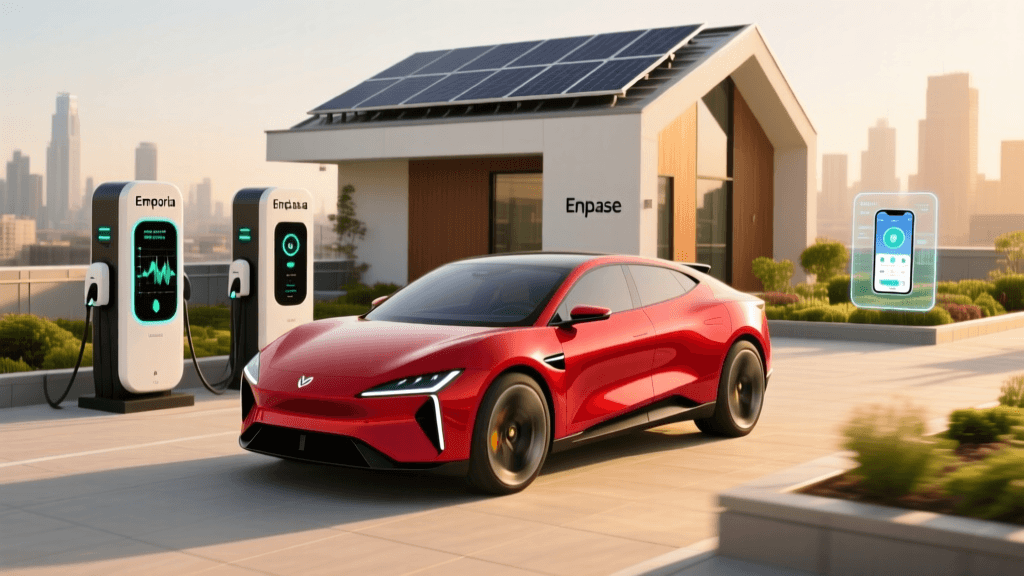
The Emporia ecosystem is built around the Vue energy monitor, a device that tracks your home's energy consumption and solar production at the circuit level. To enable solar diversion, the Emporia EV Charger communicates directly with the Vue monitor via your home's Wi-Fi network.
How the Solar Diversion Works
When you enable 'Eco Mode' or 'Solar Only' charging in the Emporia app, the system monitors the main service lines and the solar production lines in real-time. If your solar panels are generating 3 kW of excess power that would otherwise be exported to the grid (often for minimal compensation), the Emporia charger dynamically adjusts the amperage sent to your EV to absorb exactly that excess. If a cloud passes over and solar production drops, the charger throttles down or pauses entirely to prevent pulling from the grid.
Installation Requirements
Installing the Emporia system is more involved than a standard plug-and-play charger. Your electrician must install the main Vue monitor inside your electrical panel. This requires placing Current Transformer (CT) clamps around your main utility feed lines and your solar inverter feed lines. Space inside the electrical panel is a primary constraint; if your panel is already crowded with breakers, finding room for the Vue monitor and the EV charger's dedicated 50-amp or 60-amp breaker can be challenging.
- Wiring: Supports both hardwired and NEMA 14-50. However, for continuous 40A solar diversion, hardwiring is highly recommended to avoid thermal throttling associated with 14-50 receptacles.
- Connectivity: Requires a stable 2.4 GHz Wi-Fi signal at the charger location and the electrical panel for the Vue monitor.
Enphase IQ EV Charger: The Microinverter Master
Enphase is a titan in the solar industry, famous for its microinverter technology. The Enphase IQ EV Charger is designed specifically for homes that already utilize the Enphase ecosystem. Unlike Emporia, which measures power at the main panel, Enphase measures solar production at the individual panel level via its microinverters and aggregates this data through the Envoy gateway.
How the Solar Diversion Works
The Enphase IQ EV Charger connects directly to the Enphase Envoy gateway using a proprietary low-voltage communication wire or via the local network. Because the Envoy already knows exactly how much excess solar is being produced, the IQ charger can seamlessly initiate 'Green Charging' mode. The U.S. Department of Energy highlights that integrated smart home energy management systems like Enphase's can significantly reduce a household's net grid dependency by automating load-shifting behaviors.
Installation Requirements
The primary caveat of the Enphase IQ charger is ecosystem lock-in. It will not communicate with SolarEdge, SMA, or generic string inverters. Furthermore, the IQ charger is strictly hardwired; Enphase does not offer a NEMA 14-50 plug version. This means your electrician must run conduit directly to the unit and terminate the wires inside the charger's housing. While this eliminates the fire risk associated with loose 14-50 receptacle connections, it makes the charger semi-permanent and slightly harder to relocate if you move.
Head-to-Head: Electrical Panel Upgrades and Code Compliance
When integrating high-draw EV chargers with existing solar systems, electrical panel capacity is the ultimate bottleneck. According to research from the National Renewable Energy Laboratory (NREL), residential electrical infrastructure often requires upgrades to accommodate the simultaneous presence of solar backfeed and heavy EV charging loads.
The 120% Rule and NEC Article 625
Under the National Electrical Code (NEC), specifically the 120% rule for busbar ratings, a standard 200-amp electrical panel can handle a maximum of 240 amps of combined utility and solar backfeed. If you have a 40A continuous EV charger (requiring a 50A breaker) and a large solar array backfeeding a 60A breaker, you may exceed the busbar rating.
Pro Tip for Homeowners: If your 200A panel cannot accommodate both the solar backfeed and the new EV charger breaker under the 120% rule, your electrician may need to perform a 'line-side tap' for the solar connection, install an automated load management system, or upgrade your main service panel to 300A or 400A. Smart panels like the SPAN Panel can dynamically manage these circuits without requiring a full utility service upgrade.
NEMA 14-50 vs. Hardwired for Solar Homes
While Emporia offers a NEMA 14-50 plug option, solar diversion often involves long, continuous charging sessions throughout the afternoon. The NEC recently updated code requirements regarding torque specifications for receptacles. Many local inspectors now require a receptacle to be installed on a dedicated circuit with no other outlets, and some jurisdictions are pushing back against 14-50 plugs for continuous 40A loads due to thermal melting risks. For a dedicated solar-diverting setup, hardwiring either the Emporia or the Enphase unit is the superior, code-compliant choice.
Cost Analysis: Hardware, Installation, and ROI
Calculating the true cost of these systems requires looking beyond the sticker price of the charger itself.
- Emporia Total Setup Cost: The charger ($400) plus the Vue monitor ($150) brings the hardware to $550. Installation typically ranges from $500 to $1,200, depending on the complexity of fitting the CT clamps and running 6-gauge THHN wire through conduit. Total estimated cost: $1,050 - $1,750.
- Enphase Total Setup Cost: The charger and necessary gateway upgrades typically cost around $750. Because it requires hardwiring and strict integration with the existing Envoy, installation can range from $600 to $1,500. Total estimated cost: $1,350 - $2,250.
However, the ROI is realized through net metering avoidance. If your utility company has reduced solar export compensation (NEM 3.0 in California, for example), self-consuming your solar via EV charging is vastly more profitable than selling it back to the grid for pennies.
The Verdict: Which Solar EV Charger Should You Install?
The choice between Emporia and Enphase ultimately comes down to your existing solar hardware and your installation preferences.
Choose the Emporia Level 2 EV Charger if:
You have a non-Enphase solar system (such as a SolarEdge string inverter or Tesla Solar Panels). Emporia's Vue monitor is agnostic to the solar brand; it simply measures the physics of the electrons entering and leaving your panel. It is also the better choice if you prefer the flexibility of a NEMA 14-50 receptacle installation, provided your local electrical codes permit it for continuous loads.
Choose the Enphase IQ EV Charger if:
Your roof is already equipped with Enphase IQ microinverters. The native integration is flawless, requiring no additional CT clamps or third-party energy monitors in your electrical panel. The hardwired-only approach also provides superior long-term safety and reliability for high-amperage, continuous solar charging sessions.
Both chargers represent the pinnacle of residential energy management. By selecting the right unit for your specific ecosystem, you can effectively turn your electric vehicle into a rolling solar battery, maximizing your renewable energy investment while minimizing your utility bills.