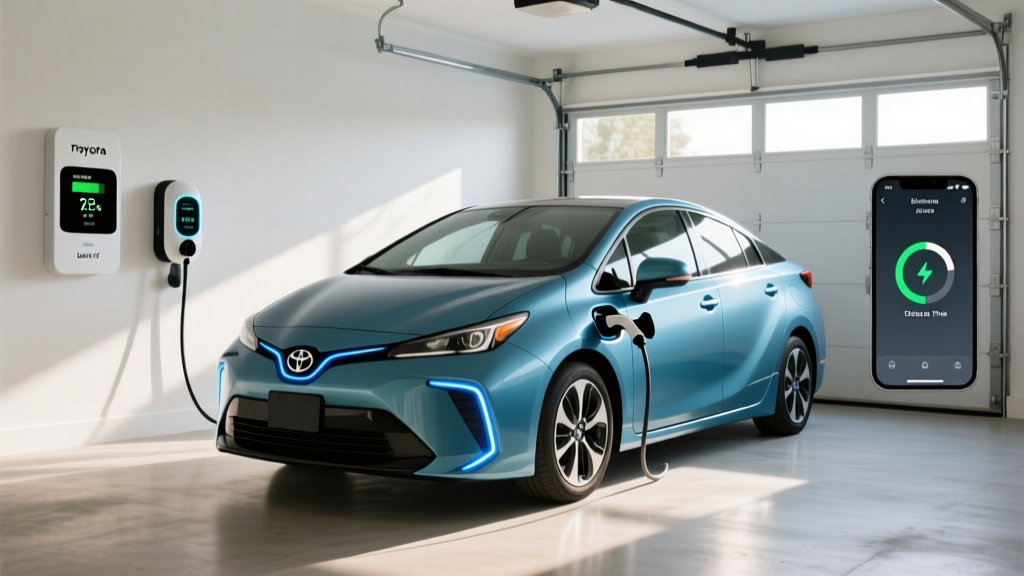
The 2025 Toyota Prius Prime delivers an EPA-estimated 44 miles of electric-only range on higher trims (SE offers 48 miles), making it one of the most efficient plug-in hybrids on the market. But extracting every one of those EV miles — and minimizing your cost per mile — depends entirely on how you charge. A proper Level 2 home setup ensures you start every morning with a full 13.6 kWh battery, while relying on Level 1 alone means you may never fully replenish the pack overnight.
This guide breaks down the exact charging speeds, home installation requirements, connector compatibility, and real-world costs for Prius Prime owners in 2026, with data sourced from fueleconomy.gov and Toyota's official specifications.
Prius PHEV Range and Battery: What You're Charging
Before selecting a charger, understand what you're filling. The current-generation Prius Prime (2023–2026 model years) uses a 13.6 kWh lithium-ion battery pack (NMC chemistry). However, not all of that capacity is usable — Toyota buffers the top and bottom of the pack to preserve longevity, yielding roughly 11.5–12.0 kWh of usable energy for propulsion.
The EPA rates the Prius Prime XSE at 44 miles EV-only and the SE at 48 miles. In real-world driving, expect 36–42 miles at sustained highway speeds (70+ mph) or in cold weather below 40°F, where cabin heating and battery resistance reduce efficiency. City driving with regenerative braking often matches or slightly exceeds the EPA sticker.
| Spec | SE | XSE / XSE Premium |
|---|---|---|
| EPA EV Range | 48 mi | 44 mi |
| Battery (total / usable) | 13.6 kWh / ~12.0 kWh | 13.6 kWh / ~12.0 kWh |
| Combined MPGe (EV mode) | 127 MPGe | 114 MPGe |
| Combined MPG (hybrid mode) | 52 MPG | 48 MPG |
| Onboard AC charger | 3.3 kW | 3.3 kW |
| Max DC Fast Charge | Not supported | Not supported |
| Charge Port | J1772 | J1772 |
| Base MSRP | ~$33,475 | ~$36,725 |
| Hybrid Battery Warranty | 10 yr / 150,000 mi | 10 yr / 150,000 mi |
Critical limitation: The Prius Prime has a 3.3 kW onboard AC charger and no DC fast-charging capability. This means even if you plug into a 48-amp Level 2 station, the car will only accept 3.3 kW. This fundamentally shapes your charging strategy — there's no benefit to oversizing your home charger beyond what the car can accept.
Charging Levels Explained: Speeds in kW and Miles Per Hour
Understanding the difference between kW (power — the rate of energy delivery) and kWh (energy — the battery's capacity) is essential. Think of kW as the flow rate of a hose and kWh as the size of the bucket.
| Level | Voltage | Max Power | Prius Prime Actual | EV Miles/Hour | Full Charge Time |
|---|---|---|---|---|---|
| Level 1 | 120V AC | ~1.4 kW | 1.4 kW | ~4–5 mi/hr | ~9–10 hours |
| Level 2 | 240V AC | Up to 19.2 kW | 3.3 kW (car-limited) | ~12–14 mi/hr | ~4 hours |
| DC Fast | 200–500V DC | 50–350 kW | N/A | N/A | N/A |
Key takeaway for Prius Prime owners: Level 1 charging can work if you drive less than 30 miles daily and have 10+ hours between drives. But a Level 2 home charger cuts charge time to roughly 4 hours, meaning you can easily top off mid-day or guarantee a full battery every morning even with a late return home. DC fast charging is not an option — the Prius Prime lacks a CCS or CHAdeMO port for rapid charging.
Home Charger Installation: Electrical Requirements and Costs
Since the Prius Prime accepts only 3.3 kW, you might assume a basic circuit is sufficient — and you'd be right. A 240V / 20A dedicated circuit (delivering ~3.8 kW, more than the car can use) is the minimum professional recommendation. However, most electricians recommend installing a 240V / 40A or 50A circuit to future-proof for a BEV upgrade or a second EV.
What the Installation Involves
- Dedicated circuit: A 240V circuit run from your main panel to the charging location, with appropriately sized wire (10-gauge for 20A, 6-gauge for 40A, 4-gauge for 50A).
- GFCI protection: The National Electrical Code (NEC) requires GFCI protection for EV charging outlets in garages and all outdoor locations.
- NEMA 14-50 outlet vs. hardwired: A NEMA 14-50 receptacle (50A) offers flexibility — you can unplug the charger when moving. Hardwired units eliminate the outlet but may be required if your panel lacks capacity for a high-amperage receptacle.
- Permit: Most jurisdictions require an electrical permit for new 240V circuits. Your electrician typically pulls this; inspection follows.
Panel Upgrade Considerations
This is where costs can spike. Older homes with 100A electrical service may not have sufficient spare capacity for a new 40A or 50A circuit, especially if you already run electric HVAC, a dryer, and an electric range. A panel upgrade to 200A service costs between $1,500 and $3,000+ depending on your utility and local code requirements. Newer homes (post-2000) typically have 200A panels with adequate headroom.
Pro tip: Since the Prius Prime only needs 3.3 kW (~16A at 240V), you may be able to install a 20A circuit without a panel upgrade even in older homes. Ask your electrician to perform a load calculation per NEC Article 220 before committing to a panel upgrade.
| Component | Basic (20A/3.8 kW) | Standard (40A/9.6 kW) | With Panel Upgrade |
|---|---|---|---|
| EV Charger (Level 2 unit) | $200–$400 | $350–$700 | $350–$700 |
| Electrician labor + materials | $400–$800 | $600–$1,500 | $600–$1,500 |
| Electrical permit | $50–$200 | $50–$200 | $150–$400 |
| Panel upgrade (if needed) | — | — | $1,500–$3,000+ |
| Total Estimated Cost | $650–$1,400 | $1,000–$2,400 | $2,600–$5,600+ |
Note: The IRS §30D tax credit applies to new EV purchases, not charger installation. However, some utilities and state programs offer rebates of $250–$500 for Level 2 equipment or installation. Check with your local utility and your state energy office. A tax professional can confirm eligibility for any active residential energy credits.
Connector Compatibility: J1772, NACS, and Adapters
The Prius Prime uses a J1772 connector for AC charging — the North American standard for Level 1 and Level 2. It does not have a NACS (Tesla) port or a CCS1 port, and it cannot use DC fast chargers of any type.
| Connector | Type | Prius Prime Compatible? | Notes |
|---|---|---|---|
| J1772 | AC (L1/L2) | ✅ Yes — native port | All home chargers and public AC stations |
| NACS (Tesla) | AC/DC | ⚠️ With adapter (AC only) | Tesla Mobile Connector with J1772 adapter works; Tesla wall connector includes J1772 adapter on some models |
| CCS1 | DC Fast | ❌ No | Prius Prime has no DC fast-charge capability |
| CHAdeMO | DC Fast | ❌ No | Legacy DC standard; not applicable |
Bottom line: Any Level 2 home charger with a J1772 plug will work natively with the Prius Prime. If you're considering a Tesla Wall Connector (which ships with a NACS plug), you'll need the Tesla J1772 adapter (~$50) to charge a Prius Prime. Many non-Tesla chargers ship with J1772 as standard.
Recommended Level 2 Chargers for the Prius Prime
Because the Prius Prime caps AC charging at 3.3 kW, you don't need a 48-amp charger. A 16-amp or 20-amp Level 2 unit is technically sufficient. However, most buyers wisely invest in a 32A or 40A charger for future-proofing — the cost difference is minimal, and the charger will support a future BEV.
Emporia Level 2 Smart Charger
- Power: 48A / 11.5 kW (Prius uses 3.3 kW)
- Connector: J1772
- Cable length: 24 ft
- Smart features: Wi-Fi, energy monitoring, scheduling via app, load management
- Price: ~$399
- Best for: Budget-conscious buyers wanting smart features and energy tracking
ChargePoint Home Flex
- Power: Configurable 16A–50A / up to 12 kW
- Connector: J1772
- Cable length: 23 ft
- Smart features: Wi-Fi, app scheduling, Alexa integration, amperage adjustable to circuit
- Price: ~$549
- Best for: Flexibility — set amperage to match your circuit without buying a new unit
Tesla Wall Connector
- Power: 48A / 11.5 kW
- Connector: NACS (requires Tesla-to-J1772 adapter for Prius Prime)
- Cable length: 24 ft
- Smart features: Wi-Fi, OTA updates, power sharing between two units
- Price: ~$420 + ~$50 adapter
- Best for: Households with both a Tesla and a J1772 vehicle
Grizzl-E Smart
- Power: 40A / 9.6 kW
- Connector: J1772
- Cable length: 24 ft
- Smart features: Bluetooth, OCPP-compatible, rugged outdoor-rated enclosure
- Price: ~$449
- Best for: Outdoor installations and extreme climates (-40°F rated)
Cost to Charge: Per-Mile Breakdown vs. Gasoline
The Prius Prime's 13.6 kWh battery (approximately 12 kWh usable) is small by BEV standards, which makes charging costs exceptionally low. Here's what you'll actually spend per mile in different scenarios:
| Scenario | Rate | Cost for Full Charge (~12 kWh) | Cost Per Mile (EV) |
|---|---|---|---|
| Home (off-peak utility rate) | $0.10/kWh | $1.20 | $0.027/mi |
| Home (national avg. residential) | $0.17/kWh | $2.04 | $0.046/mi |
| Public Level 2 (network pricing) | $0.25–$0.49/kWh | $3.00–$5.88 | $0.068–$0.134/mi |
| Gasoline (hybrid mode, 52 MPG) | $3.40/gal (2026 avg.) | — | $0.065/mi |
The verdict: Charging at home on off-peak rates, the Prius Prime costs roughly 2.7 cents per mile in EV mode — less than half the cost of driving it in hybrid mode on gasoline. Even at average residential electricity rates, EV mode undercuts gas by about 30%. However, expensive public Level 2 stations ($0.40+/kWh) can actually cost more per mile than the Prius's highly efficient hybrid mode. This is why home charging is essential for maximizing the economic benefit of a PHEV.
For a driver covering 12,000 miles/year with 70% of those miles in EV mode on home charging, annual fuel savings versus running exclusively on gas are approximately $280–$350. The Prius Prime's advantage isn't dramatic per-mile savings — it's the combination of EV-mode silence and smoothness for daily commuting, plus gas flexibility for road trips without range anxiety.
Safety, Code, and Best Practices
A Level 2 charger installation is a permanent electrical modification to your home. Getting it right protects your property, your vehicle, and your insurance coverage.
- Always use a licensed electrician. DIY 240V work is dangerous and typically voids homeowner insurance if unpermitted work causes a fire.
- Dedicated circuit required. NEC 625.40 requires EV charging equipment to be on its own dedicated branch circuit — it cannot share with other appliances.
- GFCI protection. NEC 2023 (625.54) mandates GFCI protection for all receptacles used for EV charging, including indoor garages. This may require a GFCI breaker ($40–$80 additional).
- Outdoor-rated equipment. If your charger is installed outside, ensure the unit has a NEMA 4 weather-resistance rating. All recommended chargers above meet this standard.
- Cable management. A 24-foot cable can become a tripping hazard. Wall-mount a cable organizer or choose a charger with a retractable cord system.
- Don't use extension cords. Never plug a Level 1 or Level 2 charger into an extension cord — this creates a fire risk and violates NEC.
- Set charge scheduling. Use your charger's app to schedule charging during off-peak utility hours (typically 10 PM–6 AM) to save $0.05–$0.10/kWh.
Frequently Asked Questions
How much does it cost to install a home EV charger for a Prius Prime?
For a basic 240V/20A circuit with a budget Level 2 charger, expect $650–$1,400 total (equipment, electrician, permit). A standard 40A installation runs $1,000–$2,400. If your home needs a panel upgrade from 100A to 200A service, add $1,500–$3,000+. Since the Prius Prime only draws 3.3 kW, the basic 20A installation is perfectly adequate and often avoids the need for a panel upgrade.
How fast will each charging level add range to the Prius Prime?
Level 1 (120V standard outlet) adds approximately 4–5 miles of EV range per hour, meaning a full charge from empty takes 9–10 hours. Level 2 (240V) adds approximately 12–14 miles per hour, reaching a full charge in about 4 hours. The Prius Prime does not support DC fast charging.
Which connector and charger is compatible with my Prius Prime?
The Prius Prime uses the J1772 connector for AC charging. Any Level 1 or Level 2 charger with a J1772 plug is natively compatible. Tesla Wall Connectors require a Tesla-to-J1772 adapter (~$50). The Prius Prime cannot use CCS1, CHAdeMO, or NACS DC fast chargers.
How much does charging cost per mile versus gasoline?
At home off-peak rates ($0.10/kWh), EV mode costs roughly $0.027/mile. At average residential rates ($0.17/kWh), it's about $0.046/mile. Gasoline in hybrid mode at 52 MPG and $3.40/gallon costs $0.065/mile. Home charging is consistently cheaper; expensive public Level 2 stations ($0.40+/kWh) can exceed gasoline cost per mile.
What electrical upgrades might I need for a Prius Prime charger?
The Prius Prime's 3.3 kW draw is modest. Most homes with a 200A panel can add a 20A or 40A 240V circuit without a panel upgrade. Homes with 100A service may need a load calculation — if spare capacity is insufficient, a panel upgrade to 200A costs $1,500–$3,000+. Because the Prius Prime needs so little power, a 20A circuit (requiring less panel headroom) is often the smartest choice for older homes.
Can I just use the included Level 1 charger?
Yes, if your daily driving is under 30 miles and you have 10+ hours between drives. The included Level 1 cord (120V, ~1.4 kW) will replenish the battery overnight. However, Level 1 charging is slow, generates more heat in the cord over extended sessions, and won't fully recharge the battery if you return home with a depleted pack and need a full charge by morning. A Level 2 installation is strongly recommended for anyone wanting to maximize their Prius PHEV range utilization daily.
Does the Prius Prime qualify for a federal tax credit?
The Prius Prime may qualify for up to $3,750 under the IRS §30D Clean Vehicle Credit, depending on battery mineral sourcing requirements that change annually. Eligibility also depends on your modified adjusted gross income (caps: $150K single, $300K joint) and the vehicle's MSRP (must be under $55,000 for cars). The credit can now be transferred to the dealer as a point-of-sale discount. Consult IRS.gov §30D guidelines and a tax professional for your specific eligibility.