The VW ID.4 V2L Adapter Question: What You Need to Know
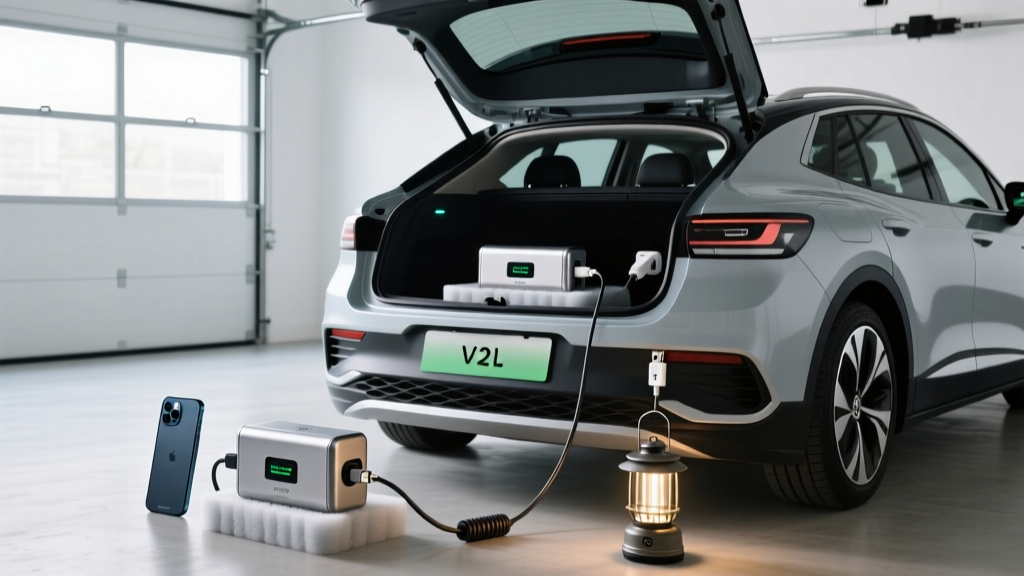
If you own or are shopping for a Volkswagen ID.4 and want to power devices, appliances, or even a home panel from your EV's battery, you've likely searched for a VW ID.4 V2L adapter. Vehicle-to-Load (V2L) lets you plug standard 120V AC devices directly into your EV, essentially turning its battery pack into a giant portable generator. It's one of the most compelling features on competitors like the Hyundai Ioniq 5, Kia EV6, and Ford F-150 Lightning — but the ID.4's story is different.
Here's the reality for the 2025–2026 model years: Volkswagen has not officially enabled V2L on the US-spec ID.4. While the ID.4's MEB platform is technically capable of bidirectional power flow in some markets (notably China, where a V2L adapter was offered), the North American ID.4 lacks the software authorization and the OEM adapter accessory. There is no VW part number you can order from a US dealer to enable AC power output from the charge port or cabin outlets.
Some owners have experimented with third-party CCS1-to-AC adapters from overseas marketplaces, but these carry real risks: no UL listing, no VW warranty coverage, potential damage to the vehicle's onboard charger, and possible electrical code violations. Until VW formally enables the feature in the US market, the safest path for ID.4 owners who need portable power is a standalone battery generator (like an EcoFlow or Jackery) or a small inverter paired with a dedicated auxiliary battery — not the traction battery.
Charging the VW ID.4: Every Level Explained
Whether or not V2L is available, keeping your ID.4 charged is straightforward once you understand the three charging levels. The ID.4 comes with an 82 kWh usable battery pack (NMC chemistry) and EPA-rated range of up to 291 miles on the Pro S AWD trim. Here's how each charging level performs:
| Level | Power Source | Max kW | Miles of Range Added per Hour | Typical Use Case |
|---|---|---|---|---|
| Level 1 | 120V household outlet | ~1.2 kW | ~3–5 mi/hr | Emergency top-ups, overnight trickle |
| Level 2 | 240V (home or public) | 11 kW (ID.4 onboard limit) | ~32–37 mi/hr | Daily home charging, workplace |
| DC Fast | 480V+ public station | 175 kW peak (2025+ models) | ~200+ mi in 30 min | Road trips, highway corridors |
A critical distinction for new EV owners: kW (kilowatts) measures power — the rate of energy flow — while kWh (kilowatt-hours) measures energy, the total amount stored in the battery. Think of kW as how fast water flows through a hose, and kWh as the total gallons in the tank. Your home Level 2 charger delivers power in kW; your ID.4's battery stores energy in kWh.
On DC fast charging, the 2025–2026 ID.4 peaks at 175 kW on compatible CCS1 stations. In real-world testing, expect a 10–80% charge in roughly 30–34 minutes. Note that the charge curve tapers significantly above 80% — charging from 80–100% can take nearly as long as 10–80%. For road trips, plan to leave at 80% to minimize station time.
Home Level 2 Installation: Requirements, Costs, and Gotchas
Most ID.4 owners will do 85–95% of their charging at home on a Level 2 station. The ID.4's onboard charger accepts up to 11 kW on AC power, which means a 48-amp charger on a 240V/60A circuit will max out the vehicle's AC charging capability. Here's what a proper installation requires:
Electrical requirements: A dedicated 240V circuit with a 60-amp breaker (for a 48A continuous-load charger, per NEC 80% rule). If you opt for a 40-amp charger, a 50-amp breaker suffices. The circuit must be run from your main electrical panel using appropriately gauged wire (typically 6 AWG copper for 60A, 8 AWG for 50A).
Panel upgrade reality: Many homes built before 2000 have 100-amp main panels that may not have capacity for an additional 60A EV circuit. A panel upgrade to 200 amps typically costs $1,500–$3,000 before any charger work begins. Have an electrician perform a load calculation before committing to equipment.
| Component | Low Estimate | High Estimate | Notes |
|---|---|---|---|
| Level 2 EVSE equipment | $350 | $750 | 40A–48A smart charger |
| Electrician labor | $500 | $1,500 | Depends on panel-to-outlet distance |
| Electrical materials (wire, conduit) | $150 | $500 | Long runs increase cost significantly |
| Permit and inspection | $50 | $300 | Varies by municipality |
| Panel upgrade (if needed) | $1,500 | $3,000 | 100A to 200A service upgrade |
| Total (no panel upgrade) | $1,050 | $3,050 | |
| Total (with panel upgrade) | $2,550 | $6,050 |
Always pull a permit. Unpermitted electrical work can void your homeowner's insurance and cause issues during a home sale. Most jurisdictions require a licensed electrician to pull the permit, and an inspection ensures the work meets NEC Article 625 (Electric Vehicle Charging System Equipment).
Connector Compatibility: CCS1, NACS, and Adapter Needs
The US-spec VW ID.4 uses a CCS1 (Combined Charging System) connector for both AC Level 2 and DC fast charging. This is the standard shared by most non-Tesla EVs sold in North America through 2024. However, the industry is shifting rapidly toward Tesla's NACS (North American Charging Standard), and this affects your long-term charging access.
| Connector | Used By | AC + DC Combined? | ID.4 Compatible? |
|---|---|---|---|
| CCS1 | VW, BMW, GM (pre-2025), Hyundai/Kia (pre-2025), Ford (pre-2025) | Yes | Native — no adapter needed |
| NACS (Tesla) | Tesla (all), Ford (2025+), GM (2025+), Rivian, Volvo, most OEMs by 2026 | Yes | Adapter required for NACS stations |
| CHAdeMO | Nissan Leaf (legacy), Mitsubishi | DC only (J1772 for AC) | Not compatible; not needed |
Starting in 2025, Volkswagen announced that future US models will transition to NACS. For current ID.4 owners, VW offers a CCS1-to-NACS adapter (or it may be included depending on model year) to access Tesla Supercharger stations. As of 2025–2026, most Electrify America, EVgo, and ChargePoint DC fast stations still have CCS1 cables, so ID.4 owners have broad access without adapters at non-Tesla networks.
For home Level 2 charging, all Level 2 EVSE units sold in the US come with a J1772 connector, which is the AC portion of the CCS1 plug. Your ID.4 will accept any standard Level 2 charger without an adapter.
Charging Cost Per Mile: EV vs Gas
One of the strongest ownership arguments for the ID.4 is fuel cost savings. Here's how charging costs compare to gasoline on a per-mile basis, using the ID.4's EPA-rated efficiency of approximately 3.0–3.2 kWh per mile (roughly 104 MPGe combined):
| Scenario | Cost per kWh or Gallon | Cost per Mile | Annual Cost (12,000 mi) |
|---|---|---|---|
| Home charging (off-peak utility rate) | $0.12/kWh | $0.036–$0.038 | $432–$456 |
| Home charging (standard rate) | $0.18/kWh | $0.054–$0.058 | $648–$696 |
| Public Level 2 (e.g., ChargePoint) | $0.30/kWh | $0.090–$0.096 | $1,080–$1,152 |
| DC Fast Charging (e.g., Electrify America) | $0.48/kWh | $0.144–$0.154 | $1,728–$1,848 |
| Gasoline SUV (25 MPG combined) | $3.50/gal | $0.140 | $1,680 |
Home charging on an off-peak or time-of-use rate plan is roughly 75% cheaper per mile than gasoline. Even public DC fast charging at premium rates is cost-competitive with gas in many regions. The key to maximizing savings is setting up home Level 2 charging and using scheduled charging to hit off-peak utility windows (often midnight–6 AM).
Check your utility's EV rate plan — many now offer dedicated EV tariffs with significantly reduced overnight rates. According to the U.S. Department of Energy's EV cost calculator, electricity rates vary enormously by state, from under $0.10/kWh in parts of the Pacific Northwest to over $0.30/kWh in Hawaii and California peak hours.
Recommended Level 2 Chargers for the VW ID.4
Since the ID.4 caps AC charging at 11 kW, a 48-amp charger on a 60A circuit is the sweet spot. Here are top picks based on reliability, smart features, and real-world performance:
ChargePoint Home Flex
Power: Up to 12 kW (50A adjustable)
Connector: J1772 (CCS1 AC compatible)
Cable: 23 ft
Smart features: Wi-Fi, app scheduling, Alexa, load sharing
Price: ~$550–$650
Why it works: Amperage adjustable from 16A–50A, works with any panel capacity. Excellent app for tracking ID.4 charging sessions and scheduling off-peak charges.
Emporia Level 2 EV Charger
Power: Up to 11.5 kW (48A)
Connector: J1772
Cable: 24 ft
Smart features: Wi-Fi, app, energy monitoring, solar integration
Price: ~$350–$400
Why it works: Best value in smart chargers. Real-time energy monitoring helps track exact charging cost per session. Pairs well with Emporia's whole-home energy monitor.
Wallbox Pulsar Plus
Power: Up to 11.5 kW (48A)
Connector: J1772
Cable: 25 ft
Smart features: Wi-Fi + Bluetooth, app scheduling, Power Sharing
Price: ~$450–$550
Why it works: Compact form factor, NEMA 4 outdoor rating, and Power Sharing lets you daisy-chain two units on one circuit — ideal for two-EV households.
For all of these chargers, the ID.4 will cap draw at 11 kW regardless of the EVSE's maximum output. A 48A charger gives you headroom for future EVs that may accept higher AC rates (like the Ford F-150 Lightning at 19.2 kW).
Safety, Code, and Installation Best Practices
EV charging installations must comply with NEC Article 625, which governs Electric Vehicle Charging System Equipment. Key requirements:
- Dedicated circuit: Your EV charger must be on its own dedicated breaker — no shared circuits with other appliances.
- GFCI protection: NEC 2020 and later require GFCI protection for all EVSE outlets (receptacle-type installations). Hardwired units have built-in ground-fault protection.
- Outdoor rating: If installing outdoors or in an exposed garage, choose a NEMA 4 or NEMA 4X rated charger to withstand rain, dust, and temperature extremes.
- Cable management: Avoid running charging cables across walkways. Wall-mount a cable organizer to prevent tripping hazards and cord damage.
- Continuous load rule: EV charging is classified as a continuous load (over 3 hours). The circuit breaker must be rated at 125% of the charger's maximum amperage — hence a 48A charger requires a 60A breaker.
Never use an extension cord with your EV charger. Never plug a Level 1 charger into a circuit shared with high-draw appliances (refrigerators, space heaters). And always verify that your outlet or hardwired connection is properly grounded — an ungrounded 240V circuit is a serious shock hazard.
Frequently Asked Questions
Can I use a third-party V2L adapter with my VW ID.4?
Third-party CCS-to-AC adapters exist on overseas marketplaces, but they are not UL-listed, not approved by Volkswagen, and may damage the ID.4's onboard charger or void your powertrain warranty. We strongly recommend against using any V2L adapter not sold and supported by VW through official US channels.
Will VW add V2L to the ID.4 in a future software update?
Volkswagen has indicated interest in bidirectional charging capabilities for the MEB platform, and the hardware supports it. However, as of the 2026 model year, no official timeline or commitment has been made for US-spec V2L activation. VW's ID.7 and future SSP-platform vehicles are more likely candidates for first US bidirectional features.
How much does it cost to install a home EV charger for the ID.4?
Expect $1,050–$3,050 for a standard installation (equipment, electrician, materials, permit) if your electrical panel has sufficient capacity. If a panel upgrade from 100A to 200A is required, add $1,500–$3,000, bringing the total to $2,550–$6,050.
How fast does the ID.4 charge on Level 2 at home?
At the ID.4's maximum AC rate of 11 kW, you'll add approximately 32–37 miles of range per hour. A full charge from 10% to 100% on a depleted 82 kWh battery takes roughly 8–9 hours — easily accomplished overnight.
Does the ID.4 need a NACS adapter for Tesla Superchargers?
Yes. The ID.4 uses a CCS1 connector. To access Tesla Supercharger stations (which use NACS), you'll need a CCS1-to-NACS adapter. Check with your VW dealer for availability, as VW has been providing adapters to qualifying ID.4 owners.
What's the ID.4's DC fast charging time from 10–80%?
On a 175 kW CCS1-capable DC fast charger, the 2025–2026 ID.4 charges from 10% to 80% in approximately 30–34 minutes. Peak charge rate of 175 kW is sustained only between roughly 10–30% SoC, after which the curve tapers. Expect average charging power of ~110–120 kW across the full 10–80% session.
Sources: fueleconomy.gov for EPA range and efficiency data; Volkswagen USA for ID.4 specifications and charging details; IRS.gov for current federal EV tax credit eligibility rules.