Why a New 2-Door Charger Setup Changes Your Electrical Plan
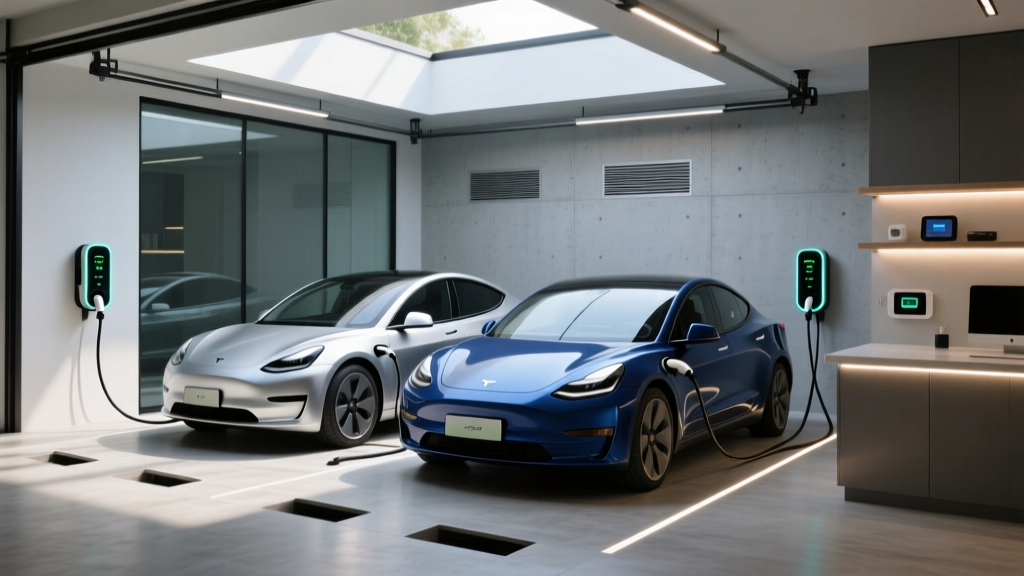
If you're designing a new 2-door charger garage — a two-bay garage with separate doors where each bay gets its own dedicated EV charger — you're planning for one of the most practical home EV setups available. Whether you're charging two vehicles simultaneously or simply want a charger on each side of a shared wall, the electrical and equipment decisions you make now will define your daily charging experience for years.
Dual-charger garages introduce a critical variable that single-charger setups don't: simultaneous load. Two Level 2 chargers running at 40 amps each pull 80 amps of continuous 240V draw, which translates to a 100-amp circuit allocation under the National Electrical Code's 125% continuous-load rule. That's a significant chunk of a typical 200-amp residential panel, and it's the single most important factor driving your installation cost and feasibility.
This guide covers every technical and financial detail you need to plan a new 2-door charger installation in 2026, from circuit sizing and panel upgrades to connector compatibility and per-mile charging costs.
Charging Levels Explained: Speeds, Power, and Range Added
Before choosing equipment, you need a clear understanding of the three EV charging levels and what each delivers in real-world terms. The critical distinction: kW (kilowatts) measures power — the rate at which energy flows into your battery. kWh (kilowatt-hours) measures energy — the total capacity stored. Think of kW as the diameter of a hose and kWh as the size of the bucket.
| Level | Voltage | Power (kW) | Miles of Range Added Per Hour | Typical Use Case |
|---|---|---|---|---|
| Level 1 | 120V AC | 1.0–1.4 kW | 3–5 mi/hr | Overnight top-ups, PHEVs, emergency backup |
| Level 2 | 240V AC | 3.3–19.2 kW | 12–75 mi/hr | Daily home charging — the standard for BEV owners |
| DC Fast Charging | 200–900V DC | 50–350+ kW | 150–1,200+ mi/hr (at peak) | Road trips, quick top-ups on public networks |
For a new 2-door charger garage, Level 2 is your primary installation. Most dual-charger setups use two 48-amp chargers (each pulling 40A continuous on a 50A circuit) or two 40-amp chargers (32A continuous on a 40A circuit). A 48-amp charger delivering 11.5 kW adds roughly 35–44 miles of range per hour depending on vehicle efficiency — enough to fully replenish most EV batteries overnight.
DC fast charging is not installed at home. Those 50–350 kW stations are public infrastructure operated by networks like Electrify America, Tesla Superchargers, and EVgo. You'll use them for road trips, but daily charging should happen at home on Level 2 for battery longevity and cost efficiency.
How Much Does It Cost to Install a Dual Home EV Charger?
A new 2-door charger installation involves four cost layers: the charger hardware, electrical labor, permitting, and potential panel or service upgrades. Here's a realistic breakdown based on 2026 contractor pricing and equipment costs.
| Cost Component | Low-End Estimate | High-End Estimate | Notes |
|---|---|---|---|
| Charger hardware (×2 Level 2 units) | $700 | $1,400 | Smart Wi-Fi chargers, 40–48A, 24ft cable |
| Electrician labor (2 dedicated 240V circuits) | $1,200 | $3,500 | Depends on run length from panel to garage |
| Electrical permit and inspection | $100 | $400 | Varies by municipality; some bundle dual circuits |
| Panel upgrade (if needed: 200A → 325A or 400A) | $2,500 | $5,500 | Required when existing panel lacks capacity for dual 50A circuits |
| Conduit, wiring, and misc. materials | $200 | $800 | THHN copper wire, PVC or EMT conduit, junction boxes |
| Total (no panel upgrade) | $2,200 | $6,100 | Most homes with modern 200A panels and short runs |
| Total (with panel upgrade) | $4,700 | $11,600 | Homes with older 100–150A service or maxed-out panels |
The panel upgrade is the wildcard. A typical 200-amp residential panel may already be near capacity with HVAC, electric range, dryer, and water heater loads. Adding two 50-amp circuits (100 amps combined allocation) can push total calculated load beyond the panel's safe limit. A licensed electrician will perform a load calculation per NEC Article 220 to determine if your panel can handle the addition. If it can't, you'll need either a service upgrade (to 325A or 400A) or a smart load-management system that dynamically throttles charger output when household demand spikes.
Load-management systems like the Emporia Smart Load Manager or Tesla's built-in Power Sharing allow two chargers to share a single 60-amp circuit, splitting available current between them. This can avoid a panel upgrade entirely, though it means slower charging when both vehicles charge simultaneously.
Electrical Requirements: What Your Garage Needs
Each Level 2 charger in a new 2-door charger setup requires its own dedicated 240-volt circuit. Here's what the electrical infrastructure looks like for a typical dual installation:
- Circuit rating: 50-amp breaker per charger (for 40A continuous draw) or 60-amp breaker (for 48A continuous draw). NEC requires circuits rated at 125% of continuous load.
- Wire gauge: 6 AWG copper THHN for 50A circuits; 4 AWG copper for 60A circuits. Aluminum wire (cheaper but thicker) is an option for longer runs.
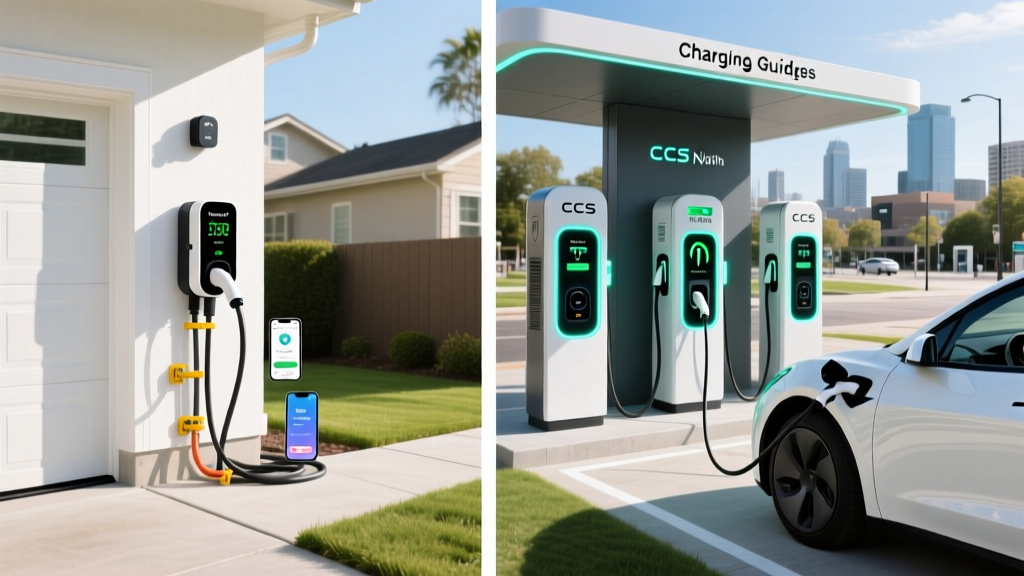
- Outlet vs. hardwired: NEMA 14-50 outlets offer portability (you can unplug and take the charger when you move), while hardwired connections support higher amperage (48A+) and eliminate the GFCI breaker requirement that some jurisdictions mandate on receptacles.
- GFCI protection: NEC 2020 and later require GFCI protection on garage receptacles. Hardwired chargers bypass this requirement. Note: some EV chargers (like the Tesla Wall Connector) already include built-in ground-fault protection.
- Outdoor rating: If either charger is mounted on an exterior wall or in an open carport, it must carry a NEMA 4 or IP65 weather-resistance rating.
Which Connector and Charger Is Compatible With My EV?
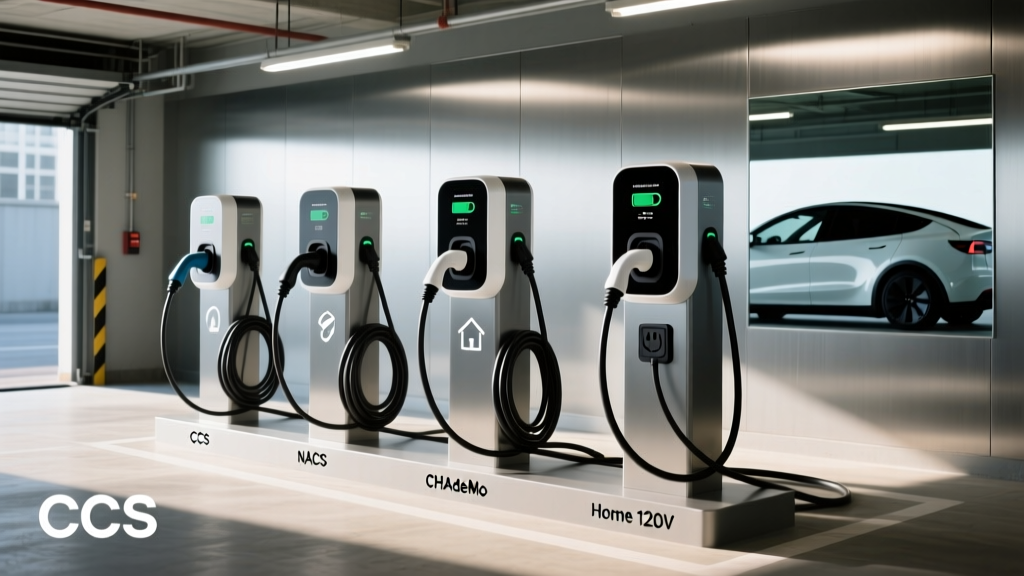
The connector landscape has shifted dramatically. As of 2026, the North American Charging Standard (NACS) — originally Tesla's proprietary connector — has become the dominant plug across nearly all new EVs. Here's where each brand stands:
| EV Brand | Built-In Connector | Adapter Needed for Other Networks? |
|---|---|---|
| Tesla (all models) | NACS | NACS → CCS adapter (included) for non-Tesla DC stations |
| Ford (Mustang Mach-E, F-150 Lightning) | NACS (2025+) | CCS vehicles (pre-2025) need CCS → NACS adapter for Superchargers |
| GM (Chevy Equinox EV, Blazer EV, Silverado EV, Cadillac LYRIQ) | NACS (2025+) | CCS vehicles (pre-2025) need adapter for Supercharger access |
| Hyundai / Kia (Ioniq 5/6, EV6, EV9) | NACS (2025+ models) | Pre-2025 CCS models need adapter for Tesla network |
| Rivian (R1T, R1S) | NACS | No adapter needed for Superchargers |
| BMW (i4, i5, iX, i7) | CCS1 | CCS → NACS adapter for Supercharger access |
| Volkswagen (ID.4, ID.7) | CCS1 | CCS → NACS adapter for Supercharger access |
| Nissan (Leaf — legacy, Ariya) | CHAdeMO (Leaf) / CCS1 (Ariya) | Leaf owners need CHAdeMO → NACS adapter (limited availability) |
For your new 2-door charger garage, the smartest move in 2026 is to install NACS-terminated chargers. Even if you currently own a CCS-equipped EV, a NACS charger with a CCS adapter gives you forward compatibility as the market standardizes. Most charger manufacturers now ship NACS as the default connector, with CCS adapter cables available for $100–$200.
Equipment Picks: Best Level 2 Chargers for a Dual Setup
Here are four proven Level 2 chargers well-suited to a new 2-door charger garage configuration. Each is evaluated on power output, cable length, smart features, and connector availability.
ChargePoint Home Flex (NACS)
- Power: Up to 12 kW (50A circuit) — adjustable down to 16A
- Connector: NACS (native); CCS adapter available
- Cable length: 23 feet
- Smart features: Wi-Fi, app scheduling, Alexa/Google integration, energy tracking
- Load sharing: Yes — pairs two units on one circuit via ChargePoint app
- Price: ~$549 per unit
- Best for: Dual-charger setups with load-sharing on a single 60A circuit
Tesla Wall Connector (NACS)
- Power: Up to 11.5 kW (48A on 60A circuit)
- Connector: NACS native
- Cable length: 24 feet
- Smart features: Wi-Fi, OTA updates, Power Sharing (up to 6 units on one circuit), Tesla app integration
- Load sharing: Yes — industry-leading Power Sharing protocol
- Price: ~$450 per unit
- Best for: Tesla owners or mixed fleets with NACS-equipped vehicles
Emporia Level 2 Smart Charger
- Power: Up to 11.5 kW (48A)
- Connector: NACS or CCS1 (configurable)
- Cable length: 24 feet
- Smart features: Wi-Fi, solar integration, real-time energy monitoring, V2H-ready (with compatible inverter)
- Load sharing: Yes — via Emporia Smart Load Manager
- Price: ~$399 per unit
- Best for: Homes with solar panels or energy monitoring via Emporia Vue
Grizzl-E Smart (NACS)
- Power: Up to 10 kW (40A on 50A circuit)
- Connector: NACS or J1772 (configurable)
- Cable length: 24 feet
- Smart features: Wi-Fi, OCPP-compatible, adjustable amperage via dip switches
- Load sharing: No native pairing — requires separate circuits
- Price: ~$449 per unit
- Best for: Cold-climate durability (rated to -40°F) and simple, rugged operation
If your panel can support two separate 50A or 60A circuits, any of these chargers work independently. If you need to share a single circuit to avoid a panel upgrade, the ChargePoint Home Flex and Tesla Wall Connector both offer native load-sharing — the most elegant solution for a new 2-door charger garage on a constrained electrical system.
How Much Does EV Charging Cost Per Mile vs. Gas?
One of the strongest financial arguments for home charging is the per-mile cost advantage. Here's how common charging scenarios compare to a gasoline baseline in 2026.
| Scenario | Rate | Vehicle Efficiency | Cost Per Mile |
|---|---|---|---|
| Home Level 2 (national avg. electricity) | $0.16/kWh | 3.0 mi/kWh (112 MPGe) | $0.053/mi |
| Home Level 2 (off-peak TOU rate) | $0.09/kWh | 3.0 mi/kWh | $0.030/mi |
| Public Level 2 (network pricing) | $0.30/kWh | 3.0 mi/kWh | $0.100/mi |
| DC Fast Charging (public) | $0.48/kWh | 3.0 mi/kWh | $0.160/mi |
| Gasoline vehicle (baseline) | $3.40/gallon | 28 MPG combined | $0.121/mi |
At off-peak residential rates, home Level 2 charging costs roughly one-quarter of what gasoline costs per mile. Even public DC fast charging at premium rates stays competitive with gasoline on a per-mile basis. The key is maximizing home charging — specifically overnight on time-of-use (TOU) plans that offer reduced rates between 10 PM and 6 AM.
For a driver covering 12,000 miles annually, the savings break down as follows: home-charging at off-peak rates costs roughly $360/year in electricity. The same miles in a 28 MPG gas car cost approximately $1,457/year. That's a $1,097 annual fuel savings — and it doubles the financial benefit of a dual-charger setup serving two vehicles.
Charging Time Examples: How Long to Recharge Common EV Batteries
Charging time depends on battery capacity (kWh), charger power output (kW), and the vehicle's onboard charge-management curve. Batteries charge fastest between 10% and 50% state of charge (SoC) and taper significantly above 80% to protect cell health. Here are realistic 10–80% times for common battery sizes on a 48-amp (11.5 kW) Level 2 charger:
- 60 kWh battery (e.g., base Tesla Model Y RWD, Chevrolet Equinox EV 2LT): ~4.1 hours from 10–80%
- 75 kWh battery (e.g., Tesla Model Y Long Range, Hyundai Ioniq 5 Long Range): ~5.2 hours from 10–80%
- 85 kWh battery (e.g., Ford Mustang Mach-E Extended Range): ~5.9 hours from 10–80%
- 100 kWh battery (e.g., Rivian R1S Max Pack, GMC Sierra EV): ~6.9 hours from 10–80%
- 131 kWh battery (e.g., Ford F-150 Lightning Extended Range): ~9.0 hours from 10–80%
All of these fit comfortably within an overnight charging window. With a new 2-door charger setup, both vehicles can begin charging at 10 PM and reach 80%+ SoC by morning — even the largest battery packs. If you're on a load-sharing circuit (say, 60A shared between two chargers), each unit gets 5.75 kW when both are active, extending these times roughly twofold. Plan accordingly: start charging earlier or set your departure time to allow the full overnight window.
Safety, Code Compliance, and Inspection
EV charger installations must comply with the National Electrical Code (NEC) Article 625 and your local jurisdiction's amendments. Key requirements for a new 2-door charger garage include:
- Dedicated circuits: Each charger must be on its own dedicated circuit — no sharing with garage outlets, lighting, or other appliances (unless using a paired load-sharing system on a single dedicated circuit).
- Permit and inspection: Virtually all jurisdictions require an electrical permit for new 240V circuits. The installation must pass inspection before use. Unpermitted work can void homeowner insurance coverage in the event of an electrical fire.
- Mounting height: NEC doesn't specify a mounting height, but most jurisdictions and manufacturers recommend 48–60 inches from the floor to the charger unit to keep cables off the ground and away from vehicle tires.
- Cable management: Loose cables on garage floors create trip hazards and can be run over. Wall-mounted cable organizers or retractors ($30–$60) are strongly recommended.
- Ventilation: Level 2 chargers generate minimal heat and do not require dedicated ventilation in a residential garage. However, ensure the charger is not enclosed in a sealed cabinet.
Hire a licensed electrician — not a general handyman — for this work. EV charger installations involve load calculations, breaker-panel work, and code compliance that require proper licensing. Many charger manufacturers maintain certified-installer directories, and some utilities offer rebates that require professional installation documentation.
Frequently Asked Questions
How much does it cost to install a home EV charger in a 2-door garage?
For a dual Level 2 installation without a panel upgrade, expect $2,200–$6,100 total (two charger units, two dedicated circuits, labor, and permits). If your electrical panel needs a service upgrade to accommodate the additional load, add $2,500–$5,500, bringing the total to $4,700–$11,600. The biggest variables are the distance from your panel to the garage and whether your existing panel has sufficient capacity.
Can I run two EV chargers on a single circuit?
Yes, but only with a load-sharing system. Chargers like the Tesla Wall Connector and ChargePoint Home Flex support pairing two units on a single 60-amp circuit, dynamically splitting the available current. When only one car is charging, it gets the full 48 amps. When both charge simultaneously, each gets roughly 24 amps (5.75 kW). This avoids the need for a panel upgrade but doubles charging time when both vehicles are plugged in.
Do I need a NACS or CCS charger for my garage?
In 2026, NACS is the recommended default for new installations. Nearly all new EVs from Tesla, Ford, GM, Hyundai, Kia, and Rivian now ship with NACS ports. If you own a CCS-equipped vehicle (most pre-2025 models from VW, BMW, and older Hyundai/Kia), you can use a CCS-to-NACS adapter ($100–$200) with a NACS charger. Installing NACS now future-proofs your garage as the market standardizes.
Will charging two EVs overnight trip my main breaker?
Not if the installation is done correctly. A licensed electrician performs a NEC Article 220 load calculation to verify your panel can handle the added circuits. If total calculated load approaches your panel's rating, the electrician will recommend either a service upgrade or a load-management system that throttles charger amperage when other major appliances (HVAC, oven, dryer) are running.
Is there a tax credit for installing a home EV charger in 2026?
The federal Alternative Fuel Vehicle Refueling Property Credit (IRS Form 8911) covers 30% of home charger hardware and installation costs, up to a maximum credit of $1,000. However, this credit is only available in eligible census tracts (generally low-income or non-urban areas). Check the IRS guidance and consult a tax professional to confirm your eligibility based on your specific address and income.