The Connector Divide: Why You Need a NACS-to-CCS1 Adapter
As of 2026, the North American Charging Standard (NACS) has won the connector war. Ford, GM, Rivian, Volvo, Hyundai, and nearly every major automaker now ships EVs with native NACS ports. But millions of CCS1-equipped EVs—sold between 2018 and 2025—still need access to Tesla's Supercharger network, which remains the most reliable DC fast-charging infrastructure in the US with over 25,000 stalls.
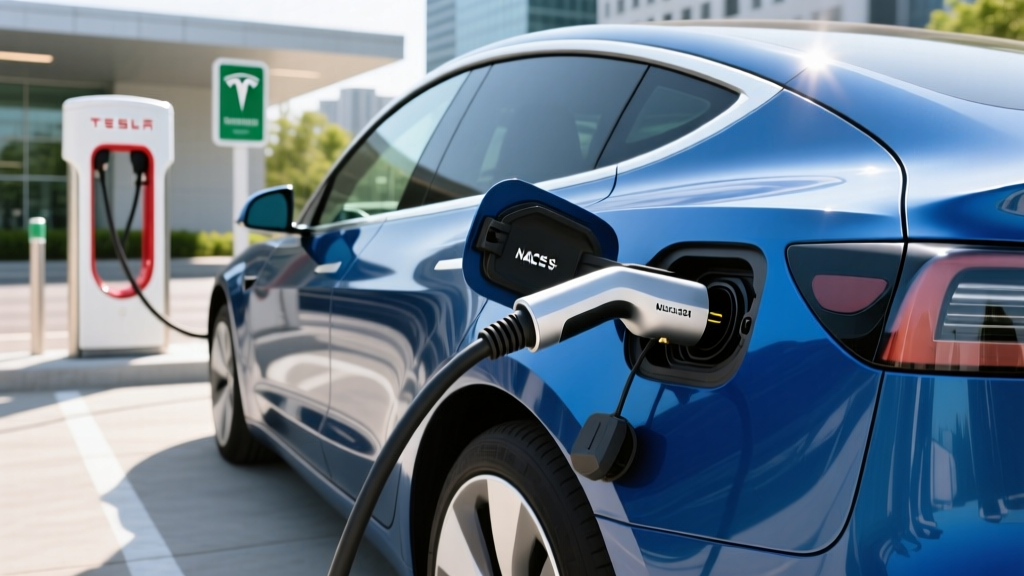
A NACS-to-CCS1 adapter bridges this gap. It physically converts the Tesla-style NACS plug into the CCS1 Combo connector your vehicle accepts, enabling DC fast charging at Superchargers and other NACS-equipped stations. This guide covers which adapters work, what speeds to expect, home charging setup, and real ownership costs.
| Connector on Vehicle | Vehicles Using It | Supercharger Access | Adapter Required |
|---|---|---|---|
| NACS (native) | Tesla (all), Ford F-150 Lightning (2025+), Hyundai Ioniq 5 (2025+), GM Ultium (2025+) | Direct plug-in | None |
| CCS1 | Hyundai/Kia (pre-2025), VW ID.4 (pre-2025), Ford Mustang Mach-E (pre-2025), BMW i4/iX, Rivian (pre-2025) | Via adapter | NACS-to-CCS1 |
| CHAdeMO | Nissan Leaf (all years), Mitsubishi Outlander PHEV | Limited (some NACS stations offer CHAdeMO) | NACS-to-CHAdeMO (rare, limited availability) |
Which NACS-to-CCS1 Adapters Actually Work?
Not all adapters are equal. Tesla's official CCS1 adapter (Part #1704325-00-A) is rated for up to 250 kW DC fast charging and is the only adapter that guarantees communication handshake compatibility with Supercharger stalls. Third-party adapters from brands like A2Z and Lectron exist at lower price points but may throttle speeds or fail handshakes at certain stations.
Tesla CCS1 Adapter (Official)
- Max DC rate: 250 kW
- Connector: NACS (station side) → CCS1 (vehicle side)
- UL Listed: Yes (UL 2252)
- Warranty: 4 years
- Price: ~$250 MSRP
- Best for: Reliable Supercharger access with full-speed negotiation
Lectron Vortex NACS-to-CCS1 Adapter
- Max DC rate: 200 kW (throttles above this)
- Connector: NACS → CCS1
- UL Listed: No (pending certification)
- Warranty: 1 year
- Price: ~$160
- Best for: Budget-conscious owners who charge at <150 kW stations
A2Z EVSE NACS-to-CCS1 Adapter
- Max DC rate: 150 kW
- Connector: NACS → CCS1
- UL Listed: No
- Warranty: 1 year
- Price: ~$130
- Best for: Occasional road-trip use, not daily reliance
Real-world caveat: Third-party adapters may not support vehicle preconditioning—the process where your EV warms the battery before arrival to maximize charge speed. Without preconditioning, expect 10-80% times to increase by 3-8 minutes depending on ambient temperature.
Charging Speeds: Level 1, Level 2, and DC Fast Charging
Understanding charging requires distinguishing kW (power—the rate of energy delivery) from kWh (energy—the battery's total capacity). Think of kW as the flow rate of a hose and kWh as the size of the tank.
| Level | Voltage / Amps | Power (kW) | Miles of Range Per Hour | Typical Use Case |
|---|---|---|---|---|
| Level 1 | 120V / 12A | 1.4 kW | 3–5 mi/hr | Overnight trickle; PHEVs; emergency top-ups |
| Level 2 (24A) | 240V / 24A | 5.8 kW | 15–20 mi/hr | Basic home charging on existing 30A circuit |
| Level 2 (40A) | 240V / 40A | 9.6 kW | 28–35 mi/hr | Standard home install; charges most EVs overnight |
| Level 2 (48A) | 240V / 48A | 11.5 kW | 35–42 mi/hr | Maximum Level 2 on a 60A circuit; large batteries |
| DC Fast (50 kW) | 200–500V DC | 50 kW | ~120–150 mi/hr | Older public stations; CHAdeMO |
| DC Fast (150 kW) | 200–920V DC | 150 kW | ~400–500 mi/hr | Electrify America, EVgo, typical Supercharger |
| DC Fast (250 kW) | 200–920V DC | 250 kW | ~600–800 mi/hr | Tesla V3 Superchargers; CCS 350 kW stations (throttled by vehicle) |
| DC Fast (350 kW) | 200–920V DC | 350 kW | ~700–1000 mi/hr | EA 350 kW stalls; only Hyundai E-GMP, Porsche Taycan, Lucid can sustain |
Charging curve reality: No EV sustains its peak kW rate for the entire session. A Hyundai Ioniq 5 with its 238 kW peak rate will charge from 10–80% in approximately 18 minutes but will taper sharply above 80%, adding the final 20% in another 15–20 minutes. Always plan DC fast stops around 10–80% to minimize total time.
Charging Time Examples for Common Battery Sizes
| Vehicle (Battery Size) | Level 2 @ 9.6 kW | DC Fast 10–80% |
|---|---|---|
| Chevrolet Bolt EV (65 kWh usable) | ~7 hours (0–100%) | ~45 min (peak 55 kW) |
| VW ID.4 (82 kWh usable) | ~9 hours (0–100%) | ~28 min (peak 170 kW) |
| Ford Mustang Mach-E Extended (91 kWh usable) | ~10 hours (0–100%) | ~32 min (peak 150 kW via adapter) |
| Hyundai Ioniq 5 (77.4 kWh usable) | ~8.5 hours (0–100%) | ~18 min (peak 238 kW, 800V) |
| Tesla Model Y LR (75 kWh usable) | ~8 hours (0–100%) | ~22 min (peak 250 kW) |
Home Charging Setup: Electrical Requirements & Install Costs
Home Level 2 charging is where 80%+ of all EV charging happens. A proper install requires a dedicated 240V circuit—typically 40A or 60A—run from your main electrical panel to a NEMA 14-50 outlet or a hardwired wall connector.
Electrical Requirements
- Voltage: 240V split-phase (standard US residential)
- Circuit amperage: 50A breaker for a 40A charger (NEC 80% rule); 60A breaker for a 48A charger
- Wire gauge: 6 AWG copper for 50A; 4 AWG copper for 60A
- Outlet type: NEMA 14-50 (plug-in) or hardwired (no outlet, direct junction)
- GFCI: Required for outdoor outlets per NEC 2020+; many jurisdictions now require it indoors as well
- Dedicated circuit: The EV charger must be on its own breaker—no shared circuits with dryers or ranges
Panel Upgrade Reality
If your home has a 100A main panel (common in pre-1990 construction), adding a 50A EV circuit may exceed available capacity. A panel upgrade to 200A costs $1,500–$3,500 and is often the single largest line item in a home charging install. Some utilities offer rebates of $200–$500 for panel upgrades paired with EV adoption.
Alternative: Load-management devices like the Emporia Load Manager or Tesla Wall Connector with Power Sharing can dynamically reduce charger amperage when other appliances are running, avoiding a panel upgrade in some cases.
| Component | Simple Install (short run, 200A panel) | Complex Install (long run or panel upgrade) |
|---|---|---|
| Level 2 Charger (equipment) | $400–$700 | $400–$700 |
| Electrician labor (wire run, outlet/hardwire) | $300–$800 | $800–$2,500 |
| Permit & inspection | $50–$200 | $50–$200 |
| Panel upgrade (if needed) | $0 | $1,500–$3,500 |
| Conduit, wire, junction boxes | $100–$300 | $300–$800 |
| Total | $850–$2,000 | $3,050–$7,700 |
Recommended Home Chargers for CCS1-Equipped EVs
Since your EV has a CCS1 port, you'll use a Level 2 charger with a J1772 connector (the AC standard all CCS1 vehicles accept). Save the NACS-to-CCS1 adapter exclusively for DC fast charging at Superchargers.
Tesla Wall Connector (J1772 version)
- Power output: Up to 11.5 kW (48A on 60A circuit)
- Cable length: 24 ft
- Connector: J1772
- Smart features: Wi-Fi, OTA updates, load sharing between multiple units, access control
- Outdoor rated: Yes (NEMA 4)
- Price: ~$475
ChargePoint Home Flex
- Power output: Up to 12 kW (50A on 60A circuit, configurable down to 16A)
- Cable length: 23 ft
- Connector: J1772
- Smart features: Wi-Fi, app scheduling, Alexa integration, energy tracking
- Outdoor rated: Yes (NEMA 4)
- Price: ~$550 (frequently on sale at $450)
Emporia Vue Level 2 Charger
- Power output: Up to 11.5 kW (48A on 60A circuit)
- Cable length: 24 ft
- Connector: J1772
- Smart features: Integrated energy monitoring, solar-aware charging, time-of-use scheduling
- Outdoor rated: Yes (NEMA 4)
- Price: ~$400
Cost to Charge: Home vs. Public DC Fast vs. Gas
Charging economics vary dramatically based on where and when you plug in. Here's a realistic cost comparison for a mid-size EV averaging 3.0 miles per kWh (typical for a VW ID.4 or Mach-E):
| Scenario | Rate ($/kWh) | Cost Per Mile | Notes |
|---|---|---|---|
| Home Level 2 (off-peak TOU rate) | $0.08–$0.12 | $0.027–$0.040 | Best-case; schedule overnight charging |
| Home Level 2 (standard rate) | $0.14–$0.18 | $0.047–$0.060 | Average US residential rate |
| Public Level 2 (workplace/mall) | $0.20–$0.35 | $0.067–$0.117 | Varies by network; some free |
| DC Fast (Electrify America) | $0.35–$0.52 | $0.117–$0.173 | Idle fees add up; membership plans reduce rate |
| DC Fast (Tesla Supercharger, via adapter) | $0.28–$0.42 | $0.093–$0.140 | Consistently priced; membership plans available |
| Gasoline (30 MPG combined @ $3.40/gal) | — | $0.113 | 2026 US avg regular unleaded |
| Gasoline (25 MPG combined @ $3.40/gal) | — | $0.136 | Typical mid-size SUV |
Bottom line: Home-charged EVs cost 50–70% less per mile than gasoline. Public DC fast charging at $0.35–$0.52/kWh narrows the gap and can equal or exceed gas costs for less-efficient EVs. The financial case for an EV depends heavily on reliable home charging access.
Safety, Code & Installation Best Practices
EV charging draws sustained high current for hours—unlike any other household appliance. Cutting corners creates fire risk.
- Dedicated circuit only: Never share the EV circuit with a dryer, oven, or HVAC system
- Hardwired vs. outlet: Hardwired installations eliminate the NEMA 14-50 outlet as a failure point. Outlets are convenient for portability but must be torqued to spec and inspected for heat damage annually
- GFCI protection: Required outdoors per NEC 2020 and later. Some older GFCI breakers nuisance-trip with EV chargers; specify an EV-compatible GFCI breaker (Eaton EVGF200 or equivalent)
- Outdoor rating: If mounted outside, the charger must be rated NEMA 4 or NEMA 4X for weather resistance
- Permit and inspection: Required in virtually all US jurisdictions. Unpermitted installs can void homeowner's insurance claims related to electrical fires
- Thermal monitoring: Quality chargers (Tesla Wall Connector, ChargePoint) include internal temperature sensors that throttle amperage if the connector or wiring overheats
Using Your NACS-to-CCS1 Adapter at Superchargers: What to Expect
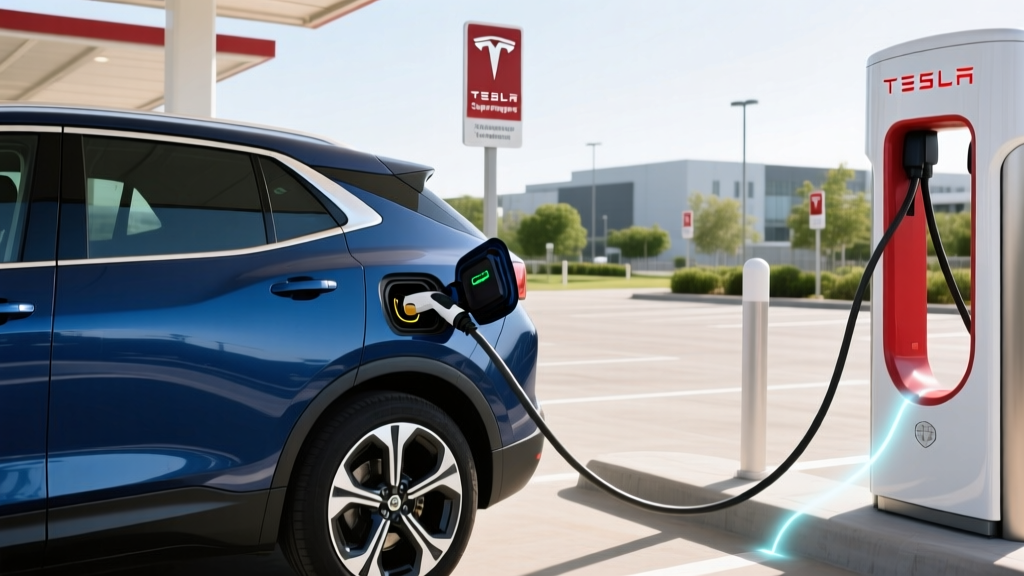
With a Tesla-issued adapter, the Supercharger experience is nearly seamless. Plug the NACS end into the Supercharger cable, attach the CCS1 end to your vehicle, and initiate charging through the Tesla app or your vehicle's built-in navigation (if supported by automaker integration, as with Ford and GM's 2025+ software updates).
Speed expectations by vehicle (via adapter):
- Hyundai Ioniq 5 (800V): Peaks at ~238 kW, 10–80% in ~18 min. The adapter does NOT bottleneck this vehicle's 800V architecture.
- VW ID.4: Peaks at ~170 kW, 10–80% in ~28 min. Adapter is transparent to vehicle's max rate.
- Ford Mustang Mach-E (pre-2025): Peaks at ~150 kW, 10–80% in ~32 min.
- Kia EV6 (800V): Peaks at ~235 kW, 10–80% in ~18 min.
- Rivian R1T/R1S (pre-2025): Peaks at ~200 kW, 10–80% in ~25 min.
Adapter limitations: The Tesla official adapter is rated to 250 kW, but your vehicle's onboard charging hardware determines actual speed. The adapter does not increase or decrease your vehicle's maximum DC charge rate. Third-party adapters rated below 250 kW may throttle vehicles capable of higher speeds.
Frequently Asked Questions
How much does it cost to install a home EV charger?
A straightforward Level 2 install on an existing 200A panel with a short wire run costs $850–$2,000 including equipment, electrician labor, and permit. Complex installs requiring a panel upgrade to 200A, long conduit runs (50+ ft), or trenching can reach $3,050–$7,700. Always get three quotes from licensed electricians who specify their EV charging experience.
How fast will each charging level add range?
Level 1 (120V) adds 3–5 miles per hour—suitable only for PHEVs with small batteries or overnight trickle charging. Level 2 at 9.6 kW (40A) adds 28–35 miles per hour, fully charging most EVs overnight. DC fast charging at 150 kW adds roughly 400–500 miles per hour, but sessions are typically limited to 10–80% (about 20–35 minutes) due to charge-curve taper above 80%.
Which connector and charger is compatible with my EV?
If your EV has a CCS1 port (most non-Tesla EVs from 2019–2024), you'll use J1772 for AC Level 2 charging at home and public Level 2 stations, and CCS1 for DC fast charging at Electrify America, EVgo, and similar networks. For Tesla Supercharger access, you need a NACS-to-CCS1 adapter. If your EV has a native NACS port (2025+ models from Ford, GM, Hyundai, Rivian, Volvo), you plug directly into Superchargers and use a NACS-to-J1772 adapter for older public Level 2 stations.
How much does charging cost per mile compared to gas?
Home charging on an off-peak rate ($0.10/kWh) costs roughly $0.03–$0.04 per mile for a typical EV—about 65–70% cheaper than a 28 MPG gas car at $3.40/gallon ($0.12/mile). Public DC fast charging at $0.40/kWh costs $0.12–$0.14 per mile, roughly equivalent to gasoline. The economic advantage of an EV depends on maximizing home charging and minimizing reliance on expensive public DC fast stations.
What electrical upgrades might I need for a home charger?
Homes with a 200A main panel and available breaker slots typically need only a new 50A or 60A breaker and a wire run—no upgrade required. Homes with 100A panels, full breaker panels, or subpanels may need a service upgrade to 200A ($1,500–$3,500) or a load-management device ($200–$400) that dynamically reduces charger amperage when other loads are active. Your electrician will perform a load calculation per NEC Article 220 to determine if your panel can support the additional circuit.
Will the NACS-to-CCS1 adapter work at non-Tesla NACS stations?
Yes. As networks like Electrify America, EVgo, and ChargePoint add NACS cables to their stations (ongoing through 2026), your CCS1 vehicle can use the adapter at any NACS-equipped DC fast charger—not just Tesla Superchargers. The adapter is a physical connector conversion; it works with any station outputting DC via a NACS plug.
Does the adapter affect my vehicle's warranty?
Tesla's official adapter is designed to meet SAE and UL standards and should not affect your vehicle's battery or powertrain warranty. However, damage caused by a non-UL-listed third-party adapter (overheating, pin damage, communication failure) may not be covered. Always use adapters that carry UL 2252 certification.
Sources: fueleconomy.gov (EPA range and efficiency data), Tesla CCS Adapter Support, NFPA National Electrical Code (NEC)